Florida ATV Safety Course Requirements for Riders Under 16
A family can drive hours to Croom, Ocala National Forest, or another Florida riding area and discover at the trailhead that a young rider needs proof of safety training. This guide explains when Florida’s under-16 ATV and UTV course requirement applies, what a certificate does and does not cover, how visitors should think about out-of-state training, and what to check before loading up.
Florida’s ATV safety course rule for riders under 16
Florida’s under-16 safety course requirement is tied to operating an off-highway vehicle on public land. That distinction matters: a course requirement for a public riding area is not necessarily a blanket rule for every ride on private property, and a course certificate is not a riding permit.
The details can also depend on the land manager. A state forest, national forest, local trail system, and private park may have different entry procedures or additional rules. Before a trip, confirm the requirement with the agency or facility that manages the specific place you plan to ride.
When the course requirement applies
Florida requires a person under 16 to complete an approved off-highway vehicle safety course to operate an OHV on public lands. The rule is relevant to young riders using public riding areas, not only to riders on a particular kind of machine. Depending on the machine and the land manager’s terminology, the rules may refer to ATVs, UTVs, side-by-sides, or OHVs more generally.
In practical terms, if a 14-year-old is bringing a quad to a designated public trail system, the family should plan for that rider to have completed the required training and be able to show proof. A child riding a UTV on public land should not assume the course rule is only for traditional four-wheel ATVs. Check the facility’s rules for the specific vehicle class and any age restrictions.
The phrase “public land” can be easy to misunderstand. It does not simply mean land that anyone can see or enter. A managed riding area may have a gate, pass requirement, designated trails, and posted operating rules while still being public land. Conversely, a private riding park can set its own requirements even though it is not public land. If the classification or rule is unclear, ask the land manager before the trip.
For a closer look at the general course requirement, see Florida ATV Safety Course for Public Land Riding. The important planning point is that a rider’s age and where the machine will be operated both matter.
Which vehicles and riding situations to consider
The course rule is part of Florida’s off-highway vehicle safety framework. Families should not assume that switching from a quad to a side-by-side automatically removes the requirement. A young person driving a UTV on a public OHV trail may still fall within the land manager’s OHV rules, even if the machine has seats, a steering wheel, and seat belts.
Also separate operating a vehicle from riding as a passenger. The under-16 course requirement is about the person operating the OHV. A passenger’s age, permitted seating position, helmet requirements, and supervision rules are separate questions. A child who has completed a course is not automatically allowed to drive every machine, carry a passenger, or use every trail.
Road use is another separate issue. A safety certificate does not make an ATV or UTV legal on an ordinary road, and it does not replace any roadway age, supervision, equipment, or county-access rules. If your plan includes leaving a trail area or using a road, review Florida ATV Road Rules: Where You Can Legally Ride and confirm that the specific road is open to that type of vehicle.
| Question | What to keep in mind |
|---|---|
| Is the rider under 16? | Check the course rule and the riding area’s age requirements. |
| Is the land public? | Confirm with the land manager; public OHV areas can have controlled access and specific rules. |
| Is the machine an ATV or UTV? | Do not assume a side-by-side is exempt; check the rules for its class. |
| Is the young person driving or riding as a passenger? | Course requirements for operators and passenger rules are different. |
| Is the route on a road? | A course certificate does not create permission to ride on a roadway. |
| Is a pass or permit needed? | A safety certificate and an OHV pass are separate requirements. |
How to complete the course and keep proof ready
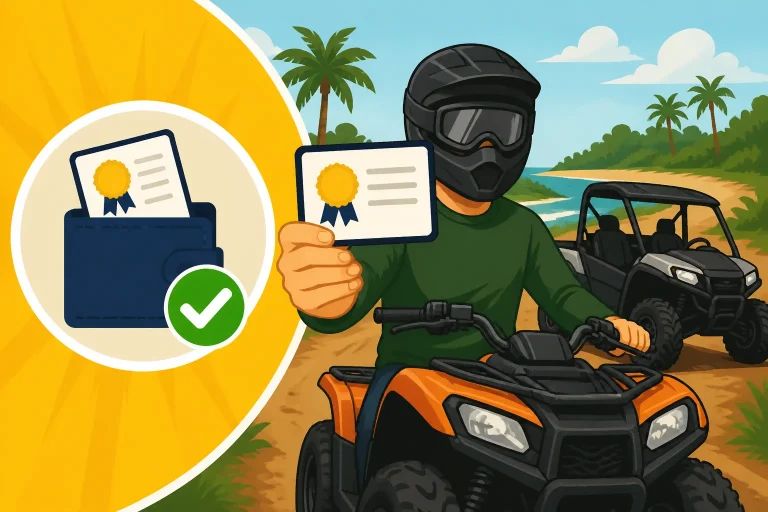
Families often get tripped up not by the riding itself, but by the paperwork: the course is completed, the certificate is saved in an email, and no one can find it when a ranger or gate attendant asks. Build proof into the trip checklist rather than treating it as an afterthought.
Florida’s young-rider safety training is associated with the state’s OHV safety program. Before enrolling, confirm that the course is recognized for the type of public-land riding you plan to do. A course that sounds relevant is not necessarily accepted by every agency or facility.
Confirm the course is approved before enrolling
Start with the Florida agency or land manager responsible for the ride. Check its OHV safety information and identify the course it accepts for under-16 operators. Florida’s young-rider certification information is covered in FDACS Safety Certification for Young Florida Riders.
This check is especially useful if you are comparing online and in-person options. Course names can sound nearly identical, while the provider, completion record, or acceptance rules may differ. If a course page does not clearly say that it satisfies Florida’s public-land requirement, ask the course provider and the riding-area manager before paying or enrolling.
Make the decision based on the actual trip, not just on a search result. For example, a family planning to ride in a national forest should check the national forest’s requirements as well as the state course information. The facility may have its own documentation procedure or additional operating rules. See Florida National Forest Under-16 Course Requirement for the national-forest angle.
Keep a record of the course provider’s name, the rider’s completion date, and the certificate or confirmation number. That information can help if a digital certificate is misplaced or a facility asks for details beyond a quick visual check. Do not assume that a parent’s recollection that “the course was done” will be enough at a gate.
Save a copy that is easy to show
Once the rider finishes the course, save the certificate in more than one useful place. Keep the original digital file in an accessible phone folder or email account, and consider carrying a printed copy in the tow vehicle or riding pack. If the facility requires a particular format or proof method, follow that instruction.
A practical setup is to create a small document pouch with the course certificate, relevant pass information, and a note of the emergency contact details. Some riders use a waterproof sleeve or document holder; Amazon is one place people may compare those basic storage items, but choose a format that keeps the certificate legible and protected rather than relying on a product listing alone.
Do a quick test before leaving home: turn off mobile data or use airplane mode and see whether the certificate can still be opened. A screenshot or downloaded PDF may be easier to access than a link that requires a login or signal. A printed backup can be helpful in areas where reception is weak, though it should not replace any method the land manager specifically requires.
For a trail-specific checklist, Carrying a Safety Certificate on the Trail covers the practical proof question. It is far less stressful to check this the night before than to discover at the trailhead that the phone battery is low, the inbox will not load, or the certificate belongs to a different family member.
Understand what a certificate proves
A course certificate is evidence that the named rider completed the applicable safety training. It is not a general license to operate any ATV or UTV, and it does not prove that the rider is allowed on every trail. A machine’s size, the rider’s ability, the site’s age limits, and the trail designation still matter.
The certificate also does not automatically satisfy an OHV pass or permit requirement. A family could have a properly trained young operator and still need a separate pass for a forest or state forest riding area. Those are different obligations, often handled through different systems. Review Florida Riding on Public Land: Permits and Proof when you are sorting out which documents to bring.
Course requirements, passes, supervision, and other rules
One of the most common misunderstandings is treating “the safety requirement” as one single rule. In reality, a young rider’s trip may involve several separate checks: course completion, a site pass, adult supervision, protective gear, vehicle eligibility, and permission to use a particular trail.
A useful way to avoid confusion is to make a list for each rider and each machine. A certificate belongs to a person; a pass may apply to a particular vehicle; and some rules are specific to the land or trail. Do not assume that having one document covers the rest.
A course certificate is not an OHV pass
A course certificate demonstrates training. An OHV pass or permit grants access under the relevant land manager’s program. A family may need both, but they do different jobs. The course does not pay for access, and an access pass does not prove that an under-16 operator completed training.
The pass process may also be vehicle-specific. Some public-land systems require a separate pass for each machine, rather than one pass for everyone in the group. Read the conditions for the exact riding area, especially when bringing more than one ATV or UTV. Florida Annual OHV Passes Are Per Vehicle explains why a family should not assume that one pass covers every machine on the trailer.
This distinction matters at the counter and at the trailhead. Imagine one parent has a valid pass, one child has a course certificate, and the family brings two machines. Those facts do not necessarily satisfy every requirement for both vehicles and riders. Check the pass rules, course requirements, and machine eligibility independently.
If you are visiting from outside Florida, include the pass question in your planning. A valid training certificate does not automatically serve as an out-of-state riding permit, and an out-of-state vehicle document may not replace Florida’s access requirements. For that side of the trip, see Florida OHV Permit Rules for Out-of-State Riders.
Supervision is a separate question
Course completion does not necessarily mean a young rider can ride alone. The site may require an adult to accompany or supervise under-16 operators, and the exact meaning of supervision can depend on the rule in question. Do not treat a certificate as an exemption from adult oversight.
Ask who must supervise, how close the adult must be, and whether the adult must be operating a machine or can be nearby on foot. These details matter in a large trail system. An adult waiting at a distant campsite may not meet a requirement intended to keep a responsible adult with a young rider.
Supervision is also different from instruction. A parent who is experienced on a quad may be able to coach a child, but that does not necessarily substitute for an approved course. Likewise, course completion does not automatically establish that the child is skilled enough for steep, muddy, or technically difficult terrain. For more on this distinction, see Florida Adult Supervision Rules on Public Land and What Supervision Means in Practice.
Protective equipment and machine fit still matter
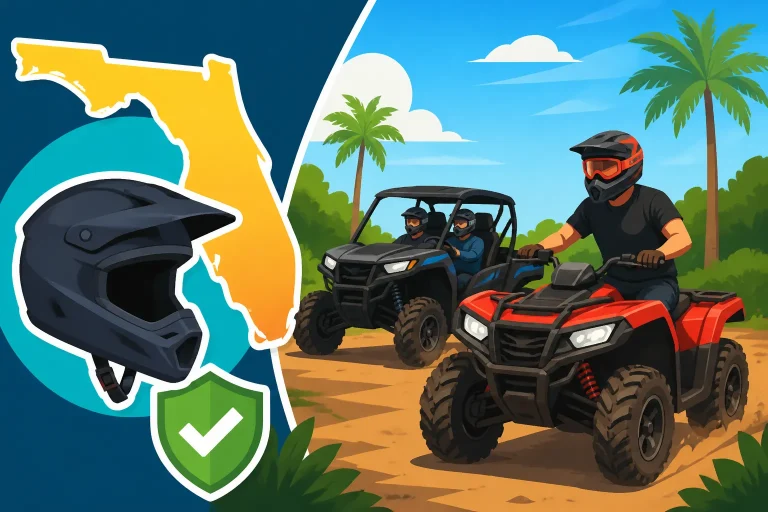
A course certificate is not a helmet, eye protection, or a substitute for following age-based safety rules. Before every ride, check the equipment requirements that apply to the rider and the location. Pay particular attention to helmet fit, eye protection, footwear, and any facility-specific gear rules.
The machine itself should suit the rider. A child who has passed a course may still be physically unable to control a large or powerful machine, reach the controls comfortably, or manage it on uneven ground. Parents should consider whether the rider can brake, steer, shift if needed, and stop safely under realistic trail conditions—not just whether the rider can sit on the machine in the driveway.
If you are replacing youth protective gear, verify sizing and safety markings directly instead of relying only on a listing description. Amazon can be useful for comparing products, but check the helmet’s labeling, fit instructions, and return conditions carefully. A product being marketed for ATV use does not by itself establish that it meets the specific requirements for your ride.
Out-of-state riders and reciprocity
Florida visitors often ask whether a safety course completed in another state will count. The safest answer is not to assume reciprocity without checking. Training programs may have different names, providers, and approval standards, while the Florida rule and the destination’s procedures determine what proof will be accepted.
This issue is separate from whether a visitor’s ATV or UTV is titled or registered elsewhere. Training, vehicle paperwork, and land-access permits are different topics. Keep them separate when asking questions, and provide the land manager with the rider’s age, course provider, and the place you plan to ride.
Check an out-of-state certificate before travel
If a young rider completed a course in Georgia, Alabama, or another state, contact the Florida course authority or the destination’s land manager before traveling. Ask whether that exact course and certificate satisfy Florida’s requirement for the planned public-land ride. Do not rely on a general statement that the course is “national” or accepted in several states unless the relevant Florida authority confirms it.
Keep the full certificate, not just a wallet card or a parent’s note. The document should make it possible to identify the rider and the course completed. If it is a digital certificate, download it in advance, and keep the course provider’s contact information available in case the land manager needs clarification.
This is particularly important for snowbird families and visiting riders who may be in Florida for a short window. If the certificate is not accepted, the problem often becomes apparent only after a trip has been booked or a group has arrived. Confirming in advance is much easier than trying to resolve a training question at the trailhead. For a state-specific example, Florida Rules for a Visiting Rider From Georgia discusses what visiting families should check.
Separate training reciprocity from permits and registration
A visiting rider might have a home-state safety certificate, an out-of-state registration document, and a Florida forest pass. None of these automatically answers the other questions. A course certificate concerns training; registration or title documents concern the machine; and a pass concerns access to land.
That separation is worth repeating because the words can blur together in casual conversation. Someone may say, “We have our registration, so we’re covered,” when the actual issue is whether a child can operate on a managed public trail. Or a family may have completed training but forget that the site requires a pass for each vehicle.
When you contact the riding area, ask three direct questions: whether the course is accepted, what proof to carry, and what pass or permit each machine needs. If you are unsure which vehicle document Florida recognizes, review Does Florida Honor an Out-of-State ATV Registration? as a separate issue from the course.
Planning a family ride on Florida public land
A well-planned trip starts with the specific riding area, not with a general assumption about Florida rules. The entry requirements for Croom, a national forest, a state forest, or a private park may not be identical. Even within a large public area, permitted vehicle types, trails, and operating conditions can differ.
Families riding with children can make the planning manageable by confirming the requirements in a fixed order: rider eligibility, course proof, supervision, vehicle eligibility, pass, equipment, and trail conditions.
Build a pre-trip checklist
Start by listing every rider, their age, and whether each person will drive or ride as a passenger. Then list each machine and identify its type. This simple step catches common oversights, such as assuming a child’s passenger status and operator status are governed by the same rule.
Next, check the destination’s current rules directly. Confirm the accepted course, proof format, supervision requirements, pass requirements, vehicle-width or class restrictions, and whether the trail system is open to your machine. If the rules are unclear, call or email the land manager and keep a note of the answer and who provided it.
Finally, gather documents in one place: course certificates, pass confirmation, any required vehicle paperwork, and emergency contacts. Put the rider’s proof somewhere it can be retrieved quickly. If using a small waterproof sleeve, Amazon may have basic options to compare, but a simple folder or sealed bag can work if it keeps papers readable and accessible.
Match the ride to the young operator
A safety course gives a young rider an introduction to safe operating practices, but it cannot make every trail appropriate. Florida terrain can change quickly: loose sugar sand may tire a rider, muddy sections can hide ruts, and water crossings can be deeper than they appear. A beginner should not be pressured to follow more experienced adults into difficult terrain.
Choose a trail that matches the rider’s control, stamina, and comfort. Agree on a pace before setting out, establish a way to stop and regroup, and make sure the young rider knows not to follow another machine into a section they do not understand. A group ride can feel intimidating when adults are eager to cover distance, so build in permission for the child to ask for a break or turn around.
For a first visit, a shorter, easier ride is often more useful than an ambitious all-day loop. You learn how the child handles the machine, heat, noise, and trail conditions without turning the day into a test. A certificate is important evidence of training, but sensible decisions on the trail remain the family’s responsibility.
Check conditions and facility rules again before departure
Trail conditions, closures, and operating rules can change. Before leaving, check the land manager’s latest notices and confirm that the riding area is open to your vehicle type. Heavy rain, maintenance, fire conditions, or seasonal management can affect access, even when the family has already arranged the course and passes.
Be especially careful about relying on old social-media posts or a previous visit. A trail that once allowed a certain vehicle may have restrictions, and a pass purchased for one system may not be valid at another. For planning around public-land access, Florida Trail Closures You Should Check First is a useful reminder to verify the destination rather than assuming it is unchanged.
Give yourself time at check-in. A hurried arrival makes it harder to locate certificates, understand a width check, or ask a question about a young rider. Put the documents where the adult responsible for the group can reach them, and make sure the child knows that course completion is only one part of being cleared to ride.
Common misunderstandings about the under-16 course rule
Families usually run into trouble when they hear a rule stated too broadly. “Every child needs a course everywhere,” “the certificate lets them ride any machine,” or “our home-state paperwork covers everything” can all lead to bad assumptions. The details depend on the land, the rider’s role, and the specific requirement being checked.
“The course is required for every private-property ride”
The Florida public-land requirement should not be casually expanded into a claim about every private-property ride. Private landowners and private parks may establish their own training, age, supervision, and protective-equipment rules. A private facility can require a course even when a different legal rule would apply elsewhere.
If a family is riding on a neighbor’s property, ask the landowner about permission and safety conditions. If the family is going to a commercial park, read the park’s rules and waiver before arriving. “Private” does not mean “no rules,” and permission to enter does not automatically mean a child can operate any machine.
The reverse assumption can also cause problems: a rider who has been allowed to ride on private land may believe the same setup is acceptable at a public trailhead. Public land has its own course and access requirements. Treat each location separately.
“Passing the course means the child is ready for any ATV or UTV”
A course is training, not a guarantee of competence on every vehicle. A small youth ATV and a powerful adult machine have different control demands. A UTV’s size and handling can create separate challenges, especially for a young driver who is still learning to judge turns, slopes, passengers, and stopping distance.
Parents should take time to assess readiness and choose a machine that fits the rider. The rider should be able to use the controls and understand the vehicle’s limits. If an adult needs to intervene constantly for the child to stay in control, the machine or terrain may be too difficult.
Treat the certificate as a foundation. Follow the course guidance, use appropriate protective gear, and supervise in a way that matches the rider’s ability and the site’s rules. The goal is not simply to get through the gate; it is for the child to ride within their skills.
“An out-of-state course or permit automatically transfers”
A certificate from another state may be accepted, but families should confirm rather than infer that it is. Likewise, an out-of-state pass or registration document may not replace a Florida land-access permit. Similar names do not guarantee that documents serve the same purpose.
If the rider’s training was completed elsewhere, identify the provider and course before calling. If you only ask, “Do you accept out-of-state certificates?” the answer may be too general to help. Ask whether the exact certificate is valid for the under-16 operator at the exact destination you have chosen.
Keep your communications focused on one issue at a time: course recognition, pass requirements, vehicle paperwork, or supervision. That makes it easier to get a clear answer and reduces the chance that an answer about one document will be mistaken for approval of the entire trip.
A practical final review before the trailhead
Before loading the trailer, confirm that every under-16 operator has completed an accepted course and that the proof is easy to retrieve. Then check the destination’s pass, supervision, vehicle, and gear rules separately. If the certificate was issued outside Florida, ask the relevant authority whether it qualifies rather than assuming reciprocity.
A calm, documented check before departure can prevent a frustrating day at the gate. It also gives parents a better chance to focus on the important part of the outing: choosing an appropriate route, watching conditions, and helping young riders build good habits without rushing.
Disclaimer
This article is for general informational purposes only and does not constitute professional advice. Laws, prices and regulations vary by location and change over time. Consult a qualified professional for guidance on your specific situation.