A 15-Year-Old on a Public Trail
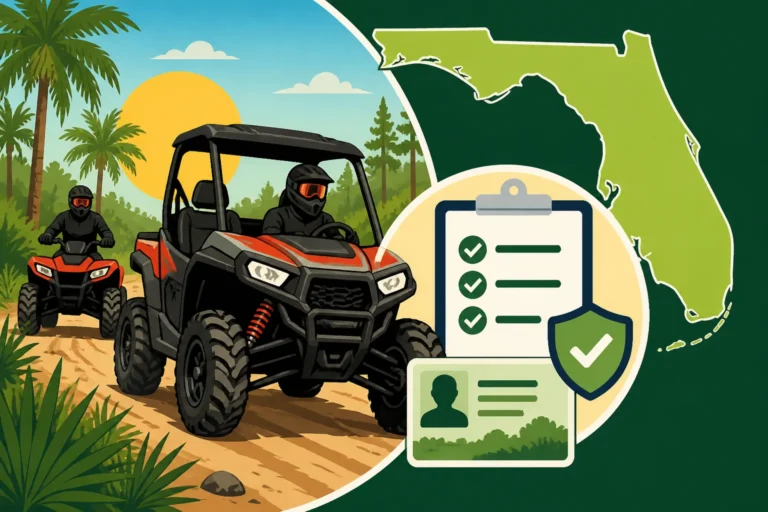
A 15-year-old may be able to ride a Florida public OHV trail, but age alone does not settle the question. Before heading out, check the safety-course rule, adult-supervision requirements, trail operator’s pass and vehicle rules, and whether the machine is suitable for the route. Treat these as separate checks: meeting one does not automatically satisfy the others.
What Florida Requires of a 15-Year-Old
For a rider who is 15, the key starting point is Florida’s under-16 safety requirement. A young rider may need to complete an approved ATV safety course before operating on public land. Helmet and eye protection are also important requirements for riders under 16. Do not assume that a child can ride just because a parent is present, or that finishing a course removes the need for supervision.
The course and supervision serve different purposes. A course demonstrates safety instruction; supervision puts a responsible adult alongside the young rider while they operate. A 15-year-old should plan to meet both requirements unless the land manager confirms otherwise for the specific riding area. Rules can differ between public lands and privately operated parks, so check the place you intend to visit rather than relying on a general rule or a friend’s past experience.
The course rule is especially easy to misunderstand when a rider has completed training elsewhere. If the course was taken in another state, ask the Florida land manager whether it accepts that certificate. Keep proof of completion with you, ideally in a form that is easy to show at the trailhead. For details on the course requirement and accepted training, see Florida ATV Safety Course for Public Land Riding and Florida National Forest Under-16 Course Requirement.
A basic preparation table can help keep the separate obligations straight:
| Check | What the 15-year-old should have or do | What to confirm |
|---|---|---|
| Safety course | Complete the required approved course and carry proof | Whether the specific land manager accepts the certificate |
| Adult supervision | Ride with a responsible adult who can supervise directly | Any site-specific definition or supervision conditions |
| Protective gear | Wear a properly fitted helmet and suitable eye protection | Whether the area has additional equipment rules |
| Riding pass | Use the required pass or permit for the machine and area | Whether the pass applies to that land and that vehicle |
| Machine and trail | Ride only a machine and route allowed at the site | Vehicle class, width, age, passenger, and route restrictions |
The law is only one part of the decision. A site may impose additional rules, close routes, or restrict certain machines. A pass or safety certificate does not guarantee that every trail is open to the rider or vehicle.
Course, Adult Supervision, and Protective Gear
The course is not the same as a riding pass
A safety certificate shows that the rider completed instruction. It is not an OHV pass, a trail permit, proof of ownership, or permission to enter a particular riding area. Those requirements are handled separately.
Florida public riding areas may have their own access systems. National forest OHV access and state forest OHV access are not interchangeable, and a pass for one area may not cover another. Before leaving home, check whether the area requires a pass, how it must be displayed, and whether a separate pass is needed for each machine. The details are covered in Florida National Forest OHV Pass: 3-Day, 7-Day or Annual and Florida State Forest OHV Day Use and Annual Passes.
Keep course proof accessible, not buried under gear or stored only on a phone that may lose service. A printed copy or an offline copy can make a check at the trailhead simpler. If a land manager has a specific way to verify a certificate, follow that process. Do not assume a course completion email, a wallet card, or another state’s document will be accepted without checking.
Adult supervision needs to be practical
A parent or other adult should be close enough to supervise the young rider throughout the ride, not merely present somewhere at the trailhead. Public trails can have uneven ground, loose sand, mud, water, traffic at intersections, and other riders approaching from behind. An adult who cannot see or communicate with the 15-year-old may not be providing meaningful supervision.
Before starting, agree on simple rules: stay within sight, stop at trail junctions, do not pass the adult without permission, and pull over if the group gets separated. Choose a route and pace that give the adult a realistic chance to monitor the rider. A challenging trail that stretches the group apart may be a poor choice even if the young rider has the skill to handle it.
For more on how this requirement works, see Florida Adult Supervision Rules on Public Land. The specific land manager’s instructions matter, so confirm whether it sets conditions beyond the general expectation of an adult supervising the ride.
Gear should fit the rider and the conditions
A helmet that is too loose, too large, or uncomfortable may not protect as intended. Check the fit before the trip, and make sure the chin strap can be secured correctly. Use eye protection that stays in place and gives the rider clear vision in dust, mud, and changing light.
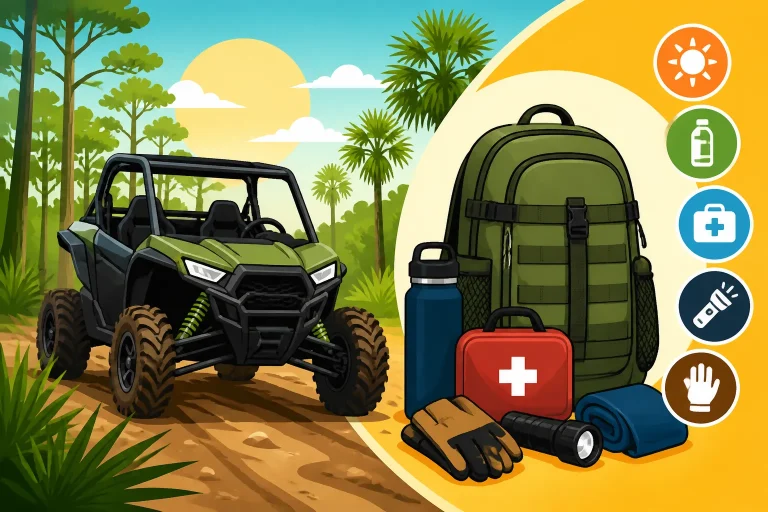
When shopping online, including through Amazon, check the helmet’s certification markings, sizing guidance, and return policy rather than relying only on a product title or customer photos. A product listing is not a substitute for checking that the actual helmet is suitable and fits the rider. Gloves, long sleeves, long pants, and sturdy closed-toe boots can also help protect against brush, flying debris, hot parts, and minor falls.
Florida weather adds practical challenges. Heat, sudden rain, and dust can make a ride tiring or visibility poor. Carry water and plan breaks, especially on longer routes. If the young rider becomes overheated, fatigued, or uncomfortable, stop and reassess instead of pressing on to finish the loop.
Check the Trail, Vehicle, and Pass Before You Go
A public trail is not a single category with one set of rules. National forests, state forests, and other public areas can have different access rules, permitted routes, seasonal closures, and pass requirements. Some trails are limited to particular vehicle types or dimensions. A machine that can physically fit down a route is not necessarily authorized to use it.
Start with the official information for the exact riding area. Confirm that it is open, that the route is open to the machine, and that a 15-year-old may operate there under the site’s requirements. If details are unclear, contact the land manager before driving to the trailhead. An old map, a social-media post, or a previous visit may not reflect current closures.
The pass also needs to match the riding area and vehicle. A national forest pass should not be treated as permission for a state forest trail, and a pass assigned to one machine may not cover a second machine. See [Florida OHV Pass for a Second Machine] if more than one vehicle is going, and check the provider for current pass procedures.
The young rider’s machine matters as much as their age. Confirm that the ATV or UTV is permitted on the route, that its width and other dimensions meet the site’s rules, and that the rider can control it safely. For an ATV, a machine designed for one rider should not be treated as a two-person vehicle. For a UTV, the young driver must be able to reach and use the controls properly, and all occupants should use the vehicle’s intended seats and restraints. Check the site’s rules on age, passengers, seat belts, and protective equipment before arrival. Florida ATV Passenger Rules explains why passenger rules depend on the machine and its design.
Ownership paperwork is another separate matter. A title, bill of sale, or other proof of ownership does not replace a trail pass or safety certificate. In the same way, an OHV pass does not establish ownership or make an otherwise restricted machine eligible for a route. For the distinction between the title and other permissions, see Florida ATV Title vs Registration: The Difference.
A useful pre-trip sequence is:
- Choose the specific public riding area and check its current operating information.
- Confirm that the intended trail is open and allows the ATV or UTV.
- Check the young rider’s course status and carry proof of completion.
- Arrange direct adult supervision for the full ride.
- Confirm the correct pass or permit for the area and each machine.
- Check helmets, eye protection, vehicle condition, fuel, water, and communication plans.
- Review trail markings and agree on where the group will stop or turn around.
This order helps avoid a common mistake: arriving with a valid pass but discovering that the route is closed or the vehicle is not allowed. For help finding public riding options, see Florida ATV Trails: Every Public Riding Area, then verify the specific area’s current requirements.
Make the Ride Manageable for a Teen Rider
A 15-year-old’s legal eligibility does not automatically mean every public trail is a good fit. Choose a route that matches the rider’s experience, the machine’s capabilities, and the adult’s ability to supervise. A shorter, less demanding ride is often a better first outing than a long route with difficult terrain or limited places to stop.
Talk through basic trail conduct before starting. The rider should know to slow down near blind corners, give other users room, follow posted signs, stay on designated routes, and avoid riding through closed or muddy areas. Explain what to do if the group becomes separated: stop in a safe place, do not continue guessing at the route, and use the agreed way to contact the adult.
The adult should also consider the pace of the group. If experienced riders are moving faster than the young rider can safely manage, split the group or choose an easier route. Pressure to keep up can lead to rushed decisions, poor braking, or riding beyond the teen’s ability. The goal is controlled riding, not covering the most distance.
Before entering the trail, check the ATV or UTV for basic problems such as low tire pressure, loose controls, visible leaks, and secure protective equipment. For a UTV, confirm that the rider and passengers are seated correctly and using required restraints. Stop if visibility worsens or the trail becomes more difficult than expected. Turning back is a sensible choice when conditions are not right.
Finally, do not assume a pass, a course certificate, or adult presence gives permission to ride anywhere. Public land can have designated routes, closures, and rules that change by location. A 15-year-old should be ready to show the required proof, follow posted instructions, and ride only where the vehicle and operator are allowed. Checking those details before departure makes it much more likely that the day is spent riding rather than sorting out a preventable access problem.
Disclaimer
This article is for general informational purposes only and does not constitute professional advice. Laws, prices and regulations vary by location and change over time. Consult a qualified professional for guidance on your specific situation.