What Supervision Means in Practice
A child riding an ATV or UTV on Florida public land may need more than an adult somewhere nearby. The hard part is knowing what supervision looks like on an actual trail, and how it differs from simply riding in the same area. Here’s how to plan adult oversight, check the rules that apply and reduce the chance of a preventable problem.
What supervision means on a Florida public trail
For riders under 16, supervision is part of the safety picture on public riding land. It is not a substitute for required safety training, protective gear, a valid land-use pass or the trail’s operating rules. Nor should “supervised” be treated as permission for a child to ride any machine, on any route, at any speed.
In practical terms, the supervising adult should be able to keep track of the young rider, notice when conditions become unsafe and act quickly if the child needs help. That usually means the adult is close enough to see or communicate with the rider, not waiting back at the parking area or riding somewhere else in the forest.
The exact requirements can depend on the law and the land manager’s rules. A national forest, state forest and privately operated park may set different conditions. Before heading out, confirm the current rules for the specific riding area, including its definition of a qualifying supervisor and any age, course, vehicle or trail restrictions. Florida Adult Supervision Rules on Public Land covers the broader rule; this article focuses on making supervision meaningful once you are on the trail.
A useful working standard is that an adult should be able to answer yes to these questions:
- Can I see the young rider often enough to judge their pace and behavior?
- Can I communicate with them promptly if they are approaching a hazard or need to stop?
- Can I reach them quickly without breaking another rule or leaving another child unsupervised?
- Do I know the route, the group’s plan and what we will do if someone gets separated?
- Is the rider using a machine and trail appropriate for their ability?
If several answers are no, the adult may be present without providing effective oversight. A group ride can create extra complications: a child may be physically surrounded by adults but still fall out of view, get left behind or be unable to get an adult’s attention.
Supervision also does not mean controlling every movement. A young rider needs room to operate independently within safe limits. The adult’s job is to choose those limits, watch how the child handles the machine and intervene before a small mistake becomes a serious one.
Set up the ride so oversight is possible
Supervision starts before the engine is running. Choose a route, pace and group arrangement that let the adult keep the young rider in view and respond without putting other riders at risk. A plan that works on a wide, familiar trail may not work on a narrow route with turns, dust, changing terrain or several branches.
Agree on positions and communication
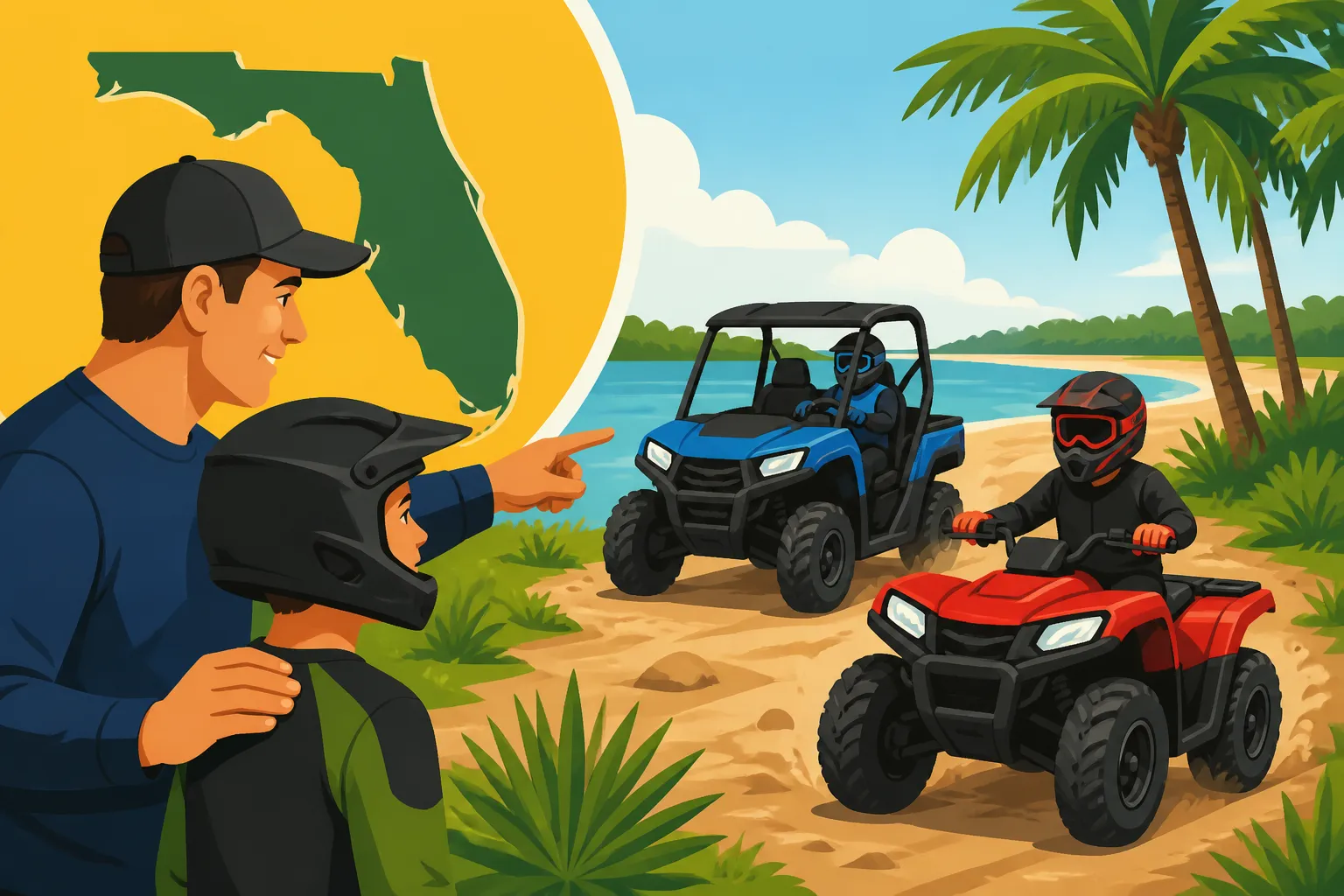
For a family ride, decide where the child will ride in the group. Often, having the young rider between an adult leading and another responsible adult following makes it easier to maintain contact. If there is only one supervising adult, a short, familiar route with clear sightlines may be more manageable than a long ride with many turns.
Agree on simple instructions before setting off:
- Stop when the group stops.
- Do not pass the designated adult or leave the group without permission.
- If separated, stop in a safe place rather than continuing to search.
- Use an agreed signal or communication device if voices cannot be heard.
- Tell the adult immediately about a mechanical problem, injury or discomfort.
Do not assume that shouting will work. Helmets, engine noise, wind and distance can make voices hard to hear. Hand signals, a brief radio check or a clear regrouping point can help, but electronic communication is only a backup. A rider who cannot use it reliably still needs close visual supervision.
If the adult plans to ride a separate machine, make sure the arrangement allows attention to stay on the child. Trying to lead at speed, navigate an unfamiliar trail and monitor a young rider at the same time can exceed one person’s capacity. Keep the pace modest enough that the adult can observe the child’s control, braking and response to changing conditions.
Match the ride to the child, not the group
A child’s age alone does not show whether they are ready for a particular trail or vehicle. Consider their experience, ability to follow directions, comfort with the machine and capacity to recognize hazards. A young rider who is confident on a familiar open route may still struggle with deep sand, mud, steep slopes, tight turns or crowded trail traffic.
The vehicle matters too. Use a machine designed for the rider and follow the manufacturer’s age and operating guidance. A larger or more powerful ATV is not automatically a safer choice because an adult is nearby. On a UTV, confirm that the child is allowed to occupy that seating position and can be properly restrained. Never assume that an extra seat makes a machine suitable for a young passenger.
Trail choice matters just as much. Start with a route the adult knows, avoid conditions beyond the child’s ability and be ready to turn around. If dust, weather, crowding or fatigue makes it harder to keep the child safe, end the ride or take a break. Best Florida ATV Trails for Beginners can help with choosing an easier starting point, but check the riding area’s own current trail information before you go.
Build in checks and stopping points
Do not wait for a problem to check in. Agree on places to pause, and use them to confirm that everyone is together, hydrated and comfortable. If the trail becomes difficult, stop somewhere safe before discussing what to do next. Avoid making a young rider answer questions while balancing on a machine in unstable terrain.
Keep the group small enough that the supervising adult can track everyone. If several children are riding, one adult may not be able to supervise each one effectively, especially when riders have different skill levels. Assign adults to specific children rather than relying on a vague “we’re all watching them” arrangement.
A simple ride plan can include the route, expected duration, regrouping points, a turnaround point and what to do if someone stops or becomes separated. Share the plan with another adult at the trailhead if the ride is long or unfamiliar.
Training, equipment and trail rules still matter
Supervision does not replace other requirements. Riders under 16 may be subject to safety-course rules on public land, and the adult should confirm whether the particular site requires a course, proof of completion or other documentation. Requirements can differ by land type, so do not assume that completing a course for one riding area automatically satisfies another. See Florida ATV Safety Course Requirements for Riders Under 16 and Florida National Forest Under-16 Course Requirement for related details.
If a course is required, complete it before the trip and make sure the certificate can be produced if asked. A course can help a young rider understand basic controls and hazards, but it does not make every route or machine appropriate. The adult still needs to judge conditions and the child’s readiness.
Protective equipment should fit correctly and be in good condition. Check the required helmet and eye protection rules for the area, as well as any additional park requirements. Choose a properly fitting helmet that meets the applicable standard; do not rely on a product listing alone to establish compliance. Retailers such as Amazon may carry a range of gear, but the buyer still needs to verify fit, certification markings and the riding area’s requirements. Gloves, long sleeves, long pants and sturdy footwear can add protection, but they do not replace required safety gear.
Before leaving home, inspect the machine and confirm that the child knows how to use its controls. Check brakes, throttle operation, tires, lights where needed, and any protective equipment supplied with the vehicle. Make sure the rider can reach and operate the controls without stretching or losing control. If the machine has a speed limiter, use it appropriately, but do not treat it as a replacement for supervision.
Also confirm the land-use requirements. A title, registration or pass can be relevant for different reasons, and one document does not necessarily stand in for another. Review Florida ATV Safety Course for Public Land Riding, Carrying a Safety Certificate on the Trail and Florida OHV Permits: What You Need Before You Ride as needed. Then check the current site information for access, closures, vehicle limits and any rules for minors.
| Before the ride | What the adult should confirm |
|---|---|
| Rider eligibility | The child meets the applicable age and site requirements |
| Training | Any required safety course is complete and proof is available |
| Machine | The vehicle is suitable for the rider and fits them properly |
| Protective gear | Required helmet and eye protection fit and are in good condition |
| Route | The trail matches the child’s ability and current conditions |
| Supervision plan | The adult can keep contact and respond promptly |
| Site access | Passes, closures and land-manager rules have been checked |
| Group plan | Positions, signals, stops and separation steps are understood |
Rules may also differ between public land and a private riding park. Private parks can set their own age minimums, supervision conditions, machine limits and protective-gear rules. Do not carry a public-land rule over to a private property, or assume that a park’s approach applies in a national forest. Confirm with the operator before arrival, particularly if a child will ride independently or ride as a passenger.
What effective supervision looks like when plans change
Good oversight is most important when the conditions stop matching the plan. A child may tire, become nervous, ride faster than expected or encounter terrain that is harder than it looked from the staging area. The adult should be ready to slow down, take a break, change routes or stop for the day.
Watch for signs that the child is struggling: repeated stalling, poor throttle control, difficulty keeping a safe line, delayed responses to instructions, frustration or unusual silence. Fatigue can reduce judgment and coordination. Heat, dust and noise can make it harder for a young rider to concentrate, even when they were comfortable at the start.
If the child falls or the machine has a problem, stop the group in a safe place and assess the situation before moving anyone. Do not rush a rider back onto a machine just because the fall seems minor. For a serious injury, follow the site’s emergency procedures and contact emergency services when appropriate. Make sure the adult knows how to describe the location, including a trail marker, junction or other clear landmark.
If the group becomes separated, avoid sending a child farther down an unfamiliar route to find the adult. A pre-agreed response should be simple: stop in a safe place, keep the machine off the trail if possible and wait for the adult or follow the specific plan discussed before the ride. The adult should account for all riders at every planned stop and after any unexpected delay.
At a trailhead, an officer or ranger may ask about site compliance or request documentation. Keep required proof accessible and make sure the adult knows where it is. Florida Ranger Checks at a Trailhead explains the kinds of checks riders may encounter. If you are unsure whether a course certificate, pass or other document is required, verify before the trip rather than relying on a guess at the gate.
Effective supervision is not a guarantee that nothing will go wrong. It is a practical system: choose a suitable ride, keep the child within observation or communication, maintain a safe pace and respond early when something changes. If an adult cannot stay attentive, maintain contact or safely manage the group, the best decision may be to postpone the ride or choose a simpler route.
Disclaimer
This article is for general informational purposes only and does not constitute professional advice. Laws, prices and regulations vary by location and change over time. Consult a qualified professional for guidance on your specific situation.