Florida Ranger Checks at a Trailhead
A ranger check can happen before you unload, at a trail entrance, or while you’re already riding. The details depend on the land and the machine, so a pass that worked at one riding area may not cover another. Here’s what Florida ATV and UTV riders should be ready to show, how to make the check smoother, and what to do if something is missing.
What a Ranger May Check
There is no single checklist that applies at every Florida trailhead. National forests, state forests, wildlife areas, and private riding parks have different rules and staff. A ranger or other authorized employee may check whether your machine and group meet the requirements for that specific place.
| Check | What to have ready | Why it may matter |
|---|---|---|
| Riding pass or permit | The required pass for the land and machine | Some public riding areas require a pass before you enter designated routes |
| Machine identity | The machine’s identifying information and proof of ownership, if requested | Staff may need to confirm which machine is using a pass or resolve an ownership question |
| Rider safety requirements | Any required course certificate or other proof | Rules can apply to younger riders on public land |
| Trail access | Current map, route information, or closure notice | Not every road or trail on public land is open to ATVs and UTVs |
| Machine suitability | Vehicle dimensions or class information | Some routes and facilities restrict machine types or sizes |
| Group conduct | Riders following posted instructions and site rules | Speed, noise, passenger, and resource-protection rules can be enforced |
A pass is often tied to a particular public land manager, vehicle, or riding area. It should not be assumed to work everywhere in Florida. Before the trip, check the current rules for the exact property and route, including whether the pass must be displayed on the machine or whether staff expect to see it another way. For background, see Florida OHV Permit Rules for Out-of-State Riders, Florida National Forest OHV Pass: 3-Day, 7-Day or Annual, and Florida State Forest OHV Day Use and Annual Passes.
Staff may also ask what you are riding and where you plan to go. That doesn’t mean every ranger will ask for every document, or that each site conducts the same kind of inspection. A brief pass check at one entrance may be different from a longer conversation about a machine’s width, a young rider’s course certificate, or an area closure.
Keep the distinction between public land and a private riding park in mind. A private park sets its own entry, age, machine, and waiver requirements. A public forest or other public property has its own rules, which may be administered by a different agency. A private park pass or waiver generally does not substitute for a public-land permit, and a public-land pass does not automatically grant access to private property.
Prepare Your Pass and Paperwork
The easiest trailhead check is one where you can quickly show the right pass and answer basic questions about your machine. Confirm the rules before leaving home rather than trying to sort out eligibility at the gate.
Match the pass to the property and machine
First identify who manages the place you plan to ride. Florida’s national forests and state forests do not necessarily use the same pass system. A pass for one property should not be treated as permission to ride another unless the issuing agency says it applies there. Likewise, a pass may be associated with an individual machine rather than every rider in your group. Confirm how the pass works for each vehicle and whether passengers or additional machines require separate arrangements.
Check the current instructions for buying, displaying, or carrying the pass. If you purchase it online, save the confirmation and any document the provider tells you to bring. A screenshot may be convenient, but don’t rely on a phone alone if the site’s instructions require a printed pass, a visible vehicle tag, or another form of proof. Cell service can be unreliable at remote trailheads, and a dead battery can turn a simple check into a delay.
If you are visiting from another state, don’t assume an out-of-state plate, registration, or permit replaces the Florida riding-area pass. Those documents may help establish where the machine is registered, but local access rules still apply. Review Does Florida Honor an Out-of-State ATV Registration? alongside the property’s current pass instructions.
Carry useful ownership information
A ranger’s routine pass check is not the same thing as a title application, and riders should not assume they will always be asked to produce a title. Still, it is sensible to know the machine’s make, model, and identifying number and to have ownership paperwork accessible if a question comes up. Keep original documents protected; a secure copy or a clear digital record may be useful, but confirm what the land manager accepts if it specifically requires a document.
For Florida residents, title rules can matter when riding public land. Review Florida Residents Who Ride Public Land Must Title and the relevant rules for your machine instead of waiting for a trailhead conversation to find out that paperwork needs attention. A title establishes ownership information; it does not itself authorize riding on a closed route or replace an OHV pass.
If you are borrowing or transporting someone else’s machine, ask the owner for the information you may need and confirm that the pass requirements are satisfied. A group should be able to identify which pass belongs to which machine without a long search through phones, glove compartments, or trailer storage.
Have youth-rider requirements covered
Some public-land riding rules apply specifically to riders under 16, including safety-course requirements. Parents and guardians should confirm the applicable requirement for the land they plan to visit, complete any required course in advance, and bring the certificate or proof specified by the agency. See Florida ATV Safety Course Requirements for Riders Under 16 and Carrying a Safety Certificate on the Trail.
Do not assume that a child’s age, riding experience, or course completed for a different purpose automatically satisfies the requirement at a particular riding area. Confirm the accepted course and documentation directly with the land manager. Keep youth-rider paperwork easy to reach, and make sure the adult responsible for the group knows where it is.
What to Expect During the Check
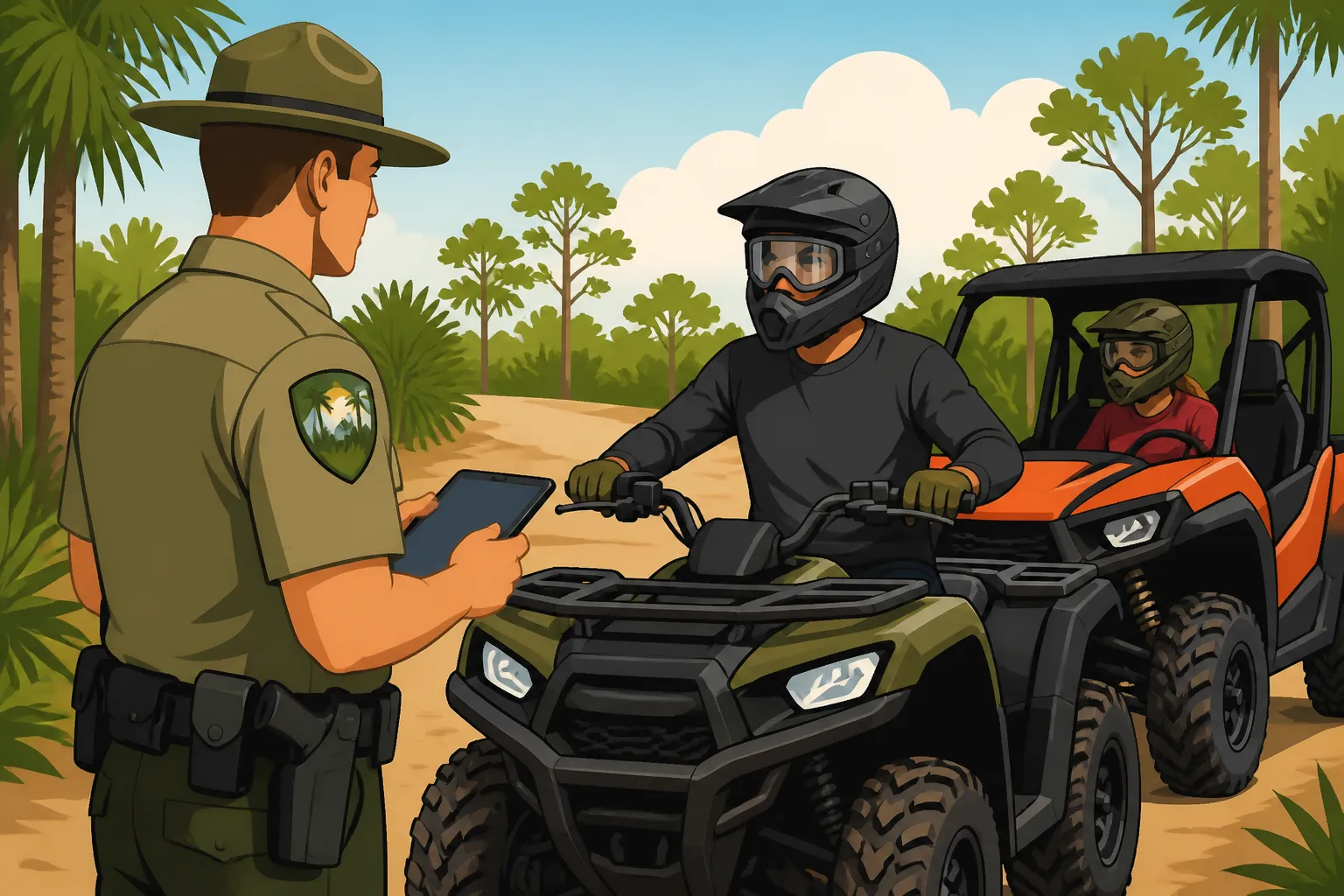
At a staffed entrance, stop where directed and follow posted instructions. Have the pass ready before reaching the counter or gate. If a ranger approaches while the group is stopped on a trail, pull over only where it is safe and permitted, turn off the machine if asked, and listen before reaching for documents or equipment.
A calm, direct answer is usually more useful than guessing. If you are asked which pass you have, show the pass and identify the machine it covers. If you are asked about a route, explain your intended destination and check the map or signs together. If you don’t understand what is being requested, ask politely for clarification. Don’t argue from a rule you remember from another county, forest, or park; the property’s posted requirements and current agency instructions are the better reference.
A staff member might ask riders to stop because of a closure, a route restriction, unsafe conditions, or a concern about how the group is using the area. A pass is not permission to ignore a closed trail, go around a barrier, or ride outside the designated area. Before heading out, check Florida Trail Closures You Should Check First and carry a map or other reliable route information.
If you cannot show a pass or required proof, explain the situation honestly and ask what options are available. Staff may direct you to leave, obtain the correct pass, or follow another procedure, depending on the site’s rules. Do not try to fix the problem by using another rider’s pass or altering a display. A disputed or missing document is easier to address through the issuing agency than by making the issue worse at the trailhead.
A roadside or trail encounter also isn’t the best time to make assumptions about an officer’s role. A ranger, forest employee, law-enforcement officer, or private-park employee may have different responsibilities and authority. Follow reasonable safety instructions, avoid escalating the interaction, and write down the name of the property and the question you need resolved. If you believe a decision was mistaken, ask which office handles follow-up and contact that office afterward.
Make the Trip Easier Before You Arrive
A little organization prevents most avoidable delays. The day before the ride, check the land manager’s current information for passes, closures, operating instructions, and vehicle restrictions. Confirm that your planned route is open to your type of ATV or UTV; the fact that a trail appears on an old map does not guarantee it is currently available.
Pack documents so the group can reach them without unpacking the trailer. One person can keep the pass confirmation and route details together, while each rider or guardian keeps any personal certificate that may be required. Use a protective sleeve or another secure place for paper documents. If you use digital records, download them before traveling and keep the phone charged.
Before entering, check that the vehicle matches the access rules. Width, weight, vehicle class, and route designation may affect where a machine can go. Don’t rely only on a familiar model name: accessories, tires, or modifications can change a machine’s dimensions. If a route or facility has a specific limit, verify how it is measured and ask the land manager if your machine is close to the limit. Related information is available in Florida’s 55-Inch ATV Definition and Why It Matters and Florida UTV Titling for Side-by-Sides Over 55 Inches.
When a group includes several machines, assign one person to keep track of the passes and paperwork, but make sure each rider knows the rules that apply to them. Agree on a meeting point in case the group gets separated, and don’t leave a rider behind to negotiate an entry issue alone. For a broader packing checklist, see What to Carry Into a Florida State Forest.
Finally, treat the ranger check as part of using shared land, not as a guarantee that every question has the same answer everywhere. Staff may be checking a pass, explaining a closure, or addressing a safety issue. Being prepared, following posted instructions, and asking where to confirm a rule will usually get you farther than relying on assumptions from another riding area.
Disclaimer
This article is for general informational purposes only and does not constitute professional advice. Laws, prices and regulations vary by location and change over time. Consult a qualified professional for guidance on your specific situation.