Organized Event Rules on Forest Land
An organized ATV or UTV ride on Florida forest land takes more than a stack of individual riding passes. The land manager may require advance approval for an event, and permission to ride one forest does not automatically cover another. Here’s how to identify the right authority, ask for event approval and keep permits, passes and out-of-state credentials straight.
First identify who manages the land
“Forest land” can mean a national forest, a Florida state forest or another public property with its own rules. These areas do not share one event-permit system. Before choosing a route or advertising a ride, identify the managing agency for every part of the proposed event.
Florida’s national forests and state forests are managed separately. A route that crosses different jurisdictions may require separate approvals, and a permit from one manager should not be treated as permission to use another manager’s land. The distinction also matters for ordinary riding: see Florida National Forest Riding vs State Forest Riding for how access and requirements can differ.
An organized event is more than several friends deciding to ride together. It may include a planned route and schedule, a named organizer, public invitations, registration, fees, sponsors, prizes, guided instruction or a large group using a trail system at a set time. A charity ride or club event can still count as organized even if no one is making a profit. Conversely, a small informal gathering may be treated differently. The manager decides based on the event, the location and the likely effect on public use and resources.
Do not assume that a group ride is exempt simply because every participant has a valid pass. Individual riding access and authorization to stage or conduct an event are separate questions. A standard OHV pass does not itself reserve a trail, approve a route, authorize organized activity or give an organizer exclusive use of public land. The same principle applies to other documents that prove a rider can access a particular area: they do not necessarily cover the event itself.
Start with the manager of the exact riding area. For a national forest event, contact the appropriate Forest Service office responsible for that forest and location. For a state forest event, contact the Florida Forest Service office responsible for that state forest. Ask which office handles organized recreation or special-use requests, and describe the event plainly rather than asking only whether a “group ride” is allowed.
The event’s size is relevant, but it is not the only factor. A modest ride that uses a sensitive area, requires temporary signs, affects other visitors or includes a commercial component could need more review than a larger informal outing on an established route. The manager may also consider whether the proposed date conflicts with closures, maintenance, hunting activity, fire restrictions or other scheduled uses. Check Florida Trail Closures You Should Check First before building a plan around a particular trail.
Event approval, riding passes and other documents
Think of event authorization as permission for the planned activity, while a riding pass is generally tied to individual or vehicle access under the rules for a particular area. They solve different problems. A permit for an event does not necessarily replace each rider’s pass, and a pass does not replace event approval.
The table below is a planning aid, not a substitute for the land manager’s decision. Requirements can vary by forest, route, activity and event design.
| Item | What it may cover | What it does not automatically cover |
|---|---|---|
| Organized-event or special-use authorization | The approved event, date, location and conditions specified by the land manager | Riding outside the approved scope, using another forest or ignoring access requirements |
| National forest OHV pass | Eligible recreational OHV use under the rules for the applicable national forest area | Organizing an event, reserving a route or getting permission for commercial activity |
| State forest OHV pass or day-use access | Eligible riding and entry under the rules for the applicable state forest | An organized ride or use of a separate property |
| Rider safety certificate or other required proof | A rider’s compliance with applicable age or safety requirements | Permission to organize an event |
| Insurance or other event documents | Risk and operational requirements when requested by the manager | Land access unless the manager has separately approved it |
For ordinary access in a national forest, review Florida National Forest OHV Pass: 3-Day, 7-Day or Annual. State forest access is separate; see Florida State Forest OHV Day Use and Annual Passes. Check the current official instructions for the specific location before buying passes or telling participants what they need.
An event organizer should ask whether every participant needs an individual pass, whether the event authorization includes any access charges, and whether participants must carry proof with them. Do not infer that one organizer’s permit pays for or covers every vehicle. Passes may be issued or accounted for by vehicle, participant or visit depending on the program, so confirm the applicable method instead of collecting a single payment and assuming the group is covered. Florida OHV Pass and Trailer Parking can help with a related practical question, but trailer access and event approval remain separate matters.
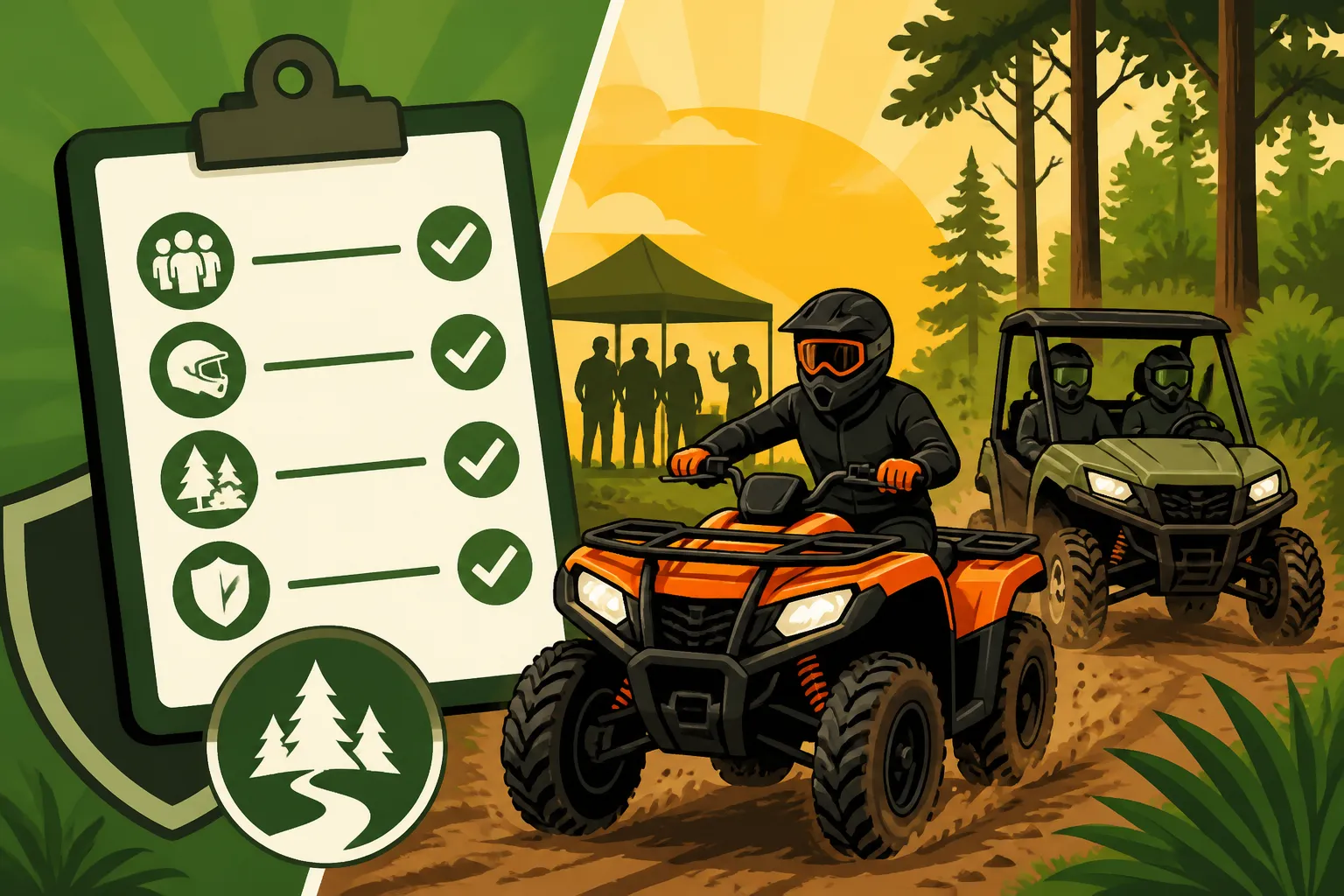
An event application may ask for details such as the organizer’s contact information, the proposed dates and hours, estimated attendance, vehicle types, route or staging area, parking plan, event purpose and whether the activity is open to the public. The manager may request a safety plan, proof of insurance, an operating plan, fee information or additional documentation. These are possibilities, not a fixed checklist for every forest. Ask for the requirements before announcing a date or taking registrations.
Permission can also come with conditions. The manager may limit the approved route, participant count or hours; require check-in procedures; restrict signs or temporary facilities; or require changes to protect other visitors and natural resources. Treat the written authorization as the controlling document. If the event needs a different route, date, activity or attendance plan, ask whether the approval must be amended before making that change.
An organizer should not describe a public ride as “permitted” until approval is confirmed. A pending application is not permission, and a conversation with a staff member is not necessarily formal authorization. Ask how approval will be issued and what document participants or event staff should have available. The broader basics are covered in Florida Riding on Public Land: Permits and Proof.
How to request approval without derailing the event
Contact the land manager early enough to allow time for questions, review and any changes. There may be an application process or a review schedule, and a manager may need to consider other uses or site conditions. Do not assume that approval will be available on short notice, especially if the event involves many riders, public promotion, commercial activity, temporary facilities or a route through multiple areas.
A practical planning sequence is:
- Choose the exact area. Identify the forest, riding area, staging point and proposed route. If the route could cross a boundary, mark the boundary and contact each manager whose land is involved.
- Describe what makes the ride organized. Explain whether it is a club outing, fundraiser, competition, guided ride, training session or public event. State whether participants pay, whether sponsors are involved and whether registration is open.
- Estimate the activity. Provide a realistic attendance range, the number and type of machines, arrival and departure times, support vehicles and any planned stops. If attendance is uncertain, say so rather than presenting a guess as a firm limit.
- Ask for the correct application and conditions. Find out whether the activity needs an event authorization, what documents are required, whether insurance is needed and whether the manager can approve the proposed route and date.
- Plan for participants’ separate requirements. Confirm which passes, safety credentials, ownership documents or other proof riders must carry. The event permit may not settle these individual requirements.
- Wait for written confirmation before committing. Do not rely on a submitted form, an informal conversation or a pass purchase as proof that the event is approved.
- Brief the group using the approved plan. Share the authorized staging location, route, schedule, check-in details, restrictions and contingency plan. Ask participants to follow the land manager’s directions and posted closures.
A good application is specific without promising what the organizer cannot control. For example, identify the trail system and likely group size, but do not assure participants that the entire area will remain open. Weather, fire conditions, maintenance, resource protection and other management needs can affect access. Build flexibility into the schedule and tell participants how they will receive updates.
Plan the staging area as carefully as the trail. A large gathering may affect parking, traffic flow, emergency access, sanitation or other visitors even when the riding route itself is approved. Ask whether the proposed staging point can support the group and whether a separate approval is needed for tents, tables, signs, vendors, sound equipment or temporary structures. Do not place markers, block a trail or set up facilities unless the manager allows it.
The organizer should also ask what happens if conditions change. Find out who to contact if a closure is posted, a storm affects the site, attendance exceeds the estimate or an emergency interrupts the ride. Keep the event’s public information consistent with the authorization. If the approved plan changes materially, contact the manager rather than deciding that the original approval is broad enough.
Whether a ride is public, private or charitable does not by itself settle the permit question. A private club may still be conducting an organized activity, and a nonprofit event may still affect public access. Likewise, charging a registration fee does not automatically determine whether an event is commercial. Explain the facts and let the manager classify the proposal.
For additional context about group outings at public riding areas, see Florida Group Ride Rules at Public Areas. Those rules are useful background, but an event that is formally planned or promoted still warrants a direct answer from the land manager.
Out-of-state riders and permit reciprocity
An event may attract riders from Georgia, Alabama or elsewhere, but an out-of-state registration, permit or trail pass should not be assumed to transfer to Florida forest land. Reciprocity is not one blanket arrangement covering every forest, every kind of vehicle and every event. Ask the manager which credentials are accepted for the specific location and whether visiting riders must meet additional Florida requirements.
Keep three questions separate:
- Can the visiting rider use the area? This depends on the land manager’s access rules and any required pass.
- Does the rider meet safety or age requirements? Requirements can depend on the area and the rider’s age. Check the current rules rather than assuming an out-of-state course or document is accepted.
- Is the organized event approved? The event organizer must address this independently of the participants’ individual credentials.
For visiting riders, Florida OHV Permit Rules for Out-of-State Riders explains why a home-state credential should not be treated as automatic permission in Florida. The organizer can help by sending participants a clear list of the location-specific documents they need, but each rider remains responsible for arriving prepared.
A Florida pass, where required, also should not be treated as a portable authorization for every public riding area. National forest and state forest systems are distinct, and a pass for one does not automatically provide access to another. Likewise, approval for an event at one location does not automatically authorize a second ride elsewhere. Before collecting money or publishing an itinerary, identify each site and confirm its rules separately.
At the event, keep a copy of the written authorization and the contact details for the responsible office. Make sure the ride lead knows the approved route and any limits. Ask participants to carry whatever individual proof the manager requires, and have a plan for riders who arrive without it. The organizer should not attempt to solve a missing document by telling a rider that the event permit covers everyone unless the authorization explicitly says so.
The safest approach is to treat the event permit, each rider’s access requirements and any safety or age requirements as separate checks. Confirm all three for the correct forest, communicate them before the ride and follow the written conditions on the day. That preparation reduces the risk of a canceled event, a route conflict or a group discovering at the trailhead that an individual credential does not provide permission for the planned activity.
Disclaimer
This article is for general informational purposes only and does not constitute professional advice. Laws, prices and regulations vary by location and change over time. Consult a qualified professional for guidance on your specific situation.