Can You Ride an Untitled ATV on Private Land in Florida
It's a common scenario in Florida: you've got an ATV, maybe you picked it up used from a neighbor, or it's been sitting in your shed for years, and it simply doesn't have a title. You just want to enjoy it on your own sprawling property, or perhaps a friend's vast ranch, and the thought of dealing with government paperwork for something that never leaves private land can feel like an unnecessary hassle. This guide is here to untangle the confusion and clearly explain if you can legally ride an untitled ATV on private property in the Sunshine State, and what important considerations you absolutely shouldn't overlook.
The Fundamentals: What Florida's Title Law Really Means for Private Land
Florida has specific laws when it comes to titling off-highway vehicles (OHVs), which include ATVs. It's easy to get caught up in the details, especially when you compare it to the rules for cars or trucks, which are almost universally titled and registered. But with ATVs, there's a crucial distinction many riders miss, and it often revolves around where you intend to ride.
The Core of Florida's OHV Titling Law
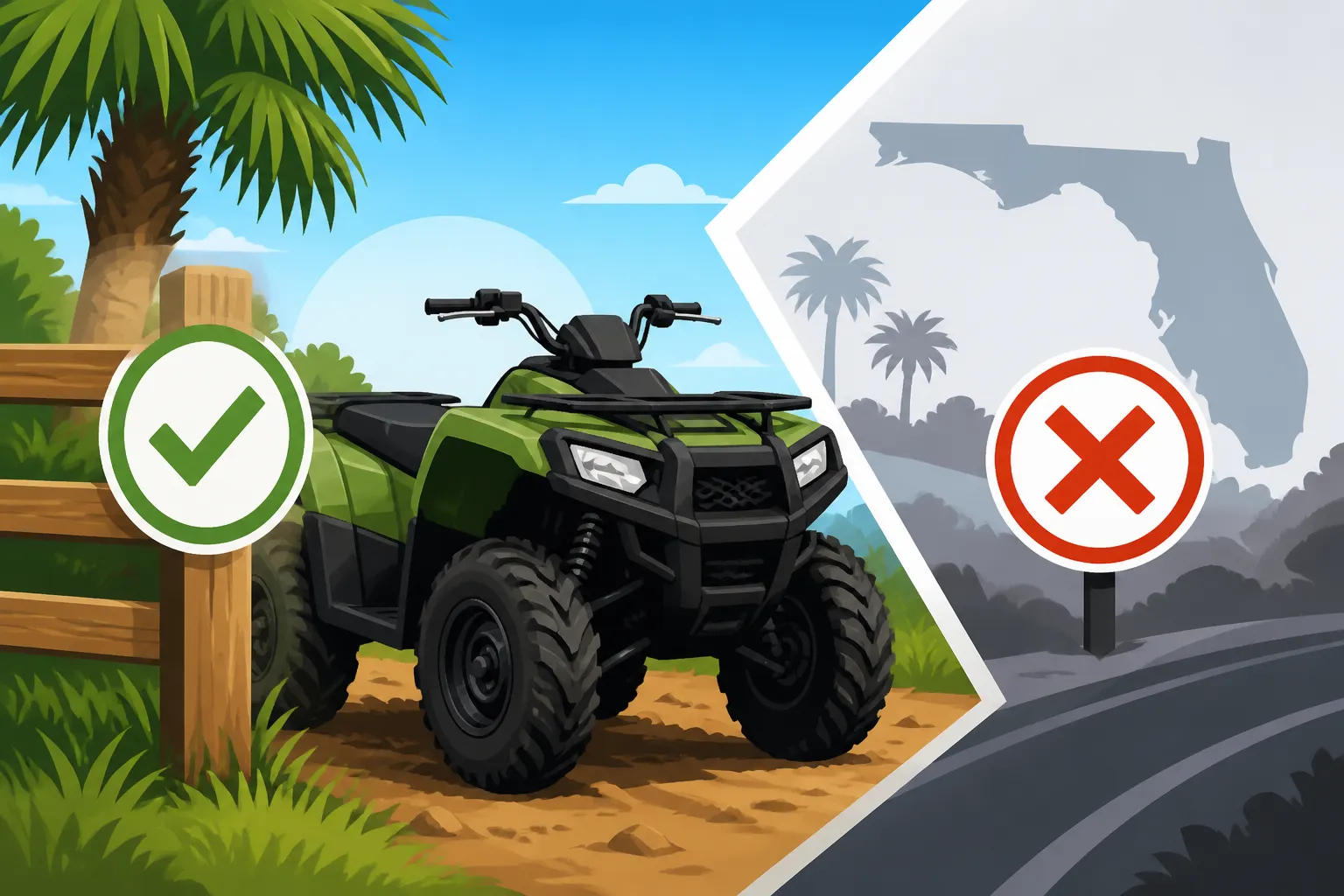
Let's cut right to the chase: Florida's primary motivation for requiring an ATV title is tied directly to its operation on public lands. This is often the biggest point of confusion, because many people assume all vehicles, regardless of their intended use, must be titled. But for ATVs, the law (specifically Florida Statute 316.2123) generally states that an ATV must be titled if it's going to be operated on designated public lands. This means if you're planning a trip to a state forest like Blackwater River or a national forest like Ocala, your ATV absolutely needs a title. Without it, you're looking at potential fines and a very unpleasant encounter with a park ranger.
The law isn't designed to dictate what you do in your own backyard, but rather to establish clear ownership and help manage public resources. Think of it this way: the state wants to know who owns the machine if it's going to be out there sharing trails with other people, causing potential environmental impact, or needing identification in case of an accident or theft. This distinction is vital for understanding your rights and responsibilities.
Does "Private Land" Exempt You?
When we talk about "private land," we're generally referring to property that is not owned, maintained, or designated for public use by any government entity. This could be your own residential lot, a privately-owned ranch, a farm, or land owned by a private club. The good news is that under Florida law, an ATV operated exclusively on private property, which you own or have explicit permission to use, is generally not required to be titled. This comes as a huge relief to many riders who simply want to enjoy their machines without the bureaucracy.
However, "generally not required" is a key phrase. It doesn't mean there are no rules or considerations. While the state won't usually fine you for an untitled ATV on your private spread, you still need to prove ownership if a question arises. For instance, if you bought a quad with no title from a neighbor, riding it on your own property is probably fine from a titling perspective, but imagine if it were stolen. How would you prove it's yours without documentation? This is where many riders get into a sticky situation, thinking that because the state doesn't demand a title for private use, they can skip all other forms of documentation. This couldn't be further from the truth.
Understanding "Private Land" and Permissible Use
Defining "private land" might seem straightforward, but in Florida, property lines and access can sometimes be ambiguous. Knowing exactly where you're permitted to ride and what qualifies as private land is crucial to avoid unintended legal troubles.
Your Own Property vs. Someone Else's
Let's start with your own property. If you own the land, whether it's a small parcel or hundreds of acres, you generally have the right to operate your untitled ATV there. This is your personal domain, and the state isn't typically going to intervene regarding title status for machines used solely within its boundaries. You're free to rip around your fields, clear trails, or just enjoy a leisurely ride without needing to show a title.
However, the moment you venture onto someone else's land, even if it's just a sliver of their property or an easement, you need their express permission. Without it, you're trespassing, and that's a whole different legal issue, title or no title. Imagine your neighbor has a few acres, and you've ridden your untitled quad there for years. Now, what if they sell their property, and the new owner doesn't appreciate your impromptu trail riding? Suddenly, your informal arrangement can lead to a formal complaint. Always get clear, preferably written, permission if you're riding on land you don't own. This applies whether it's a friend's farm, a relative's grove, or even a piece of land that looks abandoned. [Florida Trespass Law for ATV Riders] delves into this in more detail, and it's essential reading for anyone riding off their own deeded property.
What About Private Trails or Clubs?
Florida is home to a fantastic array of private riding parks and clubs. Places like Hog Waller ATV Resort in Palatka or Redneck Mud Park near Punta Gorda offer expansive, managed areas for off-road enthusiasts. These parks are, by definition, private land, even if they're open to the public for a fee. The good news here is that these private parks typically do not require your ATV to be titled by the state of Florida to ride there. Their focus is usually on safety, valid admission, and sometimes machine-specific rules (like width restrictions or spark arrestors).
When you enter one of these parks, you'll likely sign a comprehensive liability waiver. This waiver is their protection, and it indicates you understand the risks involved. While they won't ask for your state-issued title, they will expect proof that you are the rightful owner or operator of the machine you're riding, especially if there's an incident or a question of theft. A bill of sale or other purchase agreement can be invaluable in these situations. Always check the specific rules of any private park before you go, as they can vary widely. Some might have age restrictions, helmet requirements, or even specific vehicle types they don't allow.
Why Even Private Riding Deserves Proper Documentation
Just because you can ride an untitled ATV on private land doesn't mean you should ignore all forms of documentation. In fact, doing so can leave you incredibly vulnerable. There are several compelling reasons to have at least some paperwork, even if it's not a state-issued title.
Proving Ownership Beyond a Shadow of a Doubt
Imagine this nightmare scenario: your untitled ATV, which you happily ride on your property, is stolen right out of your shed. You call the sheriff, eager for them to recover your beloved machine. The first thing they'll ask for is proof of ownership. If all you have is a verbal agreement from the seller and a faded receipt for parts, you're in a tough spot. Without a title, a Manufacturer's Certificate of Origin (MSO), or a robust bill of sale, proving that the ATV is actually yours can be incredibly difficult.
This is where proactive documentation comes into play. Even for an untitled machine, a detailed bill of sale is your best friend. It should include the ATV's Vehicle Identification Number (VIN), make, model, year, the purchase price, and the names and signatures of both the buyer and seller. You can find excellent templates for this kind of document online. For instance, reputable services like LawDepot offer customizable bill of sale forms that can be a lifesaver in these situations. Having this kind of documentation clearly establishes who bought what from whom, providing a solid paper trail. This protects you in cases of theft, disputes over prior ownership, or even if you decide to sell the machine down the line. For more on this, check out [Florida ATV Bill of Sale: What It Needs to Say].
The Slippery Slope to Public Roads
Florida's landscape, while beautiful, can be tricky. What starts as a fun ride on your private property can sometimes, unintentionally, lead you onto a public road or right-of-way. Maybe your property backs up to a dirt county road, or you need to cross a short stretch of pavement to get to another part of your land. This is where an untitled ATV can land you in serious trouble.
As soon as your tires touch public pavement or a designated public dirt road, the rules change drastically. Florida law is clear: operating an ATV on a public road, street, or highway is generally prohibited, unless it's on a specifically designated unpaved road or meets very strict agricultural or emergency criteria. If you're caught on a public road with an untitled ATV, you're looking at multiple violations: operating an unregistered/untitled vehicle (if the county requires it for specific roads) and operating an ATV illegally on a public thoroughfare. Even if you argue it was "just for a second," law enforcement might not see it that way. Always be acutely aware of property boundaries and public access points. It's often safer to trailer your ATV to designated riding areas, even if they're just across the road from your property. This also speaks to the broader issue of [Can You Drive an ATV on the Road in Florida?] and its detailed restrictions.
The Gray Areas and What to Watch Out For
While riding an untitled ATV on your private land in Florida offers a degree of freedom, it’s not an entirely consequence-free zone. There are still crucial aspects, often overlooked, that can turn a fun outing into a headache.
Accidental Trespass and Law Enforcement
Property lines can sometimes be blurry, especially in rural Florida with its sprawling tracts and less-defined boundaries. You might think you’re deep within your own property, only to accidentally cross onto a neighbor’s land or, worse, state-owned conservation land. If you’re caught trespassing, even accidentally, law enforcement has every right to intervene. While the lack of a title might not be the primary offense in this situation, it can certainly complicate matters. An officer might ask for proof of ownership to determine if the ATV itself is stolen or if you have any right to operate it. If you can’t readily provide a bill of sale or other documentation, you could find yourself in a much more difficult situation than simply being asked to leave.
Furthermore, some properties, particularly those owned by water management districts or large timber companies, might have easements or access roads that appear public but are, in fact, private. Riding on these without explicit permission is a form of trespass. Understanding local property maps and clearly marking your boundaries is critical. If you're on someone else's property, even with permission, always ensure you have a copy of that permission with you. A simple, written permission slip, perhaps created using a LawDepot template for property use, can save you a lot of grief if you encounter a land manager or law enforcement officer. It’s always better to be over-prepared than to assume you're in the clear.
Insurance and Liability Concerns
Here's a scenario that keeps many private landowners up at night: an accident happens on your property involving an ATV. It could be you, a family member, or a guest. Even though the ATV might not be titled for public land use, an accident can lead to significant liability. Your standard homeowner's insurance policy might offer some coverage, but it's crucial to understand its limitations regarding recreational vehicles, especially if they are involved in an injury or property damage. Some policies specifically exclude coverage for ATVs or only cover them under very narrow circumstances.
If the ATV isn't titled and therefore not officially recorded with the state, it might further complicate any insurance claims or legal proceedings following an accident. Proving ownership, again, becomes paramount. If a guest is injured while riding your untitled ATV, their medical bills and potential lawsuit could fall squarely on you as the landowner and machine owner. You might think, "Well, it's just my family," but accidents happen, and a severe injury can devastate lives and finances. For this reason, many riders with untitled ATVs still choose to look into specific off-road vehicle insurance policies, even if just for liability coverage. This can provide a critical layer of protection that goes beyond the basic legality of titling. It’s a proactive step to protect yourself and your assets, regardless of whether you're riding in your backyard or at a designated private park. [Insurance After an Off-Road Collision] is a topic worth exploring for this very reason.
In summary, while Florida law generally permits you to ride an untitled ATV on private land you own or have permission to use, this freedom comes with significant responsibilities. Always prioritize clear documentation of ownership and be mindful of property boundaries and potential liabilities.
| Feature | Untitled ATV on Private Land | Titled ATV on Public Land |
|---|---|---|
| Legality of Riding | Generally permissible if on land you own or have permission for. | Required for designated public OHV trails and areas. |
| Titling Required? | No, not for exclusive private land use. | Yes, legally mandated for public land use. |
| Proof of Ownership | Highly recommended (Bill of Sale, MSO) for disputes/theft. | Title is primary proof, MSO for new machines, Bill of Sale for sales. |
| Law Enforcement | Typically no issue if truly private, but trespass is an offense. | May stop you if no title/illegal operation on public land. |
| Insurance Impact | Homeowner's policy may have exclusions; dedicated OHV insurance recommended. | Often easier to insure; some public areas may require proof of insurance. |
| Liability Risk | Owner/Operator assumes significant liability for accidents. | Owner/Operator assumes significant liability for accidents. |
| Resale Value | Harder to sell without clear title; limited market. | Easier to sell with clear title; broader market. |
Disclaimer
This article is for general informational purposes only and does not constitute professional advice. Laws, prices and regulations vary by location and change over time. Consult a qualified professional for guidance on your specific situation.