FDACS Safety Certification for Young Florida Riders
A young rider can finish an ATV safety course and still be turned away from a Florida riding area if the family brings the wrong proof, misunderstands supervision rules, or assumes a course certificate is the same as a land-use permit. This guide explains how FDACS safety certification fits into Florida’s rules, what parents should prepare, and what to check before heading to a trail.
What FDACS Safety Certification Means
The purpose of the course
Florida’s ATV and off-highway vehicle safety course is intended to prepare young riders to make safer decisions before they operate a machine. It addresses practical risks that are easy to underestimate, such as changing traction, blind corners, steep or uneven ground, and the way a vehicle can behave differently in sand or mud than it does on a driveway.
For a parent, the course is more than a form to complete. It creates an opportunity to talk about judgment: when to slow down, when to stop, how to keep a safe distance from another rider, and why a young operator should not try a difficult obstacle just because someone else did. Those conversations matter on Florida terrain, where loose sand, standing water, roots, and sudden changes in trail conditions can challenge even an experienced rider.
The certification is evidence that a young rider completed an approved safety course. It does not establish that the rider is skilled on every ATV or UTV, and it does not replace adult supervision, protective equipment, or careful decisions about whether a trail is appropriate. Think of the course as one part of a safety plan, not a guarantee that a rider is ready for every situation.
Who the requirement concerns
Florida’s youth safety rules focus on riders under 16, but families should check the requirements for the particular land and riding area they plan to use. State law, a forest’s operating rules, and a private park’s policies can overlap without being identical. A course that satisfies one requirement may not answer every question at the gate.
This distinction can be confusing when a family has more than one child. A 15-year-old may be subject to a course requirement that does not apply in the same way to a 16-year-old, while both riders may still need helmets, suitable eye protection, and a machine that matches their size and ability. Age alone does not make a child ready to operate a full-size ATV or UTV.
For a closer look at the age-related requirements, see Florida ATV Safety Course Requirements for Riders Under 16. Before relying on a course certificate, confirm the rider’s age, the type of vehicle, and the rules for the exact riding area. If the family plans to visit more than one location, check each land manager separately rather than assuming one rule covers every trail.
Certification is not a driving license
An FDACS safety certificate is not a driver’s license, road permit, vehicle title, registration, or general authorization to ride anywhere. It shows course completion; it does not make an ATV street legal or grant permission to use a trail, forest road, conservation area, or private property.
This matters because families often prepare the certificate and overlook the other requirements. A public riding area may have its own pass or permit system, vehicle restrictions, hours, approved routes, and equipment rules. A machine may also need to meet width or other eligibility requirements for a particular trail system. The certificate alone does not resolve any of those issues.
It also does not change rules about who may supervise a minor or whether a particular machine is suitable for that child. A young rider could have a valid certificate and still be prohibited from riding alone, carrying a passenger, or using a route that exceeds their ability. For a broader explanation of the distinction between rider credentials and land access, see Two Different Florida Safety Course Rules.
How to Complete the Certification
Find a course that is accepted for the intended ride
Start by identifying the land manager or riding area, then check which safety course it accepts for riders under 16. For Florida public-land riding, families commonly encounter requirements connected with FDACS-approved safety training. National forest rules can have their own documentation expectations, so do not assume that a general online ATV course automatically meets every local requirement.
Use the official FDACS information and the riding area’s own instructions to identify an acceptable course. Be cautious with search results that use phrases such as “ATV certificate” or “safety card” without explaining who recognizes them. A certificate from a commercial training provider may be useful, but its name alone does not prove that it satisfies a particular Florida requirement.
If your destination is in a national forest, review Florida National Forest Under-16 Course Requirement before you leave. For a day at a state forest, private park, or other public riding area, check that location’s current rules as well. The goal is to confirm acceptance before a child completes a course, not discover at the entrance that the paperwork is not the kind the staff expects.
Help the child take the course seriously
If the course is completed online, choose a time when the child can concentrate rather than squeezing it in while everyone is packing the truck. A young rider who clicks through material while distracted may receive a certificate without absorbing the decisions that matter on the trail. Sit nearby, invite questions, and connect the lessons to the type of riding the child will actually do.
Use familiar examples. Ask what the rider would do if a machine ahead suddenly stops, if the trail narrows, or if the group reaches a water crossing that looks deeper than expected. Discuss how to signal a problem and why it is sensible to stop before the rider becomes tired or overwhelmed. Those practical conversations help turn course material into habits.
Course formats and availability can change, so check the provider’s current instructions for enrollment, completion, and proof. For a closer comparison of delivery formats, see Florida Online Safety Course vs In-Person. Whichever format you choose, keep the completion record accessible and make sure the child understands that finishing the course is the beginning of safe riding practice, not a reason to take bigger risks.
Save proof in more than one place
After the course is complete, follow the instructions for obtaining the certificate or other proof. Check that the child’s name is correct and that the document is readable. If the certificate is digital, save a copy on a phone and keep another copy in a family email account or secure cloud storage. If a paper version is available, place it with the documents you bring to the trail.
Do not rely on a single phone screen or a screenshot that may be hard to open when reception is weak. Some trailheads have limited cell service, and a low battery can turn a simple check into a frustrating delay. A printed copy is a sensible backup, especially when several adults may transport the child or when the group is visiting an unfamiliar area.
Before departure, make sure the adult responsible for the trip knows where the proof is stored. If a ranger or riding-area employee asks for it, the child should not be left trying to remember which device has the document. These small preparations can make a gate check calmer and help avoid a long conversation while the rest of the group waits.
Supervision and Other Youth Rules
What adult supervision should look like
A course certificate does not remove the need for adult supervision when a minor is required to ride under supervision. In practical terms, supervision means more than being somewhere on the property or waiting back at the campsite. The adult should be able to observe the young rider, communicate with them, and respond if the rider gets into trouble.
Before setting out, agree on simple boundaries: which trails are allowed, how far the child may ride ahead, where the group will regroup, and what to do if someone becomes separated. On a busy trail, a family might keep the young rider between two adults or have the child follow directly behind the most experienced rider. The right arrangement depends on the terrain, the child’s ability, and the riding-area rules.
For more detail on putting the requirement into practice, read What Supervision Means in Practice and Florida Adult Supervision Rules on Public Land. A supervising adult should also be ready to call off a ride when conditions change. Heavy rain, deep mud, fatigue, or an unfamiliar route can make a trail unsuitable even when the young rider is certified and eager to continue.
Helmets, eye protection, and riding gear
Certification is only one part of youth safety. Florida rules and individual riding-area policies may require protective equipment, and a young rider should have gear that fits correctly. A helmet that shifts, pinches, or blocks vision is not a good fit simply because it is labeled for an appropriate age group. Check that it sits securely and is fastened as intended.
Eye protection matters on sandy trails, where dust and small debris can be uncomfortable or dangerous. Riders should also wear clothing suited to the terrain: long sleeves and durable pants can help protect skin, while gloves and sturdy footwear improve comfort and control. Gear should not interfere with the rider’s ability to reach controls or move naturally on the machine.
Parents sometimes feel pressure to match a child’s gear to the day’s heat. Comfort matters, but the answer is not to remove essential protection. Choose breathable clothing, plan breaks, bring water, and pay attention to signs of overheating. For age-specific guidance on required protective equipment, see Florida ATV Helmet Law for Riders Under 16. Check the destination’s rules too, because a private park may set additional requirements.
Match the machine to the child
A safety certificate cannot make an oversized or overly powerful machine appropriate for a young rider. The child should be able to reach and operate the controls comfortably, understand how to stop, and handle the machine’s weight without relying on luck. A vehicle that seems manageable on flat ground may feel very different on a slope, in loose sand, or when turning around in a narrow trail.
Parents should consider the rider’s experience, physical size, attention span, and ability to follow instructions—not just age or confidence. A child who can explain the rules may still freeze when a machine slides or another rider comes up behind them. Start with a controlled, low-pressure setting, observe how the child handles basic turns and stops, and increase difficulty gradually.
Passenger arrangements deserve particular care. Do not assume that an ATV can safely carry two people because there is room to sit. Follow the manufacturer’s design and the riding area’s rules. A child should never be pressured to carry a passenger or keep up with a faster adult. A conservative machine choice and pace are often what make a family ride enjoyable rather than stressful.
The Certificate Versus Permits and Trail Access
A safety course does not replace an OHV pass
One of the most common misunderstandings is treating course certification as permission to ride on public land. A certificate demonstrates training; an OHV pass or permit relates to access. Depending on the destination, a family may need to arrange both, along with any required vehicle documentation and proof of ownership.
The pass rules may be tied to the vehicle rather than the rider. That means a family with two machines should not assume one pass covers both, even if the same child rides each ATV. Likewise, the adult who buys a pass does not necessarily make every machine in the group eligible for entry. Read the land manager’s instructions about where the pass must be displayed or carried.
Before visiting a forest trail system, check the pass requirements, accepted payment or purchase process, and any vehicle restrictions. A useful starting point is Florida Riding on Public Land: Permits and Proof. For young riders, also confirm which safety certificate must be carried. Treat the pass and the certificate as separate items on your trip checklist.
Rules can differ between public lands and private parks
Florida riding areas are not governed by one identical set of entry rules. National forests, state forests, other public lands, and private parks may each have different access requirements, vehicle limits, operating hours, and safety policies. A certificate accepted at one destination should not be assumed to satisfy the rules at the next.
Private parks may set their own age minimums, supervision expectations, machine restrictions, and waiver requirements. They may also have rules about passengers or which areas children can use. A park’s policy can be more restrictive than a family expects, so checking directly with the operator before booking or driving out can prevent an awkward surprise at the entrance.
Public-land requirements can vary as well. A trail may be closed seasonally, a route may exclude certain machine types, or a land manager may require a particular pass even when a rider already has a course certificate. If the plan includes both a public trail and a private park in one weekend, make a separate checklist for each stop instead of treating the trip as one continuous permission.
A practical document checklist
The paperwork depends on the destination, but organizing it ahead of time reduces stress. Keep the young rider’s course proof, any required OHV pass information, and the contact details for the riding area together. If the family is visiting an unfamiliar location, save the rules page or confirmation email for offline access.
| Item to check | What it proves or supports | Why families should verify it |
|---|---|---|
| Safety course certificate | The young rider completed the accepted course | Course acceptance and proof requirements can depend on the land manager |
| OHV pass or permit | The machine or rider has the required access authorization | Pass rules may differ by forest, park, or other destination |
| Vehicle and ownership documents | Information about the machine and who owns it | A land manager may have vehicle eligibility or documentation rules |
| Helmet and eye protection | The rider has required protective equipment | Fit, type, and use requirements may vary |
| Adult contact information | Who is supervising and how to reach them | Useful if the group becomes separated or a problem occurs |
| Trail and closure information | Which routes are open and appropriate | Closures and conditions can change the ride plan |
This checklist is a starting point, not a universal list of legal requirements. Some destinations may ask for additional items, and others may use a different process. When instructions are unclear, call or message the land manager before the trip and ask specifically what a rider under 16 must carry.
For details on carrying proof during a ride, see Carrying a Safety Certificate on the Trail. Keep the certificate accessible without making it a distraction while riding. A small document pouch in a vehicle or a secure place in the tow vehicle is often more practical than asking a child to manage loose papers on the trail.
Course Recognition, Expiration, and Visiting Riders
Will an out-of-state course count?
A visiting family should not assume that a safety course from another state is automatically accepted for every Florida riding area. Course recognition can depend on the land manager and the specific rule being applied. A course card that is valid where the family lives may not answer the question a Florida ranger or park employee is asking.
Before traveling, contact the destination and describe the rider’s age, the course provider, and the document the child has. Ask whether that specific proof is accepted for the planned ride. If the family is visiting more than one area, ask each location separately. A state’s vehicle registration or title does not necessarily settle whether its safety course is recognized.
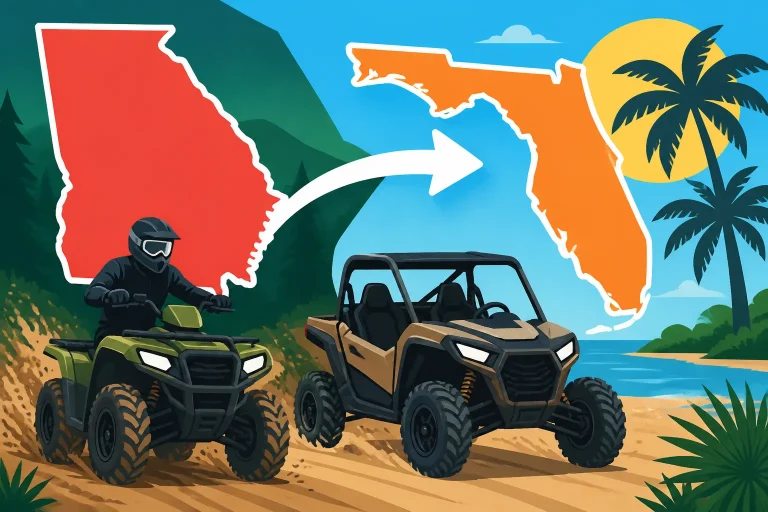
This is especially important for seasonal visitors who bring a quad from Georgia, Alabama, or another nearby state. The family may be familiar with its home-state requirements but encounter different Florida public-land rules. For more on the visitor question, see Florida Rules for a Visiting Rider From Georgia. When in doubt, confirm course acceptance before making a long drive or paying for a riding-area reservation.
Does the certificate expire?
Do not assume that a certificate lasts forever, but do not assume that it expires on a schedule either. The answer can depend on the course and the destination’s requirements. Check the certificate itself and the current instructions from the issuing course provider and land manager, particularly if the child completed training several years ago.
A certificate may still be useful as proof of course completion even when a child has not ridden recently. That does not mean the child’s practical skills are current. A long break, a change in machine size, or new riding conditions can justify a refresher in a controlled area before the family tackles a longer trail.
For a more focused discussion, see Does a Florida Safety Course Expire?. If you cannot locate the certificate, look for a course-completion email or account record and use the provider’s instructions for retrieving proof. Do not wait until you arrive at a remote trailhead to discover that the family cannot access the document.
How to handle a missing or unclear certificate
If a certificate is lost, first identify the organization that provided the course and search the email address or account used at registration. Check spam, archived messages, and family records. If the course was completed through an official program, use its published process for checking or recovering a completion record.
If the name or date on the document is incorrect, resolve that before the trip where possible. A certificate with a misspelled name may create questions when staff compare it with identification or a registration record. Keep any confirmation from the course provider showing that a correction or replacement request has been made.
If no record can be found, do not try to pass off a different document as proof. Ask the land manager what it will accept and whether the child needs to retake an approved course. The straightforward answer may be less convenient, but it is better than being turned away after the family has loaded the machines and driven to the trail.
Building Safer Habits After Certification
Start with a low-pressure practice ride
A course gives a young rider useful information, but comfort and judgment develop through practice. Begin somewhere appropriate for supervised training, away from crowds and difficult obstacles. Let the child practice stopping, turning, starting smoothly, and responding to simple instructions before joining a busier route.
Keep the first ride short enough that the child is still attentive at the end. Fatigue can show up as rushed decisions, missed signals, or frustration. If the rider starts making avoidable mistakes, take a break or call it a day rather than treating the problem as a challenge to push through.
Before moving to more difficult terrain, ask the rider to explain the plan in their own words. They should know where the group is going, how to signal a stop, and what to do if they cannot see the adult. If the child cannot describe the plan calmly, simplify the ride. Building confidence gradually is safer than making a young rider feel they must prove themselves.
Make trail decisions together
Children are more likely to follow safety rules when adults explain the reason behind them. Instead of saying only “don’t go in that water,” explain that depth, hidden ruts, and soft ground can be hard to judge from the trail. Instead of demanding that a child keep up, agree on a pace that lets the group stay together without pressure.
Set clear rules before the engine starts. Decide whether the child may pass another rider, how much space to leave, and what the group will do at intersections or trail junctions. Use consistent signals and agree on a stopping place if someone gets separated. These simple routines are especially helpful when several families are riding together.
Adults set the tone. If an experienced rider ignores closures, cuts corners, or rides beyond their ability, a young rider may interpret that behavior as permission. Model the habits you want the child to use: slow down when visibility is limited, stop when uncertain, respect posted restrictions, and leave room for other trail users.
Know when not to ride
Sometimes the safest decision is to postpone a ride. A young rider may be tired, upset, unwell, or distracted; the machine may not fit; or the trail may be beyond the child’s current ability. A certificate does not obligate a family to ride, and a prepaid trip should not pressure a parent into ignoring a reasonable concern.
Conditions in Florida can change quickly. Rain can make some areas muddy or slippery, while dry conditions can create dust and reduce visibility. Heat can also affect a child’s concentration. Bring water, take breaks, and watch for signs that the rider is becoming overheated or mentally tired. A ride that starts well can become unsafe if the group treats the original plan as unchangeable.
Agree as a family that anyone can ask to stop without being teased or blamed. This is a particularly useful rule for children who may be reluctant to admit they are scared or exhausted. When a young rider feels comfortable speaking up, adults can make better decisions before a small problem turns into an emergency.
A Parent’s Pre-Ride Plan
Check the details before loading the machines
A little planning can prevent the most common certification-related problems. Confirm the destination’s rules, identify the accepted course proof, and check whether a separate OHV pass is needed. Review any machine restrictions and make sure the planned trails suit the vehicle and the child’s experience.
Look at the practical details too: operating hours, route closures, weather conditions, and where the group can get help. Save the destination’s contact information. If the ride requires a reservation or online pass, verify that the confirmation is easy to retrieve without relying on a strong cell signal at the trailhead.
For families heading to a national forest, review both the safety-course requirements and the pass process rather than treating them as a single task. For other public lands or private parks, ask the same questions directly. The few minutes spent checking can prevent a child from waiting at the entrance while an adult tries to sort out paperwork on a phone.
Use a simple go-or-no-go conversation
Before the first ride, ask the child to tell you what the certificate means and what it does not mean. A helpful answer is that the course taught safety principles and provided proof of completion, but the rider still needs adult supervision, protective gear, an appropriate machine, and permission to ride at that location.
Then talk through a few situations: what to do if the child cannot see the adult, if another rider falls, or if the route looks too difficult. There is no need to turn this into a test. The point is to make sure the child knows that stopping and asking for help are responsible choices.
Finally, make a family agreement about the ride’s limits. Decide when the group will take breaks, what behavior means the ride is over, and how the child can speak up without embarrassment. That agreement makes it easier to prioritize safety when excitement, peer pressure, or the desire to finish a trail starts competing with good judgment.
Keep a record of what works
After the ride, take a few minutes to talk about what went well and what felt difficult. A child may have handled a sandy turn confidently but felt uncomfortable near other machines. Those details help you choose the next route and decide whether the rider needs more practice before trying a different type of terrain.
Keep track of the course proof, the machine used, and any rules that were specific to the destination. If the family visits the same area again, those notes can save time. If the child moves to a different machine or the family chooses a new riding area, use the notes as a prompt to check requirements again rather than assuming the old plan still applies.
The best outcome is not simply making it through a ride without incident. It is helping a young rider develop habits that carry from one trip to the next: respecting limits, communicating clearly, caring for equipment, and understanding that a safe decision is more important than finishing a route.
Disclaimer
This article is for general informational purposes only and does not constitute professional advice. Laws, prices and regulations vary by location and change over time. Consult a qualified professional for guidance on your specific situation.