Carrying the Certificate at All Times
A safety-course certificate is easy to leave at home, especially when it seems like one more piece of trail paperwork. For young riders on Florida public land, that can create a preventable problem at a check. Here’s when to carry proof, what form to bring, how it differs from an OHV pass, and what to do if the certificate is missing or unavailable.
When Florida riders need to carry a safety-course certificate
Florida has safety-course requirements for some young OHV riders on public land. The rules can depend on the rider’s age and the land manager’s requirements, so don’t assume that having a certificate at home is enough. If a rider is required to complete an approved course, carry proof of completion while riding.
The safest approach is to check the current rules for the specific riding area before you leave. Requirements for a national forest, state forest, private park, or other property may differ. A certificate that satisfies one land manager’s rule may not automatically satisfy another’s. For a broader overview, see Florida ATV Safety Course Requirements for Riders Under 16 and Florida ATV Safety Course for Public Land Riding.
A certificate proves that a rider completed a course; it does not authorize access to every trail or replace other requirements. Riders may also need an OHV pass, comply with supervision rules, and follow the riding area’s age, machine, and safety rules. The distinction matters: a family may have completed the training and still be turned away for lacking a required pass or for riding on a closed trail.
| Item | What it generally shows | What it does not replace |
|---|---|---|
| Safety-course certificate | The rider completed an approved safety course | An OHV pass, supervision, trail access, or machine-specific rules |
| OHV pass | Required access or fee status for a particular public riding area | Safety training or proof of course completion |
| Proof of ownership | A connection between a rider and the machine, if requested | A riding permit or safety certificate |
| Parent or guardian contact details | Useful information in an emergency | Any required adult supervision |
The certificate requirement is especially easy to confuse with the general rules for operating on public land. A parent may have taken the course, but that does not establish that a child has completed it. Likewise, a child’s certificate does not remove any separate supervision requirement. Review Florida National Forest Under-16 Course Requirement and Florida Adult Supervision Rules on Public Land for related issues.
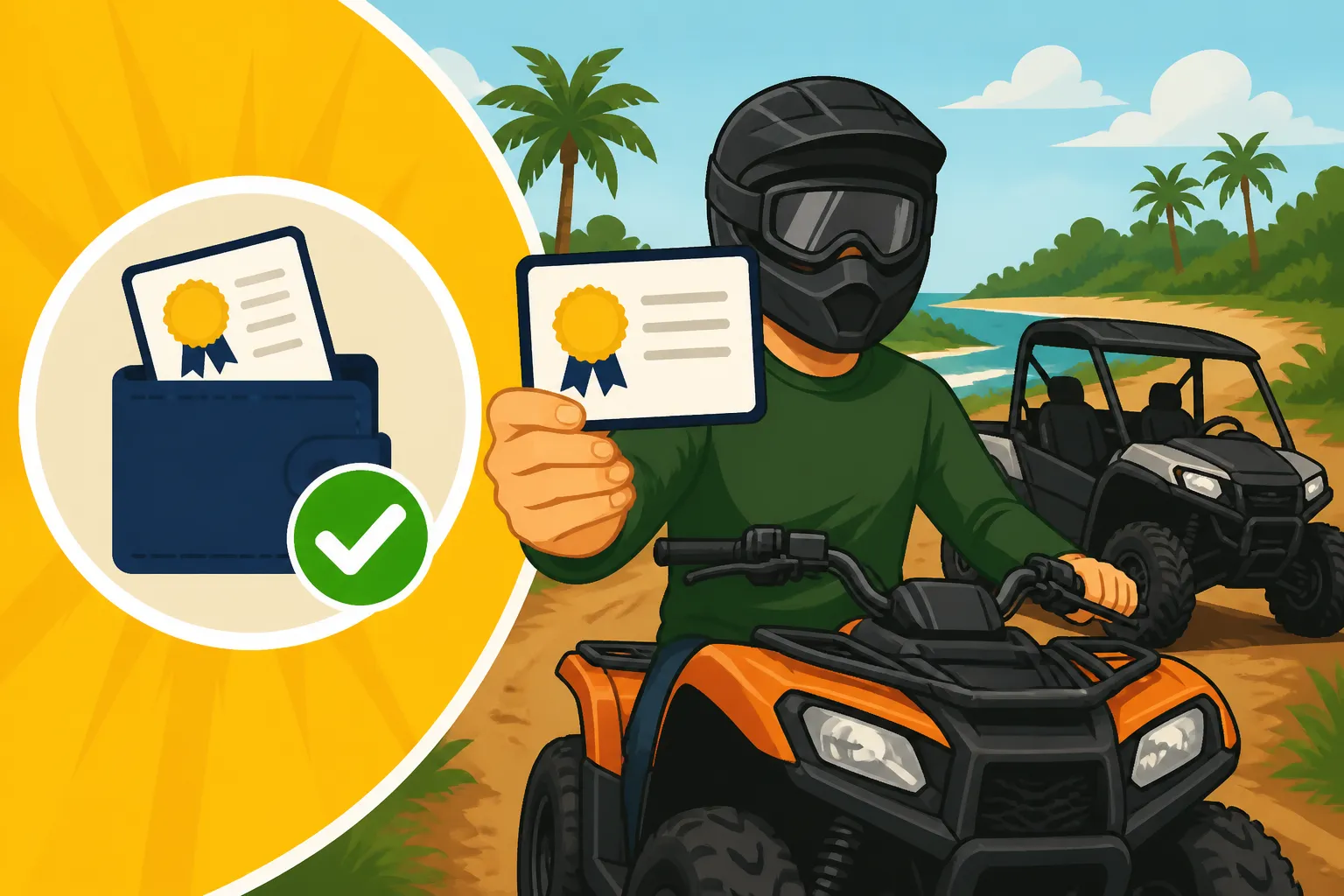
Even if a particular location does not ask for a certificate at every visit, carrying it is sensible when a rider is subject to a training requirement. A ranger or other land manager may ask for proof during a check. Showing that the certificate is at home can take time to sort out and may not be accepted as proof on the trail.
What counts as proof, and how to carry it
Start by using the certificate or confirmation issued by the course provider. Check that it identifies the rider and clearly shows course completion. If the provider offers a way to retrieve or verify the certificate, make sure the rider’s details are correct and that you know how to access the record before reaching the trailhead.
When the land manager does not clearly say that a digital copy is acceptable, carry a printed copy. A phone image can be a useful backup, but it depends on having a working device, enough battery, and a readable file. Cell service can also be unreliable in some riding areas. A printout avoids several of those problems and is quick to show during a check.
A practical setup is to keep one paper copy with the rider’s trail documents and a second copy with the supervising adult. A small waterproof document sleeve can protect the printout from rain, mud, and spills; general retailers such as Amazon carry these, but any secure, water-resistant holder will do. Avoid storing the only copy loose in a pocket where it can tear or become illegible.
Before a ride, confirm that the certificate is:
- For the rider who is actually going on the trip.
- Readable, with the rider’s name and completion information visible.
- Available offline if you plan to rely on a phone copy.
- Stored somewhere accessible without unpacking the whole vehicle.
- Consistent with the course type accepted by the riding area.
If the rider has completed a course but cannot locate the paperwork, contact the course provider and ask how to retrieve proof. Some providers offer an online lookup or replacement record. Check Florida ATV Safety Course Certificate Lookup for help with that step, and confirm that the resulting document is acceptable to the destination’s land manager.
Do not assume that a photograph of a certificate, a course enrollment email, or a parent’s statement will count as proof. Those items may help explain what happened, but they may not meet the site’s requirement. If you cannot obtain a proper record in time, contact the land manager before traveling rather than relying on a last-minute explanation at the entrance.
Certificate, OHV pass, and other paperwork
The certificate is only one part of preparing for a public-land ride. An OHV pass, where required, is a separate access document. It may be associated with the machine rather than each rider, depending on the program, so check the exact rule for your destination. A pass for one riding area does not necessarily cover another, and a safety certificate is not a substitute for a pass.
The same goes for ownership and title paperwork. A title establishes information about ownership; it is not a riding permit or proof of safety training. For an overview of the difference between title and registration, see Florida ATV Title vs Registration: The Difference. For public-land paperwork more broadly, Florida Riding on Public Land: Permits and Proof can help you build a pre-ride checklist.
Keep documents grouped, but don’t treat them as interchangeable. A simple folder or pouch can hold the certificate, pass information, and any other paperwork the land manager asks riders to carry. Before leaving, verify which documents need to be displayed, attached to the machine, or available to show on request. Some items may be accepted digitally while others may need to be printed or displayed according to local instructions.
A useful pre-ride check is:
- Identify the land manager and confirm that the area is open to the machine you plan to ride.
- Review the current access, pass, age, supervision, and safety-course rules.
- Confirm that each rider who needs training has completed the accepted course.
- Put the certificate or other acceptable proof where it can be reached during the ride.
- Check that any required pass is valid and associated with the right machine or visit.
- Save the land manager’s contact information in case a requirement is unclear.
The course provider and the riding-area operator answer different questions. The provider can help retrieve proof of completion or clarify what course a rider took. The land manager can say whether that proof satisfies its rules, what else riders need to carry, and how it wants documents presented. If you are unsure whether an online record is enough, ask the land manager directly.
If the certificate is lost or a rider has no proof
If a rider has completed the course but the certificate is lost, pause before the trip and request a replacement or record from the provider. Keep any confirmation you receive, but do not assume that a confirmation email will be treated as the official certificate. Ask the riding area whether it will accept the replacement format.
If the rider has not completed the required course, do not treat borrowing another person’s certificate or showing a parent’s certificate as a workaround. Course records belong to the person who completed the training. Find an approved course and confirm the accepted format before planning a ride. Information about course options and requirements is available in Florida Online Safety Course vs In-Person and Which Online Safety Course Florida’s National Forests Accept.
A missed certificate can also reveal a larger planning gap. Check whether the rider needs direct adult supervision, whether the adult must meet a particular requirement, and whether the machine is permitted on the intended trail. Age-related rules can change what a young rider may do even after completing training. See Florida Riders Turning 16 and the Course Rule for a related age question, and verify the current requirements with the land manager before setting out.
If a ranger or staff member asks to see proof and you cannot produce it, stay calm and follow the directions given. Do not argue that a phone with no signal, a parent’s memory, or a document stored at home should count. Ask what options are available, and be prepared to stop riding or leave if the site’s rules require proof that you cannot provide. A quick check before the trip is easier than trying to resolve the issue at the trailhead.
The simplest routine is to store a paper copy with the rider’s regular trail documents and keep a backup accessible to the supervising adult. Check the destination’s current requirements each time you visit, especially if you are traveling to a different kind of public land. Carrying proof is a small step, but it can prevent confusion and help keep the focus on a safe, permitted ride.
Disclaimer
This article is for general informational purposes only and does not constitute professional advice. Laws, prices and regulations vary by location and change over time. Consult a qualified professional for guidance on your specific situation.