Florida Online Safety Course vs In-Person
Florida riders comparing an online ATV safety course with an in-person class need to know more than which format is convenient. The right choice depends on the rider’s age, where the machine will be used, and whether the land manager accepts that course. Here’s how to compare the options and confirm that a certificate will count before you ride.
What the course requirement means in Florida
Florida’s safety-course rules matter most for younger riders using public riding areas. The exact requirement can depend on the rider’s age and the land being used, so don’t assume that a course required at one location automatically satisfies the rules at another. Start by checking Florida ATV Safety Course Requirements for Riders Under 16 and Two Different Florida Safety Course Rules.
A safety course is about riding knowledge and risk reduction. It is not the same thing as an OHV pass, a title, a registration, or permission to ride a particular trail. For example, a course certificate does not by itself provide access to a national forest trail system. Check the riding area’s separate requirements through Florida OHV Permits: What You Need Before You Ride.
This distinction is especially useful when planning a visit from out of state. A rider may already have completed a class elsewhere, but acceptance depends on the applicable Florida requirement and the land manager’s rules. Confirm directly with the relevant agency or riding area before relying on an out-of-state certificate. Florida Rules for a Visiting Rider From Georgia explains why visitors should check requirements rather than assume their home-state paperwork carries over.
Confirm three things before enrolling
Before choosing a format, get clear answers to these questions:
- Who needs the course? Check the age rules that apply to the rider and the location. A requirement for a young rider should not be treated as an automatic requirement—or exemption—for every rider.
- Which course is accepted? Ask whether the course provider and format meet the specific rule. “ATV safety course” on a website does not necessarily mean every agency accepts that course.
- What proof must the rider carry? Find out whether the rider needs a completion certificate, a digital record, or another form of proof while riding. The practical advice in Carrying a Safety Certificate on the Trail is relevant even when the certificate is stored electronically.
Florida’s public-land and national-forest requirements can involve different rules or accepted courses. If your destination is a national forest, review Florida National Forest Under-16 Course Requirement and confirm details with the forest before you travel. A course that seems suitable in general may not meet a location-specific requirement.
Online vs. in-person: how the options compare
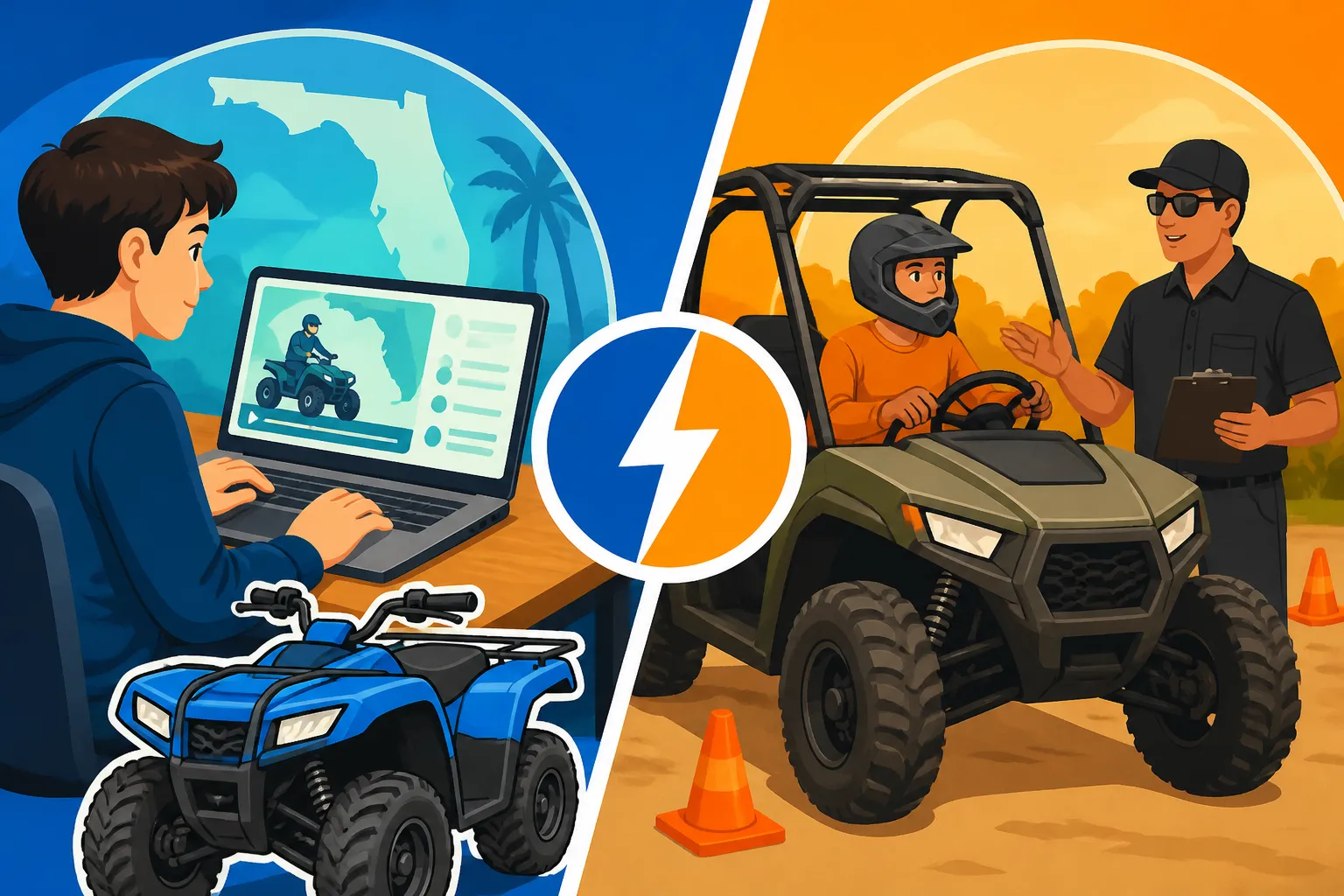
An online course is often easier to schedule and complete at home. An in-person class can provide direct instruction, demonstrations, and a chance to ask questions as they come up. Neither format is automatically better for every rider, and neither is useful for compliance unless it is accepted for the rider and riding location.
| Consideration | Online course | In-person course |
|---|---|---|
| Scheduling | Often easier to fit around school, work, or travel | Depends on class dates, location, and available spaces |
| Learning setup | Self-paced or screen-based, depending on the provider | Instructor-led, with opportunities to ask questions |
| Hands-on practice | May offer limited or no direct machine practice | May include practical instruction, but confirm what the class actually covers |
| Proof of completion | Check how the provider issues or records the certificate | Check whether the provider gives a certificate or submits completion records |
| Acceptance | Must be confirmed with the relevant Florida agency or land manager | Must also be confirmed; an in-person format alone does not guarantee acceptance |
| Best fit | Riders who can learn independently and need a flexible schedule | Riders who benefit from live explanations or practical coaching |
The most important comparison is not “online versus classroom.” It is accepted course versus unaccepted course. A live instructor does not make a course automatically valid for every Florida requirement, and an online course is not automatically disqualified because it is online. Verify the provider, course, and certificate before paying or setting aside time.
What an online course can do well
Online instruction can make it easier to cover foundational topics at a comfortable pace. A rider may be able to pause, review a section, and return to a topic that was not clear the first time. That can help with concepts such as protective gear, riding within one’s ability, passenger safety, trail awareness, and avoiding unsafe terrain.
The trade-off is that an online course may not give a young rider hands-on practice or immediate feedback. Completing a knowledge course should not be treated as proof that a rider is ready to handle a machine independently. Parents and guardians still need to consider the rider’s size, judgment, experience, and ability to follow instructions. The course requirement is a minimum standard, not a substitute for supervision and suitable equipment.
What an in-person course can do well
A classroom or instructor-led course offers direct interaction. Riders can ask for clarification, and an instructor may be able to demonstrate techniques or explain why a particular choice is risky. If a course includes practical instruction, that can provide a more realistic learning experience than reading or watching material alone.
But “in-person” can mean different things. Some classes may focus on discussion or classroom material, while others may include a practical component. Ask what is included before enrolling. Also confirm that the class is accepted for the intended Florida use; attending a local class is not enough if it does not satisfy the relevant rule.
How to choose the right format
Choose based on the rider’s needs and the rules at the destination, not just convenience. If a young rider is comfortable learning independently, can read and follow course material, and the relevant agency accepts the online course, online instruction may be a practical option. If the rider needs more explanation, benefits from live interaction, or has limited experience, an instructor-led course may be a better learning fit—provided it is accepted.
A course can be both educational and useful for compliance, but those are separate tests. Ask the provider about content and completion records. Ask the agency or land manager whether the course counts. If the answers are unclear, pause before enrolling and get confirmation in writing when possible.
Use this decision process
- Choose the riding area first. Course rules can differ by location. Identify the specific public land, forest, or riding facility you plan to visit.
- Check the rider’s age and applicable rule. Do not rely on a general statement about “Florida riders” if the requirement is age-specific.
- Ask the land manager what it accepts. Confirm whether an online course, an in-person course, or either format can satisfy the requirement.
- Confirm the provider and certificate. Ask how completion is documented, how the rider can retrieve proof later, and whether the certificate must be carried.
- Select the format that suits the rider. Consider attention, reading ability, comfort asking questions, and the need for supervised practice.
- Save proof and check other access rules. A course certificate may be only one item needed for the trip. Confirm passes, machine eligibility, trail access, and any age or supervision requirements separately.
If you are unsure whether a completed course is recognized, use Florida ATV Safety Course Certificate Lookup to understand how certificate records may be checked, then confirm the process with the relevant authority. Do not wait until arriving at the trailhead to find out that a certificate cannot be located or does not meet the local requirement.
When an out-of-state course may be involved
Visitors may have completed a course in another state, or they may be traveling with a certificate issued by a national provider. That history is worth mentioning when asking about acceptance, but it is not a guarantee. The receiving agency or land manager decides what satisfies its rule.
When you call or send an inquiry, give the rider’s age, the course name, the provider, the completion date if available, and the Florida destination. Ask whether the existing certificate is accepted and what proof to bring. If the rider has not taken a course yet, ask before choosing one. Florida OHV Permit Rules for Out-of-State Riders can help frame the broader questions visitors should ask, but it does not replace checking the course requirement for a specific location.
Before you ride: keep the paperwork and preparation separate
A certificate is easiest to use when the rider or accompanying adult can retrieve it quickly. Save a copy on a phone and keep another copy somewhere accessible, such as with trip paperwork. If the issuing provider offers a way to retrieve or verify completion, keep the account details or certificate information needed to use it. Ask whether a digital copy is acceptable; don’t assume that a screenshot or an email confirmation is enough.
Also remember that course completion does not establish every other requirement for a ride. Depending on the destination, you may need a separate pass, proof of ownership, or permission to use a particular trail. Some places may have their own age, supervision, machine, or safety-equipment rules. Review Florida Adult Supervision Rules on Public Land if a minor will be riding, and check the land manager’s current information before departure.
For a practical pre-ride check, make sure you can answer all of the following:
- Is the rider required to complete a safety course for this location?
- Does the land manager accept the exact course the rider completed?
- Can the rider or accompanying adult produce acceptable proof?
- Are any supervision or age rules separate from the course requirement?
- Does the machine need its own pass or other authorization?
- Is the trail open to that type and size of machine?
If the answer to any course-related question is uncertain, verify it before the trip. That is more reliable than choosing a format based on a provider’s general description or assuming that a certificate accepted elsewhere will be accepted throughout Florida. For a broader overview of the course requirement and where it applies, see Florida ATV Safety Course for Public Land Riding.
Disclaimer
This article is for general informational purposes only and does not constitute professional advice. Laws, prices and regulations vary by location and change over time. Consult a qualified professional for guidance on your specific situation.