Two Different Florida Safety Course Rules
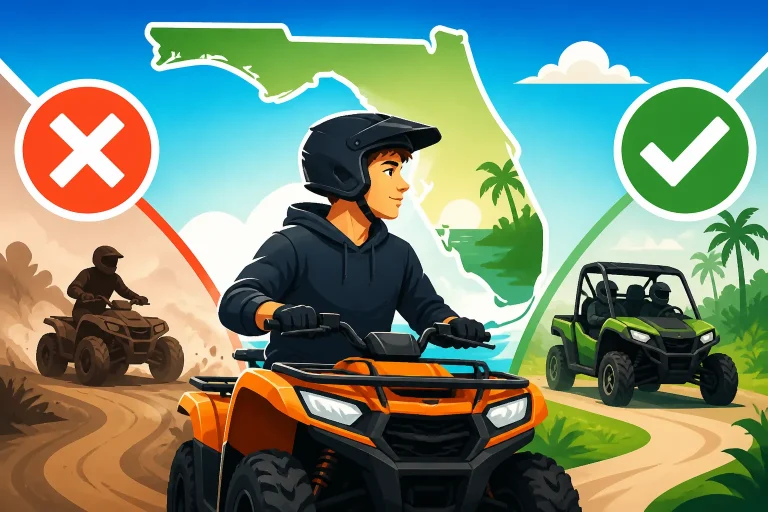
Florida riders can hear that young riders “need a safety course,” then get conflicting advice about where the rule applies and whether a certificate must be carried. The practical distinction is between Florida’s under-16 safety requirement and the rules a particular riding area uses to check compliance. Here’s how to think about both, what proof to keep, and what to verify before heading out.
The two rules riders are usually talking about
The phrase “Florida ATV safety course rule” can refer to two related but different things: the requirement for a young rider to complete an approved course, and the requirement to show proof when riding on particular public land. Treating them as one rule can lead to an avoidable problem at a trailhead.
The first is about the rider. Florida’s rules for young ATV operators make safety training relevant to riders under 16, especially when riding on public land. The exact requirements depend on the type of machine and where it is being operated, so parents should check the current guidance before assuming a child is covered by a course taken elsewhere.
The second is about access and compliance at the riding area. A land manager may require riders to carry a certificate, show it during a check, or meet additional site rules. That is not necessarily a second course. It is often the same training certificate being used as proof that the rider met the applicable requirement.
| What people mean by “the course rule” | What it concerns | What to do |
|---|---|---|
| Florida’s young-rider safety requirement | Whether a rider under 16 needs approved training for the kind of riding planned | Confirm the current requirement for the vehicle and location |
| A riding area’s proof requirement | Whether the rider must carry or show the certificate at that site | Keep a paper or accessible electronic copy with the rider |
| A land manager’s other conditions | Supervision, passes, vehicle limits, closures, or other access rules | Check the specific trail or forest before traveling |
A course certificate does not by itself provide permission to ride wherever you want. It does not replace an OHV pass, a land-use permit, adult supervision where required, or a trail’s machine restrictions. For the broader age and training rules, see Florida ATV Safety Course Requirements for Riders Under 16 and Florida ATV Safety Course for Public Land Riding.
The useful way to approach the issue is to ask two separate questions:
- Does this rider need to complete an approved course for this kind of riding?
- What proof or other conditions does this specific riding area require?
Answer both before you leave. A rider may have completed the course but still arrive without the documents, pass, or supervision required at the destination.
Florida’s rule focuses on the young rider
The main practical concern is the rider’s age. A child’s experience on private property, a parent’s experience, or the fact that the child can physically handle the controls does not automatically settle whether a course is required for public-land riding.
Florida’s requirements are aimed at making sure young operators receive safety instruction and ride under the conditions that apply to them. A parent should not treat the course as optional simply because a child has been riding for years. Nor should a parent assume every course with “ATV” in its name is automatically accepted for every Florida public-land requirement.
The course should be one that meets the applicable Florida requirement. The relevant state agency and the land manager are the right places to confirm which course is accepted. For information about how the certification is handled, see FDACS Safety Certification for Young Florida Riders.
Don’t confuse training with supervision
Course completion and supervision are separate considerations. A training certificate is evidence that the rider completed instruction; it does not mean a young rider can ignore an adult-supervision requirement or operate outside the limits set for that rider.
Before a ride, check all the conditions that apply to the child, including:
- The rider’s age and the kind of machine being operated
- Whether the applicable rule requires an approved safety course
- Whether an adult must supervise the rider, and what “supervision” means at that location
- Any helmet and eye-protection requirements
- Whether the trail allows that vehicle’s class, width, or passenger setup
- Whether the site requires a pass or other authorization
Parents sometimes focus on the certificate because it is the item that is easiest to forget. But a certificate does not cure a problem with an unsuitable machine, a missing pass, inadequate safety equipment, or a child riding without required supervision.
The machine matters too
People often use “ATV” as a catch-all term for quads, side-by-sides, and other off-highway vehicles. Rules and site restrictions may distinguish among them. A course that is appropriate for one type of machine may not answer every question about a different vehicle or riding area.
If your family rides both a quad and a side-by-side, check the rules for each machine rather than assuming the same conditions apply. The trail may also have separate vehicle restrictions, even if the operator holds a valid certificate. A useful starting point is Florida ATV Trails That Allow Side-by-Sides.
The same care applies when a visitor brings a machine from another state. A registration document or out-of-state course card may be useful, but do not assume it automatically replaces a Florida requirement or a site-specific proof rule. See Florida OHV Permit Rules for Out-of-State Riders if you are planning a visit from outside Florida.
A land manager can add a proof check
A certificate can be required in practice even when a rider has already completed the course. That is because land managers need a way to confirm that riders meet the rules before or during use of a public riding area.
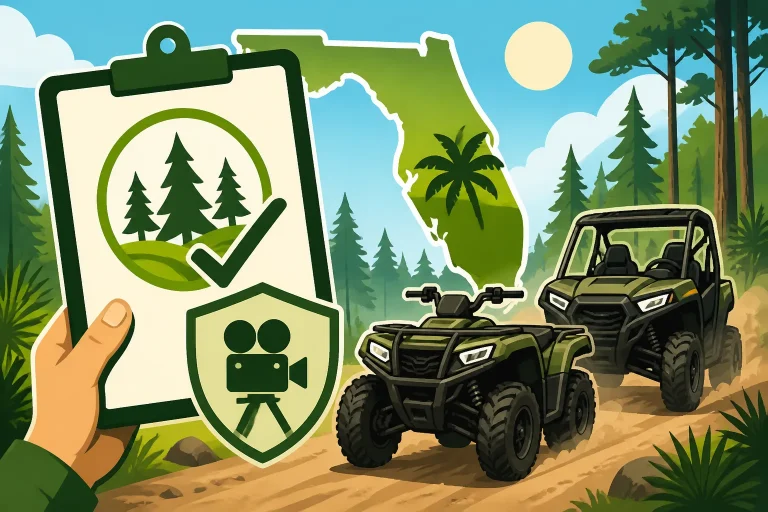
This is the second rule riders commonly mean: not another training course, but an expectation that the rider can produce proof. At some locations, the certificate may be checked at the entrance or during a ranger’s inspection. At others, the agency’s instructions may tell riders to carry proof while operating. The precise process can vary by land and may change, so check the official information for the specific destination.
National forest riding is a good example of why it pays to separate statewide requirements from site procedures. A young rider may need to meet Florida’s applicable course requirement and also follow the forest’s rules for carrying proof, supervision, passes, and vehicle use. For details aimed specifically at that setting, see Florida National Forest Under-16 Course Requirement.
Keep proof easy to retrieve
Do not leave the certificate at home or buried under camping gear in a truck. If the rider is asked to show it, a quick, legible copy makes the conversation straightforward.
A practical approach is to keep:
- A paper copy in a waterproof document sleeve
- A digital copy saved on a phone, if the land manager accepts digital proof
- A backup copy with the supervising adult
A digital copy is convenient, but it is not wise to rely on a phone alone. Battery problems, poor reception, a damaged device, or a file that will not open can turn a simple check into a delay. Confirm whether the site accepts an electronic copy before depending on one.
If you need a small waterproof sleeve or a document organizer, Amazon may have options; choose one that keeps the certificate readable and can be secured with your riding gear. Whatever the source, do not put the only copy somewhere it can fall out on the trail.
The document should be readable and show enough information to identify the rider and the completed course. If the certificate has a number or other verification detail, preserve it. Avoid photographing a certificate at an angle or saving a cropped image that cuts off the important information.
A course card is not a trail pass
Safety training and riding authorization serve different purposes. A course certificate says something about the rider’s training. A pass or permit addresses access to a place or riding area. One generally does not stand in for the other.
For example, a rider may have completed an approved course and still need the applicable forest OHV pass. Conversely, having a pass for the machine does not establish that a young rider has completed required training. If your trip includes a national forest, review Florida National Forest OHV Pass: 3-Day, 7-Day or Annual and check the current pass instructions for the riding area.
Also check whether the pass is tied to a particular vehicle, whether each machine needs its own pass, and what proof must be displayed or carried. Those conditions are separate from the course question.
Choosing and completing an accepted course
A course only helps if it satisfies the requirement that applies to the rider. Before enrolling, confirm the provider and course format are accepted for the intended use. A course certificate from another state, a dealer orientation, a private lesson, or an informal safety talk may be valuable experience, but that does not automatically mean it meets Florida’s public-land certification requirement.
Start with the current information from the Florida agency responsible for the course certification and the land manager for your planned destination. If the instructions are unclear, ask directly whether the exact course and certificate you are considering will be accepted for a rider of that age and vehicle type.
Online or in person
Online and in-person courses can serve different needs. An online course may be convenient for families who want to complete the classroom material before a trip. In-person instruction can offer an opportunity to ask questions and, depending on the course, practice safety skills with an instructor. The accepted formats and course details should be checked before registering.
Do not choose based only on speed or convenience. Look for clear confirmation that the course produces the certification needed for the planned riding. If the certificate is required at a trailhead, confirm that it will be available before the trip and that the rider’s name and identifying details are correct.
For a closer comparison, see Florida Online Safety Course vs In-Person. If you are planning around a trip date, How Long the Florida ATV Safety Course Takes can help you decide when to get started. Leave enough time to complete the course, resolve any certificate issue, and obtain the pass or other documents for the riding area.
Amazon is not a substitute for an approved training provider. It can be useful for buying practical items such as a folder, protective gear, or a helmet, but a purchased book or video should not be assumed to create an official course certificate. If you shop there for safety equipment, check the product details and fit carefully; a low price or a familiar product label does not establish that equipment meets the applicable requirement.
Make sure the certificate is usable
After completing the course, take a moment to check the certificate rather than assuming everything was processed correctly. Confirm that:
- The rider’s name is spelled correctly
- The completion status is clear
- The certificate or record is available to the family
- Any identification or verification details are present
- You know how to retrieve a replacement if it is lost
If the provider uses an online record, save the completion confirmation and the certificate itself. Keep copies in more than one place. A parent might store a copy at home, keep another on a phone, and place a paper copy with the rider’s trail documents.
For more on what to carry while riding, see Carrying a Safety Certificate on the Trail. A certificate is only helpful during a check if you can retrieve it and it is legible.
A pre-ride checklist for families
The simplest way to avoid confusion is to prepare for the ride by location, not by relying on a general statement someone made about “Florida rules.” Different places can have different permit, access, and documentation procedures, and a rider may be subject to more than one layer of requirements.
Use this checklist before loading the machine:
- Identify the exact riding area. Confirm whether it is private property, a state forest, a national forest, or another public riding site. Do not assume that rules at one trail system carry over to another.
- Check the rider’s age and the applicable course requirement. Verify that the course was approved for the rider and intended use.
- Ask what proof must be carried. Confirm whether a paper copy is needed, whether a digital certificate is accepted, and whether a ranger or gate attendant may request it.
- Check supervision rules. Make sure the adult accompanying the young rider meets the site’s requirements and can supervise in the way the rules expect.
- Confirm machine eligibility. Look at vehicle class, width, passenger rules, and any restrictions that could keep the machine off a particular trail.
- Get the correct pass or permit. Confirm whether authorization is needed for each machine and whether the pass covers the planned riding area.
- Review current closures and conditions. A valid course and pass do not make a closed trail available.
- Pack the documents where they can be reached. Keep the certificate separate from items likely to get wet, muddy, or left in another vehicle.
If a child has completed a course but cannot produce proof at a site that asks for it, do not assume the land manager will accept a verbal explanation. Contact the agency before the trip if the certificate is delayed or missing. If you are already at the trailhead, follow the instructions of the staff or ranger rather than riding first and trying to sort it out later.
A simple document routine can help if your family rides often. Keep a labeled folder for each machine or rider with the course certificate, pass information, and any other documents the land manager asks you to carry. Amazon may offer waterproof organizers suitable for this purpose, but the important part is keeping documents current, protected, and easy to find—not the brand or where you bought the folder.
Common misunderstandings to avoid
“The course is only a formality”
A course is not just a card to show at the gate. The point is to give young riders a basic understanding of machine operation, trail behavior, and safety decisions. A child who has completed training still needs age-appropriate supervision and a suitable machine. Parents should treat the course as preparation, not as permission to take risks.
“We took a class, so every trail is covered”
A completed course does not guarantee that every land manager accepts that course or that a certificate from another jurisdiction meets the same requirement. Check the provider and destination requirements before relying on a course completed elsewhere.
“The pass proves the rider is trained”
A pass and a safety certificate do different jobs. A pass concerns access; the certificate concerns training. Carry whichever documents the site requires rather than assuming one document answers both questions.
“Private property rules settle public-land rules”
A family may ride on private property under different conditions than those that apply on public land. Prior experience riding at home does not establish that a young rider meets the requirements at a state or national forest trail. When you change locations, check the rules again.
“If no one asks for the certificate, it wasn’t needed”
A rider may not be checked on every visit. That does not mean the requirement has disappeared. Carry the requested proof and follow the posted rules even when the entrance is quiet.
“Every side-by-side follows the same ATV course rule”
A side-by-side and a quad may be treated differently under a particular rule or site policy. Do not assume that a course requirement, youth rule, trail restriction, or passenger rule transfers unchanged from one vehicle type to another. If the family uses more than one kind of OHV, verify each one separately.
What to do when the rules seem inconsistent
It is common to find brief descriptions that do not explain whether they are talking about Florida law, a forest’s access procedure, or a particular course provider’s policy. When instructions seem to conflict, write down the specific questions and ask the agency that controls the riding area.
Be ready to identify:
- The rider’s age
- The type of machine
- The exact riding area and trail system
- The course provider and certificate format
- Whether you are asking about training, carrying proof, supervision, or a pass
That detail helps avoid an answer that is technically correct but aimed at a different situation. For example, an answer about taking an ATV course may not tell you whether a national forest expects the certificate to be available during a trail check. An answer about a forest pass may not settle the state’s youth training requirement.
For a broader overview of the young-rider certification, use Florida ATV Safety Course Requirements for Riders Under 16. Then confirm site-specific conditions with the land manager before setting out. The reliable plan is to complete the appropriate course, keep proof accessible, obtain the correct pass, and follow the rules for the exact property where you intend to ride.
Disclaimer
This article is for general informational purposes only and does not constitute professional advice. Laws, prices and regulations vary by location and change over time. Consult a qualified professional for guidance on your specific situation.