Group Size Limits on Florida Forest Land
A large ride group can turn a straightforward Florida forest trip into a permitting or access problem. The complication is that “group size” may mean riders, machines, or an organized event, and rules depend on who manages the land. Here’s how to check the right limit, avoid confusing pass requirements with group caps, and plan a ride that won’t be turned away.
Is There a Statewide Group Size Limit?
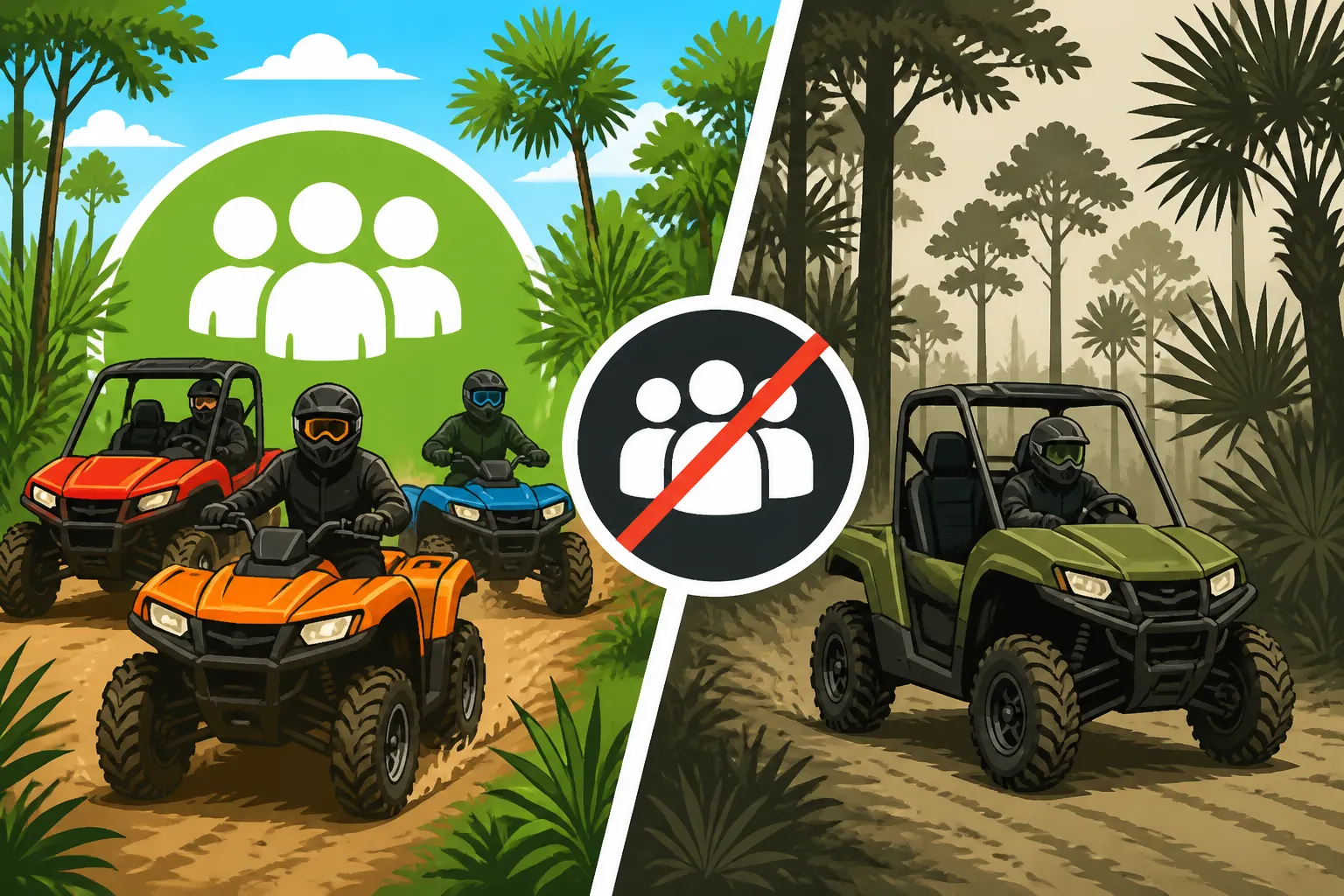
There is no single group-size number that applies to every Florida forest and every kind of ride. A forest’s manager may set site-specific limits, and the rules can differ between national forests, state forests, and private riding areas. Requirements may also depend on whether you are simply riding with friends or organizing an event.
That means a group should not assume it is allowed just because it can buy a pass for each machine. A pass may cover access or use under particular conditions, but it does not automatically authorize a large gathering, a commercial tour, or an organized ride. Check the rules for the exact riding area and trail system before setting a maximum headcount.
The word “group” can refer to several different things:
- Riders: Everyone participating, including passengers where they are permitted.
- Machines: Each ATV, UTV, or other off-highway vehicle in the party.
- A gathering: A planned meetup or event at a trailhead or other forest location.
- A commercial activity: A guided tour, rental operation, filming, or other activity conducted for business.
A rule or permit may apply to one of these categories without setting a simple limit on the others. For example, a pass may be required per vehicle, while a separate approval may be needed for an organized event. A private group’s rider count does not necessarily tell you whether event rules apply; the purpose, organization, location, and expected impact can matter too.
It also helps to separate forest access rules from riding-area rules. A forest may allow vehicles only on designated roads or trails, while a particular OHV area has its own operating conditions. A machine can have the right pass and still be prohibited from a trail because of its type, width, or other site restriction. Review Florida OHV Permits: What You Need Before You Ride and Florida Trail Closures You Should Check First alongside any group-size information.
| What you are checking | What it may control | What to verify |
|---|---|---|
| Group or event rule | Whether a gathering or organized activity needs approval or has a size cap | Whether the rule applies to your location and type of ride |
| OHV pass | Access or use by eligible vehicles | Whether each machine needs its own pass and which areas it covers |
| Trail designation | Which machines may use a particular route | Vehicle type, width restrictions, closures, and allowed routes |
| Special-use approval | Organized, commercial, or otherwise non-routine use | Application process, lead time, conditions, and approved location |
| Parking or staging rule | Where and how many machines can assemble | Lot capacity, trailer space, and any limits posted at the site |
The practical takeaway: look for a rule tied to the specific forest and activity, not a number repeated in a general social media post or an old ride flyer. If the official rules do not clearly state whether your group needs approval, ask the land manager before you travel.
Why the Land Manager and Ride Type Matter
Florida forest land is managed in different ways. National forests and state forests may have separate rules, pass systems, contact points, and processes for special activities. Even within one forest, OHV access can be limited to designated areas or routes. A rule for one trailhead should not be assumed to apply throughout the forest.
For national forest riding, check the current information for the specific forest and OHV area. Florida’s national forest pass options and covered areas are explained in Florida National Forest OHV Pass: 3-Day, 7-Day or Annual. For state forest riding, check the rules and pass requirements for that particular state forest; Florida State Forest OHV Day Use and Annual Passes is a useful starting point. A pass is not a substitute for checking whether your planned group activity is permitted.
The type of ride matters as well:
- A casual ride with friends: This is not automatically the same as an organized event. Still, participants must follow the site’s regular access, vehicle, and trail rules.
- A club ride or scheduled meetup: Advertising, a planned gathering point, a route schedule, or a large number of participants may mean you should ask whether event approval is required.
- A charity ride, poker run, or competition: These activities are more likely to involve event-specific requirements. Do not assume ordinary day-use access covers them.
- A guided or paid ride: Charging participants or operating as a business can trigger requirements beyond those for a private recreational group.
- A gathering with filming or commercial promotion: The activity may need separate authorization even if the machines use routes open to regular riders.
A useful distinction is whether you are simply sharing a trail with other visitors or arranging an activity that brings people together at a defined time and place. The manager—not the size of your group alone—can tell you how the activity is classified. For organized activities, see Organized Event Rules on Forest Land. For ordinary riding, Florida Group Ride Rules at Public Areas can help with the practical side of keeping a party orderly.
Do not rely on a riding area’s online calendar, an old event page, or a previous approval as proof that the same activity is allowed now. Locations can close, capacity can change, and approvals may be limited to particular dates, routes, or organizers. Confirm the current conditions directly with the land manager.
How to Check the Limit Before You Go
Make the check before inviting a large group or collecting money. A quick confirmation can prevent a long drive to a full trailhead, an event that cannot proceed, or a disagreement with staff about what your group is doing.
- Identify the exact land and riding area. “A Florida forest” is not specific enough. Note the forest, OHV area, trailhead, and proposed riding date. If your route crosses different management areas, check each one.
- Describe the activity plainly. Say whether this is a private ride, club outing, charity event, guided ride, or commercial activity. Include whether it is advertised, whether participants pay, and whether you expect to gather at a particular staging area.
- Give both headcount and machine count. Managers may need to know the number of people as well as the number and types of vehicles. Include passengers if relevant, and identify any UTVs or wider machines.
- Ask what rule applies. Find out whether there is a group cap, event permit, special-use authorization, reservation, or other approval. Ask whether the answer changes by trailhead, date, or vehicle type.
- Confirm what the pass covers. Ask whether each machine needs its own pass, whether the pass applies to your chosen area, and whether event approval is separate. The overview in Florida OHV Pass for a Group of Five Machines may help you frame questions about a multi-machine party.
- Check for closures and capacity limits close to departure. A trail closure, construction, weather impact, or other access notice can change your plan after you have arranged the ride.
- Keep confirmation available. Save the relevant official page or written response and share the key conditions with the group organizer. A participant should not have to guess which routes or staging areas are approved.
When contacting the manager, ask direct questions rather than only asking, “How big can our group be?” For example: “We plan to bring a private group of riders and machines to this trailhead on this date. Is there a group-size limit or approval requirement, and does each machine need a separate pass?” If it is an event, say so. A vague description can lead to an answer that does not fit your plans.
If the rules are not clear online, use the contact listed by the land manager for the specific forest or recreation area. Do not treat a general office answer for one location as permission for another. Keep the response and follow any instructions about routes, parking, signs, or timing.
Planning a Large Ride So It Works on the Ground
Even when a group is within the applicable limit, its size can affect trail safety and the experience of other visitors. A group that spreads out, blocks a trailhead, or arrives as one large convoy may create problems without breaking a stated headcount rule. Good organization makes the ride easier for everyone.
Choose a ride leader and a sweep rider, then divide the party into smaller riding clusters if the site allows it. Agree on meeting points and a simple plan for what to do if someone stops or takes a wrong turn. Do not assume every rider will have reliable phone service; check Florida Trailhead Cell Service and Getting Help and share a backup plan before leaving the staging area.
At the trailhead, park only where permitted and leave room for other visitors, emergency access, and vehicles with trailers. A parking lot’s practical capacity may be lower than the total number of machines that could legally ride the trails. If the lot is crowded or staff direct your group to split up, follow that instruction rather than trying to hold spaces or stage vehicles along a road.
Keep the group together without riding as a tightly packed line. Leave enough space to see and react to dust, braking, turns, and trail obstacles. Stop only in safe locations where your machines are not blocking a route. If your group includes new riders, children, or a mix of ATV and UTV types, choose routes suited to the least experienced rider and check each trail’s restrictions.
Before the ride, make sure participants understand that:
- Every machine must meet the riding area’s access requirements.
- Riders must stay on routes open to their vehicle type.
- A group leader cannot grant access to a closed route or private land.
- Event approval, if required, is separate from ordinary vehicle passes.
- Staff instructions and posted restrictions apply even if the group has ridden there before.
Check Florida Ranger Checks at a Trailhead for the kinds of access details that may come up during a visit. Bring the required pass or proof in the form the manager accepts, and have the group organizer know where it is. If a participant is missing a required pass or cannot meet a site rule, the entire party may need to adjust its plan.
If you cannot confirm that a large gathering is allowed, reduce the group, split the outing into separate visits only if the manager permits that approach, or choose a riding area with rules that fit the event. Do not divide one organized event on paper merely to get around a limit. Ask the land manager how it treats staggered arrivals or multiple groups before relying on that solution.
A little planning is more useful than guessing at a statewide number. Confirm the land manager, activity type, headcount, machine count, passes, and current access conditions. Then share the answer with everyone attending so the group arrives with the same expectations.
Disclaimer
This article is for general informational purposes only and does not constitute professional advice. Laws, prices and regulations vary by location and change over time. Consult a qualified professional for guidance on your specific situation.