Florida Everglades Backcountry Permits
Florida’s “Everglades backcountry” can mean more than one place, and the permit that applies to one area may not work in another. For ATV and UTV riders, the key distinction is between authorized off-road vehicle use in Big Cypress National Preserve and backcountry camping in Everglades National Park. Here’s how to tell them apart and what to verify before you go.
First, identify which public land you mean
Big Cypress National Preserve and Everglades National Park are separate places with different access rules. The word “Everglades” is often used loosely for the whole region, but that can cause real problems when you’re planning a ride.
Big Cypress has an Off-Road Vehicle program. In areas and on routes where motorized off-road use is allowed, riders need to follow the preserve’s permit process and current route rules. A permit is not permission to ride anywhere in the preserve: access is limited to designated areas and can be affected by closures or other restrictions.
Everglades National Park has backcountry access and overnight camping, but a backcountry camping permit is not an ATV or UTV riding permit. Don’t assume that a permit for a campsite authorizes motorized travel to it. Check the rules for the specific park unit and route before bringing a machine.
| Where you plan to go | What the permit generally covers | What it does not automatically allow |
|---|---|---|
| Big Cypress National Preserve | Qualifying off-road vehicle use under the preserve’s ORV program | Riding outside approved areas, on closed routes, or in Everglades National Park |
| Everglades National Park | Backcountry overnight camping, when required for the trip | ATV or UTV use in the park’s backcountry |
| State, county, water district, or private land nearby | Access under that land manager’s separate rules | Use of a Big Cypress permit as permission to ride there |
If your destination is unclear, pin the actual trailhead or access point on a map and confirm which agency manages it. A nearby road, trail, or campsite may fall under a different land manager than you expect. Everglades Access Rules for Machines explains why access rules depend on the land and the type of machine.
This distinction also matters if you’re checking reciprocity. A pass or permit from another Florida riding area, a neighboring state, or a private park does not automatically satisfy Big Cypress requirements. Permits are tied to the land manager and the activity they authorize. For more on that point, see Florida Conservation Land Riding Permission.
Big Cypress permits for ATV and UTV use
For motorized riding in Big Cypress, start with the preserve’s current ORV program information. The permit is specific to the program and its conditions; it is not a general recreation pass. Before applying or traveling, confirm the current application steps, any vehicle or rider requirements, and how the permit must be displayed or carried.
The preserve’s rules can apply to the machine as well as the person using it. Don’t assume that a permit associated with one vehicle transfers to another, or that having a permit in your name means a group can ride any machines it brings. Check the current terms for each vehicle and each rider in your party.
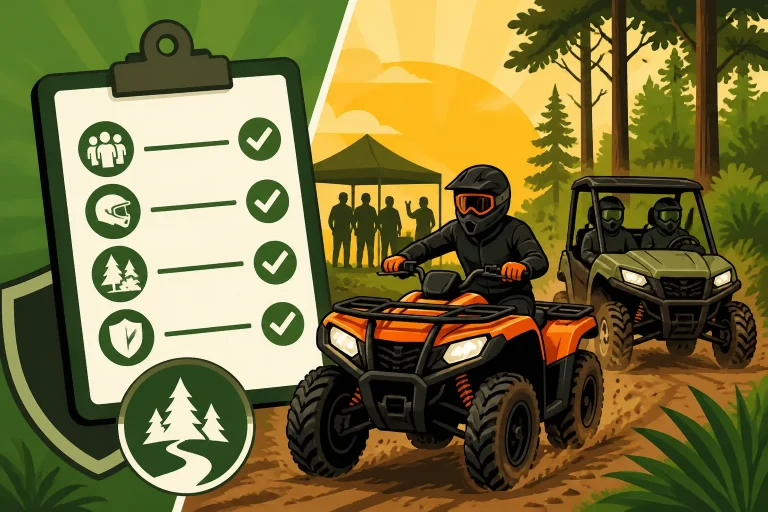
A practical preparation sequence is:
- Confirm the land unit. Make sure the route is in Big Cypress, not Everglades National Park or another nearby property.
- Check that motorized use is allowed. Find the current approved route information and look for closures or seasonal restrictions.
- Read the ORV permit requirements. Use the preserve’s official instructions to confirm application, vehicle, and documentation requirements.
- Complete any required steps before departure. If an inspection, registration, or other prerequisite applies, allow time to finish it before your planned ride.
- Carry the required proof. Bring whatever permit and supporting documents the current rules require, in the form the land manager accepts.
- Recheck conditions shortly before the trip. A route that was open when you planned the ride may later be restricted or closed.
The official program page is the place to verify current details, because permit procedures and access conditions can change. Avoid relying only on old forum posts, a friend’s previous trip, or a third-party listing. If an online seller or map suggests that a route is open, confirm it with the land manager.
It’s also worth separating the preserve’s ORV authorization from other paperwork. A vehicle title can help establish ownership, but a title is not an ORV permit. A forest OHV pass, campground booking, hunting license, or private-park waiver is not a substitute either. Florida Riding on Public Land: Permits and Proof covers the different kinds of documentation riders may need to keep straight.
If you’re bringing a vehicle from out of state, ask the preserve what it accepts before traveling. Do not count on another state’s registration or riding permit being recognized as a replacement for Big Cypress authorization. Florida OHV Permit Rules for Out-of-State Riders and Does Florida Honor an Out-of-State ATV Registration? are useful background, but the land manager’s current Big Cypress rules control access there.
Everglades National Park backcountry permits are different
In Everglades National Park, “backcountry permit” usually refers to an overnight stay in the park’s backcountry, not permission to ride an ATV or UTV. The park has its own camping and access rules. If your plan involves an overnight trip, check the park’s official information for whether a permit or reservation is required, which campsites are available, and what conditions apply.
That distinction is easy to miss when a trip combines activities. For example, a group might ride in Big Cypress and then plan a separate backcountry camping trip in Everglades National Park. Those are two separate activities under different rules. A Big Cypress ORV permit does not cover a National Park campsite, and a National Park camping permit does not authorize motorized riding.
Do not plan to ride a machine to a backcountry campsite unless the park explicitly identifies that access as permitted. In a protected area, being able to reach a location physically is not the same as being authorized to drive there. Check the park’s rules for the exact route and mode of travel, and contact the relevant park office if the wording is unclear.
For trips involving more than one property, build the plan around the stricter, location-specific rules:
- Identify each land unit on your itinerary.
- List the activity planned at each one, such as riding, camping, or hiking.
- Confirm the applicable permit or reservation for each activity.
- Check whether the planned connection between locations uses a public road, an approved route, or land where you lack access permission.
- Keep proof of each authorization separate and easy to find.
A printed copy can be helpful if you expect weak cell service. Keep it protected from water and mud; a simple waterproof document pouch, including one available through Amazon, can help keep paperwork readable. A phone screenshot is useful as a backup, but it should not replace any required original, decal, or other proof specified by the land manager.
A pre-trip checklist for permits and access
The safest approach is to treat permits, route access, and vehicle readiness as separate checks. Each answers a different question: Are you authorized to enter? Is the route open to your machine? Does your vehicle meet the applicable requirements?
Verify the route, not just the destination
A place name on a map may not tell you who manages the access road or whether motorized use is allowed. Check the official map or route information for the land unit you plan to visit. Pay attention to closures and restrictions, especially if you are relying on an older map or planning a route that crosses between properties.
If you plan to use private land, obtain permission from the owner or manager. A public-land permit does not grant access across a private parcel. Florida Ranch Lease Access for Riders explains why written permission can matter when a route crosses managed or leased land.
Match permits to machines and activities
Write down every machine in the group and the activity it will be used for. Then compare that list with the permit conditions. If the instructions are unclear about whether a permit is per rider, vehicle, or trip, ask the land manager before setting out rather than guessing at the gate.
Likewise, don’t treat a parking or camping reservation as vehicle authorization. A reservation may secure a space or campsite, while an ORV permit addresses machine use. One may not include the other.
Carry proof and have a backup plan
Bring the permit and any required supporting documents in the format specified by the issuing agency. Save digital copies where you can access them offline, and carry printed copies when practical. Check that names, vehicle details, and dates match the trip.
Have an alternate plan if the route is closed, your permit is not approved, or the machine does not meet a requirement. That could mean switching to a permitted riding area, rescheduling, or leaving the ATV at home and visiting the park for an activity allowed there. Do not try to work around a closure by taking an unapproved route.
Recheck before leaving
Conditions and rules can change. Before departure, revisit the official land manager’s permit and closure information and confirm any details that affect your itinerary. If you cannot establish that a specific route is open and your permit covers your planned use, pause and ask the agency. That short check is far less costly than arriving with the wrong authorization or losing access to a trip.
For a wider view of how permits differ among public riding areas, see Florida OHV Permit Rules for Out-of-State Riders and Florida Big Cypress ORV Permit Rules. If your plans shift to a national forest or state forest, check that land manager’s separate process rather than assuming the Big Cypress permit follows you.
Disclaimer
This article is for general informational purposes only and does not constitute professional advice. Laws, prices and regulations vary by location and change over time. Consult a qualified professional for guidance on your specific situation.