Florida Big Cypress ORV Permit Rules
Big Cypress National Preserve’s off-road vehicle permit is not a general pass to ride anywhere in the preserve. Riders need to understand which vehicles and routes it covers, how to get the current permit, and what a permit does not allow. The key is to check the National Park Service’s current requirements and access information before hauling a machine to the trail.
What the Big Cypress ORV permit allows
Big Cypress National Preserve has designated areas and routes for off-road vehicle use. An ORV permit is required to operate in those areas, but having one does not make every road, trail, or tract of preserve land open to riding. Riders must stay on routes that are open to their vehicle and follow posted closures and seasonal restrictions.
The permit is specific to the preserve’s ORV program. It is separate from a Florida state forest OHV pass, a national forest pass, and any landowner permission needed elsewhere. If you ride at more than one kind of public riding area, check each land manager’s rules rather than assuming one pass covers them all. Florida OHV Permits: What You Need Before You Ride explains why public riding areas can have separate permit systems.
| Item | What to keep in mind |
|---|---|
| Big Cypress ORV permit | Required for ORV use in the preserve’s designated areas; check current National Park Service instructions before riding |
| Route access | Limited to routes and areas open to your vehicle; closures and access conditions can change |
| Other Florida riding passes | Do not assume a state forest or national forest pass is valid in Big Cypress |
| Vehicle eligibility | Confirm that your machine meets the preserve’s current requirements before applying |
| Permit proof | Follow the current instructions for carrying or displaying permit documentation |
A permit also does not make an ATV or UTV street legal. It grants permission to use specified ORV routes under preserve rules, not permission to ride on ordinary roads or driveways. For more on how public-land riding permissions differ, see Florida Riding on Public Land: Permits and Proof.
Routes and conditions matter as much as the permit
Big Cypress is a large preserve, and its designated ORV routes pass through sensitive habitat. The route network is managed to control impacts, so a trail shown on an old map, mentioned in an online post, or visible on the ground may not be open for riding. Follow current official maps and signs rather than relying on an app’s depiction of roads and tracks.
Access may be limited by seasonal closures, resource protection, maintenance, weather, or other management decisions. A route that was open on a previous visit may not be open on your next one. Check for alerts shortly before departure, then confirm signs and barriers at the site. A permit is not a guarantee that a particular route will be available that day.
The same caution applies to informal shortcuts. A route that appears to connect two legal trails is not automatically an authorized route. Do not ride around a closure, through a gate, or beyond a posted boundary. If an area’s status is unclear, stop and check the preserve’s current information before continuing.
Getting the permit and checking your machine
The safest way to start is with the National Park Service’s current Big Cypress ORV information and the permit application instructions linked from there. The process can involve an online permit account, vehicle information, and required acknowledgments or training. Requirements and application steps may change, so use the current official instructions rather than relying on a saved checklist or an old forum post.
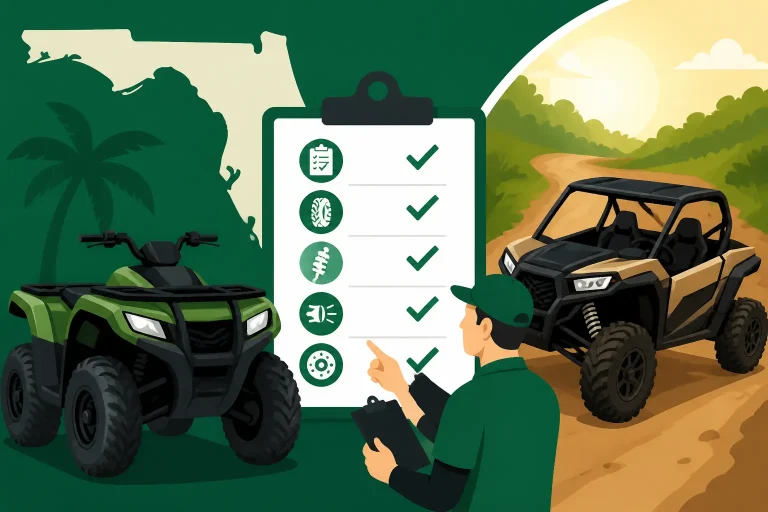
Before applying, gather accurate details for the machine you plan to take. The permit program may distinguish between vehicles, and you should not assume a permit issued for one machine can be moved to another. Check the current rules for vehicle identification, ownership or registration documents, and any required safety equipment. If you have questions about inspection requirements, Florida ORV Permit Inspection Requirements is useful background, but Big Cypress’s own rules take priority.
A practical application checklist:
- Identify the exact ATV, UTV, or other ORV you plan to use.
- Read the current Big Cypress permit instructions, including vehicle eligibility and any required training.
- Gather the vehicle details and documents requested by the application.
- Complete each required step and save the confirmation or permit documents.
- Follow the official directions for displaying a decal or carrying proof, if required.
- Check the current route map, closures, and access conditions before leaving.
Do not wait until you are at a trail entrance to find out that the application requires information you do not have, that your machine does not meet an eligibility rule, or that you have not completed a required step. Keep a digital copy of your permit confirmation, but also follow any directions about physical decals or paperwork. A screenshot alone may not meet a display requirement.
Check details that can depend on the vehicle
ATVs and UTVs do not necessarily have identical eligibility rules. The preserve may set limits or requirements based on vehicle type, dimensions, equipment, or other characteristics. Verify the current rules for your particular machine rather than applying a general assumption based on its model name or how another rider’s vehicle was handled.
If your machine has been modified, check whether those changes affect compliance. Added accessories, altered exhaust components, tires, racks, or other equipment can change dimensions or affect noise and safety requirements. Keep the machine in the configuration you intend to ride when checking its eligibility.
Do not treat a Florida title, registration, or bill of sale as a substitute for the preserve permit. Those documents can help establish ownership or identify the vehicle, but they do not independently authorize ORV use in Big Cypress. For general context on how riding permissions differ across public lands, see Florida Conservation Land Riding Permission.
Reciprocity, passes, and common misunderstandings
Big Cypress has its own ORV permit process. A permit or pass from another Florida riding area should not be treated as reciprocal unless the National Park Service explicitly says so. In particular, a Florida state forest OHV pass and a national forest OHV pass are tied to their respective programs; they do not automatically authorize riding in Big Cypress.
This distinction is easy to miss because riders may use the word “permit” for several different things. A pass might cover a vehicle in a particular forest, a day-use area, or a trail system, while a Big Cypress ORV permit governs access under the preserve’s program. The issuing agency, land boundaries, approved vehicles, and open routes can all differ. Florida National Forest OHV Pass Prices covers a separate pass system, not a substitute for Big Cypress authorization.
| Document or permission | What it generally addresses | Does it replace a Big Cypress ORV permit? |
|---|---|---|
| Big Cypress ORV permit | ORV use under the preserve’s designated program | It is the relevant permit for that program |
| Florida state forest OHV pass | Use at participating state forest OHV areas | No, unless the preserve expressly confirms otherwise |
| National forest OHV pass | Use under the applicable national forest program | No, unless the preserve expressly confirms otherwise |
| Vehicle title or ownership papers | Ownership or identification of the machine | No |
| Private landowner permission | Access to the specific private property covered | No; it does not authorize riding in the preserve |
A permit from a different land manager may still be useful for another part of a trip, but it does not expand your Big Cypress route access. If you plan to ride more than one area, make a separate checklist for each destination. Confirm whether each permit is required, which machine it covers, and where it is valid.
A second frequent misunderstanding is assuming that a permit is permission to ride anywhere within the preserve. It is not. Designated routes, closed areas, and posted restrictions still apply. Another mistake is assuming that an old permit or saved map remains valid for a later visit. Confirm current instructions and closures each time.
If you are unsure whether a trail, vehicle, or document qualifies, contact the preserve using its current official contact information before riding. Do not rely on a seller, social media post, or an unrelated pass issuer to interpret Big Cypress rules for you.
Before you ride: a practical compliance check
A little preparation helps prevent a long drive followed by a denied entry or an avoidable violation. Complete this check close to your trip, since route access and operating conditions can change.
Before leaving home
- Confirm that your Big Cypress ORV permit is current and applies to the vehicle you plan to ride.
- Review the official permit requirements, including any training, equipment, vehicle, or document rules.
- Check the current official route map and identify routes that are open to your machine.
- Look for closures, alerts, and access notices.
- Confirm how the permit must be displayed and what proof you need to carry.
- Make sure any other pass you need is valid for the separate riding area where you plan to use it.
At the preserve
Follow signs and barriers even if an online map shows a route continuing. Stay on authorized routes, respect closures, and do not assume that a route is open because another vehicle has used it. If staff ask to see permit or vehicle documentation, present the materials required by the program.
Keep your group together and make sure every rider understands the planned route and boundaries. If a route is blocked or conditions make it unsuitable, turn back rather than improvising a detour. A detour can lead into closed habitat, private property, or an area where ORV use is not allowed.
For riders planning a broader Florida trip, it can help to separate the permit question from the route question: first confirm you are authorized to use the preserve’s ORV program, then confirm the specific route is open. Florida Everglades Backcountry Permits may help clarify that other backcountry activities in the region can have their own authorization requirements; do not treat those permissions as interchangeable with the Big Cypress ORV permit.
The basic rule is straightforward: get the preserve’s current ORV permit, use only routes open to your vehicle, and do not count on another agency’s pass to cover Big Cypress. When any requirement is unclear, verify it through the National Park Service before the trip rather than guessing at the trailhead.
Disclaimer
This article is for general informational purposes only and does not constitute professional advice. Laws, prices and regulations vary by location and change over time. Consult a qualified professional for guidance on your specific situation.