Florida National Forest Under-16 Course Requirement
Florida’s under-16 course requirement can be easy to confuse with a forest pass, a title, or permission to use a trail. If your child will operate an ATV or UTV on a National Forest riding area, sort out the course before you travel. This guide explains who needs it, what proof to carry, how supervision fits in, and what the course does not authorize.
Who needs the course on a Florida National Forest
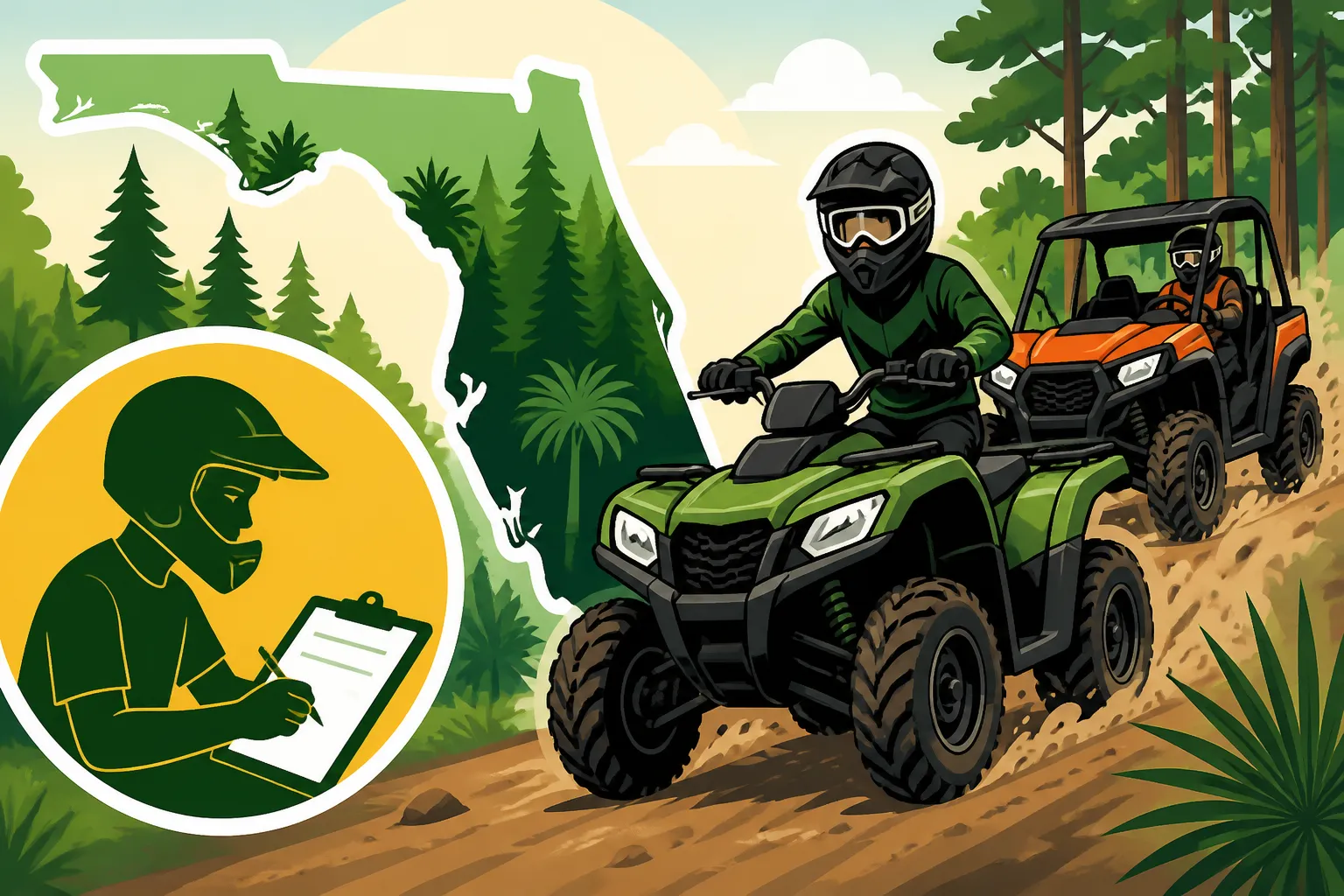
In Florida, an operator under 16 must complete an approved ATV safety course before operating an off-highway vehicle on public land where the requirement applies. National Forest land is public land, but that does not mean every road or trail in a forest is open to riding. The requirement is especially relevant when you are heading to a designated OHV area or route.
The key word is operator. A child who drives the machine needs to meet the course requirement. Simply riding as a passenger is different, though passenger rules still apply and vary by machine, route and riding area. Don’t treat a child’s course certificate as permission to carry a passenger or as proof that the vehicle is suitable for two riders.
The age cutoff is under 16. A rider who has not yet turned 16 should plan to complete the approved course before operating on applicable public land. A parent’s experience, a dealership’s informal orientation or a child’s prior time on private property does not necessarily satisfy the formal requirement.
For clarity, the course requirement is not the same thing as:
- A National Forest OHV pass or permit
- A vehicle title or ownership document
- A driver’s license
- Permission to ride a particular trail
- A helmet or eye-protection requirement
- An adult supervision requirement
These requirements can apply at the same time. A 15-year-old may have completed the course and still need an adult’s supervision, required protective gear, the correct pass for the riding area and a machine that is permitted on the route.
For a general overview of the age-related course rule, see Florida ATV Safety Course Requirements for Riders Under 16. If you are unsure whether a particular trail or riding area is open to your machine, check the forest’s current riding information rather than assuming that course completion makes the route available.
ATV, UTV and off-highway vehicle wording
Riding-area instructions may use terms such as ATV, OHV, ROV or UTV. Those labels can matter because a forest’s rules may distinguish between machine types, sizes and routes. Don’t assume a course intended for one type of machine automatically satisfies every requirement for another. Check the course description and the riding area’s rules for the vehicle your child will operate.
This is particularly important for side-by-sides. A UTV may be classified or treated differently from a small ATV for route access, dimensions and other site rules. Completing a safety course does not make a wide or heavy machine eligible for a trail that excludes it.
If you are still working out how a particular machine is categorized, Florida OHV Permit Rules for Out-of-State Riders is useful for visitors, while Florida Two-Rider ATV Titling Rules covers one separate ownership and classification issue. Neither title rules nor course completion replaces checking the forest’s route restrictions.
Public land is not the same as every forest road
A National Forest can include designated OHV trails, roads open to certain vehicles, closed routes and areas where motorized riding is not allowed. The boundary of the forest is not a blanket riding invitation. Follow the posted signs and current route map, and stay on routes open to your vehicle type.
If your family plans to ride at a named OHV area, check that location’s own requirements as well as the broader forest guidance. The course may satisfy one safety obligation, while the area may impose separate conditions on passes, helmets, vehicle dimensions, operating hours or rider conduct.
What the course is and how to choose one
The course is a safety education requirement, not merely a short talk before a ride. It is intended to prepare young operators to make safer decisions and handle an off-highway vehicle responsibly. Depending on the course format, instruction may cover controls, protective equipment, riding conditions, basic operation and ways to reduce common risks.
The important practical point is to choose a course that is accepted for the Florida public-land requirement. A course advertised online as “ATV safety” may be useful, but the name alone does not prove it meets the applicable rule. Before enrolling, verify that the course is recognized for the rider’s situation and that it provides documentation the rider can show.
Use this sequence:
- Confirm the rider’s age and role. Is the child going to operate the machine, or ride as a passenger? If the child will operate it on public land, plan on meeting the under-16 course requirement.
- Check the current Florida requirement. Review the official information from the responsible Florida agency and the riding area. If the wording is unclear, ask the forest office or the agency administering the course before paying or scheduling.
- Confirm the course is accepted. Check the provider, course name, age eligibility and whether successful completion produces a certificate or other proof.
- Complete the course before the trip. Don’t leave this to the morning you plan to ride. A course may require time to finish, and a certificate may need to be retrieved or printed.
- Save the proof in more than one form. Keep a paper copy with the trip documents and a digital copy on a phone, if available. A screenshot can be a backup, but confirm that it displays the rider’s identifying information and completion details clearly.
- Check the riding site again before departure. Verify that the route is open, the machine is allowed, the required pass is in hand and the young rider has the required gear and supervision.
If you are comparing remote and classroom instruction, don’t choose solely on convenience. A course completed online may be a practical fit for a family that needs to satisfy an education requirement before a trip. In-person instruction may be more helpful for a new rider who needs a structured chance to ask questions. The accepted format is the one that matters legally, so confirm that before enrolling. Florida Online Safety Course vs In-Person explains the trade-offs to consider.
A certificate should be treated as a record of course completion, not as a general permit. It does not certify that the rider is skilled enough for every trail or condition. A beginner who has completed a course may still need practice in a controlled, permitted setting before tackling deep sand, steep grades, mud or water crossings.
When buying helmets, goggles or other protective gear, focus on fit and required safety standards rather than a product’s photos or marketing language. A listing on Amazon, for example, is not proof that a helmet meets the standard required for a particular ride. Check the product labeling and the riding area’s rules, and make sure the gear fits the child properly before heading out.
What proof to carry and what it does not replace
Carry the course certificate or other accepted proof with the rider’s trip documents. Don’t assume that a parent’s phone has the only copy, or that an officer or ranger can look up a certificate on the spot. A paper copy is a useful backup if the phone loses power or has no signal.
Keep the document legible and make sure it identifies the young rider. If the family has more than one child, don’t assume one child’s certificate covers the others. Course completion is individual. Save each rider’s proof under that rider’s name, and check the certificate for any detail that needs to match the identification the family will carry.
A practical document folder for a family ride might include:
- Each under-16 operator’s course certificate or accepted proof
- The required OHV pass for the riding area
- Vehicle ownership or other proof of authorization to use the machine
- Any site-specific permit or reservation information
- Emergency contacts and relevant medical information
- A current map or route information for the riding area
Course proof should be available even when the rider is not the person carrying the main family paperwork. If the child rides with another adult, send the adult a copy and make sure they know where the original is. For more on carrying the document while riding, see Carrying a Safety Certificate on the Trail.
The course is not the forest pass
A course certificate shows that the rider completed safety education. A forest pass or OHV permit covers a separate access requirement. One cannot stand in for the other.
Pass rules can depend on the forest, riding area, duration of the visit and machine. Families should verify which pass applies to their destination and whether each vehicle needs its own. For an overview of pass options and how to check them, see Florida National Forest OHV Pass: 3-Day, 7-Day or Annual.
A common mistake is to bring a certificate and assume all other paperwork is settled. Before leaving, ask:
- Is this the correct pass for the specific riding area?
- Does the pass apply to the machine we are bringing?
- Is the machine allowed on the intended route?
- Does the rider need to carry proof of course completion?
- Are there current closures or access limits?
Do not rely on an old screenshot of a route map or pass page if the information could have changed. Check the current official instructions for the forest and the riding area.
The course is not a title, registration or driver’s license
An off-highway course does not establish who owns the vehicle, create a title, or authorize riding on public roads. Vehicle paperwork and road-use rules are separate subjects. For example, a title is not a road permit, and course completion does not make an ATV street legal.
If you are sorting out the machine’s ownership documents, Florida ATV Title vs Registration: The Difference explains why those records are not the same. If the family is also asking whether an ATV can be ridden on a road to reach a trail, check Florida ATV Road Rules: Where You Can Legally Ride. Trail access and public-road access should never be treated as interchangeable.
Adult supervision and protective gear still matter
Course completion does not mean a young rider can go out alone. An under-16 operator may be subject to adult supervision requirements as well as the course rule. The supervising adult should be able to monitor the child’s riding, respond if something goes wrong and help enforce safe decisions.
Do not assume that being somewhere in the same forest is enough. Before the ride, establish who is supervising, where that adult will be, how the group will stay together, and what happens if a rider becomes separated. Follow the applicable law and the specific riding area’s requirements. Florida Adult Supervision Rules on Public Land discusses how supervision fits into public-land riding.
A practical supervision plan should account for the young rider’s experience and the terrain, not just the minimum legal requirement. Keep beginners within a controlled pace and on routes suited to their skill. An adult who is busy riding ahead, guiding another group or trying to manage several machines may not be able to supervise effectively.
Protective equipment is another separate part of the plan. Check the current rules for helmets and eye protection, and make sure each item fits the rider. A helmet that shifts, a loose chin strap or goggles that fog badly can make a ride less safe even if the equipment technically appears to be present.
If you are shopping on Amazon for children’s protective gear, verify the actual safety markings and sizing information rather than relying on a product title. Try equipment on before the trip when possible. A child may outgrow a helmet between rides, and a previously acceptable fit is not a guarantee it still fits correctly.
Before starting the engine, do a short check with the child:
- Can they explain the controls and how to stop the machine?
- Do they know to stay on the permitted route?
- Can they recognize when the trail is beyond their ability?
- Do they know how to signal the adult and stop safely?
- Are their helmet, eye protection, footwear and clothing secure?
- Do they understand not to follow another rider onto a closed or unsuitable route?
These questions do not replace training. They help a parent notice whether the rider is ready for the conditions planned that day.
Visitors, course reciprocity and common mistakes
Families visiting Florida sometimes have a safety certificate from another state, a club, a private park or a dealership. Do not assume that any of these documents automatically meets Florida’s public-land requirement. Course recognition can depend on the provider and the rules in effect for the riding area.
Before traveling, contact the relevant Florida agency or the National Forest office and ask a specific question: “Will this named course and certificate satisfy the requirement for an under-16 operator at this riding area?” Have the course provider and certificate details available. If you cannot confirm acceptance, completing a course that the Florida authority recognizes may be the safer way to avoid a problem at the trailhead. Florida Rules for a Visiting Rider From Georgia is a useful starting point for out-of-state families, but confirm the details for your own home state and destination.
Families commonly run into these mistakes:
- Waiting until arrival to check the course rule. That can leave a child unable to ride or force a change of plans.
- Assuming a club orientation is the required course. Helpful training is not necessarily an accepted course.
- Treating a parent’s certificate as the child’s proof. Course completion is tied to the individual rider.
- Keeping the only copy on a phone. Batteries, reception and access to accounts can all fail.
- Assuming the course allows riding anywhere in the forest. Routes may be closed or limited by machine type.
- Mixing up a course with a pass. Both may be required, and they serve different purposes.
- Assuming a passenger needs the same course as an operator. The operator rule and passenger rules are separate; check the site’s requirements for the child’s role.
- Assuming a certificate guarantees readiness. Training helps, but it does not replace adult judgment, appropriate practice or choosing a suitable trail.
A final check before the trip can prevent most avoidable problems. Confirm the course and certificate, verify the pass, inspect the machine, check the route and closure information, and agree on a supervision plan. If any answer is uncertain, call the forest or riding-area contact before loading the trailer. A quick confirmation is much easier than discovering at the entrance that a child’s paperwork or machine does not meet the site’s rules.
Disclaimer
This article is for general informational purposes only and does not constitute professional advice. Laws, prices and regulations vary by location and change over time. Consult a qualified professional for guidance on your specific situation.