Florida ATV Trails Open Year-Round
Florida has riding areas that welcome ATV and UTV riders in every season, but “open year-round” does not mean every trail is open every day. Rain, fire danger, hunting activity, maintenance, and land-specific rules can change access with little warning. This guide explains where to look, how to check conditions, and what to confirm before towing your machine to a trailhead.
What year-round access really means in Florida
An open riding area is not an always-open trail
When a Florida riding area is described as open year-round, it generally means the site operates across the calendar rather than closing for a long off-season. It does not guarantee that every trail, parking area, or campground will be available whenever you arrive. A forest can remain open while a particular route is temporarily closed for repairs, wet conditions, wildlife management, or another land-use activity.
This distinction matters most when you have planned a full weekend around a specific loop. A trail may be closed even though the main recreation area is still open, or access might be limited to certain types of vehicles. Before leaving, check the land manager’s latest alerts and the specific riding-area rules—not just an old map, a social media post, or a general search result.
Florida also has several different kinds of riding destinations. A designated OHV trail system, an off-road park, and a network of forest roads are not interchangeable. Each may have its own rules for approved machines, permits, hours, camping, and where riders can travel. If you are new to this distinction, [Florida ATV Trails: Every Public Riding Area] provides a useful starting point for understanding the range of places available.
Seasonal conditions can change access without closing a whole site
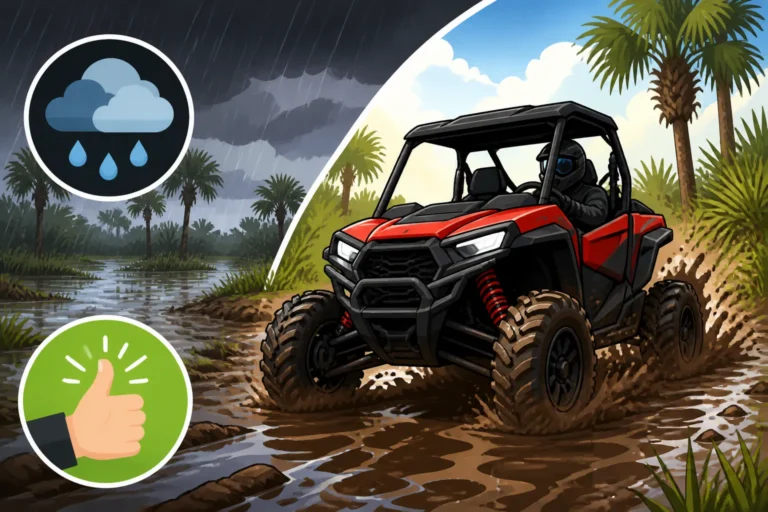
Florida’s long riding season brings its own complications. Heavy rain can leave sandy routes soft, flood low crossings, or make some sections unsuitable for vehicles. During dry spells, land managers may restrict access because of wildfire risk or other safety concerns. After a storm or hurricane, a route can be blocked by fallen trees or damaged infrastructure even when nearby roads are passable.
Hunting seasons and forestry work can also affect where and when you can ride. A riding area may stay open while certain routes are closed or access is redirected. This is especially important for riders who assume that an open gate means every route is available. Look for posted notices at the entrance, obey temporary barriers, and do not treat a closure sign as optional because another rider has gone around it.
A good planning habit is to check conditions twice: once when you are choosing the destination and again shortly before departure. Ask whether the riding area is open, whether your vehicle type is permitted, and whether the route you want to ride is currently available. [Florida Trail Closures You Should Check First] is a helpful companion when you are trying to avoid a wasted drive.
Florida riding areas to consider in different seasons
Croom and Withlacoochee State Forest
Croom Motorcycle Area in Withlacoochee State Forest is a well-known destination in the Brooksville area. Its sandy terrain and established OHV setting make it appealing to riders looking for a dedicated place to spend a day on the machine. Because it is a managed area, though, riders should check its current access conditions, operating information, vehicle restrictions, and pass requirements before loading up.
Do not assume that a trail suitable for one ATV will suit every UTV. Width limits and vehicle-type rules can affect whether a machine is allowed in a particular area. If you ride a side-by-side, confirm its dimensions and the site’s current requirements rather than relying on a general description of Croom. The related guides [Croom's 55-Inch Width Check at the Gate] and [Why Croom Turns Away Side-by-Sides] can help you understand why checking fit and access rules matters.
Croom can be a practical choice for riders in Central Florida, but a visit still benefits from a little preparation. Check whether the area is accepting riders on your planned day, what pass or permit applies, and whether facilities or campgrounds are available. For a broader look at the site, see [Croom Motorcycle Area: Florida's Biggest OHV Park].
Ocala National Forest and other forest riding areas
Ocala National Forest offers designated OHV riding opportunities, including the Ocala Centennial Trail system. Riders should distinguish designated OHV trails from ordinary forest roads: being able to see a road on a map does not mean it is open to OHV riding. Follow route markings and forest rules, and confirm current conditions before setting out. Some routes may be closed or restricted even when other parts of the forest remain accessible.
The forest’s sandy conditions can be enjoyable, but they can also make a ride tiring, especially for newer riders or anyone on a machine with unsuitable tires. Carry water, plan fuel stops around your route, and be realistic about how much ground your group can cover. Cell service can be inconsistent in remote areas, so let someone know where you plan to ride and when you expect to return.
Other public riding options include Clear Creek OHV Area in Blackwater River State Forest and designated opportunities in Tate’s Hell State Forest. These destinations are far apart, and their terrain, access arrangements, and local restrictions differ. Do not assume that the rules at one forest apply at another. The guides [Ocala National Forest ATV Trails in Florida], [Clear Creek OHV Area at Blackwater River State Forest], and [Tate's Hell OHV Trail System in Florida] are useful starting points for comparing them.
| Riding destination | What to check before you go | Planning note |
|---|---|---|
| Croom Motorcycle Area | Current access, vehicle width and type rules, passes, and any trail closures | A dedicated OHV area near Brooksville; confirm that your machine is allowed |
| Ocala National Forest | Designated OHV routes, forest alerts, required passes, and weather conditions | Do not assume every forest road is an OHV trail |
| Clear Creek OHV Area | Current site status, route availability, passes, and permitted vehicle types | Check the rules for this specific state forest area |
| Tate’s Hell State Forest | Current access notices, route restrictions, conditions, and permits | Plan for remote riding and verify the routes you intend to use |
How to check whether a trail is open before you travel
Start with the land manager, not an old map
The most dependable first check is the official land manager responsible for the riding area. For a national forest, look for the forest’s recreation information and alerts. For a state forest, check the Florida Forest Service information for that specific forest and OHV area. For a private park, check directly with the park because operating days, events, and closures can vary.
A map can help you understand where an area is and how routes connect, but it may not show a closure that began recently. Apps such as onX Offroad can help with route planning and orientation, but treat any mapping tool as a planning aid—not as permission to ride. Confirm that the land is open to your vehicle and that the route is designated or otherwise allowed before following it.
Before you leave, verify a few practical details: whether the gate is open on your planned day, whether your ATV or UTV is permitted, whether passes or permits are required, and whether camping or day-use access is available. If the information online is unclear, contact the site or land manager. A quick call can save hours of driving and prevent an awkward arrival with a machine that does not meet the site’s rules.
Check the whole trip, not only the trail
Your route to the riding area matters too. A closure, construction detour, or inaccessible entrance can change your travel plan even if the trails themselves are open. Look at the access roads, parking arrangements, and any instructions for trailers. If you are towing a wide UTV or several machines, make sure the staging area can accommodate your group.
It is also worth checking weather and ground conditions close to departure. A route that looked manageable on a dry afternoon may be difficult after sustained rain. Conversely, a period of dry weather can bring fire restrictions or other land-management measures. Do not rely on a forecast alone to decide whether a trail is open; use it to guide your preparation, then check the official site status.
onX Offroad can be useful for organizing a planned route and keeping track of your location, particularly when a group is unfamiliar with the area. Still, use official signs and current land-manager guidance to resolve questions about access. If a map, app, trail marker, and posted closure do not agree, do not ride past the closure while trying to sort it out. Stop, check with the responsible authority, and choose an authorized route.
Permits, vehicle rules, and responsible riding
Confirm permits and machine eligibility
Public-land riding may require a pass or permit in addition to the machine meeting the area’s vehicle rules. Requirements depend on the land manager and destination, so a pass for one site should not be assumed to cover another. Some systems may also have separate rules for day use, annual access, or individual vehicles. Check what applies to your specific trip before arriving at the gate.
Vehicle eligibility can be just as important as permits. A narrow ATV and a wider side-by-side may be treated differently, and some trail systems limit access by machine type or dimensions. Check your owner’s manual or measure your machine if the site sets a width limit. If your UTV has accessories that add width, include those in your assessment rather than measuring only the original bodywork.
Riders under 16 may face additional safety-course or supervision requirements on public land. Those rules can vary by land manager and riding context, so confirm the requirements for the destination and age group in your party. [Florida OHV Permit Rules for Out-of-State Riders] and [Florida ATV Safety Course Requirements for Riders Under 16] offer more detail on issues that can affect visitors and families.
Ride only routes open to your vehicle and ability
Once you arrive, follow the marked routes for your vehicle type and respect barriers, closure signs, and posted instructions. A track visible beyond a trail marker does not automatically mean it is open to the public. Shortcuts can damage sensitive land, create conflicts with other users, or put riders in areas where they are not permitted to operate.
Match the route to the least experienced rider in your group. Florida sand, ruts, standing water, and changing trail conditions can be more challenging than they look from a parking area. Build in breaks, carry drinking water, and agree on a simple regrouping plan before the group spreads out. For a family ride, make sure children understand that they should stay with the group and stop at designated meeting points if separated.
A navigation app can assist with orientation, but it should not be used to justify riding off a marked route. onX Offroad may help riders review mapped tracks before a trip, yet maps can’t replace current signs or site-specific instructions. Keep your device charged, consider carrying an offline map where available, and tell someone outside the group where you are going. For more preparation advice, see [Florida OHV Trail Etiquette Locals Expect] and [What to Carry Into a Florida State Forest].
Choosing a year-round riding plan that works
Pick the destination based on the group, not just the calendar
A year-round destination is most useful when it fits the people and machines in your group. A first-time rider may prefer an established riding area with clear route markings and a manageable loop. A family with different machine sizes should prioritize vehicle eligibility and simple regrouping points. Experienced riders may be more interested in varied terrain, but should still check closures and weather before committing to a long route.
Distance is another practical consideration. If you are coming from Tampa, Brooksville-area Croom may be a more convenient option than a Panhandle destination. Riders based near Gainesville or Ocala may find the Ocala National Forest more practical, while riders in northwest Florida might investigate Clear Creek or Tate’s Hell. A closer option can make it easier to change plans if weather turns or a site is temporarily restricted.
Also consider whether your group wants a day ride, overnight camping, or a full weekend. Do not assume the riding pass includes camping or that a campground guarantees trail access. Confirm both separately. If you are comparing places, [Florida ATV Camping With Trail Access] and [Florida National Forest OHV Riding vs State Forest Riding] can help you think through the trade-offs.
Use a simple pre-ride checklist
A short checklist is more reliable than trying to remember every detail on the morning of departure. Confirm the riding area’s status and the routes you plan to use. Check permit requirements, operating information, machine restrictions, and weather. Make sure your trailer, tie-downs, fuel plan, helmets, and basic recovery gear are ready before you leave home.
For a group, decide who is leading and who is sweeping from the rear. Share the destination and planned return time with someone who is not riding. Carry identification and any required permits or safety certificates, and keep a charged phone or navigation device available. If the area has limited cell coverage, do not count on being able to look up directions or call for help everywhere on the trail.
Finally, be willing to change the plan. If rain has made a route unsafe, a gate notice closes your intended trail, or a machine is not eligible for the area, choose another authorized option rather than forcing the trip. The most reliable way to enjoy Florida ATV trails throughout the year is to stay flexible: identify a primary destination, have a backup, and verify the status of both before you tow.
Disclaimer
This article is for general informational purposes only and does not constitute professional advice. Laws, prices and regulations vary by location and change over time. Consult a qualified professional for guidance on your specific situation.