Florida Deer Season Trail Closures
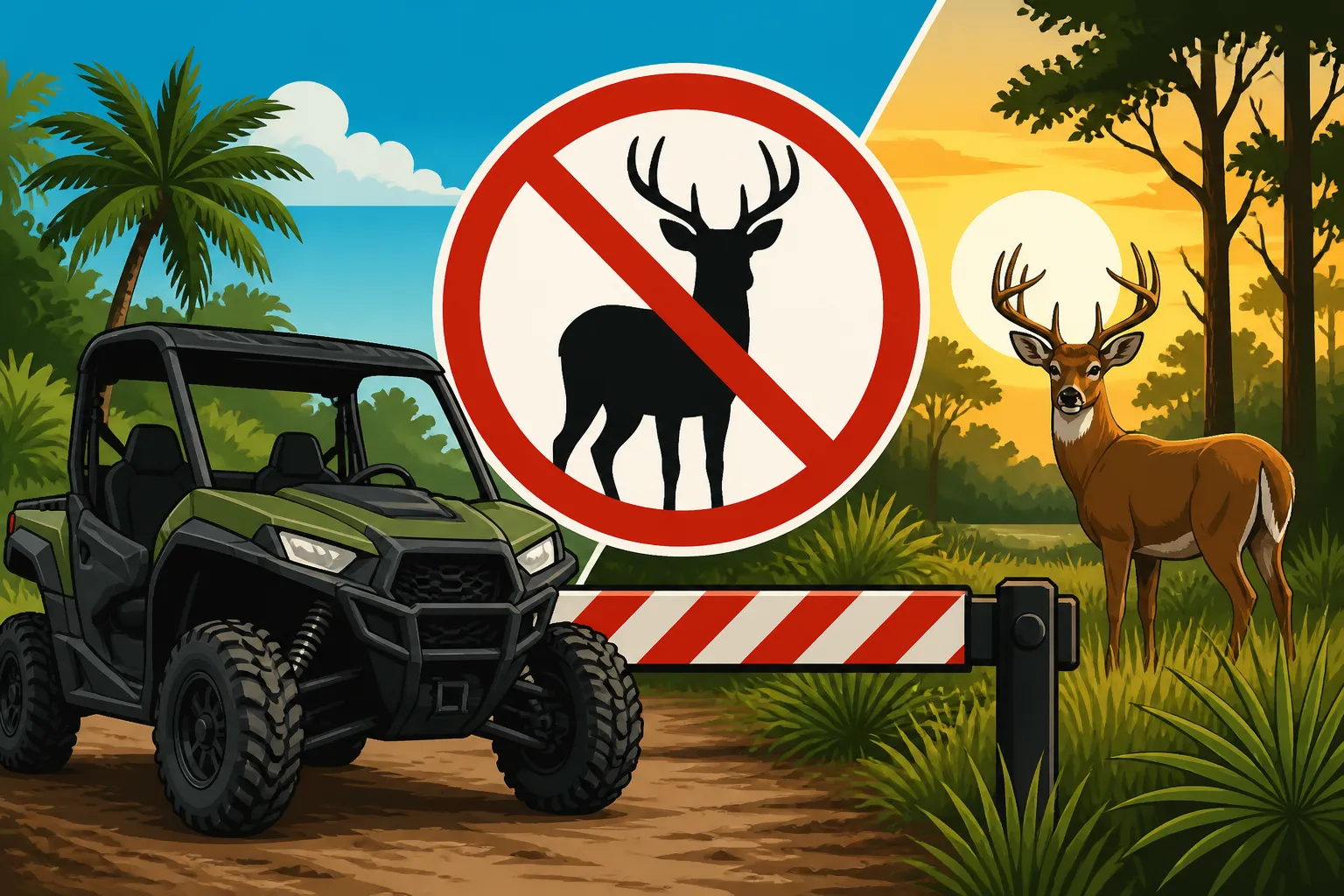
Florida deer season can affect more than the hunters heading into the woods: an ATV trail may close, become hunting access only, or stay open under different rules. The challenge is that dates and restrictions vary by property and land manager. Check the specific area before you load up, and treat a riding permit as permission to ride only where and when riding is allowed.
Why deer season can change ATV access
Florida does not have one statewide closure calendar that applies to every ATV and UTV riding area. Public land is managed in different ways, and a closure at one property does not mean nearby trails are closed—or that they are open. A trail may be unavailable for a scheduled hunt, temporarily closed for safety or land management, or open only on designated routes.
The key distinction is between hunting access and recreational OHV riding. A road that hunters may use to reach a permitted hunting area is not automatically open to recreational riding. Likewise, having a hunting license, management-area permit, or OHV pass does not grant permission to ride on a closed road or outside a designated riding area.
This matters most on land where several uses overlap. A forest can contain marked OHV trails, public roads, wildlife management areas, hunting access roads, and places where motorized travel is prohibited. Each may have a different set of rules. A trail map from an earlier visit may not reflect a current seasonal closure.
For a broader overview of the kinds of notices to look for, see Florida Trail Closures You Should Check First. If your trip involves a wildlife management area, review Florida WMA Rules for ATV Riders as well. Those rules are not interchangeable with the requirements for a designated OHV trail.
What a seasonal closure can mean
A deer-season notice might close a trail or road completely, restrict riding to certain routes, or limit access during particular hunt dates. Some properties keep recreation trails open but warn riders that hunting is underway nearby. Others may close a recreation area for a scheduled hunt or another management activity. The notice should state which property, route, or use is affected; read the details rather than assuming the entire forest has the same status.
Closures can also change during a season. A property may have multiple hunt periods, and access rules may differ between them. A trail that was open during one visit could be closed for your next trip. Weather, fire risk, timber work, habitat management, or trail conditions can create additional closures unrelated to deer season.
Do not rely on a general statement such as “the forest is open” or “the hunting season starts this month.” Confirm whether the specific route you plan to ride is open to recreational vehicles on the day of your visit.
Why hunters and riders can be on the same property
A public property may allow hunting and OHV riding in different parts of the same landscape, or at different times. That overlap does not mean the activities share every road or trail. Hunting access may be governed by wildlife-management rules, while riding is governed by the land manager’s OHV rules and designated trail system.
The safest assumption is simple: a road shown on a map is not necessarily a legal riding route, and a route open to hunters is not necessarily open to ATVs or UTVs. Follow posted signs and current official notices even if another map, an older social media post, or a familiar route suggests otherwise.
How to check whether your route is open
Start with the agency or land manager responsible for the riding area. Check its current alerts, recreation page, trail map, or office contact information. Then confirm whether the notice covers the trailhead, route, and dates you intend to use. If information is unclear or seems out of date, call the managing office before setting out.
Use this process before each trip:
- Identify the exact property and riding area. “Near Ocala” or “in the Panhandle” is not specific enough. Find the name of the forest, park, OHV area, or management area, along with the trailhead you plan to use.
- Look for current closure and hunt notices. Check for deer-season schedules, temporary closures, route restrictions, and notices about public access. Read the full notice, including any maps or dates.
- Confirm that recreational riding is allowed. A property may be open to the public while motorized access is limited. Verify that ATVs or UTVs are permitted on the route, not merely that the property itself is open.
- Check permit requirements separately. An OHV pass may be required for a designated riding area, while a management-area visit may have other conditions. A pass does not cancel a closure or authorize riding off trail.
- Recheck close to departure. Notices can change after you plan the trip. Check again before loading your machine, especially if you are traveling a long distance.
- Follow signs at the entrance and along the route. If on-site signs conflict with an old map or saved directions, do not ride through a posted closure. Contact the land manager for clarification.
A useful starting point is Florida Hunting Season Access on Public Land, but do not treat a general hunting overview as a current trail-status report. For riding requirements, see Florida OHV Permits: What You Need Before You Ride and confirm the rules for the particular property.
| What you need to confirm | Why it matters | Where to verify |
|---|---|---|
| Trail or road status | A property may be open while a particular route is closed | Current notice from the land manager |
| Whether motorized recreation is allowed | Hunting access and public access do not automatically permit ATV riding | Property rules and posted signs |
| Hunt dates and affected areas | Restrictions can apply only to certain dates, zones, or routes | Current hunting or management-area schedule |
| OHV permit or pass | The riding area may require a separate pass | Official OHV or recreation information |
| Vehicle eligibility and route limits | Width, machine type, or designated-route rules may apply | Trail-area rules and signs |
| Recent changes | Weather, fire, work, or wildlife management may affect access | Alerts and a direct call to the property office |
For designated forest riding, the rules can differ between national forest and state forest areas. Read Florida National Forest OHV Pass: 3-Day, 7-Day or Annual or Florida State Forest OHV Areas Explained according to where you plan to ride. Neither a forest pass nor a hunting permit should be treated as a substitute for checking seasonal closures.
Permits, hunting rules, and riding are separate questions
Deer season can make it tempting to focus only on hunting dates. Riders should instead check three separate things: whether the property is open, whether the specific route is open to recreational riding, and whether the rider has the required permit or pass.
An OHV pass does not override a closure
A permit generally supports access under the rules for the area where it applies. It does not create access to a closed trail, allow travel beyond designated routes, or guarantee that every part of a property is available. This is true whether the closure is for a scheduled hunt, safety, trail conditions, fire management, or another reason.
Before buying a pass for a trip, confirm that the target riding area is expected to be open. If you already have a pass, check the terms and current notices anyway. A valid pass is not a reason to disregard a closure sign.
A hunting credential does not automatically authorize riding
A person may be allowed to hunt on a property but still be prohibited from riding an ATV on a particular road or trail. Hunting access can come with its own vehicle and route restrictions. Do not assume that a hunting permit, license, or permission to enter an area includes permission to ride for recreation.
If you are riding with someone who is hunting, each person should understand the rules that apply to their activity. Confirm whether the vehicle is being used for permitted hunting access or recreational trail riding, and use only routes authorized for that purpose.
Out-of-state visitors should check both access and permit rules
A visitor coming from another state should not assume that an out-of-state registration, permit, or hunting credential is accepted for every Florida property. Requirements can differ by land manager and by activity. Confirm what the riding area accepts, whether a separate Florida OHV pass is needed, and what documentation riders must carry.
The details are covered in Florida OHV Permit Rules for Out-of-State Riders and Does Florida Honor an Out-of-State ATV Registration?. The important practical point is that reciprocity, where applicable, does not make a closed trail open or remove local access restrictions.
Public-land riding may involve other paperwork
A pass is only one part of trip preparation. Some riders also need to confirm machine eligibility, ownership documentation, or safety requirements. For a checklist of what may be useful at a riding area, see What to Carry Into a Florida State Forest and Florida Riding on Public Land: Permits and Proof. Requirements can vary, so use the current rules for the property rather than assuming one checklist covers every site.
Plan a safer deer-season ride
Even where a route remains open, riding during hunting season calls for extra care. Hunters may be using nearby access roads, and visibility can be limited by vegetation, bends, or low light. A quiet trail can still have people on foot nearby. Stay on the authorized route, keep to the posted speed and operating rules, and be prepared to stop when visibility is poor or people are present.
Before leaving home, save the official closure information and trail map on your phone. Cell service may be unreliable at a trailhead or deep in a forest. A printed map or a saved offline copy can help you avoid relying on live directions. A waterproof document sleeve from a retailer such as Amazon can help protect printed information from rain and mud, but it is no substitute for checking that the information is current.
A practical trip plan should include:
- The property name, designated riding area, and intended trailhead.
- The official closure notice and the date you checked it.
- The route you are allowed to ride and any closed connectors.
- The required pass or permit, including any machine-specific conditions.
- A backup riding location in case the route closes.
- A way to contact the land manager if signs or maps are unclear.
If you arrive and find a closure, do not try to route around it through an unmarked road, gate, or neighboring parcel. A detour may cross private land, a wildlife management area with different restrictions, or a route closed for a safety reason. Choose a confirmed open area instead. Florida Trail Closures You Should Check First offers more context on handling changing access conditions.
Before departure, check again for fire, weather, and maintenance notices as well as hunting closures. A recent heavy rain can make a route unsuitable even when it is not formally closed; see Florida ATV Trail Conditions After Heavy Rain for related trip-planning considerations. If the status remains unclear, the prudent choice is to contact the manager or pick a different riding area.
Deer season does not automatically close every Florida ATV trail, but it does make assumptions risky. Verify access at the property level, distinguish hunting access from recreational riding, and keep permits and closure notices separate in your planning. That small check can save a wasted drive and help keep both riders and hunters on the routes intended for them.
Disclaimer
This article is for general informational purposes only and does not constitute professional advice. Laws, prices and regulations vary by location and change over time. Consult a qualified professional for guidance on your specific situation.