Florida OHV Trail Etiquette Locals Expect
A ride can go sour before the machines even hit the trail: a blocked gate, a cloud of dust through someone’s group, or a shortcut across a closed muddy section can frustrate locals and damage access for everyone. Florida OHV etiquette is mostly about sharing space, respecting land, and avoiding preventable problems. This guide covers what considerate riders do at trailheads, on trails, and around camp.
Before You Ride in Florida
Check the riding area’s rules and conditions
Florida riding areas are not interchangeable. A forest trail, a managed OHV park, and a private mud park may have different requirements for passes, machine types, sound, pets, camping, and where you can ride. A rule that applies at Croom may not apply at a private park near Palatka, and assumptions based on another state can cause trouble at a Florida trailhead.
Before leaving, check the riding area’s official notices and posted signs. Look for closures, trail restrictions, weather-related changes, and any limits on ATVs or side-by-sides. A trail that appears on a map is not automatically open, and a visible track in the sand is not permission to follow it. [Florida Trail Closures You Should Check First] is a useful reminder to confirm access before making the drive.
A navigation app such as onX Offroad can help you plan a route and understand the surrounding area, but treat it as a planning aid—not the authority on whether a route is open today. Confirm current access and restrictions with the land manager or park. This matters especially in areas with seasonal closures, forest roads, or multiple land boundaries.
Get organized before you block the trailhead
At a busy staging area, small delays can create a frustrating bottleneck. Unload in a designated spot, move your truck and trailer out of the way when you can, and finish fastening helmets, goggles, and gear before joining a line of riders. If your group is still sorting out who has the keys, where the map is, or whether everyone brought a pass, step aside rather than occupying the launch area.
Have your required pass or permit ready, along with proof of ownership if the riding area asks for it. Rules vary by land manager, so review [Florida OHV Permits: What You Need Before You Ride] before heading out. If you are unsure whether your machine is allowed, ask before unloading; learning that a side-by-side cannot use a particular trail after the trailer is parked is an avoidable headache.
Make a simple plan for the group: who leads, who rides last, where you will stop, and what to do if someone gets separated. Download or save route information before entering an area with unreliable cell service. onX Offroad may be useful for keeping a planned route visible offline, but carry a backup plan and follow official trail signs if your map and the land disagree.
Choose a route that fits the group and machine
A trail that feels easy to one rider may be stressful for a beginner, a young rider, or someone on a wider machine. Look at the route description and rating before setting off, and be honest about experience, ground clearance, tire setup, and the group’s comfort with sand or mud. [Florida Trail Ratings and What Green Means] can help riders understand why trail color or difficulty labels deserve attention rather than a casual glance.
In places such as the Croom Motorcycle Area or the Ocala National Forest, routes and riding conditions can vary considerably. A group with a novice rider should agree on a manageable loop and a regrouping point rather than letting the fastest rider choose every turn. If one machine struggles, stop somewhere safe, communicate clearly, and decide together whether to continue or turn back.
A route-planning tool like onX Offroad can help you compare route options before the ride, especially when you are coordinating several machines. Still, avoid treating a drawn line as a guarantee of trail width, surface condition, or current access. Give the group time to check signs and make decisions on the ground.
Trail Manners That Make a Ride Better
Keep right, control speed, and make passing predictable
Stay on the marked route and leave room for other users. On a narrow trail, ride at a speed that lets you respond to a blind bend, an oncoming machine, a fallen branch, or a rider who has slowed down unexpectedly. A fast approach can startle other riders and send dust or debris toward them, even if no collision occurs.
When meeting another group, slow down early and communicate. Give space, avoid forcing anyone toward the edge, and wait for a safe place to pass if the trail is tight. Do not assume that the other rider has seen you, particularly around bends, in thick vegetation, or where engine noise makes conversation difficult. A wave or clear hand signal can help, but it does not replace slowing down.
If you need to stop, move out of the main travel line when it is safe. A rider pulled over around a blind corner can create a hazard for everyone approaching. Choose a visible, stable spot, and let the rest of your group know you are stopping so they do not bunch up behind you.
Yield courteously and avoid surprise encounters
Trail users may include other OHV riders, hikers, cyclists, horseback riders, or maintenance crews, depending on the area. Follow the specific rules posted for that land. When you encounter someone, reduce speed, give them room, and wait patiently for the safest way to pass. Do not rev the engine to hurry people along or assume they should move just because your group is larger.
Within an OHV group, yielding and passing should also be orderly. Avoid leapfrogging through the pack, cutting across someone’s line, or racing to catch the lead rider. If you want to pass a friend, make your intention clear and wait until the trail is wide, visible, and safe. A quick pass on a blind corner can turn a relaxed ride into a serious crash.
If your group is large, ride in smaller clusters when the area allows it and regroup at a safe pullout. This reduces the long, dusty procession that can frustrate other visitors and makes it easier to keep track of everyone. [Florida Group Ride Rules at Public Areas] is a helpful related topic when you are planning a ride with several machines.
Give dust and noise some thought
Florida’s sandy trails can throw up dust even at moderate speeds, especially during dry conditions. Leave enough distance that the rider behind you can see and breathe comfortably. If you are following closely and the dust is thick, ease off rather than riding into the cloud. On a group ride, a little extra space can improve visibility for everyone.
Avoid unnecessary revving, repeated high-speed passes, and loud behavior in staging or camping areas. Sound carries across open ground and through quiet forest surroundings, particularly early in the morning or later in the day. Follow posted sound rules and respect nearby campers and residents. Even where a specific behavior is not prohibited, being considerate helps keep riding areas welcome to the public.
If your machine has a mechanical problem, move to a safe place before troubleshooting when possible. Revving it repeatedly in a crowded staging area is rarely helpful to anyone. Let the group know what is happening and keep the machine out of the way of arriving and departing riders.
Respect Trails, Land, and Other Visitors
Stay on designated routes and leave closed areas alone
The quickest-looking line is not always an acceptable one. Do not cut across vegetation, bypass a gate, ride around a closure, or make a new route to avoid a muddy section. Those detours can widen damage, harm sensitive ground, and make a closed area harder to restore. A closure sign is not an invitation to look for another way through.
Florida’s mix of sand, wetlands, pine flatwoods, and seasonal water can make off-trail riding especially damaging. A spot that looks firm from the seat may hide soft ground or fragile vegetation. If a marked route is blocked, stop and use the official detour if one is posted. If there is no safe, authorized option, turn around rather than creating one.
Never assume that an old tire track means public access. Tracks can lead onto private property or land with different restrictions. Route-planning tools such as onX Offroad can help you understand nearby boundaries, but confirm access with the relevant manager and obey posted signs. The best etiquette is to leave no doubt about where you are allowed to ride.
Treat mud, water, and trail obstacles with care
A deep puddle or muddy pit can look like the fun part of the ride, but water depth and surface conditions are hard to judge from the trail edge. Do not follow another machine into water just because it made it across. The first rider may have taken a different line, and the hole could conceal a drop, a stump, or a soft shoulder.
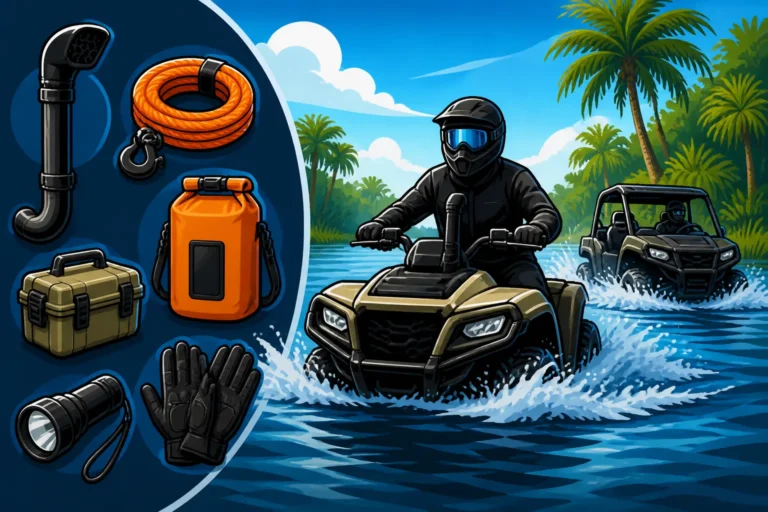
If you are riding in an area where water crossings are permitted, assess them cautiously and follow local instructions. Avoid spinning tires in one spot, widening the trail, or pushing vegetation aside to find a route. If an obstacle cannot be crossed safely and legally, turn back. [What Florida Riders Carry for Deep Water Crossings] covers preparation for these situations, but equipment does not make an unauthorized or unsafe crossing acceptable.
Mud thrown toward other people, parked machines, or public areas is also poor form. At designated mud parks, follow the venue’s layout and keep the mess where it belongs. At forest trailheads and campsites, do not use a shared access road or parking area as a place to spin tires for entertainment.
Pack out trash and respect shared facilities
Bring out everything you bring in: food wrappers, cans, broken straps, zip ties, and used parts. Secure lightweight items before riding because a loose bottle or glove can disappear quickly and become someone else’s cleanup job. If you see a small piece of litter and can safely pick it up, doing so is a simple way to leave the site better than you found it.
Use restrooms, washdown stations, and garbage facilities only as intended. Do not wash mud into a drainage area or leave a machine leaking fluids at a staging spot. If an area has no washdown facility, plan how you will clean up at home or at an authorized location rather than improvising at the trailhead.
Camping etiquette matters, too. Keep noise reasonable, follow fire rules, and do not spread gear into a neighboring site or block access lanes. If you are bringing a dog, check the specific location’s rules before you arrive; some areas restrict pets or require them to be controlled. [Florida Riding Areas That Ban Pets] can help you remember that access rules may differ from one riding area to another.
Common Situations and the Considerate Response
When someone is riding too fast or too close
Do not respond to aggressive riding by racing, blocking the trail, or escalating the encounter. Move to a safe spot if you can, let the rider pass when it is appropriate, and avoid confronting someone in a way that creates more danger. If the behavior appears to violate posted rules or puts people at immediate risk, contact the park staff or land manager when it is safe to do so.
If you are the rider who has caught up to a slower group, wait for a suitable passing area. A slower pace may reflect a beginner, a mechanical concern, a child riding with supervision, or simply someone enjoying the route. Tailgating does not make them move safely; it only adds pressure.
When your machine gets stuck or breaks down
First, make sure everyone is safe and move the machine out of active traffic if possible. Tell the group where you are and what help you need. Avoid asking an unprepared rider to make a risky tow or pushing a machine into vegetation to clear the trail. If you need assistance, use the area’s designated contact process or emergency procedures.
Keep the group together while help is arranged. One person can stay with the machine while another communicates from a safe location, but do not split up without agreeing on where to meet. In areas with weak service, a saved map and a preplanned check-in point can prevent a small breakdown from becoming a confusing search.
When the weather or trail changes
Florida conditions can shift quickly. Heavy rain may change the traction, visibility, and depth of water on a route. Heat can also make a ride harder than expected, especially for children, newer riders, or anyone wearing muddy gear in the sun. If the group is tired, overheated, or uncertain about conditions, shorten the ride rather than pushing on to complete a planned loop.
Check conditions before you go and be willing to change plans. [Florida Trail Riding Gear for the Heat] offers useful preparation ideas, while [Florida Riding Season Month by Month] can help with broader seasonal planning. Neither a schedule nor an app overrides a closure, a storm warning, or a trail manager’s direction.
| Situation | Considerate choice | Avoid |
|---|---|---|
| Meeting riders on a narrow trail | Slow down, communicate, and pass only when there is room | Forcing another rider off the route |
| Following through dust | Increase your following distance | Riding close enough to lose visibility |
| Finding a closed or muddy section | Use an authorized detour or turn back | Cutting a new track around it |
| Stopping for a problem | Pull off where you are visible and out of traffic | Stopping around a blind bend |
| Planning a group ride | Pick a suitable route and agree on regrouping points | Letting the fastest rider set an unsafe pace |
| Leaving the staging area | Pack out trash and keep shared spaces clear | Leaving parts, food waste, or fluid spills behind |
Good Florida OHV etiquette is not complicated, but it does take attention: check the rules, ride within your group’s ability, give others room, stay on authorized routes, and leave the place clean. Those habits make the outing safer and help protect access to the riding areas people come back to enjoy.
Disclaimer
This article is for general informational purposes only and does not constitute professional advice. Laws, prices and regulations vary by location and change over time. Consult a qualified professional for guidance on your specific situation.