Florida Riding Areas That Close for Hunting Season
A trail that was open last weekend may be closed when hunting season begins, and the change is not always obvious from the road. In Florida, riding access can vary by property, trail system, date, and hunting activity. This guide explains how to check for seasonal closures, plan around them, and avoid arriving at a locked gate or riding where access is restricted.
Why Florida riding areas close during hunting season
Hunting activity can change where riding is allowed
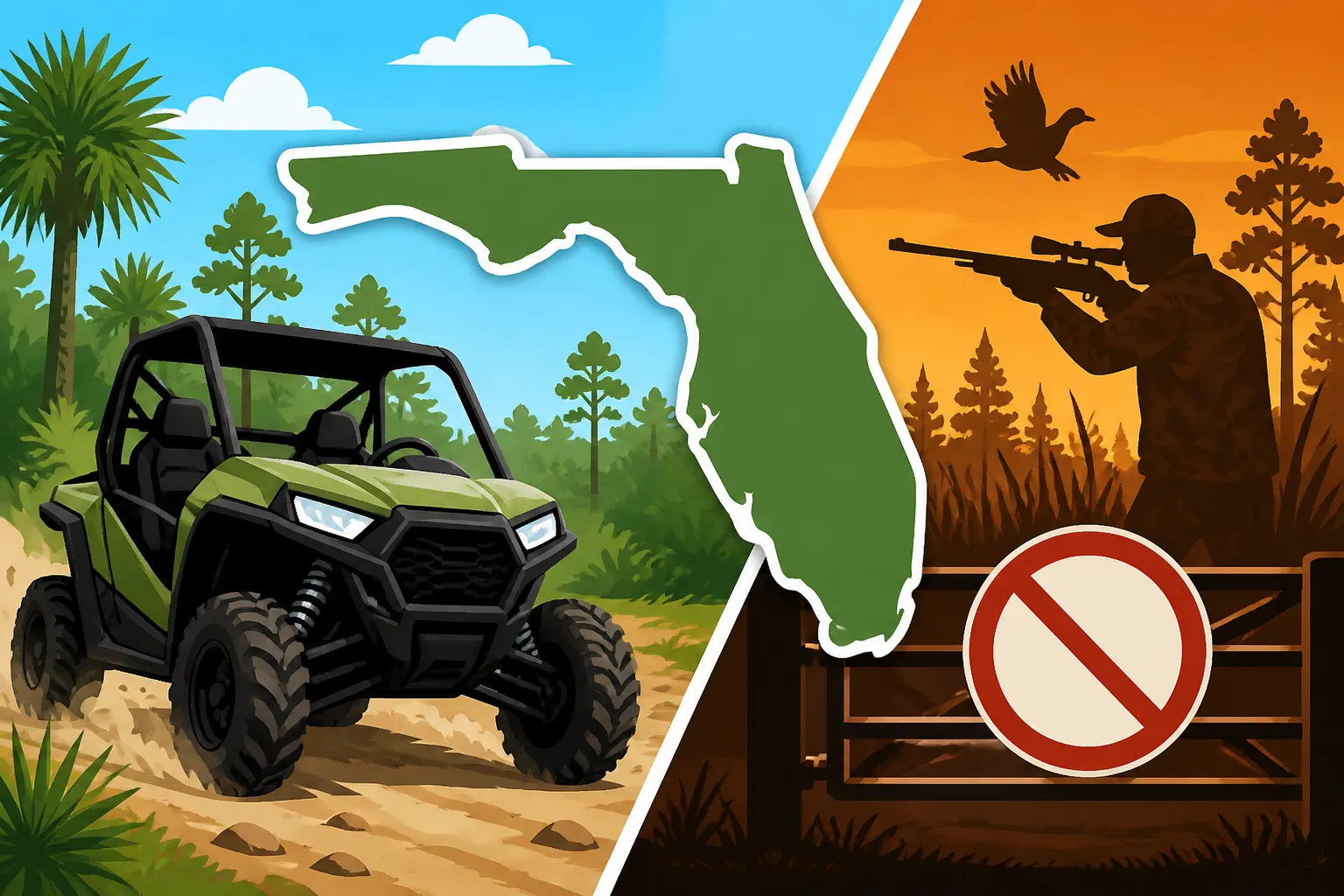
Florida’s public lands serve several purposes at once: recreation, wildlife management, forestry, and hunting. When a hunt is scheduled, an agency may close a road, trail, campground, or entire management area to other visitors. A closure can help keep riders away from active hunting zones, reduce conflicts, and protect wildlife habitat.
That does not mean every public riding area closes for every hunting season. Some places keep designated OHV routes open while limiting access to other parts of the property. Others may close only on specific hunt dates or during particular parts of a season. Rules can differ even between neighboring properties, so “the forest is open” does not necessarily mean “the trail I want is open.”
This is why general assumptions can lead to a frustrating trip. A rider heading to Ocala National Forest, for example, needs to check the status of the specific OHV area and route they plan to use—not just whether the national forest is open. The same applies to state forests and wildlife management areas.
Closures may be temporary, partial, or easy to miss
Hunting-season restrictions are not always a simple, full-property closure. A notice might apply to one access road, a trail segment, a day-use area, or a particular date range. Access may reopen between hunt periods, then close again when another scheduled activity begins.
The wording matters. “Closed to public access,” “OHV trail closed,” and “hunting activity in progress” can have different practical implications. A trail map that shows a route does not prove that it is open today. And a gate standing open does not necessarily override a posted closure notice farther along the route.
For a broader planning checklist, see [Florida Riding Areas That Close for Logging] and Florida Trail Closures You Should Check First.
How to check whether a trail is open
Start with the agency that manages the land
Before you load the trailer, identify who manages the riding area. Florida’s OHV opportunities include national forests, state forests, and privately operated parks. Each has its own announcements and access rules. A trail’s name or nearby town is not enough to identify the responsible agency.
For national forest areas, check the relevant U.S. Forest Service information and any alerts for the forest or OHV trail system. For state forest riding, look for notices from the Florida Forest Service. If a route crosses or sits within a wildlife management area, check the Florida Fish and Wildlife Conservation Commission’s information for that specific area and hunt dates. A private park’s website or direct contact is the appropriate source for its closures.
The key is to check for the exact destination and date, not just the broad region. Riders planning a weekend near Ocala, Brooksville, or the Panhandle should confirm the status of the actual trailhead and route they intend to ride. A nearby campground or forest road may be governed by a different set of rules.
Confirm details before you leave home
Use online maps and trail apps to orient yourself, but treat them as planning tools rather than official closure notices. onX Offroad can help you understand where a route sits relative to roads and public-land boundaries, but verify access restrictions with the managing agency. A mapped trail can remain visible even when seasonal access has changed.
If an agency notice is unclear, contact the land manager or the riding area directly. Ask whether the designated OHV trail is open on your planned date, whether any approach roads are affected, and whether a pass or permit is still required. When possible, check again shortly before departure; notices can change with weather, fire conditions, forestry work, or scheduled hunts.
| What to check | Why it matters | Where to confirm |
|---|---|---|
| Exact riding area and trailhead | Nearby properties may have different rules | Land manager’s official page or office |
| Dates and hours of a closure | Restrictions may apply only during certain periods | Current alerts, hunt schedules, posted notices |
| Route and access-road status | A trail may be open while its approach is restricted | Official trail or road updates |
| Pass or permit requirements | Access rules can continue even when trails are open | Managing agency or park operator |
| Conditions on arrival | Gates and signs may reflect newer information | Posted notices and staff instructions |
For related planning details, Florida Riding Areas That Close for Hunting Season and [Florida Hunting Season Access on Public Land] are useful topics to review alongside the specific property’s current notices.
Florida areas where seasonal access deserves extra checking
National forests and OHV trail systems
Florida’s national forests include large areas where recreation, forestry, conservation, and hunting can overlap. Riders may look at places such as Ocala National Forest, Apalachicola National Forest, or Osceola National Forest, but the access picture is not identical across them. A route open in one forest does not establish the rules for another, and a forest-wide notice may not describe every trail-level restriction.
For Ocala, check the specific riding area and trail system you plan to visit, such as the Ocala Centennial OHV Trail or Big Scrub. Trailheads, forest roads, and adjacent recreation sites may have separate conditions. In the Panhandle, verify the current status of the riding area you have in mind, including Clear Creek in Blackwater River State Forest or routes associated with Tate’s Hell. Do not assume that a familiar route is open just because you rode it during another season.
Planning with Florida National Forest Riding vs State Forest Riding can help clarify why the land manager matters. If you rely on a map app such as onX Offroad to plan a route, compare the route with the current official notices before you go. Keep a copy or screenshot of the relevant notice for your own trip planning, but follow any newer signs or staff instructions at the site.
State forests, wildlife areas, and private parks
State forests may offer designated OHV areas while also containing land used for hunting or other management activities. Croom Motorcycle Area near Brooksville is a well-known riding destination, but riders should still check its current operating information rather than assuming access is unchanged during hunting periods. For other state forest opportunities, consult the relevant forest’s notices and confirm that the specific OHV area is open.
Wildlife management areas can have especially location-specific rules. A property may be open for one type of recreation while restricting motorized access in another area or on certain hunt dates. Check the rules for the named management area, not just the county. If a route crosses a boundary or follows a road through multiple land parcels, confirm the status of each section.
Private parks set their own schedules and policies. Some may remain open during public-land hunting seasons, while others can close for events, weather, or other operational reasons. Call or check the operator’s current information before setting out. For general context on hunting and riding access, see [Florida WMA Rules for ATV Riders], Florida State Forest OHV Areas Explained, and Florida ATV Trails: Every Public Riding Area.
How to plan a responsible ride around seasonal restrictions
Build a backup plan before trailering
A backup destination can save a weekend when a seasonal closure affects your first choice. Select another legal riding area within a reasonable distance, then check its status and entry requirements separately. Do not assume that a closure at one property automatically applies to nearby land—or that nearby land is open simply because the first property is closed.
Keep your plan flexible. If a notice closes the trailhead or route you intended to use, do not try to reach the same area by taking an unmarked road, bypassing a gate, or crossing private land. A closure applies to access, not merely to the most convenient entrance. Changing plans is less costly than a citation, damaged habitat, or a conflict with landowners or hunters.
Check what you need for the alternate site, too. Some areas require a pass, safety documentation, or specific equipment. The related guides [Florida OHV Permits: What You Need Before You Ride] and [What to Carry Into a Florida State Forest] can help you prepare for public-land requirements.
Respect signs and keep distance from active hunts
When you arrive, read every posted notice before unloading. Pay attention to temporary signs at gates, trail junctions, and parking areas. If you encounter hunters, a closed route, or an unclear boundary, stop and reassess rather than continuing to see whether the trail opens farther ahead.
Stay on designated routes and avoid disturbing hunting activity. Keep noise and speed under control near access points, follow instructions from agency staff, and do not ride around barriers. A route that looks passable is not permission to enter. If a closure is posted, leave the area and use your backup plan.
Using onX Offroad or another mapping tool can help you keep track of where you are, but it cannot replace signs, land-manager instructions, or current access notices. Save relevant agency contact information before you lose cell service, and make sure everyone in your group understands the plan. These small steps help prevent the familiar trail-day disappointment of arriving at a closed gate—and help keep riding access respectful and safe for everyone using Florida’s public lands.
Disclaimer
This article is for general informational purposes only and does not constitute professional advice. Laws, prices and regulations vary by location and change over time. Consult a qualified professional for guidance on your specific situation.