How a Florida Quad Title Compares to a Car Title
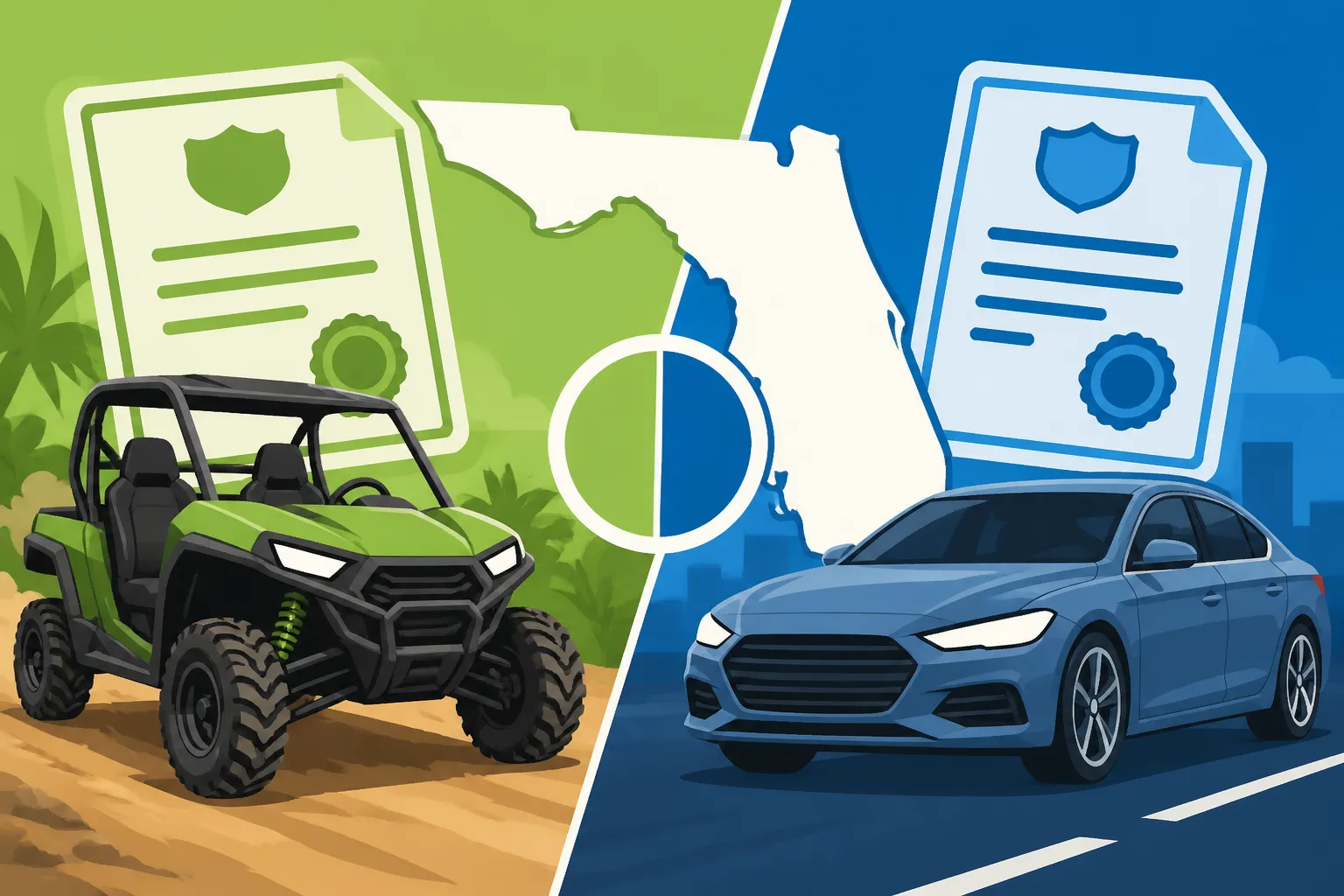
When you first get into the exciting world of Florida ATVs and UTVs, it's natural to assume that titling your quad will be just like titling your car. After all, a title is a title, right? Not exactly. While both serve the fundamental purpose of proving ownership, Florida's system for off-highway vehicles (OHVs) like ATVs and UTVs has some very distinct differences from the process for your everyday car. This guide will walk you through those crucial distinctions, helping you understand why your quad's title isn't quite the same as your sedan's.
The Core Purpose of a Title: What Stays the Same?
Let's start with the common ground. Despite their differences, both car titles and ATV titles in Florida share some fundamental responsibilities. They are the bedrock of legal ownership and play a critical role in the lifecycle of your vehicle, whether it has four wheels for the road or four knobby tires for the trail.
Proving Ownership and Preventing Theft
First and foremost, a title is your ultimate proof of ownership. Think of it as the deed to your vehicle. For both cars and ATVs, the title officially records who the legal owner is. This is incredibly important for protecting your investment. If your beloved quad or car ever gets stolen, having a clear, properly issued title is vital for law enforcement to track it down and for you to prove it belongs to you. Without that paper trail, recovering a stolen machine becomes a nightmare. Both types of titles include a Vehicle Identification Number (VIN), which is a unique serial number that identifies your specific machine, allowing it to be traced. This VIN is the fingerprint of your vehicle, linking it directly to your title document.
Facilitating Sales and Transfers
When the time comes to sell your car or your ATV, the title is absolutely non-negotiable. It's the key document that facilitates a legal transfer of ownership from seller to buyer. Whether you're selling it privately to a neighbor or trading it in at a dealership, the title must be signed over correctly. This ensures that the new owner can then title the vehicle in their name. Similarly, if you take out a loan to buy either a car or an ATV, the lender will typically record a lien on the title. This lien serves as their legal claim on the vehicle until you pay off the loan. Once the loan is satisfied, the lien is released, and you receive a clear title. Understanding how to handle these transfers and liens is crucial for both types of vehicles. You might even use a service like LawDepot to create a clear, legally sound bill of sale to accompany the title transfer, ensuring all parties are protected.
Key Differences: Where ATV Titles Diverge from Car Titles
Now, let's dive into the aspects where Florida ATV titles take a distinctly different path from car titles. These differences are rooted in how the state views and regulates off-highway vehicles versus street-legal automobiles.
No License Plate or Registration for ATVs Generally
This is arguably the biggest and most important difference. When you title a car in Florida, that title is the gateway to getting a license plate and registration, which are absolutely mandatory for driving on public roads. Without them, your car is not street legal.
For ATVs and UTVs, however, titling does not lead to a license plate or traditional road registration. Florida's Off-Highway Vehicle Title law requires most ATVs and UTVs to be titled if they are going to be used on public lands or if they are purchased new. However, this title is purely for ownership purposes and does not grant road-use privileges. An ATV title simply proves you own the machine; it doesn't give you a green light to drive it down US-19. This distinction is often a point of confusion for new owners who assume a title means full legal road access, much like a car. You'll find a deeper dive into this topic in [Florida ATV Title vs Registration: The Difference].
Road Use Restrictions and Why They Matter
Cars are designed, manufactured, and regulated for extensive road use. They have specific safety features, lighting, and emissions standards that allow them to be driven on paved streets and highways. ATVs and UTVs, conversely, are designed for off-road environments. Their tires, suspension, and lack of many standard road safety features (like turn signals, specific headlights, and brake lights in some older models) make them generally unsuitable and illegal for paved public roads in Florida.
While there are specific, limited exceptions for ATVs on certain unpaved roads, primarily in rural areas or for agricultural purposes, these are very narrow. These exceptions often come with strict conditions regarding speed, daytime operation, and the driver's age and license status. The rules governing where you can legally ride your ATV are a complex web that is entirely separate from car road laws. If you attempt to treat your titled ATV like a titled car on public streets, you're likely to face a hefty fine and potentially have your machine impounded. It’s crucial to understand [Are ATVs Street Legal in Florida?] before you hit any paved surfaces.
Insurance Requirements
For cars titled and registered for road use in Florida, mandatory Personal Injury Protection (PIP) and Property Damage Liability (PDL) insurance are required. This ensures that in the event of an accident, there's a baseline of coverage for injuries and property damage.
For ATVs, the titling process itself does not mandate liability insurance in the same way. While it is highly, highly recommended to carry insurance for your ATV for your own protection and peace of mind – especially if you ride in state parks or private mud parks that may require it – the state does not typically enforce insurance as a prerequisite for titling an off-highway vehicle for general off-road use. However, if you are riding on public lands, some of those facilities might have their own insurance requirements or recommendations. If you're curious about the specifics of coverage, you can explore [Do Florida ATVs Need Insurance to Be Titled].
Fees and Documentation
While both car and ATV titles involve fees and specific paperwork, the exact amounts and forms can vary. For instance, the initial title application fee for an OHV in Florida is currently a flat rate plus service charges. Car title fees can sometimes be more complex, especially when factoring in various plate fees, registration renewals, and potential additional taxes.
For new machines, both cars and ATVs require a Manufacturer's Certificate of Origin (MSO) to prove the vehicle is new and has never been titled before. This MSO is a crucial document that essentially bridges the gap between the manufacturer and the first owner. When buying used, both will require the previous owner's signed-over title. Understanding the nuances of these documents, which platforms like LawDepot aim to simplify for private sales, can make the process smoother. For a detailed breakdown of costs, check out [The $29 Initial Title Application Fee Explained] and [When an MSO Beats a Bill of Sale].
Physical Characteristics and Classification
The state of Florida has very specific definitions for what constitutes an "all-terrain vehicle" (ATV) or a "recreational off-highway vehicle" (ROV), and these classifications dictate how they are titled and regulated. These definitions often hinge on factors like width, dry weight, and the number of wheels.
For example, an ATV is generally defined as a motorized, off-highway vehicle designed to travel on four low-pressure tires, with a seat designed to be straddled by the operator, and handlebars for steering, usually not exceeding 55 inches in width. If your machine is wider than that, it likely falls into the ROV (side-by-side) category, which has its own set of rules. Cars, on the other hand, have clear, established classifications based on body style (sedan, SUV, truck) and weight, but these don't carry the same regulatory implications for basic road legality as an ATV's width does for off-road use. For clarity on these dimensions, refer to [Florida's 55-Inch ATV Definition and Why It Matters] and [Florida ROV Definition: 80 Inches and 3,500 Pounds].
Here's a quick comparison table to help visualize these key differences:
| Feature | Florida Car Title | Florida ATV/UTV Title |
|---|---|---|
| Primary Purpose | Ownership, Road Registration, License Plate | Ownership, Public Land Access (Not Road Registration) |
| Road Legality | Generally Street-Legal with Registration/Plate | Generally NOT Street-Legal on Paved Roads |
| License Plate Issued? | Yes, mandatory for road use | No, never issued for standard OHV titles |
| Mandatory Insurance | Yes (PIP/PDL) for road use | No (for titling), but highly recommended |
| Primary Use | Paved public roads, highways | Off-road trails, private land, unpaved agricultural roads |
| Width/Weight Defined | Standard vehicle classes | Specific definitions (e.g., 55" width for ATV) dictate class |
| Common Frustrations | Registration renewal costs, tag fees | Misunderstanding road rules, lack of street legality |
Navigating Title Applications: Practical Considerations
When it comes to the actual process of applying for a title, both cars and ATVs follow similar administrative paths in Florida, but the specific requirements will, again, reflect their differing natures.
Where to File Your Application
Whether you're titling a brand-new car or a used quad you just bought, the process typically goes through the Florida Department of Highway Safety and Motor Vehicles (FLHSMV) via your local county tax collector's office or a licensed tag agency. These offices are your one-stop shop for submitting paperwork, paying fees, and handling all title-related transactions.
You'll visit the same counter, whether you're there for a sedan or a side-by-side. The convenience of these local offices means you don't have to go far to get your paperwork sorted. Just be sure to check their specific hours and any appointment requirements, as things can vary from county to county. For details on where to go, check out [Where to File an ATV Title in Florida].
Essential Forms and Supporting Documents
For both types of vehicles, you'll need to complete specific forms. The primary application for a Florida title is often Form HSMV 82040, "Application for Certificate of Title With/Without Registration." This form covers both vehicles and off-highway vehicles, requiring you to check the appropriate boxes.
Beyond the application, you'll need:
- Proof of Identity: A valid driver's license or state ID.
- Proof of Ownership: For new vehicles, this is the Manufacturer's Certificate of Origin (MSO). For used vehicles, it's the properly signed-over previous title.
- Bill of Sale: Especially crucial for private sales, this document outlines the purchase details. Even if you're not a lawyer, services like LawDepot can help you generate a clear, comprehensive bill of sale, which adds a layer of protection to your private transaction.
- Odometer Disclosure: For cars, this is usually mandatory, but for ATVs, it's generally not required due to their off-road nature.
- Payment for Fees: The title application fee, service charges, and sales tax.
Ensuring you have all your ducks in a row with the correct paperwork will save you a lot of time and frustration at the tax collector's office. You can find more information on specific documents in [Florida ATV Bill of Sale: What It Needs to Say].
Dealing with Liens and Encumbrances
Just like a car, an ATV or UTV can have a lien recorded on its title if you financed the purchase. The process for recording and releasing these liens is essentially the same for both vehicle types. When you pay off your loan, the lender will send you a lien satisfaction document, which you then submit to the FLHSMV to have the lien removed from your title. This ensures you receive a "clear" title, free of any outstanding claims.
It’s always a good practice to verify a clear title before purchasing any vehicle, car or ATV, especially in a private sale. A quick title search can reveal any hidden liens. If you're dealing with a lien on your quad, [Florida ATV Title With a Lien Recorded] offers more specific guidance.
Why Understanding These Differences Matters
Ignoring the distinctions between a car title and an ATV title in Florida isn't just a matter of semantics; it can lead to real-world problems, from legal trouble to financial headaches.
Avoiding Legal Headaches
The state of Florida takes its vehicle laws seriously. If you mistakenly believe your titled ATV can be ridden on public roads just because it has a title, you could be setting yourself up for a citation, significant fines, and potentially even the impoundment of your machine. Riding an ATV where it's not permitted isn't just illegal; it can also be dangerous due to the different handling characteristics of an off-road machine on pavement.
Understanding Florida's specific OHV laws helps you stay compliant and enjoy your machine responsibly. Don't let a simple misunderstanding turn your fun ride into a costly legal battle. Always know where you can legally ride, which you can start to learn more about in [Florida ATV Road Rules: Where You Can Legally Ride].
Protecting Your Investment
A properly processed title, whether for a car or an ATV, is your best defense against fraud and legal disputes. When buying a used machine, ensuring the title is clear and legitimately transferred protects you from unknowingly purchasing a stolen vehicle or one with undisclosed liens. When selling, a correct title transfer protects you from future liability.
Thinking through all the paperwork, and perhaps using reliable templates from resources like LawDepot, helps ensure you have a solid, legally sound transaction. It’s an extra step that prevents potential headaches down the line and safeguards what is often a significant investment. Always check the title history, a process detailed in [Checking a Florida Quad's Title History], to ensure peace of mind.
Smart Planning for Your Rides
Knowing the differences helps you plan your adventures effectively. If you understand that your ATV title doesn't grant you street-legal access, you'll know that you need to trailer your quad to designated off-road riding areas, rather than attempting to ride it on city streets. This also informs your decisions about where to buy and store your machine, and what kind of gear you might need for proper off-road use.
Ultimately, appreciating these distinctions is about being a responsible and informed owner, ready to embrace all the thrilling possibilities that Florida's off-road lifestyle has to offer, safely and legally.
Disclaimer
This article is for general informational purposes only and does not constitute professional advice. Laws, prices and regulations vary by location and change over time. Consult a qualified professional for guidance on your specific situation.