Farm Side-by-Sides and Florida Title Rules
It can be incredibly confusing to figure out whether your trusty farm side-by-side needs a title in Florida. Many assume that because a UTV is primarily used for work on private agricultural land, it automatically bypasses the typical titling requirements. This guide is here to untangle the specifics of Florida’s OHV titling rules, especially as they apply to those hard-working machines that keep our farms running, and help you understand when and how to get your farm UTV titled, ensuring you avoid any potential headaches down the line.
The Big Question: Does My Farm Side-by-Side Need a Florida Title?
This is easily one of the most common questions we hear from folks in Florida's agricultural communities. You’ve got a side-by-side, maybe a hefty utility vehicle (UTV) like a Polaris Ranger or a John Deere Gator, and its primary job is hauling feed, checking fences, or moving equipment around your acreage. It rarely, if ever, sees a paved road, let alone a public trail system. So, why would it need a title? Well, the answer, like so many things in life, isn't a simple yes or no; it really boils down to how and where you're using it.
It Depends on Where You Ride
Florida law is pretty clear: if an off-highway vehicle (OHV)—which includes most side-by-sides—is operated on "public land," it generally needs a title. "Public land" in this context isn't just your designated state parks or national forests. It can also include things like unimproved public roads, rights-of-way, and even some paths that are technically accessible to the public, even if they aren't paved.
Now, if your farm side-by-side never leaves your private property, and you can guarantee it won't even cross a short stretch of a county-maintained dirt road to get from one pasture to another, then the immediate need for a title under the public land rule is less pressing. However, how many of us can truly say our UTVs are never going to touch a sliver of public access? Think about driving it down a short stretch of rural road to your neighbor's farm, or perhaps crossing a utility easement that's technically public access. Even if it's just for a few feet, that could trigger the titling requirement. It’s always better to err on the side of caution than to find yourself explaining to a law enforcement officer why your essential farm equipment is technically operating in violation of the law. You can delve deeper into the overarching rules by reading [Florida Off-Highway Vehicle Title Rules Explained].
Why Titling Provides Peace of Mind
Beyond legal compliance, having a title for your farm side-by-side offers significant protection and peace of mind. A title is the official proof of ownership. Imagine this scenario: your valuable side-by-side, indispensable for your daily farm operations, is stolen. Without a title, proving that the machine is yours can become an absolute nightmare. A bill of sale is a good start, but a state-issued title is ironclad. It links your name directly to that specific vehicle identification number (VIN), making it much harder for thieves to legally sell it and much easier for law enforcement to return it to you if recovered.
Moreover, if you ever decide to sell the farm, or just upgrade your equipment, having a clear title makes the transfer of ownership smooth and legitimate. Buyers, especially those who plan to use the UTV on public lands or desire clear documentation, will be much more confident purchasing a titled machine. Skipping the title now might save you a few dollars, but it could cost you much more in stress, legal fees, or lost value later on. This is particularly true if the machine has a lien against it from a financing company; the title is critical for recording and releasing that lien.
Understanding Florida's Off-Highway Vehicle (OHV) Titling Law
Florida's approach to titling off-highway vehicles, including side-by-sides, aims to provide a clear chain of ownership and regulate use on public lands. It's not about making life harder for farmers; it's about ensuring accountability and proper documentation for vehicles that, while often used off-road, can still interact with the wider public sphere. The law makes distinct classifications based on vehicle type and intended use, which is critical for farm owners to understand. For a broader overview, check out [Florida's Off-Highway Vehicle Title Law Explained].
The Public Land Trigger
The cornerstone of Florida's OHV titling law is the "public land" provision. Essentially, if you intend to operate your side-by-side on any public land, including designated OHV trails, state forests, wildlife management areas, or even unpaved county roads that are open to public travel, you must have it titled. This requirement is in place to provide a system for identification and accountability, similar to how cars are titled for road use. Even if your farm straddles a county line, and you sometimes drive your UTV across a public easement to access different parts of your property, that incidental use on public land can be enough to trigger the titling mandate.
The law doesn't care how often you ride on public land, only that you do. A single instance of use can theoretically put you in violation if your machine isn't titled. This is why many farmers, even those who rarely leave their property, choose to title their side-by-sides. It eliminates the guesswork and the potential for a citation if an unexpected need arises to traverse a publicly accessible area. This "riding public land" rule is a fundamental concept in Florida's OHV laws and is explored more in [Riding Public Land as the Trigger for a Title].
What Counts as an "Off-Highway Vehicle"
It’s important to clarify what Florida considers an "off-highway vehicle" (OHV) in the context of these titling rules, especially for side-by-sides. The statutes define OHVs broadly to include all-terrain vehicles (ATVs) and recreational off-highway vehicles (ROVs), which is the category most modern side-by-sides fall into.
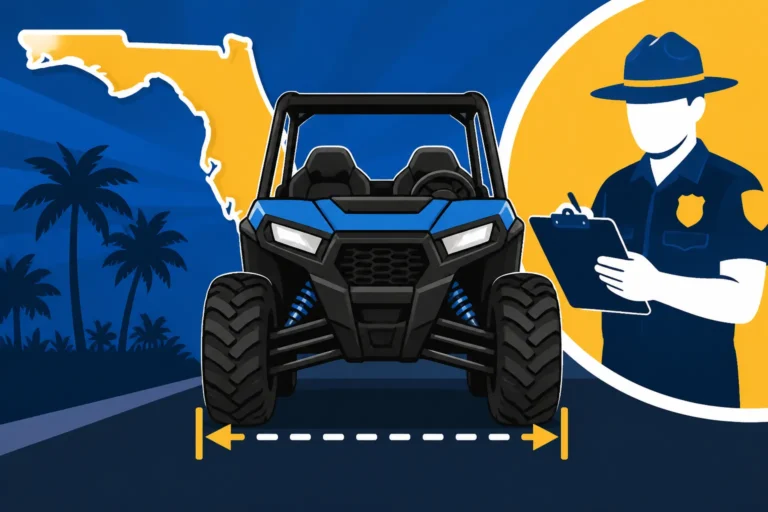
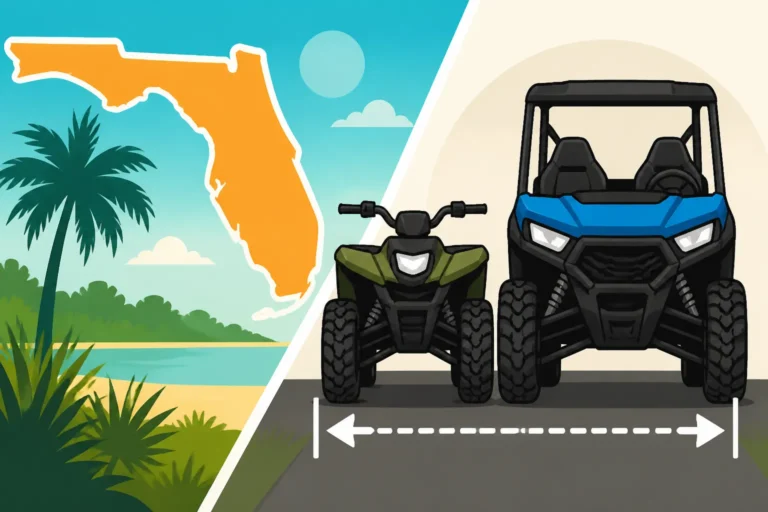
A typical ROV, or side-by-side, is designed for off-road use, has a steering wheel, foot pedals, and usually seating for two or more passengers side-by-side. Florida law specifically categorizes ROVs based on width and dry weight. Generally, if your side-by-side is over 55 inches wide but not more than 80 inches wide, and has a dry weight of 3,500 pounds or less, it's considered an ROV for titling purposes. Machines outside these parameters might fall into different categories, but most common farm utility vehicles fit squarely within the ROV definition requiring a title if used on public lands. For specific dimensions, you can learn more about [Florida UTV Titling for Side-by-Sides Over 55 Inches]. The specific definition ensures that various types of utility vehicles, whether used for recreation or work, are covered under the same titling umbrella, preventing loopholes based on slight design variations.
Agricultural Use vs. Public Use
Here’s where a lot of the confusion stems from. Many agricultural operations utilize vehicles that look like OHVs but are specifically designed and used only for farm work. Think of tractors, combines, or specialized farm implements. These vehicles generally fall under different regulations, often exempt from typical motor vehicle titling and registration because their operation is confined to private agricultural property or very specific, limited road use under agricultural exemptions.
However, a standard side-by-side, even if painted "tractor green" and equipped with a spray rig, is still functionally an off-highway vehicle under Florida law. The intent of its design and the potential for its use beyond private agricultural land means it's treated differently than, say, a backhoe. If your side-by-side is strictly confined to your own private farm, never touching a public road or trail, then it's in a grey area where titling might not be legally mandated solely for that private use. But as soon as it crosses that boundary, even briefly, into public access areas, the titling requirement kicks in. This distinction between purely agricultural equipment and off-highway vehicles that can be used recreationally or on public lands is key. It's not about what you call it, but what the vehicle is and where it's operated.
Proof of Ownership Even Without a Title
Even if your farm side-by-side never leaves your private property and you feel it doesn't need a Florida title, you absolutely must have solid proof of ownership. This isn't just about legal compliance; it's about protecting your investment and your rights. Without proper documentation, you could face significant challenges if the machine is stolen, if there's a dispute over ownership, or if you decide to sell it down the line.
Why a Bill of Sale is Crucial
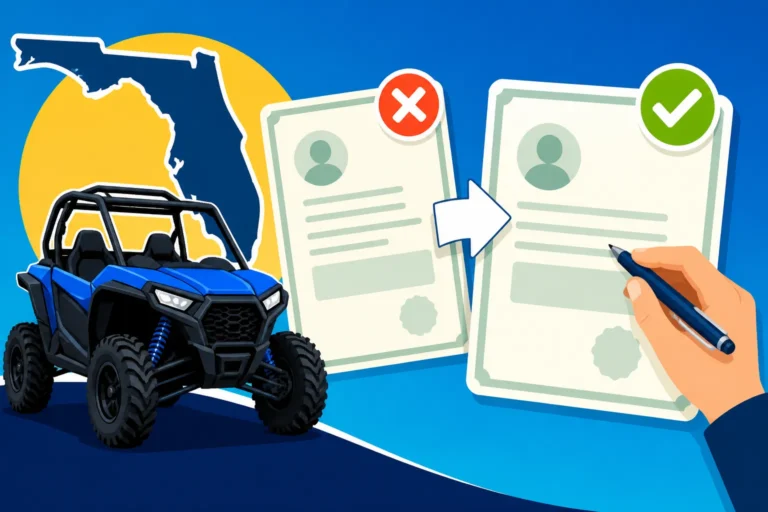
Whether you bought your farm side-by-side new from a dealer or used from another farmer, a comprehensive bill of sale is your first line of defense as proof of ownership. It might seem like a simple piece of paper, but it legally documents the transfer of the vehicle from the seller to you, detailing the machine's VIN, make, model, year, the purchase price, and the date of sale. It should also include contact information for both buyer and seller. Think of it as the birth certificate for your ownership. Without it, if someone else claims the UTV is theirs, or if a law enforcement officer questions your possession, you have little to back up your claim.
A good bill of sale protects both parties. For you, it proves you legally acquired the machine. For the seller, it proves they no longer own it, relieving them of any future liability. If you're acquiring a farm UTV, always insist on a detailed bill of sale. If you're selling one, always provide one. For tips on what to include, refer to [Florida ATV Bill of Sale: What It Needs to Say].
When the Manufacturer's Certificate of Origin (MSO) Matters
For a brand-new farm side-by-side purchased from a dealer, the Manufacturer's Certificate of Origin (MSO) is perhaps the most critical document. The MSO is essentially the vehicle's birth certificate from the factory. It’s the initial document that proves the manufacturer transferred ownership to the dealer, and then from the dealer to you. It contains the official VIN, technical specifications, and confirms the machine is new.
When you go to title your side-by-side for the first time, especially if it's new, the MSO is required by the Florida Department of Highway Safety and Motor Vehicles (FLHSMV). Without it, you cannot obtain an original title. If you're buying a used machine and the previous owner never titled it, they should have the MSO to provide to you. If they don't, and they can't produce it, you're looking at a much more complicated situation, potentially requiring a bonded title or other extensive paperwork to establish ownership. This is a common pitfall for buyers of used, untitled machines, which is discussed further in [When an MSO Beats a Bill of Sale]. Always keep your MSO in a safe place, separate from the vehicle itself.
Creating Essential Documentation
Beyond the bill of sale and MSO, sometimes you need other documents, particularly for unique situations like gifted vehicles, inherited property, or even just formalized agreements for shared use on a family farm. While many documents can be handwritten, using professional templates can add a layer of legitimacy and ensure all necessary legal language is included.
This is where services like LawDepot can be incredibly helpful. Platforms like LawDepot offer customizable legal document templates, including bills of sale, affidavits of ownership, and other agreements that can be tailored to your specific situation. Using a service like LawDepot ensures that your documents are complete, professional, and contain the legally recognized clauses that protect your interests. Even for farm-specific situations, having clear, unambiguous paperwork generated through a reliable service like LawDepot can save you significant trouble. Whether it's to formalize a private sale of a used farm UTV or simply to create a record for your own peace of mind, exploring options for professional document generation, such as those offered by LawDepot, is a smart move.
The Titling Process for a Farm Side-by-Side
So, you've decided to title your farm side-by-side, either because you ride it on public land, or simply for the protection and peace of mind a state-issued title offers. The process itself is fairly straightforward, much like titling any other off-highway vehicle in Florida. It primarily involves gathering the right documents and visiting your local tax collector’s office.
Gathering Your Paperwork
Before you head to the tax collector's office, you’ll need to make sure you have all your ducks in a row. The most important documents include:
- Manufacturer's Certificate of Origin (MSO): If the side-by-side is new and has never been titled. This is paramount.
- Previous Title: If you bought the side-by-side used and it already has a Florida title, the seller must sign it over to you. Make sure all fields are correctly filled out, especially the odometer reading (if applicable) and the seller's signature.
- Bill of Sale: Even if you have the MSO or a signed-over title, a bill of sale is always a good supporting document, especially for confirming the purchase price for sales tax calculations.
- Proof of Florida Residency: You'll need a Florida driver's license or ID card.
- Identification: A valid government-issued photo ID.
- Form HSMV 82040 (Application for Certificate of Title With/Without Registration): This is the main application form you'll fill out. You can usually download it from the FLHSMV website or get a copy at the tax collector’s office.
- VIN Verification (if applicable): If the side-by-side is coming from out of state, or if there’s any question about the VIN, you might need a VIN verification form completed by a Florida law enforcement officer or certain authorized dealers. This isn't usually required for a new machine bought in Florida.
Making sure you have every piece of paper ready before you go can save you a frustrating second trip. Double-check all signatures and ensure no fields are left blank.
Visiting Your Local Tax Collector's Office
Once your paperwork is assembled, your next stop is your local County Tax Collector's office. In Florida, these offices handle vehicle titling and many other services. You can find their locations and often their hours and wait times online. Some counties allow appointments, which can be a huge time-saver, while others are walk-in only.
When you arrive, you’ll present your completed application, all supporting documents, and your identification to a clerk. They will review everything, ensure it's correct, and process your application. This is also where you'll pay the required fees and sales tax. Don't be shy about asking questions if something is unclear. The clerks are there to help ensure you complete the process correctly. You can learn more about which office to choose in [Florida County Tax Collector vs Service Center for ATV Titles]. If you bought your side-by-side from a dealer, they might handle much of this paperwork for you as part of the sale, which is a major convenience as covered in [What a Dealer Files on Your Behalf After a Sale].
Understanding the Fees Involved
Titling a farm side-by-side in Florida involves a few fees, which are generally standard across the state. While I cannot provide specific dollar amounts (as these can change), I can describe the types of costs you should anticipate:
- Initial Title Application Fee: This is the primary charge for processing your new title.
- Service Charge: Often, the county tax collector's office will add a small service charge to each transaction.
- Lien Recording Fee: If you financed your side-by-side and there’s a lien against it (meaning the lender holds the title until you pay off the loan), there will be an additional fee to record that lien on the title.
- Sales Tax: This is a big one. Florida sales tax is generally applied to the purchase price of the side-by-side. If you bought it new from a dealer, they usually collect this. If you bought it in a private sale, you'll pay the sales tax directly to the tax collector when you title the machine. There are some nuances here, so be prepared with proof of purchase price. For private sales, understanding [Sales Tax on a Private Quad Sale in Florida] is crucial.
- Fast Title Fee (Optional): If you need your paper title back quickly, Florida offers an expedited "Fast Title" service for an additional fee. Otherwise, the title will be mailed to you within a few weeks.
Always check the current fee schedule on your County Tax Collector's website before you go, so you know exactly what to expect.
Disclaimer
This article is for general informational purposes only and does not constitute professional advice. Laws, prices and regulations vary by location and change over time. Consult a qualified professional for guidance on your specific situation.