Dry Weight Limits That Decide Your Machine’s Class
One of the most common headaches Florida ATV and UTV enthusiasts face isn't just navigating the trails, but navigating the state's seemingly complex rules for classifying their machines. It's not always as simple as "it's an ATV" or "it's a side-by-side," because Florida law often hinges on very specific dimensions, and chief among them is dry weight. This guide is here to untangle the confusion, explaining exactly how dry weight limits impact how your off-highway vehicle is classified in Florida and why understanding these nuances is crucial for proper titling and legal riding.
Understanding Florida's OHV Classification System
Florida's approach to off-highway vehicles (OHVs) isn't just about fun on the trails; it's deeply rooted in safety, public land management, and defining what kinds of machines can operate where. What you call your "quad" or "side-by-side" might be referred to by a different, very specific legal term in the Florida statutes, and those terms carry weight (pun intended!) when it comes to everything from purchasing, to titling, to where you can actually ride. It's easy to get lost in the terminology, especially when talking to other riders who might use casual terms, but the state has its own definitions that govern all the official processes.
Beyond Just "ATV" or "UTV": What Florida Sees
When you visit a Florida Tax Collector's office or speak with a park ranger, they aren't just looking at the number of wheels or how many seats your machine has. They're looking at its specifications through the lens of Florida Statute 317.0003. This statute breaks down OHVs into distinct categories, primarily "all-terrain vehicles" (ATVs) and "off-highway vehicles," which then gets further refined into classes like "recreational off-highway vehicles" (ROVs, which are your typical side-by-sides) and "off-highway motorcycles" (dirt bikes). Each of these classifications carries a specific set of rules, and a machine's dry weight is often a primary factor in determining which box it fits into. For instance, a vehicle that looks like an ATV but exceeds a certain weight threshold might suddenly be considered something else entirely, with different titling and usage requirements. This is why understanding these distinctions is so vital before you even consider hitting a public trail or going to the tax collector.
The Core Purpose of Classification: Safety and Regulation
The main reason Florida goes to such lengths to classify OHVs isn't to make life harder for riders; it's about public safety and environmental protection. Think about it: a lightweight, single-rider ATV handles very differently from a heavy, multi-passenger side-by-side. The potential for injury, the impact on trails, and even the necessary safety equipment can vary wildly between these machines. By categorizing them based on factors like dry weight, width, and number of wheels, the state can implement targeted regulations. This means that a minor on a small ATV might have different supervision requirements than an adult operating a larger ROV. These classifications also help manage access to specific areas, ensuring that the right types of vehicles are on the right types of trails, preserving both the rider's safety and the natural environment. It's all part of Florida's comprehensive [Florida's Off-Highway Vehicle Title Law Explained] that aims to keep everyone safe and our beautiful lands accessible for responsible recreation.
Historical Context of Florida's OHV Laws
Florida's OHV laws haven't always been as detailed as they are today. Like many states, Florida's regulatory framework for off-highway vehicles has evolved over time, largely in response to the growing popularity of these machines, technological advancements, and increasing concerns about safety and land management. Decades ago, the rules were much simpler, often lumping all "motorized recreational vehicles" together. However, as ATVs became more diverse, and side-by-sides (UTVs/ROVs) emerged as a distinct and rapidly growing segment of the market, it became clear that a one-size-fits-all approach was inadequate. The dry weight limits, in particular, were introduced to create clearer boundaries between different types of machines, reflecting their varying power, size, and operational characteristics. This evolution ensures that regulations are tailored to the specific risks and impacts associated with each machine type, ultimately leading to a more structured and safer environment for all Florida riders.
The Critical Role of Dry Weight for ATVs
For anyone who owns or is looking to buy an ATV in Florida, one of the most important numbers to know, outside of the price tag, is its dry weight. This seemingly technical detail isn't just for gearheads; it's a fundamental definer in Florida law that directly impacts how your machine is titled and where you can legally ride it. Overlooking this detail can lead to real headaches down the line, from being denied a title to getting a citation on the trail.
The 1,500-Pound Rule: Defining an ATV
In Florida, an "all-terrain vehicle" or ATV has a very specific legal definition, and its dry weight plays a starring role. Florida Statute 317.0003 defines an ATV as a motorized off-highway vehicle 55 inches or less in width, having a dry weight of 1,500 pounds or less, designed to travel on three or more non-highway tires, and manufactured for recreational use by a single operator or an operator and a passenger. That "1,500 pounds or less" dry weight is absolutely crucial. If your machine is wider than 55 inches, it's immediately out of the ATV category, but if it fits the width and has three or more wheels, the dry weight is the next big hurdle.
This means a machine that looks and feels like a traditional quad, but tips the scales at, say, 1,600 pounds dry, simply isn't legally an ATV in Florida's eyes. It falls into a different class, likely a recreational off-highway vehicle (ROV), which has different rules for titling and use. This distinction is vital because these heavier machines often have different handling characteristics and require different safety considerations. For a deeper dive into this specific cutoff, you might want to read [Why 1,500 Pounds Dry Weight Is the ATV Ceiling]. Understanding this limit upfront will save you potential frustration when you head to the DMV for titling or try to access certain riding areas.
What "Dry Weight" Actually Means
When the law refers to "dry weight," it's not talking about the weight of your machine after you've hosed off all the mud from your last ride. "Dry weight" is a manufacturer's specification that refers to the weight of the vehicle without any fluids, such as fuel, engine oil, coolant, or hydraulic fluid. It also excludes any cargo, accessories you've added (like a winch, light bar, or aftermarket tires), or, of course, the rider and any passengers. Essentially, it's the weight of the vehicle straight off the assembly line, before it's been prepared for operation.
This definition is important because riders often add significant weight to their machines through aftermarket parts, toolboxes, or even just a full tank of gas. While these additions increase the operational weight, they don't change the dry weight as defined by the manufacturer and, therefore, by the state of Florida for classification purposes. Always check the manufacturer's specifications for your particular model, often found in the owner's manual or on the manufacturer's website. If you're buying a used machine and the owner isn't sure, that's definitely something you'd want to research thoroughly.
Impact of Modifications on ATV Classification
You might be wondering, "What if I modify my ATV so much that it becomes heavier than 1,500 pounds?" This is a really common question, and it's where things can get a little tricky, but Florida law is usually quite clear. The "dry weight" is generally considered the manufacturer's original dry weight. Adding heavier tires, a lift kit, a heavy-duty bumper, a full skid plate package, or a large cargo box will certainly increase your machine's actual weight. However, these modifications don't typically change the classification of the machine from an ATV to an ROV if its original dry weight was 1,500 pounds or less.
The key is that the state relies on the original factory specifications for classification, not subsequent modifications. So, while your modified ATV might weigh more in practice, it should still be titled as an ATV if it met the dry weight (and width) criteria when it rolled off the assembly line. The exception here, of course, is if you're building a [Titling a Homemade or Rebuilt ATV in Florida] from scratch or significantly altering the frame and engine in a way that truly redefines the machine's fundamental characteristics. In such rare cases, you'd need to go through a special process to have the vehicle inspected and assigned a new classification and potentially a VIN. For most riders, however, modifications won't alter the official classification based on the original dry weight.
Side-by-Sides and the 3,500-Pound Dry Weight Threshold
Side-by-sides, or UTVs as they're often called, have exploded in popularity across Florida. These versatile machines offer more seating, cargo capacity, and often more stable handling than traditional ATVs, making them ideal for everything from ranch work to family trail riding. However, just like ATVs, their classification in Florida law is heavily influenced by their dry weight, with a specific, higher threshold that distinguishes them from smaller quads and even from certain street-legal vehicles.
The ROV Definition: The 3,500-Pound Limit
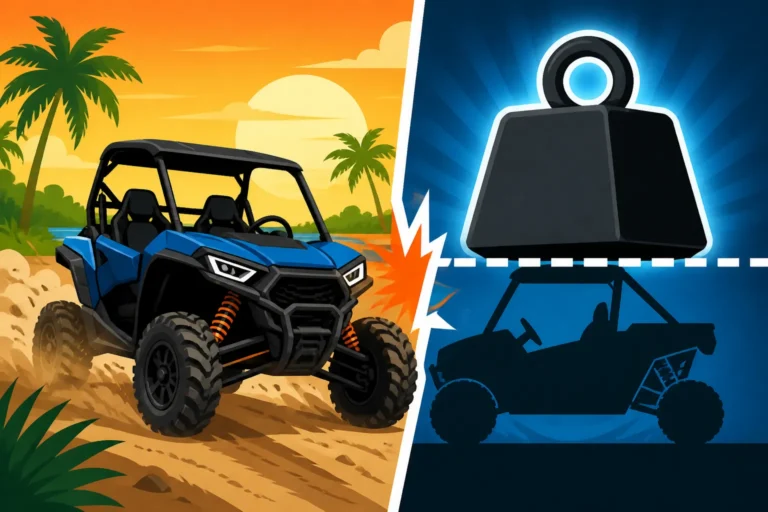
In Florida, most side-by-sides fall under the classification of a "recreational off-highway vehicle" (ROV). This isn't just a casual term; it's a legal definition found in Florida Statute 317.0003. An ROV is generally described as a motorized off-highway vehicle that is 80 inches or less in width, has a dry weight of 3,500 pounds or less, is designed to travel on four or more non-highway tires, and is manufactured for recreational use by an operator and one or more passengers. Just like with ATVs, that dry weight figure is critical: 3,500 pounds or less.
This specific weight limit helps differentiate ROVs from larger, heavier off-road vehicles that might technically be considered utility vehicles but are outside the typical recreational side-by-side range. If your side-by-side exceeds this 3,500-pound dry weight limit, it might fall into a different, less common category, potentially making it harder to title or operate on designated OHV trails. Understanding [Why 3,500 Pounds Is the Side-by-Side Ceiling] is paramount for anyone looking to purchase or register one of these popular machines in the Sunshine State. Always double-check your vehicle's specifications to ensure it fits neatly into Florida's ROV definition before you finalize your purchase.
Wider Machines and the 55-Inch Rule
While dry weight is a primary factor, it's important to remember that width also plays a significant role in Florida's OHV classification system, particularly when distinguishing between ATVs and ROVs. While ROVs have a maximum width of 80 inches, ATVs are strictly limited to 55 inches or less in width. This means that a machine could technically be under the 1,500-pound dry weight limit for an ATV, but if it's wider than 55 inches, it automatically cannot be classified as an ATV.
Instead, a machine that's wider than 55 inches but still under 3,500 pounds dry weight will almost certainly be classified as an ROV. This is a common point of confusion for riders, especially with some of the newer, wider "sport quads" or crossover machines that blur the lines. For a comprehensive look at this critical width dimension, make sure to read [Florida's 55-Inch ATV Definition and Why It Matters]. The interplay of both width and dry weight creates Florida's precise classification system, ensuring that each type of vehicle is categorized appropriately for titling, safety, and trail access.
Comparing ROV and LSV Classifications
It's easy to confuse ROVs with other types of vehicles, especially those that have been modified for limited street use. In Florida, beyond the OHV classifications like ATVs and ROVs, you also have "Low-Speed Vehicles" (LSVs). An LSV is a street-legal vehicle with a top speed of 20 to 25 mph, often resembling a golf cart but equipped with specific safety features like headlights, taillights, turn signals, seatbelts, and a VIN. Critically, LSVs require proper registration, a license plate, and insurance to be driven on public roads where the speed limit is 35 mph or less.
The key difference for our discussion here is that an ROV, by its definition, is an off-highway vehicle. While some people try to convert their side-by-sides into LSVs, this is a complex process that requires specific equipment, adherence to federal safety standards, and passing state inspections. An ROV's dry weight is irrelevant to its LSV conversion status; what matters for LSV classification are its speed capabilities and street-legal safety features, not its off-road dry weight. So, don't confuse the dry weight rules for off-highway titling with the very different set of requirements for street-legal LSV status. Your side-by-side that's classified as an ROV based on its 3,500-pound dry weight limit is not street legal by default.
Why These Weight Classifications Matter
Understanding whether your machine is legally an ATV or an ROV in Florida, primarily based on its dry weight (and width), isn't just academic; it has very real, practical implications for every aspect of OHV ownership and use. From the moment you purchase your machine to every time you hit the trails, these classifications dictate what you can and cannot do. Ignoring them can lead to bureaucratic nightmares, legal penalties, and even safety risks.
Titling Implications: Getting the Right Paperwork
The most immediate impact of your machine's classification is on the titling process. In Florida, all ATVs and ROVs that are going to be operated on public land must be titled. There's a clear distinction between [Florida ATV Title vs Registration: The Difference] to understand here – ATVs and ROVs get titles, but generally not registrations or license plates for road use. When you go to the Florida Tax Collector's office, the forms you fill out and the information they verify will depend on whether your machine is classified as an ATV or an ROV. For instance, the specific boxes you check on the title application may vary.
If your machine exceeds the 1,500-pound dry weight for an ATV, but is under 3,500 pounds and meets other ROV criteria, it needs to be titled as an ROV. Trying to title a heavier machine as an ATV, or vice-versa, will likely result in your application being rejected. This is why having documentation, like the Manufacturer's Certificate of Origin (MCO), which explicitly states the dry weight and other specifications, is so important. A resource like LawDepot can provide templates for a Bill of Sale if you're buying privately, which should accurately describe the vehicle's classification and specifications to avoid later confusion at the tax collector's office when applying for your title. Without the correct classification, your application for a [Florida ATV Title Application Explained] can be delayed or denied, leaving you unable to legally operate your machine on public trails.
Riding Restrictions and Public Land Access
Beyond titling, the dry weight classification directly impacts where you can legally ride your OHV in Florida. Many public riding areas, particularly within state forests and national forests, have specific rules about which types of vehicles are allowed on certain trails. For example, some trails might be designated for ATVs only, implying they are too narrow or challenging for wider, heavier ROVs. Conversely, other trails might be robust enough for ROVs but have restrictions on speed or noise that all vehicles must adhere to.
If your machine is an ROV due to its weight and width, but you attempt to ride it on a trail specifically marked "ATV only," you could face fines, expulsion from the park, or even impoundment of your vehicle. Park rangers and law enforcement officers are trained to identify these classifications and enforce the rules. They will often check machines at the gate or on the trail to ensure they comply with the posted regulations. Understanding [What an OHV Title Does Not Let You Do] is crucial here; a title doesn't grant universal access, but rather confirms your machine's legal status within its class, which then dictates where it can be ridden. Always check the rules of your intended riding area before you load up your machine, paying close attention to any weight or width restrictions.
Insurance and Legal Ramifications
Finally, the dry weight classification can have significant legal and insurance ramifications. While Florida does not require OHV insurance for titling, many riders opt for it to protect their investment and cover potential liabilities. Insurance companies will classify your machine based on its type (ATV, ROV, etc.), and this classification will influence your premium rates, coverage options, and even whether a claim is honored. Providing incorrect information about your machine's classification to your insurance provider, whether intentionally or not, could lead to issues with your policy.
Furthermore, in the unfortunate event of an accident, the legal classification of your vehicle will be a central point. If you were operating an ROV on an "ATV-only" trail, for example, your liability could be significantly increased, and any personal injury or property damage claims could be affected. Even creating legal documents for sale, such as a Bill of Sale, should accurately reflect the machine's true classification. Utilizing a platform like LawDepot to generate a legally sound Bill of Sale ensures that the vehicle is correctly identified as an ATV or ROV, providing clarity for both buyer and seller and reducing the risk of disputes later on. Misrepresenting your machine's class, even inadvertently, could expose you to legal challenges and financial penalties.
How to Determine Your Machine's Dry Weight
Knowing your OHV's exact dry weight is foundational to understanding its legal classification in Florida. While it might seem like a niche technical detail, getting this number right is the first step in ensuring you're compliant with state titling and riding regulations. Luckily, there are a few reliable ways to find this crucial piece of information.
Checking Your Manufacturer's Specifications
The absolute best and most accurate place to find your machine's dry weight is in the manufacturer's official specifications. When your ATV or UTV was brand new, it came with an owner's manual or a spec sheet, which almost always lists the dry weight. This figure is determined by the manufacturer under controlled conditions and is the weight the state of Florida will generally use for classification purposes.
If you don't have the original manual, don't despair! Most major manufacturers (like Polaris, Can-Am, Honda, Yamaha, Kawasaki, etc.) have detailed specifications available on their official websites for current and many past models. A quick search with your machine's make, model, and year will usually lead you straight to the information you need. Look for terms like "dry weight," "curb weight (dry)," or "shipping weight" in the technical specifications section. It's crucial to find the dry weight, not the "wet weight" (which includes fluids) or the "gross vehicle weight" (which includes fluids, passengers, and cargo), as these will be higher and give you a misleading figure for Florida's classification rules.
Weighing Your Machine Yourself (If Necessary)
In rare cases, especially with older machines, custom builds, or if manufacturer specs are hard to locate, you might consider weighing your machine yourself. This can be a bit more challenging to get an exact dry weight, but it can give you a very strong indication if your machine is close to one of Florida's critical thresholds (1,500 lbs for ATVs, 3,500 lbs for ROVs). To do this accurately, you'd want to:
- Drain Fluids: For a truly "dry" weight, you'd need to drain the fuel tank, engine oil, and any coolant. This might be impractical for a simple verification, so often people aim for a "wet weight" without cargo and subtract estimated fluid weights if a precise dry weight is needed.
- Remove Accessories: Take off any aftermarket accessories, cargo boxes, spare tires, winches, or anything else you've added.
- Find a Certified Scale: The most accurate way to weigh it is at a certified scale, like those found at truck stops, commercial recycling centers, or even some public landfills. These scales are regularly calibrated and provide precise readings. [Weighing a Side-by-Side Before You File] is particularly good advice, as these machines can sometimes be close to the 3,500-pound limit.
- Subtract Your Trailer Weight: If you're weighing it on a trailer, get the combined weight, then weigh just the empty trailer, and subtract the difference.
While self-weighing can be informative, always prioritize manufacturer's specs if available, as that's what the state will typically refer to. If you are going through a special process like titling a custom build, an official weight certificate might even be required.
Seeking Professional Verification
If you're still unsure about your machine's dry weight, especially if you have an older model with missing documentation or a highly customized build, you might need to seek professional verification. This could involve:
- Calling a Dealer: An authorized dealer for your machine's brand might be able to look up the specifications for you using the VIN, even for older models. They have access to manufacturer databases that aren't always public.
- Independent OHV Shop: Some reputable independent OHV repair shops might have the resources or knowledge to help you ascertain the weight or guide you on how to find official documentation.
- Department of Motor Vehicles (DMV) or Tax Collector's Office: While they primarily process titles, some offices may have resources or procedures for verifying vehicle details in unique circumstances, especially for custom-built or significantly altered vehicles. They might direct you to a specific type of inspection.
In certain situations, particularly for vehicles that don't fit standard classifications or have had their original identity obscured, the state may require a vehicle identification number (VIN) inspection by an authorized agent. This isn't specifically for weight, but it's part of ensuring the vehicle is properly identified. Who can verify an ATV VIN in Florida? This is often done by law enforcement or designated DMV personnel. These types of inspections are usually reserved for extreme cases of missing paperwork or questionable ownership, but they underscore the state's commitment to accurate vehicle identification.
Navigating the Gray Areas and Common Misconceptions
Florida's OHV classification system, while detailed, isn't always intuitively clear to every rider. There are certain scenarios and widespread misunderstandings that can lead to confusion, unintentional non-compliance, or frustrating encounters with official channels. Knowing these potential pitfalls can save you a lot of grief.
The Challenge of Heavily Modified Machines
We talked earlier about how adding accessories usually doesn't change the official dry weight for classification. However, the situation can get more complex with heavily modified machines, especially those where the frame has been altered, a different engine installed, or multiple components from different machines have been used to create a new vehicle. If your machine started as a standard ATV but has been fundamentally transformed into something much larger or heavier, it might inadvertently cross the line into an ROV classification, or even a category beyond typical OHVs.
For example, if you take a standard 1,200-pound ATV and stretch the frame, add a larger engine, and significantly widen the stance to over 55 inches, it's no longer just an "accessorized" ATV. It's now fundamentally different, resembling an ROV. In these rare cases, you would likely need to go through the process of [Titling a Homemade or Rebuilt ATV in Florida]. This involves presenting detailed documentation of the build, potentially having the vehicle inspected, and obtaining a new VIN if a new chassis was created. This process ensures the state accurately classifies your unique creation, even if it started life as something else entirely. It's far better to proactively address these classification questions than to wait until a ranger or a tax collector flags your machine as non-compliant.
Misinterpretations of "Incidental Use"
Another common misconception revolves around "incidental use" or farm use. Some riders believe that if they only use their larger ATV or side-by-side on private land for agricultural purposes, they don't need to title it, or that the weight rules don't apply. While Florida law does have some exceptions for vehicles used exclusively on private property or for certain agricultural purposes, these exceptions generally apply to titling requirements and not necessarily to the fundamental classification of the machine itself. The dry weight (and width) still defines what kind of machine it is.
Even if you're not required to title your machine because it's only used on private land, its inherent classification as an ATV or ROV based on its dry weight still holds true. This distinction can become critical if you ever decide to sell the machine, take it to a public trail even once, or if it's involved in an accident on your property and an insurance claim is filed. Moreover, if your property borders public land or you occasionally cross a public right-of-way, you're generally expected to adhere to all OHV laws, including titling. Don't let the idea of "farm use" lead you to disregard the fundamental classifications that govern your machine's identity.
The Importance of Official Documentation
Ultimately, the best defense against confusion and compliance issues is thorough, official documentation. Whether you're buying a new machine from a dealer or a used one from a private seller, always ensure you receive the Manufacturer's Certificate of Origin (MCO) or, for used machines, a properly assigned Florida title. The MCO is especially important for new machines as it clearly states the dry weight, width, and other key specifications that determine its classification.
If you're buying a used machine and the seller has lost the original paperwork, that's a red flag that needs to be addressed. While it is possible to get a [Florida ATV Title When the Seller Lost the Paperwork], it adds extra steps and verification. For any purchase, consider using a formal Bill of Sale, which LawDepot can help you create. This document should explicitly state the make, model, year, VIN, and importantly, the type of vehicle (ATV, ROV, etc.) as determined by its dry weight and other characteristics. Having these details in writing protects both the buyer and the seller and provides verifiable proof for future interactions with Florida's titling and regulatory agencies. Never assume; always verify with official documentation.
| Classification | Dry Weight Limit | Max Width | Min Wheels | Primary Use | Titling Requirement (Public Use) |
|---|---|---|---|---|---|
| ATV | 1,500 lbs | 55 inches | 3 | Recreational | Required (as ATV) |
| ROV | 3,500 lbs | 80 inches | 4 | Recreational | Required (as ROV) |
Disclaimer
This article is for general informational purposes only and does not constitute professional advice. Laws, prices and regulations vary by location and change over time. Consult a qualified professional for guidance on your specific situation.