Alabama Riders Crossing for the Panhandle
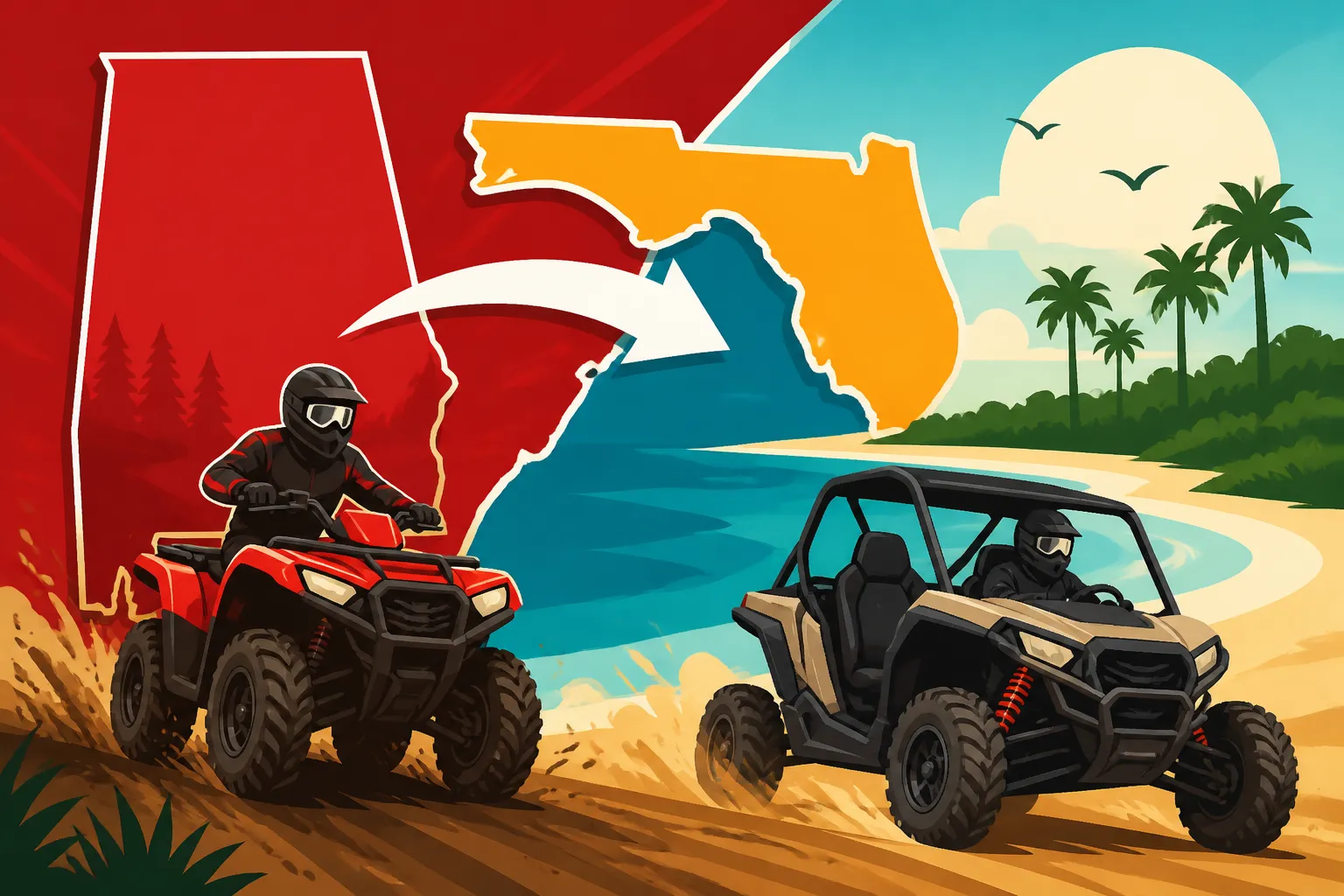
Driving from Alabama to ride in Florida’s Panhandle raises a practical question: does your home-state paperwork let you ride once you cross the state line? The short answer is that you should not assume it does. Florida access rules depend on where you ride, and a land-use pass, ownership papers, and safety requirements are separate things to check.
What Alabama riders should check before crossing into Florida
“Reciprocity” can mean different things: whether Florida recognizes an out-of-state registration, whether your machine needs a Florida title, or whether an Alabama pass gives you access to a Florida riding area. These are separate questions, and an answer to one does not automatically settle the others.
For riding, start with the land manager. A national forest, state forest, and private park can each set distinct access rules. A pass for one property does not necessarily cover another, and a machine that is allowed at one site may not meet another site’s width, equipment, or trail requirements.
Before leaving Alabama, identify the exact riding area and confirm:
- Whether ATVs, UTVs, or both are allowed on the routes you plan to use.
- Whether the site requires a day-use or annual OHV pass, and how to obtain it.
- Whether the pass is issued per vehicle or per rider.
- What ownership documents or identification riders should carry.
- Whether age, safety-course, helmet, or supervision rules apply.
- Which routes are open and whether weather, fire, hunting, or maintenance has caused closures.
For example, the Panhandle includes public lands managed under different systems, such as Apalachicola National Forest and state forests. That does not mean every road or trail on those lands is open to OHVs. Confirm access for the specific area and route, rather than relying on a map pin or a general statement that a forest allows riding.
An Alabama registration or other home-state document may help show where a machine is from, but do not treat it as a Florida trail pass. Likewise, a Florida land-use pass is not proof that you own the machine. For a closer look at the visitor question, see Florida Rules for a Visiting Rider From Alabama and Florida OHV Permit Rules for Out-of-State Riders.
Florida permits and out-of-state paperwork are different
A land-use pass grants access only under the rules of the land manager that issued it. It does not make an ATV or UTV street legal, replace ownership documents, or authorize riding on routes that are closed or not designated for OHVs.
Florida’s national forests and state forests may use different pass systems. If your plans include a national forest, check the current pass instructions for that property. The Florida National Forest OHV Pass: 3-Day, 7-Day or Annual explains the types of pass options to look into, while One Forest Pass Covers Both Ocala and Apalachicola addresses the relationship between those two national forests. Confirm the current coverage and purchase process before traveling; don’t assume a pass for a forest covers a nearby state forest or private park.
State forest rules are another separate check. Review Florida State Forest OHV Day Use and Annual Passes and the managing forest’s own instructions to see whether riding is authorized, which routes are open, and what pass applies. A forest may have public roads where OHVs are not permitted, or designated riding areas with their own restrictions.
| What you need to establish | What it answers | What it does not answer |
|---|---|---|
| Land-use pass | Whether you have the required access authorization for a particular property | Whether the machine is yours or allowed on every route |
| Ownership paperwork | Whether you can show a legitimate connection to the ATV or UTV | Whether you have paid for access |
| Registration or title documents | What paperwork applies to the machine and its owner | Whether a trail is open or street use is allowed |
| Safety-course proof, if required | Whether a rider meets an applicable training rule | Whether the rider can use any machine or trail |
| Site-specific rules | Which machines, riders, and routes are permitted there | Whether a different property follows the same rules |
For the title question, avoid relying on broad claims about “reciprocity.” Florida’s requirements can depend on whether the rider is a resident, the machine’s use, and the location. Check Does Florida Honor an Out-of-State ATV Registration? and Do Florida Visitors Need to Title a Quad for the related distinctions, then verify the rule with the appropriate official office or land manager if your situation is unusual. A title, registration, or bill of sale is not a substitute for an OHV access pass.
Plan for the Panhandle site, not just the state line
The Panhandle is a region, not one riding area with one permit. A trip near Apalachicola, Tate’s Hell, or another public property can involve different agencies and rules. Even within a forest, permitted OHV routes may be limited to marked or designated roads and trails. Do not assume that an open-looking road, utility corridor, or sandy track is legal to ride.
Use this sequence to confirm a destination:
- Name the property and entrance. Search for the official land manager’s information rather than relying only on a nearby town, trail app, or social post.
- Check machine eligibility. Confirm that your ATV or UTV type and dimensions are allowed. Some riding areas restrict wider machines or allow only certain classes.
- Check the route map and closures. Make sure the exact route is open to your vehicle. Conditions and temporary closures can change.
- Read the pass instructions. Confirm whether you need to purchase in advance, use a kiosk, display a pass, or complete another step.
- Check rider rules. Look for minimum-age, supervision, helmet, and safety-training requirements.
- Save the current instructions. Keep the relevant map, pass confirmation, and contact details accessible even if cell service is weak.
An Alabama resident who plans to ride more than one property should check each property’s rules separately. A pass bought for one forest may not be accepted at a state forest, a private park, or a different public recreation site. If you plan to visit multiple national forest areas, read One Forest Pass Covers Both Ocala and Apalachicola carefully and verify that the pass you select matches your itinerary.
Conditions also matter. Rain, fire danger, hunting activity, maintenance, and other management needs can affect route access. Check Florida Trail Closures You Should Check First shortly before departure, not just when you first plan the trip. If the route you wanted is closed, use only a legal alternative approved for the same machine type; do not ride around a gate or onto an unmarked track.
Carry the right documents and prepare riders
Keep proof of ownership or other machine paperwork available, along with any required pass and rider documents. The precise paperwork to carry can depend on the site and the machine’s circumstances, so confirm the list with the land manager. Carrying Proof of Ownership on the Trail covers why these papers can matter during a ride.
A simple document setup helps prevent avoidable delays. Keep paper documents in a waterproof sleeve or sealed bag, and store digital copies on your phone as a backup. A waterproof document sleeve—whether bought through Amazon or another retailer—can protect papers from rain, mud, and splashes, but it does not replace an original document when an official requires one. Keep any pass displayed or stored exactly as its issuer directs.
Check rider requirements before bringing children or inexperienced riders. Public-land rules may include age-related safety training or supervision conditions. The details are not necessarily the same as the rules at a private riding park. Review Florida ATV Safety Course for Public Land Riding, and confirm the requirements for the actual property and each rider’s age.
Bring appropriate protective gear, including helmets where required, eye protection, sturdy footwear, and clothing suited to the weather and terrain. In the Panhandle, heat, rain, standing water, and changing trail conditions can affect a ride. Pack drinking water, basic first-aid supplies, and a way to contact help. Tell someone where you are going and when you expect to return, especially if you will be riding somewhere with limited phone coverage.
Before unloading, check that the machine is in safe working order and that everyone understands the route plan and group signals. Ride only where signs and current maps allow. If instructions at the gate or from staff differ from an old map or online post, stop and ask before continuing.
A simple checklist for Alabama visitors
Use this checklist the day before the trip:
- Confirm the property is open and allows your type of machine.
- Check which specific roads or trails are designated for OHV use.
- Find out which pass is required and whether it must be purchased ahead of time.
- Confirm whether any out-of-state paperwork or proof of ownership should be carried.
- Review rider age, supervision, and safety-course requirements.
- Check equipment and width restrictions for ATVs and UTVs.
- Look for current closures, weather notices, and access changes.
- Save maps, pass details, and the land manager’s contact information.
- Pack protective gear, water, and documents in a secure place.
- Make sure your trailer and tow vehicle are ready for the trip as well.
The safest approach is to treat Alabama paperwork as supporting documentation, not as permission to ride in Florida. Confirm the pass, machine eligibility, and route rules directly with the land manager for each destination. That small check can prevent a wasted drive and help keep the ride on authorized ground.
Disclaimer
This article is for general informational purposes only and does not constitute professional advice. Laws, prices and regulations vary by location and change over time. Consult a qualified professional for guidance on your specific situation.