Georgia Riders Heading South for Winter
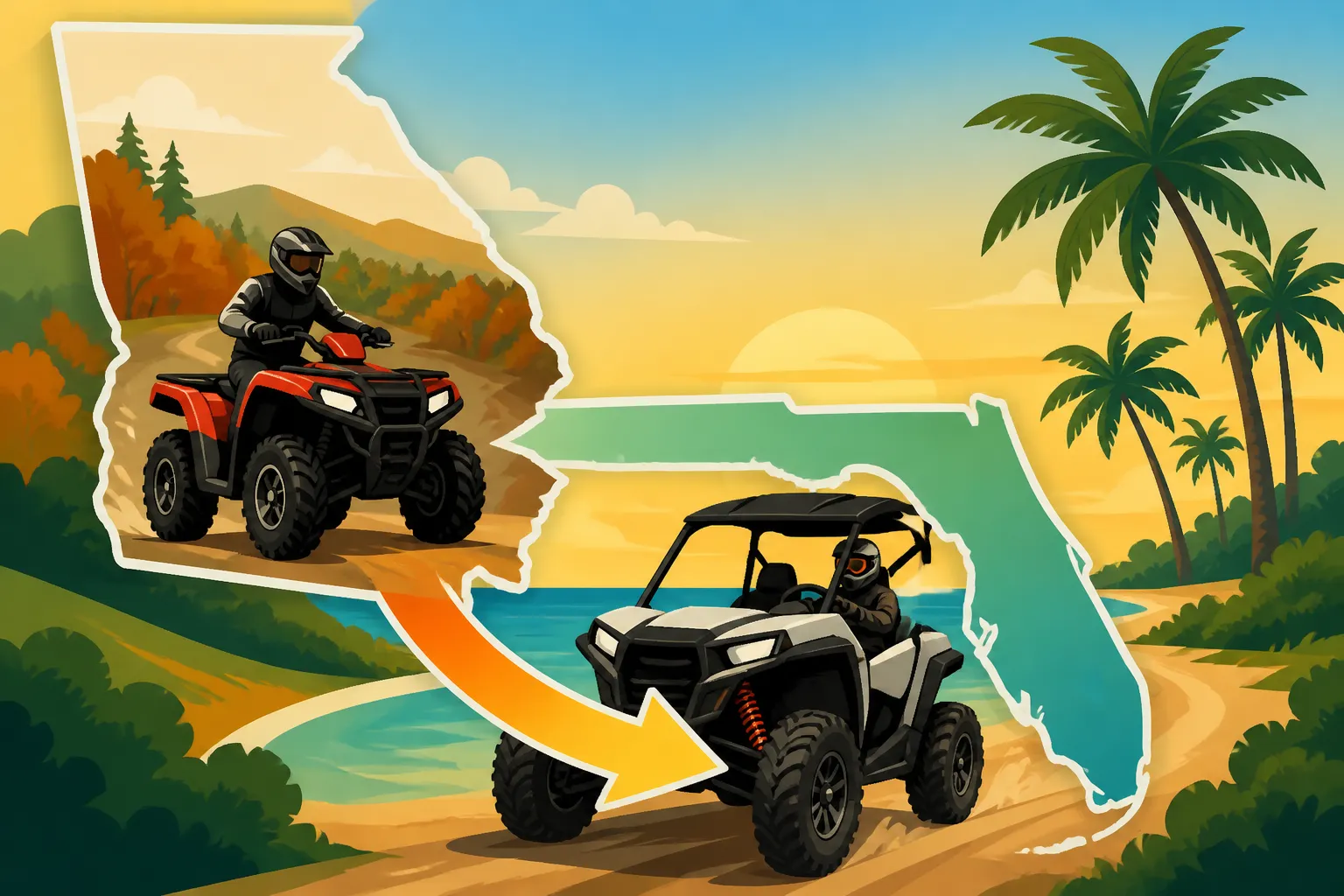
Georgia riders heading to Florida for winter often assume their home-state paperwork covers every trailhead. It may not: Florida’s riding areas can have separate pass, title and safety requirements. Check those rules before loading the trailer so you know what to carry and where your Georgia documents do—and do not—help.
What Georgia paperwork does and does not cover
A Georgia title, registration or other proof of ownership can help show that a machine belongs to you. It does not automatically replace a Florida riding-area pass or satisfy every land manager’s entry rules. Florida requirements can depend on whether you ride in a national forest, state forest or private park, and on the machine and rider.
Keep your ownership documents with you, and check the rules for the exact area you plan to visit. A pass for one type of public land may not work at another. Before treating a Georgia registration as a substitute for a Florida title or pass, ask the relevant office what it accepts for an out-of-state machine. The details in Florida Rules for a Visiting Rider From Georgia may also help you sort out which rules apply to your trip.
| What you need to check | Why it matters | What to confirm before riding |
|---|---|---|
| Proof of ownership or title | A machine’s paperwork may not meet every Florida requirement | Whether the land manager accepts your Georgia document |
| Riding-area pass | Public land can require a separate pass for the machine | Which pass applies to the specific trail system |
| Rider safety rules | Requirements may vary by rider age and land type | Whether a course, certificate or adult supervision is required |
| Machine access | Width, type and other restrictions can exclude a machine | Whether your ATV or UTV is allowed on the chosen route |
| Seasonal closures | Trails and roads may close for conditions or land management | Current access notices and operating restrictions |
Do not confuse ownership paperwork with permission to ride. A title is evidence of ownership; it is not a trail pass, road permit or guarantee that a particular machine can use a particular route. For a closer look at the distinction, see Florida ATV Title vs Registration: The Difference and Florida OHV Permit Rules for Out-of-State Riders.
If your machine has no Georgia title, do not assume that a bill of sale alone settles the question. Keep any available purchase and ownership records, then ask the Florida land manager or title office what documentation it will accept. Proof of Ownership When the MSO Is Missing explains why the original manufacturer’s paperwork can matter.
Passes depend on where you ride
Florida does not have one statewide OHV pass that covers every public trail. National forest riding areas and state forest OHV areas can have separate systems, and each may have its own ways to buy or display a pass. Private parks set their own entry terms. A Georgia resident should plan around the riding area, not simply the state where the machine is registered.
National forest riding
For a national forest OHV area, check the current pass instructions for that forest and trail system. Confirm whether the pass is required for each machine, how it must be displayed or carried, and whether your planned route is open to your vehicle type. Do not assume a pass bought for a different Florida riding area will transfer.
The Ocala and Apalachicola National Forests have a shared pass arrangement described in One Forest Pass Covers Both Ocala and Apalachicola. Still, check the current access instructions before leaving home: a pass does not override a closure or machine restriction. For buying and carrying the correct pass, see Florida National Forest OHV Pass: 3-Day, 7-Day or Annual and Printing a Pass Before You Leave Home.
State forest riding
State forest OHV areas use a different system from national forests. Check the Florida Forest Service’s current requirements for the location you want to visit, including whether you need a day-use or annual pass and how to obtain it. A national forest pass should not be treated as permission to ride in a state forest.
If you plan to ride more than one area, list them before you buy anything. Then compare each site’s pass rules and confirm that the pass you choose applies to every intended location. Florida State Forest OHV Day Use and Annual Passes and How to Buy a Florida State Forest OHV Pass cover the state forest process.
Private parks
Private riding parks set their own admission, vehicle, age and safety rules. A public-land pass does not usually replace a private park’s entry requirements. Ask the park directly about your machine’s width and type, rider age restrictions, required equipment, and whether any waiver or proof of ownership is needed.
Before traveling, also check whether the park requires reservations or has limited operating days. A trailhead being open on a map does not guarantee that a private facility will admit walk-ins or allow every kind of ATV or UTV.
Confirm the machine and rider rules before departure
A pass is only one part of the preparation. Florida’s machine classification and trail restrictions can affect whether your quad or side-by-side is allowed. A route that works for a narrow ATV may not allow a wider UTV. Confirm vehicle limits with the land manager rather than relying on a general description of the riding area.
That is especially important if you are bringing a side-by-side. Florida’s classifications use factors such as width and vehicle type, and local trail rules may be narrower than the broad legal category. See Florida’s 55-Inch ATV Definition and Why It Matters and Florida UTV Titling for Side-by-Sides Over 55 Inches for related title and classification questions. A title classification does not, by itself, grant trail access.
Rider age can also change what is required. Some public-land rules call for safety training and adult supervision for younger operators. Check the exact requirements for the forest or park you plan to visit, and carry any certificate or proof the site says you must have. The rules can differ between public lands and private facilities; a course requirement at one location does not automatically describe every location.
Use this checklist for every riding area on your itinerary:
- Identify the land manager and the specific trail system, not just the nearest town.
- Check whether the route is open and whether your ATV or UTV is allowed.
- Confirm the required pass, whether it applies per vehicle, and how it must be displayed or carried.
- Ask whether your Georgia title, registration or other ownership document is accepted for your machine.
- Check rider age, safety-course and supervision requirements.
- Review seasonal closures, operating hours, equipment rules and any private-park conditions.
- Save the official instructions and contact details where you can access them without cell service.
If the answer is unclear, ask the office responsible for that specific area. A county tax office can answer title questions, but it may not know a forest’s current pass or trail access rules. Likewise, a trailhead kiosk may explain entry requirements without resolving whether your machine’s ownership documents satisfy a title rule.
A winter visit plan that avoids counter surprises
Start with the riding location, then work backward through paperwork. If you are visiting for several weeks, it can be tempting to buy an annual pass or rely on a familiar Georgia document. First make sure the pass covers your destinations and that your machine is eligible to ride there. Confirm current terms with the provider because pass details and access conditions can change.
Keep digital and paper copies of your documents, but follow the land manager’s instructions for what must be physically carried or displayed. Store ownership records separately from passes so you can produce the right item if asked. If you have several machines, verify whether each needs its own pass rather than assuming one pass covers the trailer or the group.
Do not save all checks for the morning of your first ride. A missing pass can interrupt the day, but so can a width restriction, a closed trail or an age-related requirement. Contacting the land manager ahead of time is especially useful when your machine is modified, unusually wide, newly purchased or titled in another state.
Finally, remember that permission to ride off-road is not permission to ride on public roads. Florida roadway use has separate limits and may depend on local designations and conditions. If you plan to connect trails using roads, review Florida ATV Road Rules by County and Can You Drive an ATV on the Road in Florida? before the trip. For public-land access, use the trail system’s designated routes and follow posted signs.
The simplest approach for Georgia snowbirds is to treat every Florida riding area as its own check: verify the machine, pass, paperwork and rider rules with the land manager that controls the route. That takes a little planning, but it is much easier than learning at the gate that a Georgia document or pass does not cover what you expected.
Disclaimer
This article is for general informational purposes only and does not constitute professional advice. Laws, prices and regulations vary by location and change over time. Consult a qualified professional for guidance on your specific situation.