Out-of-State Plates at a Trailhead
An out-of-state plate can look like proof that your ATV or UTV is legal, but it does not automatically give you permission to ride a Florida trail. The rules depend on who manages the land, what paperwork your home state issues, and whether the riding area requires its own pass. Here’s what to check before you unload.
What an out-of-state plate does and does not prove
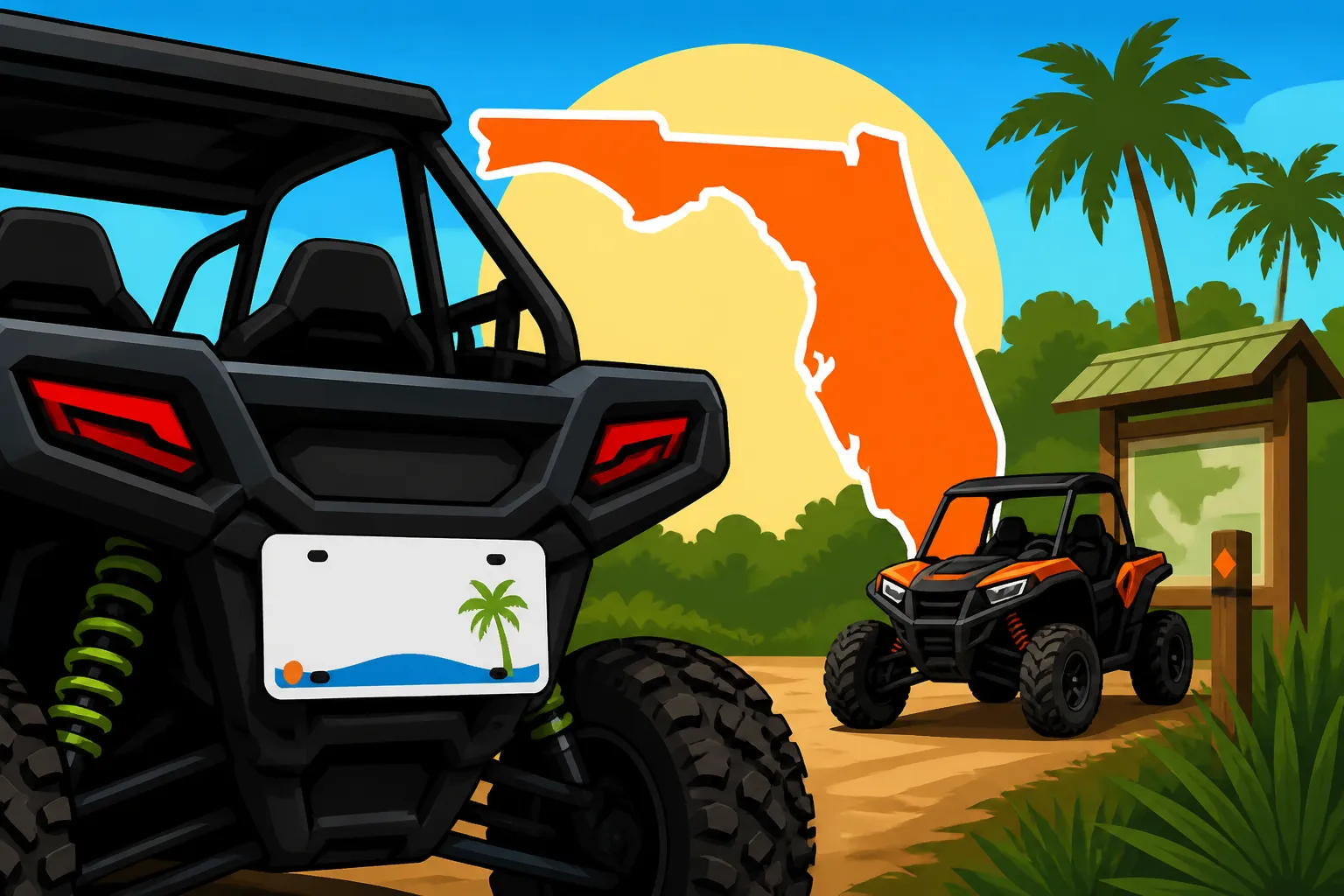
First, clarify which vehicle has the plate. A plate on your truck or trailer is not an ATV permit. It helps identify a road vehicle, while the off-highway machine may be covered by a different set of ownership, safety, and land-access rules. Even if your ATV or UTV carries a plate from another state, that plate does not by itself guarantee trail access in Florida.
For an off-highway machine, a plate or registration generally shows that a state has recorded some information about the vehicle. The details vary: one state may issue a plate for off-road use, another may issue a registration document without a road plate, and another may rely more heavily on a title or ownership certificate. These documents can be useful when a ranger or check-in attendant asks about the machine, but they are not the same as a pass to ride on a particular property.
Florida public riding areas are managed by different agencies, and their requirements are not interchangeable. A pass that works for one kind of public land may not cover a different trail system. Likewise, a document accepted as proof of ownership is not necessarily a substitute for the land manager’s riding pass. The central question is not simply, “Is my ATV plated?” It is, “Does this land manager accept my paperwork, and have I met that location’s access requirements?”
That distinction matters because out-of-state paperwork can be easy to misread at a trailhead. A vehicle may be titled in your home state but have no plate. It may have a registration card, a decal, or a plate that is intended only for off-road use. None of those arrangements automatically establishes that Florida will treat the machine as road legal, and trail access does not make it road legal either.
If your machine has an out-of-state title or registration, keep the original document or a clear, accessible copy with you. Carry a bill of sale or other ownership record if the title is not in your name, or if the machine is new and you have not yet received final paperwork. A photo of a document on your phone may be convenient, but do not assume every location will accept it in place of the original. Ask the specific site what it wants riders to carry.
For the difference between a home-state registration and Florida’s rules, see Does Florida Honor an Out-of-State ATV Registration?. If you are visiting rather than living in Florida, Do Florida Visitors Need to Title a Quad covers the separate question of titling. A Florida title is not a riding pass, and an out-of-state plate is not a substitute for checking title obligations that may apply to Florida residents.
Reciprocity is not the same as trail permission
“Reciprocity” can mean different things in different contexts. Riders often use it to ask whether Florida recognizes an out-of-state registration or plate. But even if a document is useful as proof that your machine is recorded elsewhere, that does not automatically mean every Florida trail accepts it, or that it replaces a required pass.
Think of the requirements as separate checks:
| What you are checking | What it answers | What it does not answer |
|---|---|---|
| Title or ownership paperwork | Who owns the machine, or what document supports the ownership claim | Whether you may ride a specific trail |
| Home-state registration or plate | What your home state has recorded or authorized | Whether Florida treats the machine as road legal |
| Florida land manager’s pass or permit | Whether you have met that location’s access requirement | Whether your machine is titled or properly documented |
| Safety-course or rider requirement | Whether a rider meets an applicable safety rule | Whether the trail is open or the machine is allowed |
| Trailer or road-vehicle plate | Whether a road vehicle is identified under its applicable rules | Whether the ATV or UTV itself has trail access |
The practical step is to check with the agency or private property that operates the trail, rather than relying on the issuing state’s plate alone. Ask whether it accepts your particular out-of-state registration as ownership documentation, whether you need to bring a title or bill of sale, and whether the land has its own permit or pass requirement. If your paperwork is unusual, describe exactly what you have: a title, registration card, off-road sticker, plate, or manufacturer document.
That question is especially important if you are riding on public land. The rules can differ between a national forest trail system and a state forest riding area, and a pass for one is not automatically a pass for another. Details such as whether the pass is assigned to a person or a vehicle, which machines it covers, and how it must be displayed can also depend on the land manager. Check the current official instructions before leaving home, since access rules and pass procedures may change.
For a more detailed breakdown of visitor requirements, see Florida OHV Permit Rules for Out-of-State Riders. If you are planning to ride on public land, Florida Riding on Public Land: Permits and Proof can help you think through the documents and access checks separately. For national forest riding, check the specific requirements described in Florida National Forest OHV Pass: 3-Day, 7-Day or Annual. For a state forest, use How to Buy a Florida State Forest OHV Pass as a starting point, then confirm current instructions with the relevant forest.
Do not assume a public-road plate gives you permission to ride on an off-road trail, or that an off-road plate lets you use a public road. Trail riding and road use are separate activities with separate rules. If the plan includes riding to a trailhead on public roads, check the road-use rules for the exact route rather than treating the machine’s home-state plate as blanket permission. Florida ATV Road Rules: Where You Can Legally Ride explains why access to a trail and permission to ride on a road are different questions.
What to confirm before driving to the trailhead
A quick call or check of the managing agency’s official page can prevent a long trip that ends at the gate. Give the staff the details that affect the answer: the trail or property name, your state of residence, the machine type, and the exact document you have. “It has a plate” may not be enough information, because the staff may need to know whether it is an off-road registration, a road registration, or a plate belonging to the trailer.
Ask these questions before you leave:
- Is the trail open to my type of machine? A trail may have restrictions based on vehicle class, width, or other characteristics. Do not assume that an ATV and a side-by-side can use the same routes.
- What pass or permit does this specific property require? Ask whether it is needed for each machine or rider, how to obtain it, and whether it must be displayed on the vehicle.
- What paperwork should I carry for an out-of-state machine? Explain whether you have a title, registration card, plate, bill of sale, or manufacturer’s ownership document.
- Are there rider requirements? Ask whether an age-related safety course or supervision requirement applies to the riders in your group.
- Are there location-specific restrictions or closures? A valid pass does not make a closed trail available. Confirm current access conditions before loading up.
If the answer depends on your machine’s classification, be ready to describe it accurately. An ATV, an off-highway motorcycle, and a side-by-side can fall into different categories for some requirements. The machine’s label in a home-state registration may not settle how Florida’s land manager classifies it. Share the manufacturer, model, width, and vehicle type if staff ask. Do not guess about classification based only on the plate.
Also distinguish state-managed sites from national forest areas and private parks. Private parks set their own admission and operating requirements, while public land follows the rules of its managing agency. A pass bought for one location should not be treated as a general Florida riding permit. Check the actual property you plan to visit, even if you have ridden somewhere else in the state.
When staff confirm what documents are accepted, follow their instructions closely. If they require a paper pass or a particular display location, prepare it before you reach the entrance. Save confirmation details and the agency’s contact information with your trip notes. That is more useful than trying to resolve a paperwork question while a line of riders waits behind you.
A trailhead checklist for visiting riders
Before unloading, make sure you have covered both the paperwork and the access rules. These are separate checks, and completing one does not automatically complete the other.
- Confirm the land manager. Identify whether the destination is national forest, state forest, another public property, or a private park. Use the requirements for that exact site.
- Check whether the trail is open to your machine. Confirm any restrictions on vehicle class or dimensions, and ask whether the route is suitable for your group.
- Get the required pass or permit. Confirm how to buy it, which machine it covers, and whether it needs to be displayed. Do not assume an out-of-state registration replaces it.
- Carry ownership paperwork. Bring the title or other document the site accepts. If the machine is borrowed, recently purchased, or titled to someone else, ask what additional proof is appropriate.
- Keep the home-state registration available. If you have an off-road registration card or plate, carry the related document rather than relying on the plate alone.
- Check rider rules. Make sure each rider meets any applicable safety-course, age, or supervision requirements for the property.
- Keep the trailer paperwork separate. A trailer plate relates to the trailer; it does not establish that the ATV or UTV has met trail requirements.
- Recheck conditions before departure. Closures, weather, land-management notices, and pass procedures can affect whether a trip is possible.
If a ranger or gate attendant asks about the plate, answer plainly and show the documents that support your explanation. Avoid presenting an out-of-state plate as proof that every Florida requirement has been met. A calm, complete response can make it easier to sort out whether the question is about ownership, land access, or a road-use issue.
For a broader list of what to carry while riding public land, see What to Carry Into a Florida State Forest. If you are unsure what counts as ownership evidence, Carrying Proof of Ownership on the Trail covers that practical issue. Riders who are becoming Florida residents should also check how their status affects titling; visitor guidance is not a substitute for resident requirements. Florida ATV Title Requirements for a New Resident addresses that separate situation.
The safest planning rule is simple: treat the plate as one piece of information, not as a universal permission slip. Confirm what the trail’s land manager accepts, get the correct site-specific pass, and carry documents that clearly connect you to the machine. That approach is more reliable than finding out at the gate that registration, ownership, and trail access are three different questions.
Disclaimer
This article is for general informational purposes only and does not constitute professional advice. Laws, prices and regulations vary by location and change over time. Consult a qualified professional for guidance on your specific situation.