Buying a Quad From a Craigslist Seller With No Title
Finding that perfect quad on Craigslist can feel like hitting the jackpot, especially when the price looks almost too good to be true. But then you see it: "No title." Your heart sinks a little, right? You're left wondering if it's a steal or a headache waiting to happen. This guide is here to walk you through the often-confusing world of buying an ATV in Florida when the seller can't produce a title, helping you understand the risks and what, if anything, you can do to make it yours legally.
The Risky Business of an Untitled Quad Purchase in Florida
Let's be real, the thought of saving a few hundred bucks on a quad is tempting. But when that machine comes without a title, you're not just buying a toy; you're buying into a potential mountain of paperwork, stress, and even legal trouble. It’s crucial to understand what you’re really getting into before you hand over any cash.
Why a Title Matters More Than You Think
In Florida, an ATV title isn't just a piece of paper; it's the official proof that you are the legal owner of that machine. Think of it like the deed to your house or the title to your car. It formally links you, the owner, to that specific off-highway vehicle (OHV) by its unique Vehicle Identification Number (VIN). Without it, proving ownership can become an uphill battle. This is especially important because [Florida Off-Highway Vehicle Title Rules Explained] clarify that any ATV operating on public lands or trails in Florida must be titled. If you plan to ride anywhere other than fully private property where you have explicit permission, a title is non-negotiable.
Beyond legal compliance, a title acts as a safeguard. It helps prevent the sale of stolen vehicles and ensures that any liens (debts against the vehicle) are properly recorded and addressed. Imagine buying a quad, only to find out later it was stolen, or that a bank still holds a claim on it. A clear title protects you from these nightmare scenarios, giving you peace of mind that your investment is legitimate and legally yours.
The Red Flags of a Craigslist "No Title" Listing
When browsing listings, you’ll inevitably come across sellers offering a quad with no title. They might have a whole slew of reasons: "I lost it," "It was a farm quad, never needed one," "It was inherited," or "I just never got around to titling it." While some of these might be legitimate, they are all massive red flags that should make you proceed with extreme caution. The biggest danger here is inadvertently buying a stolen machine or one that has a hidden lien against it. [Florida ATV Title With a Lien Recorded] describes how liens are recorded, and if there's no title, there's no easy way for you to check for this crucial information.
Often, you'll see prices that seem unbelievably low for the condition or model year. This is a classic tactic used to offload problem machines. A seller who is upfront and has all the proper documentation typically wouldn't discount their price so heavily just because they "lost" a title that is relatively inexpensive to replace. Always be suspicious of deals that appear too good to be true, especially when the seller can't provide basic proof of ownership. These situations often leave buyers in a bind, unable to title their new purchase and potentially out a significant amount of money.
What You Risk Legally and Financially
The risks of buying an untitled ATV are substantial, both legally and financially. First and foremost, without a title, you cannot legally operate your quad on any public land in Florida. This includes state forests, national forests like Ocala, or any designated OHV parks. [Riding Public Land as the Trigger for a Title] clearly states that a title is required. If you're caught riding an untitled ATV on public property, you could face fines, penalties, and even have your machine impounded. [Penalties for Operating Untitled on Public Land] can be quite steep and quickly negate any savings you thought you were getting.
Financially, you're looking at a serious liability. If the machine turns out to be stolen, it will be confiscated by law enforcement, and you'll lose your money with little to no recourse. If a hidden lien surfaces, the lienholder could repossess the ATV, leaving you empty-handed and still on the hook for the purchase price. Furthermore, if you ever try to sell the machine down the road, you'll face the same exact challenges you're experiencing now, making it incredibly difficult to find a buyer and significantly diminishing its resale value. It's a cycle that traps many buyers in a difficult position.
What to Do BEFORE You Buy an Untitled ATV
Okay, so you've found a quad you love, and it's untitled. Before you even think about exchanging cash, there are critical steps you absolutely must take to protect yourself. Skipping these due diligence measures can lead to regret, frustration, and a significant financial hit.
Thoroughly Investigate the Seller and the Machine
First things first: ask direct, clear questions about why the title is missing. Don't let vague answers slide. A truly honest seller should be able to explain the situation clearly, even if it's "I bought it from a friend years ago and he never gave me the title." Pay attention to inconsistencies or evasiveness. It's a huge red flag if they can't or won't provide a straightforward explanation. Then, demand a bill of sale. Even if they claim it's not needed, it's your only proof of purchase. A comprehensive bill of sale should include the seller's and buyer's full legal names and addresses, the date of sale, the purchase price, the make, model, year, and crucially, the Vehicle Identification Number (VIN) of the ATV. This document should also clearly state that the seller is transferring all ownership interest to you. For a reliable, legally sound document, consider using a template from a service like LawDepot to ensure all necessary fields are covered and it holds up as evidence. [Florida ATV Bill of Sale: What It Needs to Say] outlines other important information this document should contain.
Next, and this is non-negotiable, you absolutely must verify the VIN. The VIN is like the quad's fingerprint. It's usually stamped on the frame, often near the steering head, engine block, or under the seat. Once you have it, you need to check if the ATV has been reported stolen or has any outstanding liens against it. You can do this through online VIN check services, though some may charge a fee. You can also contact your local law enforcement agency or the National Insurance Crime Bureau (NICB) to inquire about its theft status. [Who Can Verify an ATV VIN in Florida?] further explains the importance of this step. Be incredibly wary if the VIN appears tampered with, unreadable, or if the seller tries to prevent you from inspecting it thoroughly. If the VIN comes back as stolen or with an active lien, walk away immediately. It's not worth the risk.
Understanding Florida's Proof of Ownership Hierarchy
When it comes to proving ownership of an OHV in Florida, there's a clear hierarchy of documents, and a title sits at the very top. For brand new machines, the Manufacturer's Statement of Origin (MSO) is the initial proof of ownership issued by the factory. This document is then used by the dealer to apply for the first title in the buyer's name. [When an MSO Beats a Bill of Sale] helps differentiate between these key documents. If a quad has never been titled, the MSO (if available and correctly assigned) is your best bet, but this is rare for a used machine on Craigslist.
Without an MSO or a previous title, a bill of sale becomes your primary, albeit weaker, form of evidence. While a bill of sale proves you purchased the machine, it doesn't necessarily prove the seller legally owned it or that it's free of encumbrances. The Florida Department of Highway Safety and Motor Vehicles (FLHSMV) and your county tax collector will scrutinize any application for a title based solely on a bill of sale, especially if the machine should have been titled by a previous owner. The challenge often arises when the machine was sold multiple times without any of the previous owners ever getting a title. Each missing link in that chain of ownership makes your quest to title it significantly harder. As explained in [Selling an Untitled ATV in Florida], this is a common trap for buyers.
Paths to Titling a Florida Quad Without a Traditional Title
So, you've done your due diligence, and you've decided to move forward despite the missing title. What are your options for actually getting a legal title in your name in Florida? It’s not a simple stroll to the tax collector’s office, but there are specific procedures for these non-standard situations.
The Bonded Title Process: A Last Resort
For many untitled vehicles where a clear chain of ownership cannot be established through traditional means, Florida offers the option of a bonded title. This process is essentially a way to legally prove ownership when you don't have the typical documents. A bonded title requires you to purchase a surety bond, which acts as a form of insurance. This bond protects any previous owners or lienholders who might come forward later claiming ownership or a financial interest in the ATV. If someone successfully proves they are the rightful owner within the bond period (usually three years), they can make a claim against your bond, and you could lose the machine and the money you paid for it. This is why it's considered a last resort, as it doesn't guarantee a clear outcome without financial risk.
The steps for a bonded title typically involve applying to the FLHSMV, often through your county tax collector's office. You'll need to fill out specific forms, have the VIN verified (again, [Who Can Verify an ATV VIN in Florida?] is useful here), and then obtain the surety bond for a value determined by the state, usually 1.5 times the ATV's value. The tax collector will then review your application, which can take time, and they may require additional documentation or an affidavit explaining why the title is missing. This process isn't quick or cheap; the bond itself has a cost, plus the usual title fees, and the entire procedure can stretch out over several weeks or even months. Having a detailed bill of sale, perhaps drafted using a template from LawDepot, can strengthen your application, but it doesn't eliminate the need for the bond or the state's rigorous review, as explained in [What a Bonded Title Takes in Florida].
Seeking Out Previous Owners
If the seller tells you they never titled the quad because they bought it from someone else who didn't title it, and so on, your ideal (but often impossible) path would be to trace back the chain of ownership. This would involve contacting all previous owners to get properly assigned bills of sale from each person in the chain, ending with the original titled owner or the person who received the MSO from the dealer. The goal is to piece together a complete paper trail proving legitimate transfers from one owner to the next.
In a perfect world, you'd eventually track down the person who truly held the original title or MSO, have them properly assign it to the person they sold it to, and so on, until it legitimately reaches you. However, with a Craigslist sale, this is almost always a pipe dream. People lose touch, move away, or simply aren't interested in helping a stranger resolve their paperwork issues years later. Many Craigslist sellers are intentionally vague about prior owners to avoid accountability. The more hands a quad has passed through without a title being issued or transferred, the more remote your chances of successfully tracking down everyone and securing the necessary documentation become.
The Role of a Valid Bill of Sale
Even without a traditional title, a comprehensive, legally sound bill of sale is absolutely vital. It is your foundational document proving that a transaction occurred and that you paid for the ATV. Without it, you have no legal leg to stand on whatsoever. A good bill of sale should include:
- The full legal names, addresses, and contact information for both buyer and seller.
- The specific date and time of the sale.
- The agreed-upon purchase price.
- A detailed description of the ATV, including make, model, year, color, and most importantly, the complete VIN.
- A clear statement that the seller is transferring all rights and ownership of the ATV to the buyer.
- Signatures of both the buyer and seller. Ideally, have it notarized, although Florida doesn't always require notarization for ATV bills of sale, it adds an extra layer of authenticity.
Using a template from a reputable source like LawDepot can help ensure you don't miss any critical information that could cause issues later. This document, while not a title itself, serves as the cornerstone of any application you make to the FLHSMV for a title in a non-standard situation. It's the proof of your intent and the details of your transaction, which the tax collector will review carefully when trying to establish your claim of ownership.
After the Purchase: Navigating the Florida Tax Collector's Office
Once you've made the purchase (with a solid bill of sale, of course) and taken all the investigative steps, your next hurdle is the Florida Tax Collector's office. This is where the rubber meets the road, and you'll present your case for getting a title for your untitled quad.
Required Documents for a Non-Standard Application
When you walk into the county tax collector's office, be prepared with a meticulously organized stack of paperwork. You'll definitely need a completed Form HSMV 82040, which is the official Application for Certificate of Title. This form requires detailed information about the ATV and the new owner. Critically, you will need your comprehensive bill of sale. The more detailed and legitimate this document appears, especially if you used a professional template from a service like LawDepot, the better your chances of making a strong case. If you performed a VIN inspection through a qualified authority (which you should have), bring that proof with you. [Who Can Verify an ATV VIN in Florida?] outlines who is authorized to do this.
Don't forget your personal identification! You'll need your valid Florida driver's license or ID card to prove who you are and establish residency. [Proving Florida Residency at the Counter] might require additional documentation, so be ready with utility bills or other proof of address if asked. Finally, be ready to pay the various fees and applicable sales tax. Having all these documents ready will show the clerk that you've done your homework and are serious about legally titling your machine, even under difficult circumstances.
What to Expect When You Visit the Tax Collector
Prepare for a thorough review of your application, perhaps even some skepticism. When you're trying to title a quad without a traditional title, the clerk at the counter has a duty to ensure everything is legitimate and above board. They will meticulously scrutinize your bill of sale, your VIN verification, and any other supporting documents you provide. [What a County Clerk Checks on Your Application] on an application means they'll be looking for any red flags or missing information. Be ready to answer questions about the purchase, why there's no title, and any efforts you made to contact previous owners.
It's entirely possible they will inform you that you need to go through the bonded title process, especially if the chain of ownership is unclear or very old. They may also ask for additional affidavits or written statements explaining the history of the vehicle. This is not a quick "in and out" process like transferring a clear title. Patience is absolutely key here. Don't get frustrated; just be polite, cooperative, and provide whatever information they request. The more you can prove your diligence and honest intent, the better.
Fees and Potential Additional Costs
Titling an ATV in Florida, even a straightforward one, involves several fees, and a non-standard situation might incur more. You'll pay the initial title application fee, which is explained in [The $29 Initial Title Application Fee Explained]. On top of that, Florida charges sales tax on the purchase price of the ATV, even for private sales. [Florida Sales Tax When You Title an ATV] clarifies how this is calculated. There's also a service charge, typically $4.25, that's applied to almost every title transaction, as detailed in [The $4.25 Service Charge on an OHV Title].
If you end up needing a bonded title, you will also incur the cost of the surety bond itself, which varies depending on the value of the ATV and the bonding company. This is an additional expense that can add significantly to your total outlay. If you're in a hurry and want to expedite the title process after your application is approved, there's an extra fee for a "fast title," as covered in [Florida Fast Title for an ATV: The $7 Expedited Option]. It's wise to budget for these potential extra costs when considering buying an untitled quad, as they can quickly add up and erase any perceived savings from the initial purchase price.
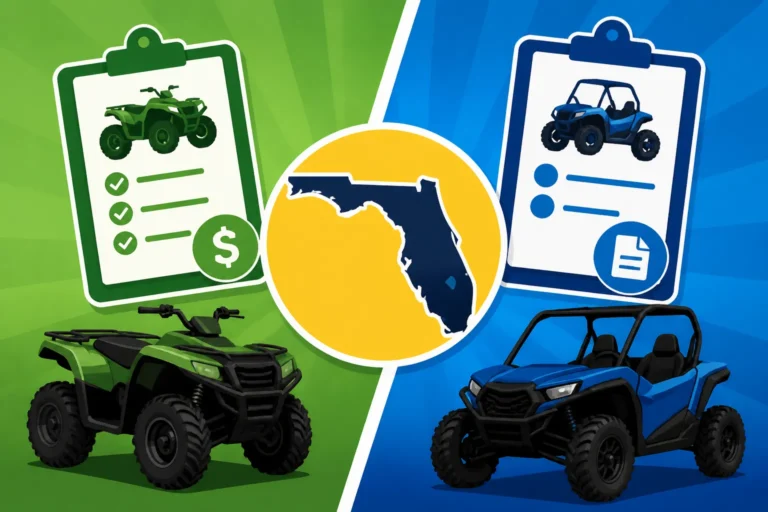
Buying with a Clear Florida Title vs. Buying a Craigslist Quad with No Title
To really drive home the differences, here's a comparison of what you can expect when buying an ATV with a clear title versus one from Craigslist with no title.
| Feature | Buying with a Clear Florida Title | Buying a Craigslist Quad with No Title |
|---|---|---|
| Proof of Ownership | Clear, recognized legal document provided by seller | Relies on bill of sale, MSO (if new), or potentially a bond process |
| Ease of Titling | Usually straightforward transfer process at the Tax Collector | Complex, often requiring extra steps, forms, and potential bonding |
| Risk of Theft | Low, can verify VIN against existing title and theft databases | Higher, VIN check is critical but not foolproof without title history |
| Riding on Public Land | Permitted once titled (and registered if applicable) | Not permitted until successfully titled and registered |
| Resale Value | Easier to sell, higher value with clear title | More difficult to sell, lower value, buyer skepticism |
| Time to Title | Standard processing times, often weeks | Can be significantly longer due to additional review and requirements |
| Cost to Title | Standard title fee, sales tax, service charge | Standard fees PLUS potential bond cost, legal fees, and more time |
Disclaimer
This article is for general informational purposes only and does not constitute professional advice. Laws, prices and regulations vary by location and change over time. Consult a qualified professional for guidance on your specific situation.