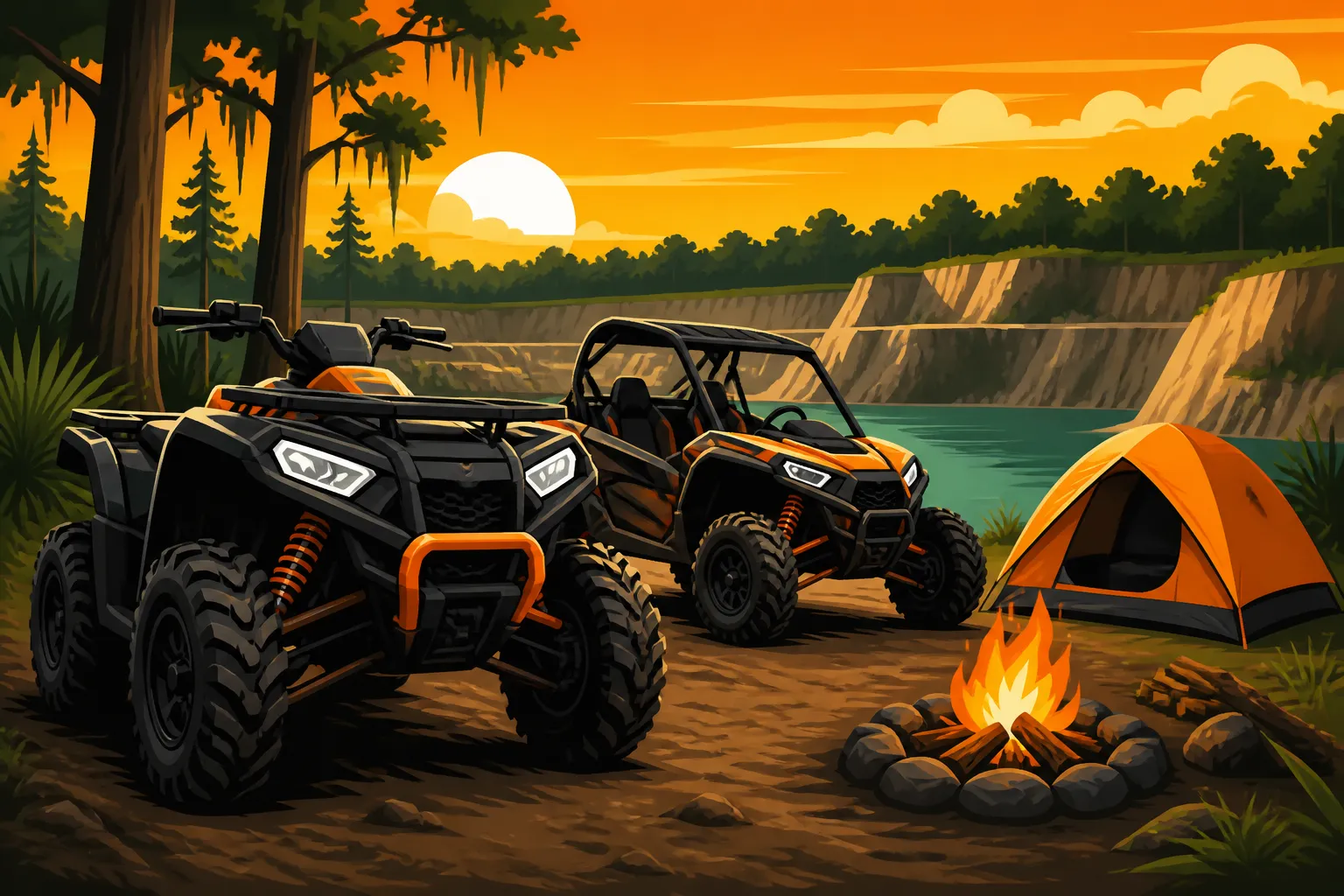
Croom Camping at Buttgenbach Mine
Camping at Buttgenbach Mine can make a Croom riding weekend easier: you can set up near the riding area instead of adding a long drive to every trail day. But campsite details, riding access, and required passes are separate things to confirm. This guide explains how to plan the stay, prepare your machines, and avoid common surprises at the campground and trailhead.
Planning a Buttgenbach Mine camping trip
Understand what the campground does and does not cover
Buttgenbach Mine is a campground associated with Croom Motorcycle Area in Withlacoochee State Forest, near Brooksville. Staying nearby can simplify a trip, especially if you’re hauling a quad or side-by-side and want to avoid packing up between riding days. Still, camping and riding are separate parts of the plan. A campsite reservation does not automatically answer whether your machine has the required access pass, whether the riding area is open, or whether your particular vehicle can use the trails.
Before you go, confirm the campground’s current arrangements and the riding area’s rules with the land manager. Ask about check-in and checkout, campsite availability, vehicle and trailer parking, permitted campfires, quiet hours, and whether any facilities or services you’re counting on are available. These details can change, and relying on an old social media post or a friend’s memory can leave you scrambling after you arrive.
It also helps to understand the bigger setting before choosing dates. Croom is a popular OHV destination, and trail conditions, operating arrangements, and access requirements may differ from those at other Florida riding areas. For a wider overview of the property and its riding opportunities, see [Croom Motorcycle Area: Florida's Biggest OHV Park]. If you’re comparing destinations that combine camping and riding, [Florida ATV Camping With Trail Access] can help you think through the trade-offs.
Keep camping logistics separate from riding requirements
A common planning mistake is treating a campground booking, an OHV pass, and permission to ride as one thing. They may involve separate steps. Check the requirements for each vehicle you plan to bring, not just the number of people in your group. Ask whether passes are tied to the machine, how they must be displayed, and whether you can obtain what you need before leaving home.
If you’re new to Florida’s forest riding areas, review [Florida OHV Permits: What You Need Before You Ride] before packing. Bring any required proof, and save confirmation emails or receipts somewhere you can access without a reliable signal. A printed copy can be useful if your phone battery runs down or you can’t get online at the trailhead.
| Part of the trip | What to confirm before departure | Why it matters |
|---|---|---|
| Campsite | Reservation, check-in process, site rules, and parking arrangements | A campsite may have different terms from the riding area |
| OHV access | Required passes, where to purchase them, and how they must be displayed | Camping does not necessarily include riding access |
| Machine eligibility | Width, machine type, and any trail-specific restrictions | Some vehicles may not be allowed on particular routes |
| Current conditions | Closures, weather impacts, and trail status | A route or area may be unavailable even if the campground is open |
| Camp setup | Fire, generator, pet, and quiet-hour rules | Local campground rules can affect what you bring and how you use your site |
Choosing dates, trails, and a suitable setup
Match your trip to the group and the machines
A relaxed family weekend and a technical riding trip call for different plans. If you’re bringing young riders, first-time riders, or people who prefer shorter outings, build in time to settle into camp and review the riding area before heading out. Don’t make the first ride a rushed attempt to cover as much ground as possible. A short, familiar route can give everyone time to get comfortable with the terrain, controls, and group-riding routine.
Before loading a side-by-side, check its dimensions and the specific access rules for the area. A machine that fits on a trailer may not fit the requirements for every trail or entrance. Croom’s width restrictions are one detail riders should verify in advance; [Croom's 55-Inch Width Check at the Gate] explains why a measurement can matter. Measure the machine as instructed by the land manager rather than estimating from a manufacturer’s general description or relying on a visual guess.
Use a current map to plan where you’re going, but don’t treat a map app as proof that a route is open or legal to ride. onX Offroad can help you organize waypoints and keep track of a planned route, particularly when you’re coordinating several riders. Check the map before the trip, download what you need if offline use is available to you, and compare your plan with official information. The land manager’s signs and rules take priority over an app’s displayed route.
Plan around Florida weather and trail conditions
Florida weather can change the feel of a weekend quickly. Heavy rain may affect trail surfaces, access roads, or the comfort of setting up camp, while heat and humidity can make a long ride more tiring than expected. Check the forecast close to departure and pack for both riding and camp comfort: drinking water, sun protection, a change of clothes, towels, and a way to keep essential gear dry.
Avoid assuming that a trail will be rideable because it was open the last time you visited. Closures can be seasonal, weather-related, or tied to land-management work. Check [Florida Trail Closures You Should Check First] before leaving, and call the campground or gatehouse if a closure could change your plans. [Calling the Croom Gatehouse Before You Drive] is a useful reminder to confirm time-sensitive details directly instead of making a long tow based on old information.
For navigation, onX Offroad may help your group follow a shared plan and note where you parked or turned around. It’s most useful as a planning aid, not a substitute for checking signs, posted restrictions, or current notices. If a route on the screen conflicts with a closed gate or official direction, follow the official direction.
Getting settled at camp and riding safely
Organize camp for an easier morning
After a long drive, it’s tempting to unload quickly and worry about the details later. A little organization on arrival can make the next morning much smoother. Park the tow vehicle and trailer where permitted, keep access lanes clear, and establish a simple place for helmets, goggles, gloves, and keys. If several people are sharing equipment, decide who is responsible for each machine and where the group will meet before riding.
Set up sleeping gear and food with the local rules in mind. Confirm whether fires, charcoal cooking, or generators are allowed at your site, and find out how trash should be handled. Don’t assume that a campground has the same facilities as a developed RV park. If you need electricity, water, showers, or a particular kind of restroom, check those details before departure rather than discovering a mismatch after dark.
Keep riding equipment separate from camp supplies where possible. A clean tote for dry clothes and personal items helps protect them from mud and dust. Store fuel and maintenance supplies only as permitted, and secure loose items before moving a machine. For a practical packing reference, [What to Carry Into a Florida State Forest] can help you think through the essentials without turning the trip into a full workshop-on-wheels.
Set group expectations before leaving camp
A group ride is safer and less stressful when everyone knows the basic plan. Agree on a lead rider and a sweep rider, set a pace that suits the least experienced person, and decide what to do if someone stops or loses sight of the group. Keep the group together at turns rather than assuming everyone knows which route to take. A phone map can be helpful, but riders should not be staring at a screen while moving.
Before starting, inspect tires, brakes, lights, controls, and fuel. Check that helmets and eye protection fit properly, and make sure each rider understands the machine they’ll operate. If children or inexperienced riders are part of the group, keep their first outing short and supervised. A campground is a convenient base, but it does not make the trails predictable or remove the need for sound riding judgment.
Use onX Offroad or another navigation tool to mark a meeting point and help riders understand the planned route before departure. Decide in advance what happens if the group becomes separated, including where to stop and how long to wait. Don’t rely solely on mobile coverage for communication; agree on simple hand signals and regrouping habits while everyone is together at camp.
Common planning mistakes and a practical checklist
Avoid assumptions that can derail the weekend
One frequent surprise is arriving with a machine that does not meet the area’s access requirements. Confirm vehicle type and width before hitching up, especially if you’re bringing a wider side-by-side or a modified machine. A tape measure and a quick check against the official rule are easier than arguing at the entrance after a long drive.
Another common problem is assuming a reservation includes every activity or fee. Confirm the campsite separately from riding access, and ask what each payment or pass covers. Likewise, don’t assume that trail access guarantees access to every route. Posted signs, closures, and vehicle restrictions still apply. A map app may show a line through an area without establishing that riding there is permitted.
Finally, don’t leave all preparation until arrival. A last-minute hunt for fuel, a missing strap, or a forgotten helmet can eat into the best part of the day. Check the tow vehicle and trailer, secure each machine properly, and give yourself enough time to unload without rushing. If your group is meeting other riders, share the campground’s confirmed location and agree on a fallback meeting point in case someone arrives late.
Use this pre-departure checklist
- Confirm your campsite reservation and the campground’s current rules.
- Ask about check-in, parking, facilities, fires, generators, and quiet hours.
- Verify riding access requirements for every ATV or UTV in your group.
- Check machine width and any trail restrictions that apply.
- Review current trail notices and weather before towing to Croom.
- Carry required passes, confirmations, and identification in an accessible place.
- Inspect machines, helmets, eye protection, trailer lights, and tie-downs.
- Pack water, sun protection, first-aid supplies, tools, and dry clothing.
- Download or prepare your navigation information, but follow official signs and closures.
- Agree on a group route, pace, meeting point, and plan if riders get separated.
For riders comparing trail loops after setting up, [Croom's Sand Hill Day-Use Loop] and [Croom's Hammock Day-Use Loop] are useful topics to review when deciding how to shape a day. Match the ride to your group’s experience and the conditions you encounter rather than trying to cover every route in one visit. A well-planned weekend at Buttgenbach Mine is less about squeezing in the most miles and more about having the right access, a comfortable camp, and a realistic riding plan.
Disclaimer
This article is for general informational purposes only and does not constitute professional advice. Laws, prices and regulations vary by location and change over time. Consult a qualified professional for guidance on your specific situation.