Fire Restrictions During a Dry Spring
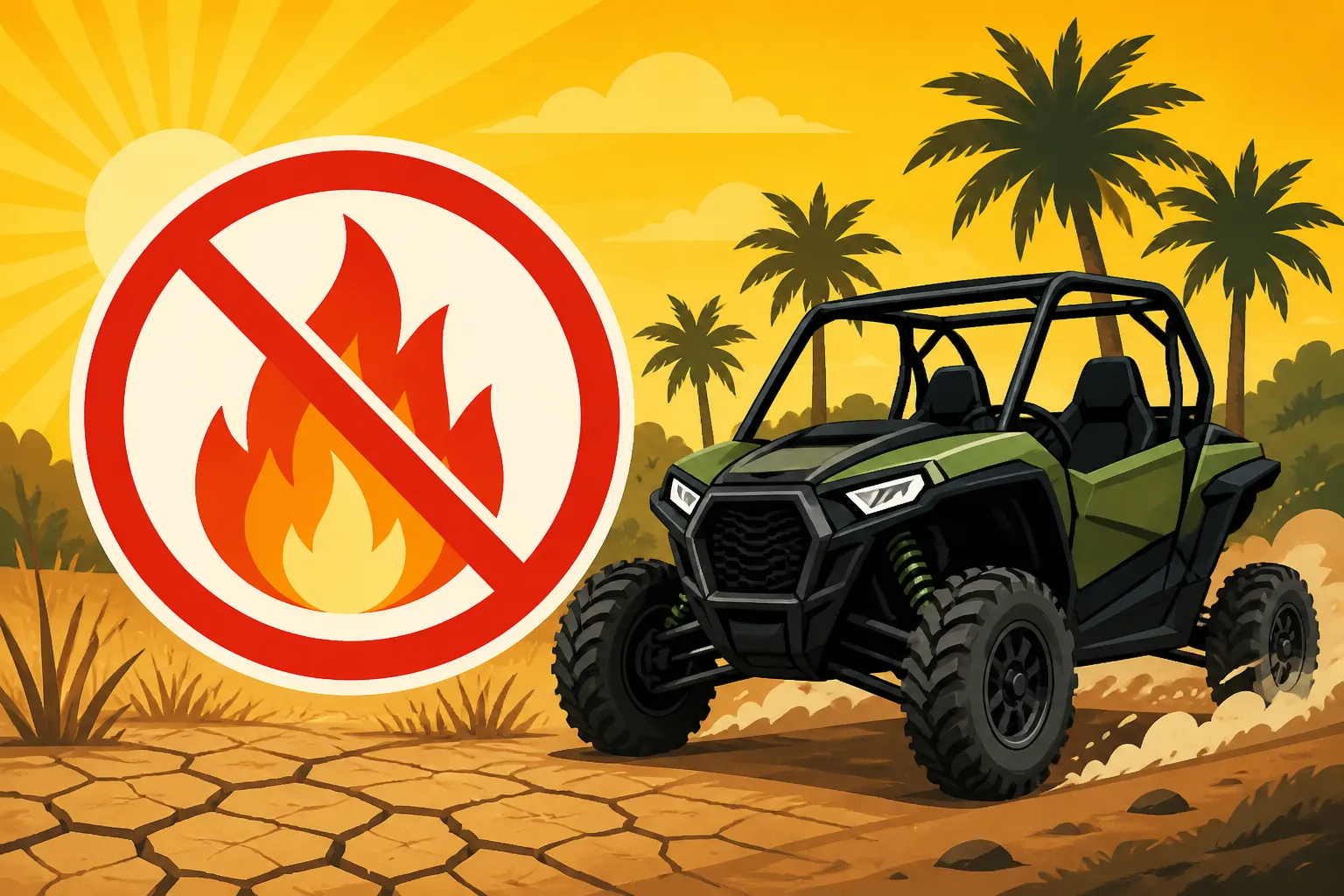
A dry spring can turn an ordinary Florida ATV or UTV ride into a higher-risk trip: dry grass, sandy trails and hot exhaust parts can all matter. Fire rules may also change by location and conditions. Check what restrictions apply before you leave, understand which activities are covered, and know when a fire-related closure means you need to change plans.
What fire restrictions can mean for ATV and UTV riders
“Fire restrictions” can refer to several different measures, not just a ban on campfires. A land manager may restrict open flames, charcoal cooking, smoking, or equipment that could create sparks. During more serious fire conditions, managers may close a campground, trail, road, or entire riding area. The exact limits depend on the land and the current order.
A general fire-danger notice is not always the same as a legal restriction. It may be a warning to use extra care, while a formal order may prohibit specific activities. Read the actual notice rather than relying on a headline, an old social media post, or a rider’s account of what was allowed on a previous visit.
Restrictions can differ between public forests, parks, private riding areas and neighboring counties. A rule that applies at one trailhead may not apply at another, even if both are in the same region. Private parks can also set their own fire and equipment policies. Check with the land manager or park operator for the specific place and date you plan to ride.
Fire rules can affect more than where you cook. A restriction might cover:
- Campfires, fire rings, charcoal grills or other open-flame cooking
- Smoking, including where smoking is allowed and how materials must be disposed of
- Parking or stopping in dry grass
- Use of equipment that creates a flame, heat or sparks
- Access to trails, roads, campsites or other parts of the property
Do not assume an ATV or UTV is automatically allowed everywhere a road vehicle can go. A closure may apply to a trail system or a particular area, and access rules can depend on signs and the land manager’s order. Check current updates alongside the trail information in Florida Trail Closures You Should Check First. If you are going to a national forest or state forest, review the specific riding and access rules as well as the fire notice.
A riding pass is not permission to ignore a temporary closure. A permit or pass may cover a particular kind of recreational access, but it does not necessarily authorize entry to an area that has been closed or an activity prohibited by a fire order. For background on how access requirements differ, see Florida OHV Permits: What You Need Before You Ride.
| What you encounter | What to do |
|---|---|
| Fire-danger advisory with no listed activity ban | Read the advisory and follow any precautions or additional instructions |
| Restriction on campfires or open flames | Do not use a prohibited flame, even at a familiar campsite |
| Restriction on smoking or equipment | Follow the stated location and equipment limits; do not infer exceptions |
| Trail, road or campground closure | Do not enter or ride through the closed area |
| Unclear or conflicting information | Contact the land manager or park operator before setting out |
How to check restrictions before you ride
The most useful check is the one tied to the exact property you plan to visit. Start with the land manager’s official website, current alerts or posted notices. For a private riding area, use the operator’s own updates or contact details. If information is unclear, ask whether the restriction affects your planned trail, parking area, campsite and cooking setup.
Check close to your departure, not only when you make plans. Dry conditions and fire response can change, and an older page or printed map may not include a new restriction. If your trip spans more than one day, check again before riding on each day. Weather can improve or worsen conditions, but do not treat rain in one location as proof that a restriction has ended. The land manager decides what is open and which restrictions remain in effect.
Look for details, not just a notice that says “fire danger.” Try to determine:
- Where the rule applies. Is it for the whole property, a campground, certain trails, or a particular zone?
- What is prohibited. Does it address open flames, smoking, cooking devices, equipment, vehicle access or some combination?
- When it applies. Check the effective period and whether the notice says conditions will be reviewed.
- Whether access is affected. A fire restriction may leave riding open, while a separate closure may shut down trails or facilities.
- Whom to contact. Use the land manager or property operator for questions the notice does not answer.
Do not rely on a pass or a prior visit as confirmation that the property is open. Before leaving, review Florida Riding on Public Land: Permits and Proof and the relevant riding-area information, but treat current land-manager alerts as the source for temporary conditions. If an area is closed, choose an alternative location that is confirmed open rather than trying to find an unofficial way around a gate or posted notice.
It is also worth checking whether camping and riding are covered by separate rules. A place may allow day riding while limiting camping, or keep a campground open while closing a trail segment. If you are planning to stay overnight, confirm the campsite’s status and the rules for cooking and fires separately from the trail rules. Florida ATV Camping With Trail Access can help with planning, but current restrictions still need to be checked directly.
Reduce ignition risk on the trail
Even when no special restriction is in effect, take dry-season conditions seriously. An ATV or UTV can be hot after a ride, and dry vegetation can catch fire easily. Avoid stopping or parking in tall, dry grass where hot components could contact vegetation. Use designated parking and staging areas, and do not ride off marked routes to reach a scenic spot or make a turnaround.
Inspect the machine before the trip. Look for grass, leaves or other debris collected around hot components, and clear it safely when the machine is cool. Follow the manufacturer’s instructions for inspection and maintenance. If the vehicle appears to be leaking fuel or oil, or has damaged wiring, address the problem before riding. A mechanical issue that creates unusual heat, sparks or a fuel leak is a reason to stop using the machine until it can be checked.
Keep your riding behavior within posted rules. Do not spin tires in dry vegetation, use unapproved equipment, or make repairs that involve sparks in a dry area. If you must stop, choose a stable, designated surface away from dry brush where possible. Do not leave an idling machine unattended.
Carry basic emergency supplies, but do not assume they make restricted activities acceptable. A suitable, accessible fire extinguisher can be a useful precaution on a machine or tow vehicle; it does not replace following a ban or calling for help when a fire is beyond your ability to handle safely. If you buy one through a retailer such as Amazon, check the product’s intended use, operating instructions, condition and mounting requirements, then secure it so it is reachable without creating a hazard. Make sure everyone in the group knows where it is and how to use it.
A phone, a charged power bank and a map can also help the group respond to a problem, but cell coverage may be unreliable in remote areas. Agree on how to contact emergency services and the land manager if a fire starts. Know the location or trail name you would give to responders, and do not delay reporting smoke or flames because you are unsure whether someone else has already called.
Use extra caution around camp. If open flames are prohibited, do not substitute a fire pan, portable stove or charcoal cooker unless the restriction clearly allows that specific device. A device that seems contained or low-risk may still be covered by the order. When cooking is allowed, use only the permitted area and equipment, keep it attended, and follow the property’s instructions for disposal of ash or fuel. Never dump hot coals or ash into vegetation or a trash container.
If a restriction changes or you see smoke
Have a backup plan before you travel. Identify another confirmed-open riding area, or be prepared to postpone the trip. Conditions and access can change while you are already on the road. If the official notice changes, follow the new instruction rather than continuing based on the plan you made earlier.
If a trail or property is closed, turn around and leave by an open route. Do not cross barriers, ride around a gate, or follow tracks into a closed section. A closure may protect people and property as well as natural resources, and entering the area can put riders in the way of response crews. Review Florida Public Land Riding Without a Pass Penalty for a related look at why access requirements matter, while remembering that a fire closure is a separate issue from a pass requirement.
If you notice smoke or a fire, move away from the area and alert emergency services or the land manager as soon as it is safe to do so. Share the clearest location details you can, such as a trail marker, road name, campground or nearby landmark. Do not ride toward the fire to investigate, try to cross smoke, or attempt to fight a spreading fire with a small extinguisher. Follow directions from responders and staff, and leave the area using an open route.
After the trip, report hazards or damaged signs to the property manager. If a sign is missing or an online notice is confusing, a clear report can help other riders avoid the same uncertainty. Before your next outing, check again: restrictions may be lifted, extended or replaced with a different closure. For general preparation, What to Carry Into a Florida State Forest offers a useful checklist to pair with the current property rules.
Disclaimer
This article is for general informational purposes only and does not constitute professional advice. Laws, prices and regulations vary by location and change over time. Consult a qualified professional for guidance on your specific situation.