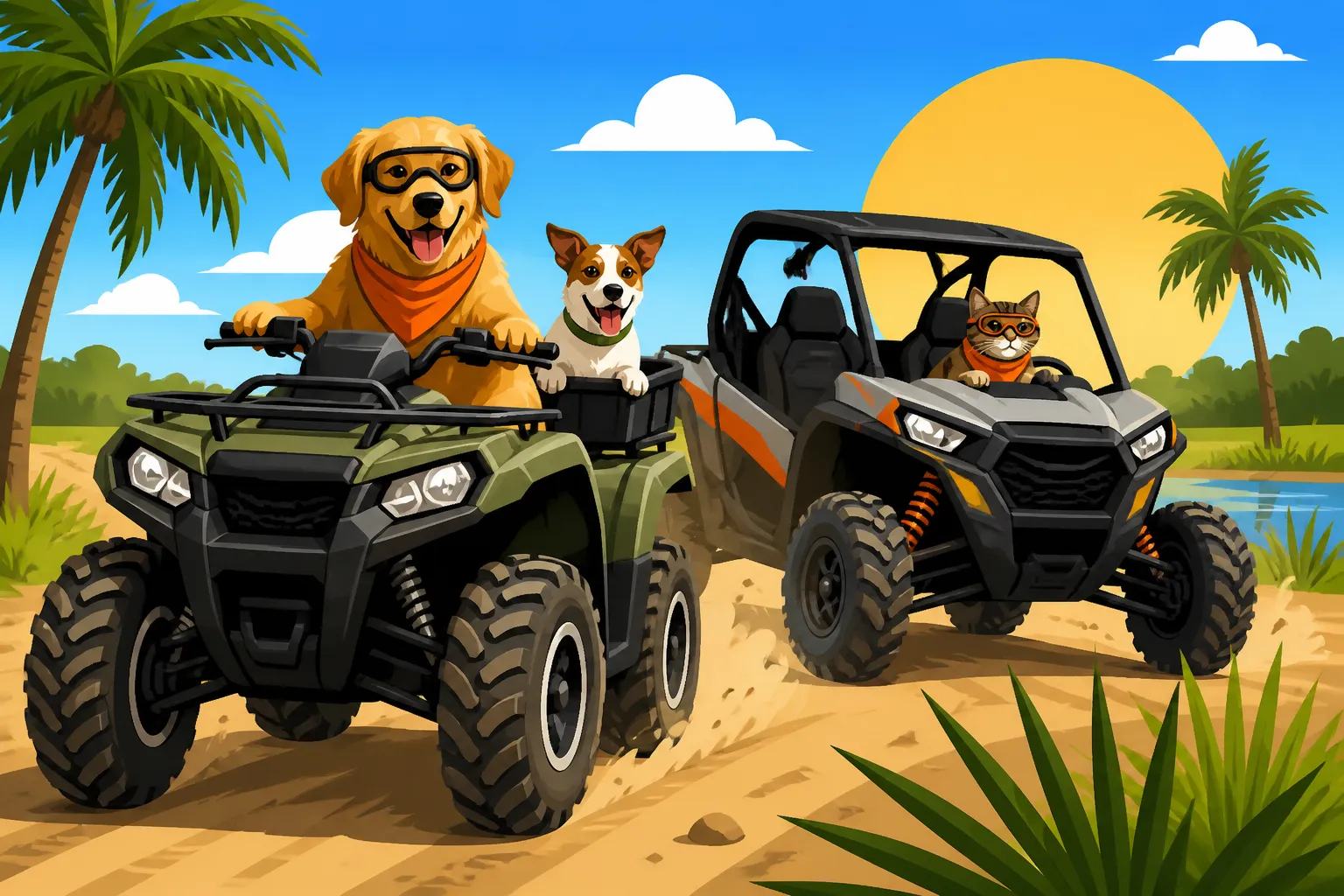
Pets at a Riding Area
Florida ATV and UTV areas do not all follow the same pet policy. Some welcome dogs in campgrounds but restrict them from riding trails; others do not allow pets on site. Check the rules for your exact destination before you travel, then plan for noise, heat, wildlife, and safe places for your pet to wait.
Check the riding area’s pet rules before you go
A pet policy can vary by land manager, riding area, and even by part of the same property. A dog allowed at a campground may not be allowed on the OHV trail, in a day-use area, or at an event. Do not assume that a pet-friendly campsite means your dog can ride along or accompany you to the staging area.
Start with the current rules from the site operator or land manager. Look for details about pets in the riding area, campground, parking lot, buildings, and on trails. If the rules are unclear, call or email before leaving home. Ask about the specific activity you have planned, not just whether pets are allowed.
| Location or activity | What to confirm |
|---|---|
| OHV trail or riding zone | Whether pets are allowed at all, and whether they may be near active trails |
| Staging area and parking | Whether dogs can wait with your group while machines are unloaded |
| Campground | Leash, quiet-hour, cleanup, and unattended-pet rules |
| Event or private park | Whether temporary event rules differ from regular park rules |
| Visitor facilities | Whether pets are allowed inside buildings or only in outdoor areas |
| Trailhead access | Whether rules change between the parking area and the riding route |
Public land and private riding parks may have different policies. Public-land requirements can also differ between forests and individual recreation areas, so a rule you encountered elsewhere may not apply at your next stop. For background on how land-management settings differ, see Florida National Forest Riding vs State Forest Riding and Florida State Forest OHV Areas Explained.
A pass or permit for riding is not permission to bring a pet. These are separate questions: the permit covers access under the land manager’s rules, while the pet policy determines where an animal may go. Review Florida Riding on Public Land: Permits and Proof for the riding-access side of the visit, and check the current pet guidance separately.
Some riding areas prohibit pets altogether, while others limit where they can go. The list Florida Riding Areas That Ban Pets can help you identify places where a no-pet rule may be central to planning, but always confirm current rules directly. Policies can change, and a third-party listing or an old trip report may not reflect what the gate staff will enforce.
Ask about the whole visit, not just the trail
When you contact a site, be specific. Ask whether your dog may come to the property, where it may go, whether it must remain leashed, and whether it can stay at your campsite while you ride. If you are visiting for a special event, ask whether event rules override the usual campground policy.
Also ask what happens if a pet becomes disruptive or if staff determine that it is unsafe near machines. A clear answer helps you decide whether to bring the dog, arrange care elsewhere, or choose a different riding area. Do not rely on being able to leave the dog in a vehicle or tied near the trailhead; either may be unsafe or prohibited.
Decide whether bringing your pet is safe
Even where pets are permitted, an active OHV area can be a poor environment for many animals. Engines start suddenly, machines move through staging areas, and riders may not see a small dog close to a vehicle. Dust, mud, hot surfaces, sharp debris, unfamiliar people, and wildlife can add risks.
Think about your individual pet’s temperament and health. A dog that is calm around household vehicles may react differently to multiple loud engines, exhaust, revving, or fast-moving machines. A frightened animal can pull free, run toward a trail, or hide where a rider cannot spot it. If your pet is sensitive to noise, prone to bolting, or difficult to control around crowds, leaving it with a trusted caregiver is usually the safer choice.
Heat is another concern. Florida’s weather can make an outdoor visit uncomfortable even when the air does not feel extreme to a person who is moving around. A dog cannot cool itself as effectively as a person can by choosing when to step into shade or remove a layer. A short walk from the parking area may still involve hot ground, limited shade, and waiting around while the group prepares.
Never assume that a vehicle provides a safe place for a pet during a ride. A parked vehicle can heat up quickly, and leaving a dog unattended creates risks even if the windows are partly open. If no responsible adult can stay with the animal in an approved, safe area, do not bring it along just to leave it behind.
Consider sound, movement, and wildlife
Dogs may bark at engines or chase movement. That can distract riders and make a busy staging area less predictable. Keep your pet away from machine paths and never let it roam off leash, even if it normally responds well to commands. A leash gives you more control, but it does not make a location safe if the dog is close to moving ATVs or UTVs.
Wildlife is another reason to keep pets close. A dog that wanders into brush may encounter animals, get lost, or damage sensitive habitat. On public land, follow the site’s rules for keeping pets under control and stay within areas where they are allowed. Responsible conduct is part of a safer visit for riders, pets, other visitors, and wildlife. The practical advice in Florida OHV Trail Etiquette Locals Expect also applies when your group brings an animal to a shared recreation area.
If the pet is permitted at the campground but not on the trails, plan for supervision. One person may need to remain behind while the rest of the group rides. Do not leave a dog tied to a trailer, fence, or tree for the duration of the ride unless the site specifically permits it and a responsible person remains present. A leash can tangle, be pulled loose, or leave the animal exposed to traffic and weather.
Prepare for a pet-friendly visit
If the riding area confirms that pets are allowed, bring only what you need to keep the animal secure and comfortable. A strong leash, properly fitted collar or harness, water, a portable bowl, waste bags, and any necessary medication are sensible basics. A collapsible bowl or reflective leash from Amazon may be convenient, but gear cannot replace supervision or make a restricted area pet-friendly.
Make sure identification is current and attached to the pet. A phone number on a tag can help if the animal slips away. Keep a recent photo available, and consider whether the animal is comfortable wearing its collar or harness for a full outing. If your pet is microchipped, check that the contact details associated with the chip are up to date.
Before the trip, consider how the dog will handle the full day rather than just the drive. How long will the group be away from the campsite? Is there shade where pets are allowed? Can someone take the dog for a quiet break away from machines? Is there a safe place for water that does not sit in direct sun? If you cannot answer these questions, revise the plan before arriving.
A useful pre-trip checklist:
- Confirm that pets are allowed in each area you plan to use.
- Ask whether the pet must be leashed and whether it can be left at camp while you ride.
- Identify a responsible person who can supervise the animal throughout the visit.
- Pack water, a bowl, leash, identification, waste bags, and needed medication.
- Plan a quiet, shaded area that the site permits pets to use.
- Be ready to leave if the dog becomes distressed or the setting proves unsafe.
Keep the dog away from loading ramps, trailer doors, fuel containers, wash areas, and machines being started or moved. Do not let it approach unfamiliar riders or other pets without permission. Some visitors are afraid of dogs, and a friendly animal can still startle someone stepping around a vehicle.
Clean up promptly and dispose of waste as the site directs. Waste left at a trailhead or campsite affects other visitors and can create sanitation problems. Keep barking under control, especially near campsites during quiet hours. These small responsibilities matter because repeated conflicts can lead a site to tighten its pet policy.
Do not assume a service animal is treated like a pet
If you need to bring a service animal, contact the land manager or facility before the visit to understand access and safety requirements for the specific areas you intend to enter. Rules and accommodations can depend on the setting, and an active riding zone presents hazards that may affect where an animal can safely go. Ask about trail access, staging areas, buildings, and any restrictions that apply to your planned route. Avoid relying on an assumption that a general pet policy answers every access question.
Make a backup plan if pets are not allowed
If pets are prohibited or the riding environment is not suitable, arrange care before you set out. Options may include leaving the animal with a trusted person, using a boarding provider, or choosing a different activity that welcomes pets. Do not arrive expecting staff to make an exception, and do not leave a dog in a hot vehicle while the group rides.
A backup plan is especially important for overnight visits. Confirm whether the campground allows pets and whether its rules differ from those at the trail system. Ask about leash requirements, unattended animals, noise, waste disposal, and where dogs may be walked. Florida Riding Areas With Primitive Camping may help with planning an overnight ride, but verify each site’s pet rules directly.
If your group is set on riding together, a pet-free arrangement may be the most practical choice. One adult can stay with the dog at a permitted campground or another suitable location, while the rest of the group rides. Another option is to choose a destination where pets are allowed in the areas you intend to use, then build a shorter ride schedule around the animal’s needs.
Before leaving, check for trail closures and changes to access that could affect where you can go. A closed route can change the day’s timing and make a pet’s wait longer than expected. Florida Trail Closures You Should Check First offers related planning context. Keep expectations flexible: if the dog is uncomfortable, the weather turns harsh, or the site’s rules do not match what you were told, change the plan rather than taking a risk.
The simplest rule is to treat pet access as a separate part of trip planning, not as an assumption attached to your riding pass. Confirm the policy, decide whether the setting is safe for your animal, and bring a backup plan. That approach protects your pet and helps keep the riding area comfortable for everyone sharing it.
Disclaimer
This article is for general informational purposes only and does not constitute professional advice. Laws, prices and regulations vary by location and change over time. Consult a qualified professional for guidance on your specific situation.