Florida Penalties for Illegal ATV Road Riding
You're out enjoying a beautiful Florida day, maybe cruising down a country lane on your quad, feeling the breeze and the freedom. Suddenly, those flashing lights appear in your rearview mirror, and your heart sinks. You thought it was just a quick hop down the road, no harm done. But in Florida, taking your ATV onto public paved roads, or even certain unpaved ones, can lead to a stack of penalties that go far beyond a simple warning. This guide is here to lay out exactly what those penalties can be, from immediate fines to the long-term headaches, so you can understand the risks and keep your riding on the right side of the law.
Why Florida Doesn't Want ATVs on Paved Roads
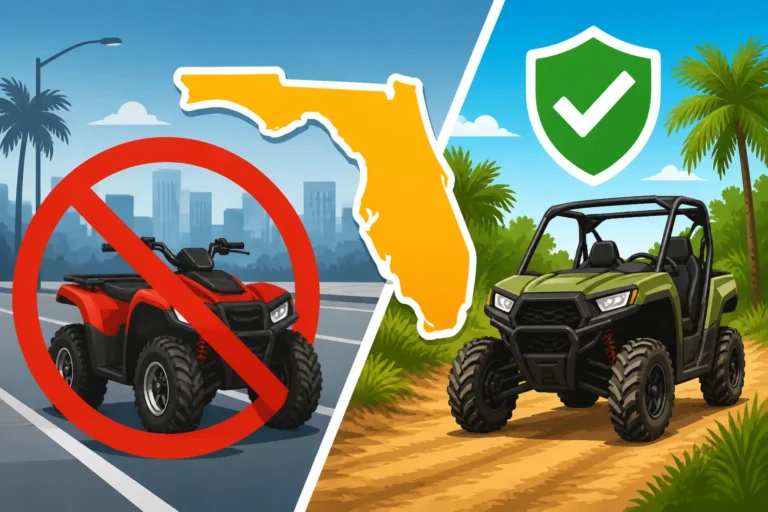
It's a common question, and one that often stems from a simple misunderstanding: "Why can't I just take my ATV down the street for a mile or two?" The reality is, Florida law draws a very clear line in the sand when it comes to off-highway vehicles (OHVs) and public roadways. It's not about spoiling your fun; it's genuinely about public safety and how these machines are designed versus the demands of road travel.
The Core Definition of an ATV
Florida Statutes define an all-terrain vehicle (ATV) very specifically. It's a motorized, off-highway vehicle designed to travel on four or more low-pressure tires, having a seat designed to be straddled by the operator, and handlebars for steering. Crucially, these machines are built for off-road use, where speeds are often lower, surfaces are varied, and interaction with traditional road traffic is minimal or nonexistent. Their suspension, braking, and steering systems are simply not engineered for the high speeds, sudden stops, and precise handling required on paved roads shared with cars, trucks, and motorcycles. The statute itself emphasizes this, focusing on their off-highway nature.
Imagine trying to navigate a busy intersection on a quad designed for mud and trails. The wide, low-pressure tires might be great for grip on loose surfaces, but they offer poor stability and responsiveness on asphalt. The lack of proper turn signals, brake lights, and rearview mirrors, which are standard on street-legal vehicles, creates significant visibility issues and safety hazards for both the ATV rider and other drivers. This fundamental design difference is the primary reason why Florida law restricts their use on public roads.
Safety Concerns on Public Thoroughfares
The safety concerns aren't just theoretical; they're very real and have been documented in numerous accidents. ATVs are much more prone to rollovers and instability on hard, flat surfaces, especially when attempting turns at speeds common on roads. The center of gravity, the suspension travel, and the aggressive tread patterns of the tires all contribute to a dangerous combination when taken out of their intended environment.
Furthermore, most ATVs lack the robust safety features found in cars, such as crumple zones, airbags, or even seatbelts (since you're meant to shift your body weight). Riders are often exposed, relying heavily on personal protective gear like helmets and goggles. While essential for trail riding, this gear offers limited protection in a collision with a 3,000-pound car or truck. The potential for serious injury or fatality in such an incident is significantly higher for an ATV rider. Law enforcement and lawmakers consider these inherent dangers when crafting regulations, prioritizing the safety of everyone on the road.
Distinguishing ATVs from Other Vehicles
It's easy to get confused because there are many types of off-road machines out there. Florida law makes distinct categorizations. An ATV is different from a golf cart, a low-speed vehicle (LSV), or even a side-by-side (UTV) that might qualify as an LSV. Golf carts have very specific rules for use in designated communities or on certain roads, usually with speed limits of 20 mph or less. LSVs, on the other hand, are four-wheeled vehicles capable of speeds between 20 and 25 mph, must have specific safety equipment (headlights, turn signals, seatbelts, windshield, VIN), and be titled and registered to be road legal. [Florida Low-Speed Vehicle Rules for Side-by-Sides] can shed more light on this distinction.
A UTV, while often wider and heavier than an ATV, is typically still considered an OHV in Florida unless it undergoes specific modifications to meet LSV requirements and is properly titled. Even then, an LSV has strict limitations on where it can be operated. An ATV, by its very design and classification, cannot be converted into a street-legal vehicle in the same way. Companies like SuperATV offer a huge range of aftermarket parts, from lift kits to light bars, which are fantastic for enhancing your machine's performance and utility on the trails or private property. However, it's crucial to remember that adding these accessories, even ones that mimic road-legal equipment, does not magically transform your ATV into a legal road vehicle in Florida. The underlying legal definition of an ATV and the specific requirements for street-legal vehicles are entirely separate. Understanding these differences is key to staying out of trouble, because a deputy will not see your ATV as a "modified LSV" if it doesn't meet the strict statutory requirements.
The Immediate Financial Hit: Fines and Citations
So, you've been stopped by a Florida deputy for riding your ATV illegally on a public road. What happens next? The most immediate and tangible consequence is usually a uniform traffic citation, more commonly known as a ticket. This isn't just a slap on the wrist; it comes with financial penalties that can quickly add up, alongside administrative costs and potential points on your driver's license.
Understanding the Uniform Traffic Citation
When a law enforcement officer issues a citation for illegal ATV road riding, it falls under Florida Statute 316.2074, which specifically addresses the operation of ATVs on public roadways. This statute clearly states that ATVs "may not be operated on the public roads or highways of this state." The officer will record the violation, your identifying information, and details about the incident.
This isn't just like getting a parking ticket. This citation can carry significant weight because it's a moving violation. You'll be given a date to either pay the fine or appear in court to contest the charge. Ignoring it is never an option, as that will lead to even more severe consequences, including license suspension and potential warrants. It’s a formal legal document, and treating it as such is the first step in addressing the situation responsibly. [Florida Sheriff Enforcement of ATV Road Rules] outlines how seriously law enforcement takes these violations.
Variable Costs and Court Fees
The base fine for operating an ATV on a public road can vary by county, but it's generally in the range of a standard non-criminal moving violation. However, that's just the starting point. On top of the base fine, you'll almost certainly face a host of surcharges and court costs. These can include:
- Court surcharges: Funds that support court operations, clerk's offices, and various state programs.
- Late fees: If you don't pay by the due date.
- Driver education funds: Often added to traffic fines.
- Criminal justice trust funds: Supporting local law enforcement.
These additional fees can easily double or even triple the initial base fine, turning a seemingly minor infraction into a substantial bill. For instance, a base fine of around $60-100 could quickly become $200-$300 once all the extra charges are tacked on. It's a frustrating reality for many riders who might not have anticipated such a hefty cost for what they perceived as a quick ride.
Additional Penalties for Repeated Offenses
Florida law doesn't look kindly on repeat offenders. If you've been cited for illegal ATV road riding before, and you're caught again, the penalties will likely escalate. While the first offense might be a non-criminal infraction, subsequent violations could lead to more serious charges. Each citation adds to your driving record, building a history that can influence how judges and prosecutors view your case.
Multiple infractions could trigger higher fines, more points on your driver's license, and increase the likelihood of vehicle impoundment. Some jurisdictions may even have ordinances that allow for enhanced penalties for repeat offenders within a certain timeframe. The legal system aims to deter continued illegal activity, and if warnings and initial fines aren't working, the next step is often more severe action. This is why understanding the rules and finding legal places to ride, such as those listed in [Florida ATV Trails: Every Public Riding Area], is so important after a first offense.
The Looming Threat of Vehicle Impoundment
One of the most immediate and distressing consequences of illegal ATV road riding in Florida is the very real possibility of having your machine impounded. It's not just about a ticket; it's about losing your quad on the spot, and then facing a complex, costly, and often frustrating process to get it back.
When Deputies Can Seize Your Quad
Law enforcement officers in Florida have the authority to seize and impound an ATV if it's being operated illegally on a public road. This isn't always discretionary; in some situations, particularly if the rider is unlicensed, a minor, or there are other compounding violations, impoundment might be standard procedure. The reasoning is straightforward: if the vehicle is being used in a manner that's illegal and poses a safety risk on public property, removing it from that environment immediately is considered necessary.
Imagine you're stopped in a county like Polk or Marion, where deputies are well-versed in OHV laws. If you're caught riding your ATV down a paved road, especially if it's a main thoroughfare, the officer might call for a tow truck on the spot. Your quad will then be transported to an impound lot, often located miles away. This immediate loss of your machine can be a jarring experience, leaving you stranded and scrambling to figure out what just happened. [Florida ATV Impound After a Road Violation] delves deeper into these scenarios.
Towing, Storage, and Administrative Fees
Getting your ATV out of impound is rarely a quick or cheap process. You'll be on the hook for a variety of charges, including:
- Towing fees: This is the cost of having your ATV transported from the point of seizure to the impound lot. These fees can vary, but expect a significant initial charge for the hook-up and mileage.
- Daily storage fees: Every day your ATV sits in the impound lot, you'll be charged a daily storage fee. These can quickly accumulate, turning a few days into hundreds of dollars. Many impound lots charge upwards of $20-$40 per day, sometimes more for larger vehicles.
- Administrative fees: The impounding agency, whether it's the sheriff's office or a municipal police department, often charges an administrative fee for handling the paperwork and processing the impoundment.
These costs are separate from any fines or court fees associated with the traffic citation itself. They must typically be paid in full before the impound lot will release your ATV. This financial burden can be a real shock, especially when you consider that a few days in impound could easily exceed the original fine for the violation.
The Headache of Getting Your Machine Back
Retrieving your impounded ATV is often a multi-step process that can feel like jumping through hoops. First, you'll likely need to go to the impounding law enforcement agency to obtain a release form. This usually requires proof of ownership (like your title or bill of sale) and your identification. [Proof of Ownership When the MSO Is Missing] might be relevant here if your paperwork isn't perfect. If you don't have a valid driver's license, you may need someone with a license to pick up the ATV for you, even if you are the owner.
Once you have the release, you then need to go to the impound lot itself, pay all the accumulated towing and storage fees, and arrange for transport of your ATV. Remember, it was impounded for being on a public road, so you can't just ride it out of the lot. You'll need a truck and a trailer, or another tow service, to take it home. This entire process can take days, requiring multiple trips and costing a significant amount of time and money, making it one of the most frustrating aspects of an illegal road riding penalty.
Beyond Fines: Driver's License and Criminal Implications
While fines and impoundment are immediate pains, the repercussions of illegal ATV road riding can extend further, impacting your driver's license and even leading to criminal charges in more severe circumstances. This is where a seemingly minor infraction can start to affect your life in more profound ways.
Points on Your Driving Record and License Suspension
Operating an ATV illegally on a public road in Florida is generally treated as a moving violation. Like other moving violations (speeding, running a stop sign), it can result in points being assessed against your driver's license. The exact number of points can vary, but accumulating too many points within a certain timeframe can lead to serious consequences, including:
- Driver's license suspension: Florida has a point system. For example, 12 points within 12 months, 18 points within 18 months, or 24 points within 36 months can result in an automatic suspension of your driving privileges. This means you wouldn't be able to drive any vehicle on public roads, not just your ATV.
- Increased insurance premiums: Points on your record signal to insurance companies that you are a higher-risk driver, almost certainly leading to a hike in your auto insurance rates for years to come.
- Mandatory traffic school: Depending on the violation and your driving history, you might be required to attend a driver improvement course, which costs time and money.
Even if you're riding an ATV without a driver's license (which is allowed in certain off-road contexts but not on public roads), being cited for this offense can still impact your ability to obtain a license in the future. [Do You Need a Driver's License for an ATV in Florida?] can clarify the specific rules here. The state takes infractions that affect road safety seriously, and points on your record are a lasting mark of that.
Potential Misdemeanor Charges
While many illegal ATV road riding offenses start as non-criminal infractions, the situation can quickly escalate to misdemeanor charges under certain circumstances. This is where a traffic violation crosses into the realm of criminal law, bringing with it more serious potential penalties.
Common scenarios that might lead to a misdemeanor include:
- Fleeing or eluding a law enforcement officer: If you attempt to get away from a deputy after they signal you to stop, you're looking at a felony charge, not just a misdemeanor. This is an extremely serious offense.
- Operating under the influence (DUI): If you're found to be operating an ATV on a public road while impaired by alcohol or drugs, you can be charged with a DUI, just as if you were driving a car. Florida's DUI laws apply to any vehicle, including ATVs, operated on public roads or even on private property if open to the public. [Florida DUI Law Applied to ATV Riders] explains this in detail.
- Reckless operation: If your riding is deemed exceptionally dangerous, causing a significant risk to others, you could face charges of reckless driving.
- Repeat offenses: As mentioned, a history of similar violations might lead a prosecutor to elevate the charge, especially if it demonstrates a pattern of disregard for the law.
- Damage to property or injury to person: If your illegal ATV use results in an accident that causes property damage or injury, even if minor, the legal consequences will be much more severe.
A misdemeanor conviction means you'll have a criminal record, which can impact employment opportunities, housing applications, and even your ability to obtain certain licenses or certifications. It's a far cry from a simple traffic ticket and underscores the importance of adhering to Florida's ATV laws.
Understanding the Legal Process
If you face misdemeanor charges, the legal process becomes much more involved than simply paying a fine. You'll likely have to:
- Appear in court multiple times: There will be arraignments, pre-trial conferences, and potentially a trial.
- Retain legal counsel: While not mandatory for misdemeanors, having an attorney is highly advisable to navigate the complexities of criminal court.
- Face potential jail time or probation: Misdemeanors can carry penalties ranging from fines and community service to up to a year in county jail and/or probation.
This can be a long, stressful, and expensive ordeal. The key takeaway is that operating an ATV on Florida's public roads isn't just a minor transgression. Depending on the circumstances and your actions, it can snowball into a significant legal battle with lasting consequences.
Long-Term Repercussions for Riders and Owners
The impact of illegally riding your ATV on Florida roads isn't just about the immediate fines, impoundment, or even a misdemeanor charge. These incidents can cast a long shadow, affecting your finances, your ability to ride in the future, and even the value of your machine. It’s important to think about the ripple effects that extend far beyond the initial encounter with law enforcement.
Insurance Rate Hikes and Coverage Issues
We briefly touched on insurance premiums rising due to points on your driver's license. But beyond that, an incident involving illegal ATV road riding can directly affect your ATV insurance (if you even have it). Many standard ATV insurance policies are specifically designed for off-road use on private property or designated trails. They often contain clauses that exclude coverage if the incident occurs while the ATV is being operated illegally on a public road.
This means if you have an accident while riding illegally on the street, your insurance company might deny your claim for damages to your ATV or for any liability you incur. You could be left paying out-of-pocket for thousands of dollars in repairs to your own machine, or even worse, for property damage or personal injuries you cause to others. This financial exposure can be devastating.
Even if your policy doesn't explicitly deny coverage, a claim resulting from illegal activity will almost certainly lead to a significant increase in your premiums for years to come. Some insurers might even opt not to renew your policy, leaving you scrambling to find coverage that could be more expensive or harder to obtain. Always review your policy carefully and understand its limitations regarding public road use. [Does Florida Require ATV Insurance for Road Use?] clarifies the current requirements.
Impact on Future Riding Opportunities
A history of illegal ATV road riding citations can have a surprising impact on your future ability to enjoy your hobby. For instance:
- Public land access: Some public riding areas, particularly those managed by state or federal agencies, might review your record for past violations. While a single minor infraction might not bar you, a pattern of disregard for regulations could lead to restrictions or even bans from certain parks or trails.
- Club memberships: If you're part of an ATV riding club or looking to join one, they often have rules of conduct. Members with a history of illegal road riding or reckless behavior might be denied membership or face disciplinary action.
- Event participation: Many organized ATV events, races, or poker runs require participants to adhere strictly to all laws. A problematic riding record could prevent you from participating in these community events.
It's not just about the law; it's about reputation within the riding community. Riders who consistently break the rules often face scrutiny and may find themselves unwelcome in spaces dedicated to responsible off-road enjoyment.
Selling a Quad After a Violation
Thinking of selling your ATV after it's been involved in an illegal road riding incident, especially one that led to impoundment or an accident? You might face some challenges.
- Title issues: If the ATV was impounded and you struggled to retrieve it, there could be liens placed on the title for unpaid towing and storage fees. You'd have to clear these before you could legally transfer the title to a new owner. [Florida ATV Title With a Lien Recorded] explains how liens work.
- Damage disclosures: If the machine was damaged during an accident while being operated illegally, you would have a legal and ethical obligation to disclose this to potential buyers. This can significantly reduce the ATV's resale value.
- Buyer reluctance: Savvy buyers often ask about the machine's history. While not always directly searchable, word of mouth or a visible history of repairs might raise questions. A buyer might be hesitant to purchase a machine known to have been involved in illegal activities or accidents, fearing potential hidden issues or a history of misuse.
In essence, an illegal road riding incident can turn your beloved quad into a financial liability rather than an asset, complicating its future sale and diminishing its worth.
Staying Legal: How to Avoid Road Riding Penalties
The best way to deal with Florida's penalties for illegal ATV road riding is, quite simply, to avoid them altogether. While the rules can sometimes feel restrictive, they exist for safety and order. Understanding where you can ride and what conditions apply is crucial for enjoying your ATV without stress or legal trouble. It requires proactive education and responsible decision-making.
Knowing Designated Riding Areas
Florida offers a variety of fantastic, legal places to ride your ATV. These designated off-highway vehicle (OHV) areas are specifically designed for ATVs, UTVs, and dirt bikes, offering diverse terrain from deep sand to challenging mud bogs. Prioritizing these locations is the most effective way to prevent road riding citations.
- State Forests and National Forests: Places like Croom Motorcycle Area within the Withlacoochee State Forest, Ocala National Forest, and Blackwater River State Forest all have extensive trail systems for OHVs. These areas are managed, often requiring a day-use or annual pass, and clearly delineate where you can and cannot ride. [Croom Motorcycle Area: Florida's Biggest OHV Park] is a great example.
- Private Mud Parks and Resorts: Florida is also home to numerous private parks, such as Hog Waller ATV Resort in Palatka or Redneck Mud Park near Punta Gorda. These facilities are built entirely for off-road recreation, offering everything from vast mud holes to camping. They typically charge admission and have their own specific rules, but they are fully legal and designed for the exact kind of riding ATVs excel at.
- Private Property with Permission: If you own private land, or have explicit, written permission from a landowner, you can ride your ATV there. This is a common practice for hunting, farming, or simply recreation on family land. However, this permission does not extend to reaching that private property via public roads unless an exception applies.
Always check the rules and regulations of any riding area before you go, as they can change based on weather, logging, or hunting seasons.
Understanding Exceptions and Special Circumstances
While the general rule is "no ATVs on public roads," Florida law does carve out a few very limited exceptions. It's vital to understand these precisely, as they are not broad permissions.
- Crossing a Paved Road: You might be allowed to cross a paved public road at a right angle if you're transitioning between two legal off-road riding areas, provided the crossing can be made safely, without unduly interfering with traffic, and at an intersection or designated crossing point. This is usually only permitted at very specific, signed locations. [Florida ATV Crossing a Paved Highway] outlines these strict conditions.
- Unpaved Roads (County Specific): Some unpaved roads maintained by counties may be designated for ATV use, but this is extremely rare and requires specific signage and local ordinances. You absolutely cannot assume an unpaved road is open to ATVs unless it is explicitly posted as such by the county. Most unpaved roads are still considered public roadways where ATVs are prohibited. [Florida's Unpaved Road Rule for ATVs Explained] provides more context.
- Agricultural and Emergency Use: There are specific exemptions for ATVs used for agricultural purposes (e.g., on a farm or ranch) or by law enforcement, fire, or emergency services. These are highly specific operational exemptions and do not apply to general recreational riding.
- Direct Supervision of Minors on Unpaved Roads: Under Florida Statute 316.2074(2), a person 16 years of age or older who holds a valid driver's license may directly supervise a minor operating an ATV on an unpaved roadway if the county has designated that unpaved roadway for ATV use. This is a very narrow exception, again relying on explicit county designation.
These exceptions are few and far between. The vast majority of paved and unpaved public roads in Florida are off-limits for ATVs.
Educating Yourself and Others
Knowledge is truly power when it comes to ATV regulations. The most effective defense against penalties is a thorough understanding of the law.
- Read the Statutes: Familiarize yourself with Florida Statutes 316.2074 (ATV operation) and 316.2123 (OHV safety courses). These are the foundational laws.
- Check Local Ordinances: Always verify local county and municipal ordinances, as some areas may have even stricter rules or specific designations for OHV use. A quick call to the county sheriff's office or tax collector's office can provide clarity. [What a County Clerk Checks on Your Application] might be helpful when seeking local information.
- Take a Safety Course: For riders under 16, a Florida ATV safety course is mandatory for public land riding, but it's an excellent idea for riders of all ages. These courses cover not just safe riding techniques but also the legal responsibilities of ATV operators. [Florida ATV Safety Course Requirements for Riders Under 16] is a good resource.
- Talk to Experienced Riders: Engage with local ATV clubs and experienced riders. They often have firsthand knowledge of legal riding spots and common pitfalls.
- Share Information: If you ride with friends or family, make sure they are also aware of the laws. Ignorance of the law is never an excuse in court.
By making a conscious effort to stay informed and ride only in designated, legal areas, you can ensure your Florida ATV adventures remain fun, safe, and free from costly penalties.
| Violation Scenario | Potential Immediate Penalties | Potential Long-Term Repercussions | How to Avoid |
|---|---|---|---|
| Riding ATV on paved public road | Uniform Traffic Citation, Base Fine + Court Fees (e.g., $200-$300+) | Points on Driver's License, Increased Auto Insurance Premiums, Possible License Suspension | Ride only on designated OHV trails or private property with permission. |
| Riding ATV on unpaved public road (no county designation) | Uniform Traffic Citation, Base Fine + Court Fees | Same as above. | Verify county ordinances and look for explicit signage designating ATV use. Assume no. |
| Fleeing a law enforcement officer on an ATV | Felony charges, Arrest, Significant Fines, Vehicle Impoundment | Criminal Record, Jail Time, License Revocation, Difficulty with future employment | Always stop immediately and comply with officer's instructions. |
| Riding ATV on public road while impaired (DUI) | DUI Arrest, Significant Fines (e.g., $500-$1000+), Vehicle Impoundment, License Suspension | Criminal Record, Jail Time/Probation, Mandatory DUI School, High Insurance Rates | Never operate an ATV (or any vehicle) under the influence of alcohol or drugs. |
| Minor riding ATV on unpaved road without adult supervision | Citation to adult supervisor, Potential Fines | Points on supervisor's license, Restrictions on minor's future riding privileges | Ensure minors are supervised by a licensed adult on designated unpaved roads. |
| ATV Impoundment after illegal road use | Towing Fees (e.g., $100-$200), Daily Storage Fees (e.g., $20-$40/day), Administrative Fees | Financial burden, Loss of use, Complications in selling machine | Adhere strictly to road use laws to prevent impoundment. |
Disclaimer
This article is for general informational purposes only and does not constitute professional advice. Laws, prices and regulations vary by location and change over time. Consult a qualified professional for guidance on your specific situation.