Florida Trail Riding and Snake Season
Florida trail riding and snake season overlap because snakes become more active in warm weather, and trails can put riders close to brush, water, and sunny patches where snakes rest. A snake sighting can be unsettling, especially when you’re riding with kids or dogs. This guide explains how to lower the risk, respond calmly, and plan a safer Florida ride.
Why snakes and trail riding overlap in Florida
Warm weather brings more snake activity
Florida does not have one short, neatly defined snake season. Snakes are present throughout the year, but warm conditions generally make them more active. They may be easier to encounter during spring and summer, when they move around to find food, shelter, and places to regulate their body temperature. On a ride, that can mean crossing paths with one on a trail, near a pond or ditch, or at the edge of a sandy clearing.
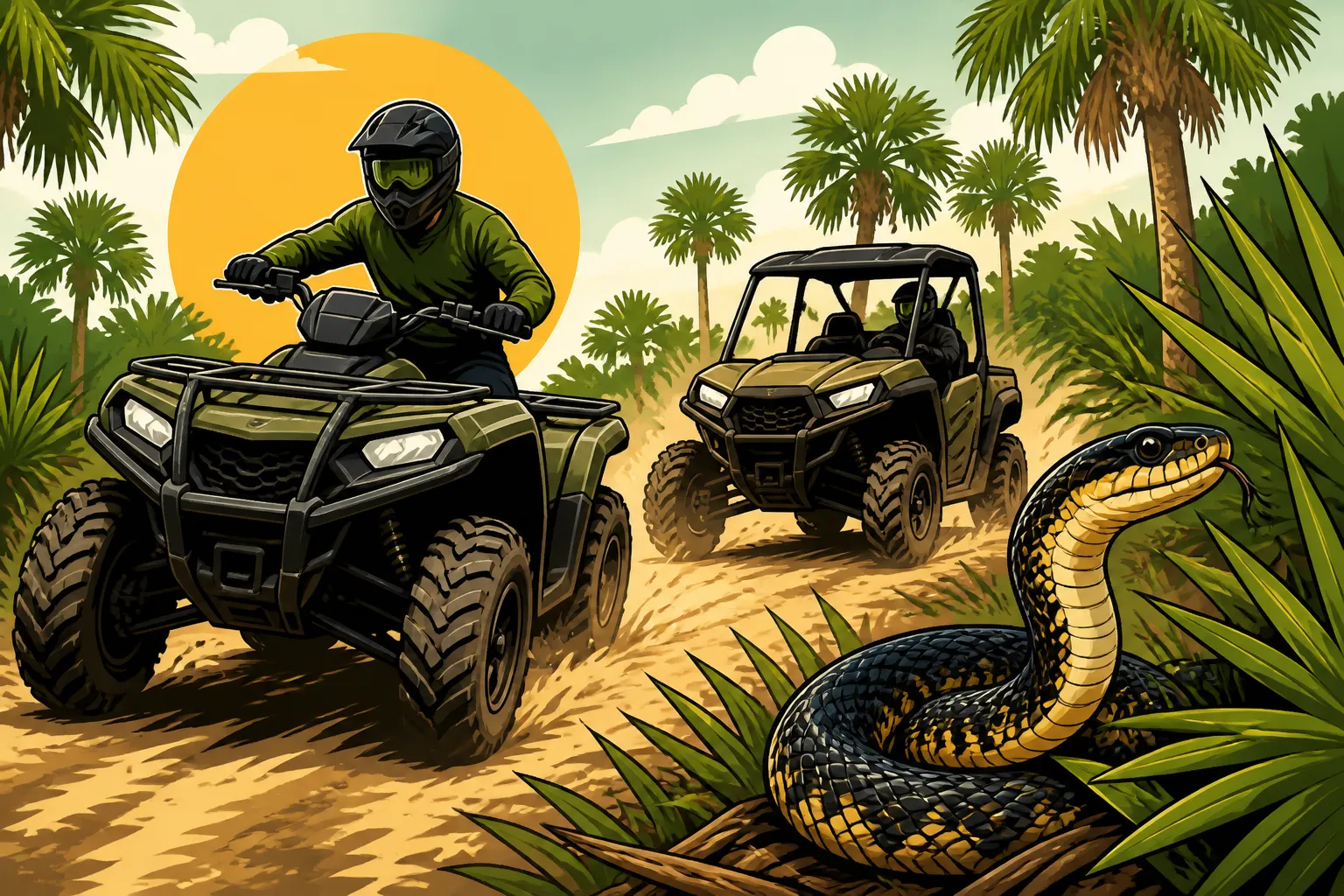
Snakes are often less noticeable than riders expect. A coiled snake may blend into leaf litter, while another may be stretched across a warm trail. Some move away when they sense people approaching; others may stay still and rely on camouflage. That’s one reason to keep a reasonable speed where visibility is limited. A bend, palmetto patch, or washout can hide an animal until you are close.
Florida has several venomous snake species, including rattlesnakes, cottonmouths, copperheads, and coral snakes. You do not need to identify a snake to make a safe decision: keep your distance and let it move away. Trying to get close for a photo or using a stick to make it move puts you within striking range. Even if you believe you know the species, identification from a distance can be difficult.
Places where riders may spot snakes
Snakes may turn up in many kinds of habitat, not just deep woods. On trails, pay extra attention near standing water, wetland edges, drainage areas, fallen logs, tall grass, and thick vegetation. At a trailhead, a snake may be near a shaded picnic area, a woodpile, or a spot where rodents gather. A sunny stretch of trail can also attract a snake looking for warmth.
Riding areas around Florida vary widely, from sandy forest trails to muddy parks and wetland-adjacent routes. Conditions can change after rain, storms, or maintenance work, so familiar trails still deserve attention. Before heading out, check the area’s access rules and trail status. Guides such as [Florida ATV Trails: Every Public Riding Area] and [Florida Trail Closures You Should Check First] can help with general trip planning, but no map or closure notice can tell you whether a snake is beside a particular trail.
How to reduce the chance of a close encounter
Ride with visibility and space in mind
A little patience makes a meaningful difference. Slow down where the trail narrows, curves sharply, crosses a ditch, or runs through tall grass. Keep enough space between machines that the rider behind you has time to react if the lead rider stops. Avoid cutting corners through brush or driving into vegetation to get around a puddle. Those shortcuts can put your wheels and legs closer to wildlife than the marked route does.
It can also help to pause before stepping off your machine. Look at the ground around the parking spot, especially near logs, rocks, tall grass, and shaded areas. If you need to walk through brush, choose a clear route and watch where you place your feet and hands. Don’t reach into a hollow, under a log, or into a pile of leaves without checking first.
Planning tools can help you understand the route and stay oriented, but they are not wildlife detectors. Riders may use onX Offroad to review mapped trails and prepare a route before leaving, then download or save what they need for areas with limited signal. That can reduce unnecessary wandering off-trail, but it cannot show whether a snake is nearby. Follow posted signs and the riding area’s rules even when a map suggests another route.
Prepare your group, passengers, and pets
Before riding, agree on a simple response: if someone spots a snake, stop at a safe distance, alert the group, and give the animal a clear path to leave. Avoid crowding it with multiple machines or surrounding it for a photo. If the snake is on the trail, wait for it to move away if you can do so safely. If it does not move, turn around or contact the riding area staff for guidance rather than trying to push it aside.
Kids may want to get a closer look, so explain in plain language that wildlife should be watched from a distance, not touched. The same goes for dogs. Keep pets close and do not let them investigate a snake. A dog nosing into brush can provoke a bite before you have time to react. If your group plans to ride in a wooded or wet area, consider whether your dog should come at all.
Useful preparation is ordinary, not complicated: closed-toe footwear for walking around, a charged phone, a first-aid kit, and a plan for getting help. A route-planning app such as onX Offroad may be useful for orientation, particularly when cell service is spotty, but tell someone outside the group where you are going and when you expect to return. Check local guidance about cell coverage, trail access, and emergency contacts before setting out.
| Situation | Safer response | Avoid |
|---|---|---|
| Snake is visible beside the trail | Stop at a distance and let it move away | Approaching for a photo |
| Snake is crossing the route | Wait if safe, or turn around | Running over it or steering through brush |
| Snake is near the parking area | Give it space and notify staff if needed | Trying to capture or relocate it |
| Someone may have been bitten | Call emergency services and keep the person calm and still | Cutting the wound, sucking venom, or applying ice |
For practical preparation beyond wildlife awareness, [Florida Trail Riding Gear for the Heat] and [Florida OHV Trail Etiquette Locals Expect] cover other details that can make a ride more comfortable and predictable.
What to do when you see a snake
Give it room and avoid handling it
If you spot a snake, stop far enough away that you are not forcing it to defend itself. Do not poke it with a branch, throw objects, rev an engine to scare it, or try to pick it up. Snakes generally want to avoid people, but they may strike if they feel threatened or cannot escape. A rider leaning over the animal for a closer look is taking an unnecessary risk.
If the snake is on the trail, wait quietly and give it time to move. Keep other riders back and prevent children or pets from approaching. If it remains in place or the trail is too narrow to pass safely, turn around and choose another route. At a managed riding area, let staff know about a snake in a high-traffic location so they can decide whether any action is needed.
Do not assume a snake is harmless because it is small, still, or moving away. Nor is it necessary to identify it before you decide what to do. Keeping space between people and the animal is the useful response. Riders who want more trip-planning context can also review [Florida Trail Riding in the Rainy Season] and [Florida Trail Riding After a Hurricane], since weather and trail conditions can affect where riders travel and what they encounter.
Respond quickly to a suspected bite
Treat any suspected snakebite as an emergency. Call 911 or the local emergency number, and follow the dispatcher’s instructions. Keep the person as calm and still as possible while help is arranged. If you can do so without approaching the snake, note its appearance from a safe distance; do not try to catch or kill it. A photo is only useful if taking it does not delay care or put anyone closer to the animal.
Remove rings, watches, or tight items near the bite if they can be taken off easily before swelling increases. Keep the bitten area still and positioned comfortably. Do not cut the wound, try to suck out venom, apply ice, or use a tourniquet. These actions can cause additional harm and delay appropriate medical treatment.
If the bite happens on a remote trail, use the location information available to guide emergency responders, and send someone to meet them at an accessible trailhead if that can be done safely. This is another reason to know your route before riding and to keep your group together. Mapping tools, including onX Offroad, can assist with orientation, but emergency response should follow local dispatch instructions rather than assumptions about the nearest road or facility.
Planning a Florida ride during snake season
Check the area before you leave
Start with the riding area’s official information. Confirm that the trails are open, learn which routes are appropriate for your machine, and check any posted wildlife or safety notices. Conditions can differ between a developed riding park, a state forest, and a national forest. If you are unfamiliar with the area, [Florida ATV Trail Map Downloads] can help you think through route options, while [Florida National Forest Riding vs State Forest Riding] explains why riding rules and access details can vary by land manager.
Build in time to ride at a pace that suits the terrain. A schedule that leaves no room to slow down or turn back can encourage risky choices when a trail is blocked or visibility is poor. Tell someone your planned destination and return time, carry water, and make sure the group knows what to do if it gets separated. Keep your phone accessible, but do not depend on having a signal everywhere.
A route app such as onX Offroad can support pre-ride planning and navigation when you have saved the relevant information ahead of time. Review routes before you start, not while moving, and do not treat mapped lines as permission to ride on land that is closed or restricted. Stay on authorized trails, respect signs, and check with the land manager if access is unclear.
Make the ride cautious, not fearful
Seeing a snake can be unnerving, especially if you have never encountered one on a trail. Still, you do not need to abandon every warm-weather ride. Most close encounters can be handled by stopping, keeping your distance, and letting the animal move away. The bigger risk often comes from trying to touch, scare, or pass too close to it.
Use the same steady habits whether you ride near Ocala, Brooksville, the Panhandle, or another part of Florida: watch the trail ahead, avoid reaching blindly into vegetation, and keep children and pets from approaching wildlife. If a trail feels too overgrown or visibility is poor, choosing another route is a sensible decision, not a failure of nerve. A good ride is one where everyone returns safely, even if the route changes.
For a broader look at ride preparation, [Florida Trail Riding Gear for the Heat] is useful when planning for long days outdoors, and [Florida ATV Trails With Restrooms at the Trailhead] can help families consider practical stops. Keep wildlife encounters simple: create distance, stay on the route, and let trained staff or emergency responders handle situations that need more than caution.
Disclaimer
This article is for general informational purposes only and does not constitute professional advice. Laws, prices and regulations vary by location and change over time. Consult a qualified professional for guidance on your specific situation.