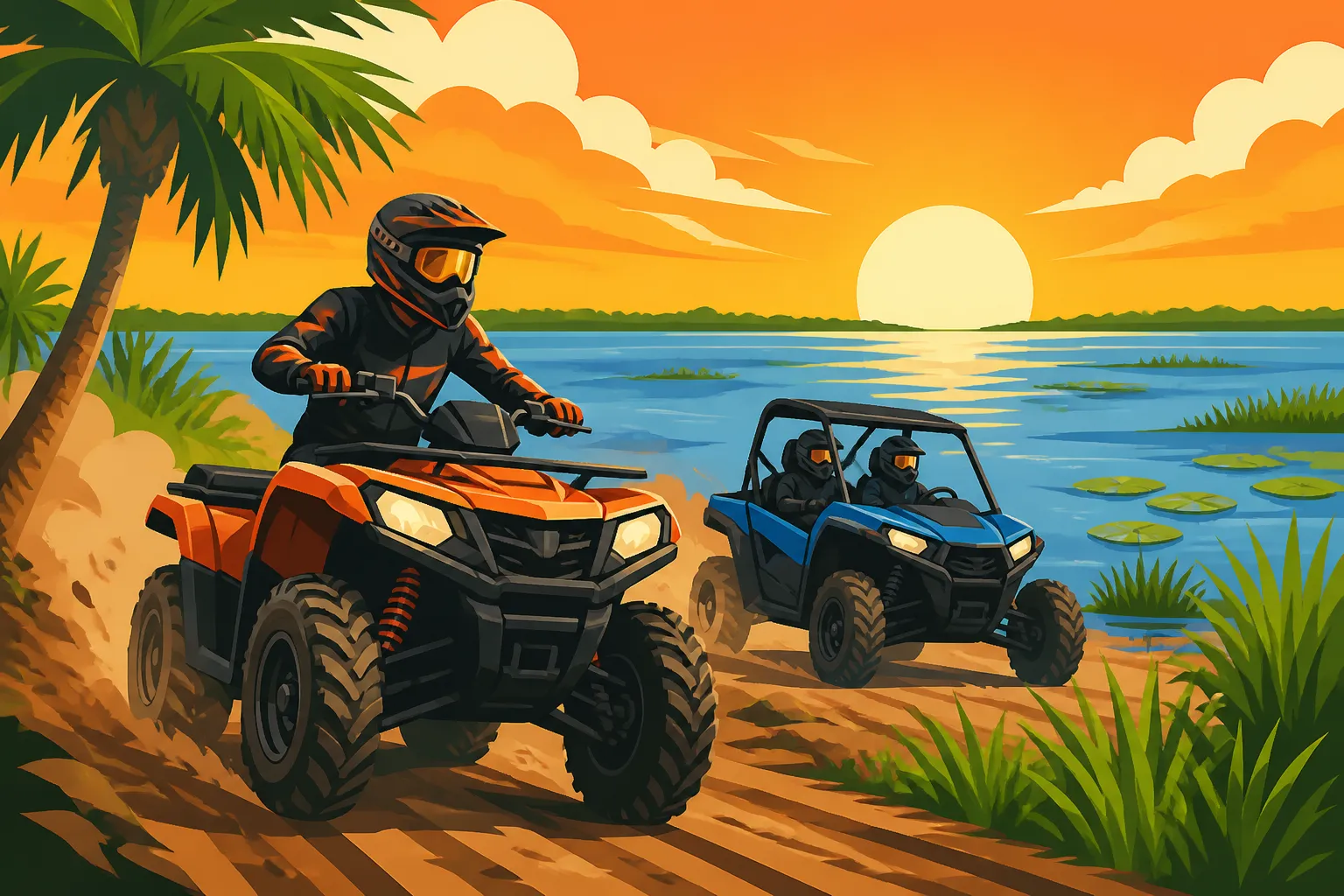
Riding Near Lake Okeechobee
Around Lake Okeechobee, a tempting dirt track can quickly turn into private ranch land, a protected wildlife area, or a restricted levee. That makes planning more important than simply finding a route on a map. This guide explains where to look for lawful ATV and UTV riding near the lake, what to check before unloading, and how to avoid confusing scenic access with permission to ride.
What riding near Lake Okeechobee really looks like
The lake’s famous trail is not an ATV trail
The Lake Okeechobee Scenic Trail, often called the LOST, follows the top of the Herbert Hoover Dike around much of the lake. It is known as a route for walking and cycling, not a place to ride an ATV or UTV. A visible track, levee road, or maintenance access point does not mean motorized recreation is allowed there.
This distinction matters because roads and paths around the lake can look open, especially where they run beside fields or water. But levees, canals, and their access roads are managed for purposes such as flood control and maintenance. Entering with a quad without authorization could put you in a restricted area, even if you see tire marks or a gate is open.
The towns around the lake—Okeechobee, Pahokee, Belle Glade, Clewiston, Moore Haven, and South Bay—are useful starting points for planning, fueling, and finding lodging. They are not, by themselves, indicators of public ATV access. Before unloading, establish that the actual property or trail is open to your machine. For background on permitted riding locations, start with Florida ATV Trails: Every Public Riding Area and Florida ATV Road Rules: Where You Can Legally Ride.
Expect a patchwork of land ownership and rules
The land around the lake includes private ranches and farms, conservation areas, wildlife management areas, public facilities, and roads with different access rules. A route that seems continuous on a screen may cross several separate parcels. One landowner may allow riding with permission, while an adjacent tract may prohibit motorized access altogether.
That patchwork is why “near Lake Okeechobee” is not the same as “open to ATV riding.” A road can be public for ordinary vehicle travel without being an approved off-road route. Likewise, a trail on conservation land may be open to hikers or cyclists while motorized riding is limited to designated routes, specific seasons, or authorized uses.
Treat each property as its own decision. Confirm the managing agency or owner, the permitted vehicle type, the route boundaries, and any seasonal closures. Florida Conservation Land Riding Permission and Florida WMA Rules for ATV Riders are useful starting points when a potential route appears to cross conservation or wildlife-managed land.
How to find legal ATV and UTV riding near the lake
Check public riding areas before choosing a route
Start by looking for a designated riding area rather than trying to create a route from roads, levees, and informal tracks. Public OHV areas typically have defined boundaries and rules about machine classes, passes, permits, hours, and trail use. The nearest suitable place may not sit directly on the lakeshore, so consider how far you are willing to trailer.
If you are looking at land managed by a water management district, do not assume that recreation access automatically includes ATVs. Check the specific tract rules and ask the land manager whether motorized riding is allowed on the exact route you plan to use. Florida Water Management District Riding Permits and Florida Riding on Water Management District Tracts can help you understand why tract-by-tract confirmation matters.
A map app can help you see roads, property boundaries, and possible staging areas, but it cannot grant permission or guarantee that a route is open. Some riders use onX Offroad to help compare possible routes with land boundaries before a trip. Use it as a planning aid, then confirm access with the land manager or property owner. If the screen shows a promising line near a canal or dike, treat that as a question to investigate—not as approval to ride.
Get permission in writing on private land
Private ranch and agricultural property may look like an ideal place to ride: open ground, long tracks, and room to spread out. But appearance is not permission. Ask the owner or authorized manager before entering, and be specific about the machine, number of riders, dates, route, and whether passengers will be riding.
Written permission helps prevent the familiar misunderstanding where one person says “the owner is fine with it” but nobody can identify who gave permission or what area they meant. A text or signed note should clearly identify the property or route and any conditions. Respect gates, fences, posted signs, livestock, crops, and quiet hours. Never assume permission for one parcel extends across a fence line or onto a neighboring property.
Use onX Offroad or another mapping tool to help identify where boundaries may change, but confirm uncertain lines directly with the owner. The app can make a planning conversation more precise—“Can we ride this section?”—but it cannot replace permission. If you cannot confirm who controls a tract, choose another destination rather than testing the boundary in person.
Plan the trip around access, machine type, and conditions
Confirm that the route suits your ATV or UTV
A trail that works for a narrow ATV may not be suitable for a wide side-by-side. Width limits, gates, trail classifications, and local restrictions can determine whether a UTV is allowed. Check the rules for the actual riding area, not only general information about Florida trails. Florida ATV Trails That Allow Side-by-Sides is a helpful reference when comparing destinations.
Before you leave, confirm the allowed machine types and whether there are restrictions on passengers, youth riders, noise, tires, or required safety equipment. Do not rely on a trail description that only says “ATVs welcome” if you are bringing a large UTV. Contact the operator or land manager and describe your machine’s width and configuration.
Also account for the vehicle used to reach the riding area. If you are towing, make sure there is a suitable legal place to park the truck and trailer, and that the staging area is open to the public. Florida ATV Trailheads With Parking for Trailers can help you think through that part of the trip. A ride can be perfectly planned on the trail and still go sideways if the access road is too tight or the designated parking area is full.
Check closures and conditions shortly before departure
South Florida weather can change the feel of a route quickly. Heavy rain can make low-lying ground muddy or impassable, while dry conditions can mean dust, heat, and limited shade. A route that was passable on a previous visit may be closed, flooded, or restricted during a later trip.
Check directly with the riding area or land manager before driving out, especially if your route depends on public land. Ask whether the area is open to your machine, whether any trails are temporarily closed, and whether there are restrictions related to weather, hunting seasons, maintenance, or conservation work. Florida Trail Closures You Should Check First offers a useful reminder to confirm conditions rather than relying on an old trip report.
A mapping app can help you save a planned route and understand nearby roads, but its displayed trail lines may not reflect a temporary closure or a change in access. onX Offroad can be one layer in your planning process; pair it with current instructions from the property manager. Share your destination and expected return time with someone who is staying off the trail, and carry a charged phone, water, and basic recovery supplies.
| Riding option near Lake Okeechobee | What to verify before you go | Common mistake to avoid |
|---|---|---|
| Designated public OHV area | Hours, permitted machines, trail limits, passes, and closures | Assuming every public recreation area allows motorized riding |
| Water management or conservation tract | Whether motorized access is allowed on the specific tract and route | Treating public ownership as permission to ride anywhere |
| Private ranch or farm | Owner permission, boundaries, conditions, and access dates | Following a track across a fence without asking |
| Levee or canal access road | Whether motorized recreation is expressly authorized | Mistaking a maintenance road or scenic route for an ATV trail |
| Public road near a riding area | Local roadway rules and legal access from the trailhead | Riding an ATV on a road just because it is unpaved |
A practical pre-ride checklist for the Okeechobee area
Before leaving home
Choose a confirmed riding destination first, then plan your drive around its access point. Do not build the day around a loop that follows the shoreline unless you have verified that every segment is legal for your vehicle. If you are combining a visit to a town such as Clewiston or Okeechobee with a ride, keep the sightseeing portion separate from the off-road route.
Save the destination’s contact details and current rules. If you are relying on a digital map, save what you need before leaving areas with reliable service. Mark the authorized entrance and parking area, not just a nearby road. A pin dropped on the wrong side of a canal or private parcel can lead to a frustrating detour—or an accidental trespass.
Prepare the machine and trailer for the conditions you expect. Check tires, fuel, tie-downs, lights, and recovery gear. Bring drinking water, sun protection, and a first-aid kit; the heat and open terrain can make even a short ride feel longer than expected. If you are bringing children or new riders, choose an area with rules and trails that match their experience.
At the trailhead or property entrance
Read posted signs before unloading. Confirm that the entrance is the correct one and that your pass or permission covers the machine you brought. If the rules are unclear, ask the staff or land manager rather than relying on another rider’s interpretation. A group already on a trail may have permission or a pass that does not apply to you.
Keep the group together and stay on authorized routes. Do not widen a trail to bypass a muddy section, cut through vegetation, or ride around a closed gate. Those shortcuts can damage sensitive habitat and make future access harder for everyone. If conditions are worse than expected, turning around is often the safest—and most considerate—choice.
For a first trip, plan a conservative route and leave time to return before dark. Let the slowest rider set the pace, check in at agreed points, and avoid splitting the group at intersections. If a route becomes uncertain, stop and verify your location instead of continuing in the hope that the track reconnects.
If you cannot confirm access
Do not ride an uncertain route simply because it is marked on a map, appears on social media, or has fresh tire tracks. Ask the land manager, property owner, or riding-area operator. If you cannot get a clear answer, choose a designated area with rules you can verify. That may mean more trailering, but it is far less stressful than being turned around at a gate or dealing with a trespass complaint.
When comparing nearby destinations, consider whether side-by-sides are accepted, whether parking accommodates a trailer, and whether the area is open on your planned day. Florida ATV Trails Open Year-Round may help with broad destination planning, but always confirm conditions and operating rules for the specific site before you travel.
The best ride near Lake Okeechobee is not necessarily the one closest to the water. It is the one where the access is clear, your machine is permitted, and the route is open for the kind of riding you want to do. Using a map tool such as onX Offroad to prepare questions, then confirming those answers with the land manager, makes it easier to spend the day riding instead of backtracking.
Disclaimer
This article is for general informational purposes only and does not constitute professional advice. Laws, prices and regulations vary by location and change over time. Consult a qualified professional for guidance on your specific situation.