Hard Rock Hookup Sites for RVs
Planning an RV trip around a ride at Hard Rock Off Road Park in Ocala involves more than finding a campsite with hookups. You’ll want to confirm what each site actually provides, whether your machine and trailer fit, and how park access works for overnight guests. This guide walks through those checks so you can arrive prepared instead of sorting out avoidable surprises at the gate.
Confirm what “hookup site” means before booking
Ask which utilities are available at your specific site
The words “RV hookup” can mean different things from one campground to another. A site might offer power only, or it might include water and sewer connections as well. Some facilities have shared amenities rather than full hookups at each individual spot. Before you reserve, ask the park what is included at the exact site you’re considering.
Be specific about your RV, too. If you need a particular electrical connection, ask what the site supports rather than assuming it will match your rig. If you plan to use a water or sewer connection, check where it is positioned and whether your hose and equipment can reach it. A quick phone call can prevent the frustrating scenario of backing into your space and discovering that a connection is on the wrong side or isn’t available there.
Also ask what the reservation covers. Does the site booking include access to riding areas, or are riding access and camping handled separately? Are guests expected to check in at different places? Are there arrival windows or instructions for after-hours arrivals? These details can affect your schedule, especially if you’re towing a long trailer or planning to ride the same day you arrive.
Match your RV and trailer to the site
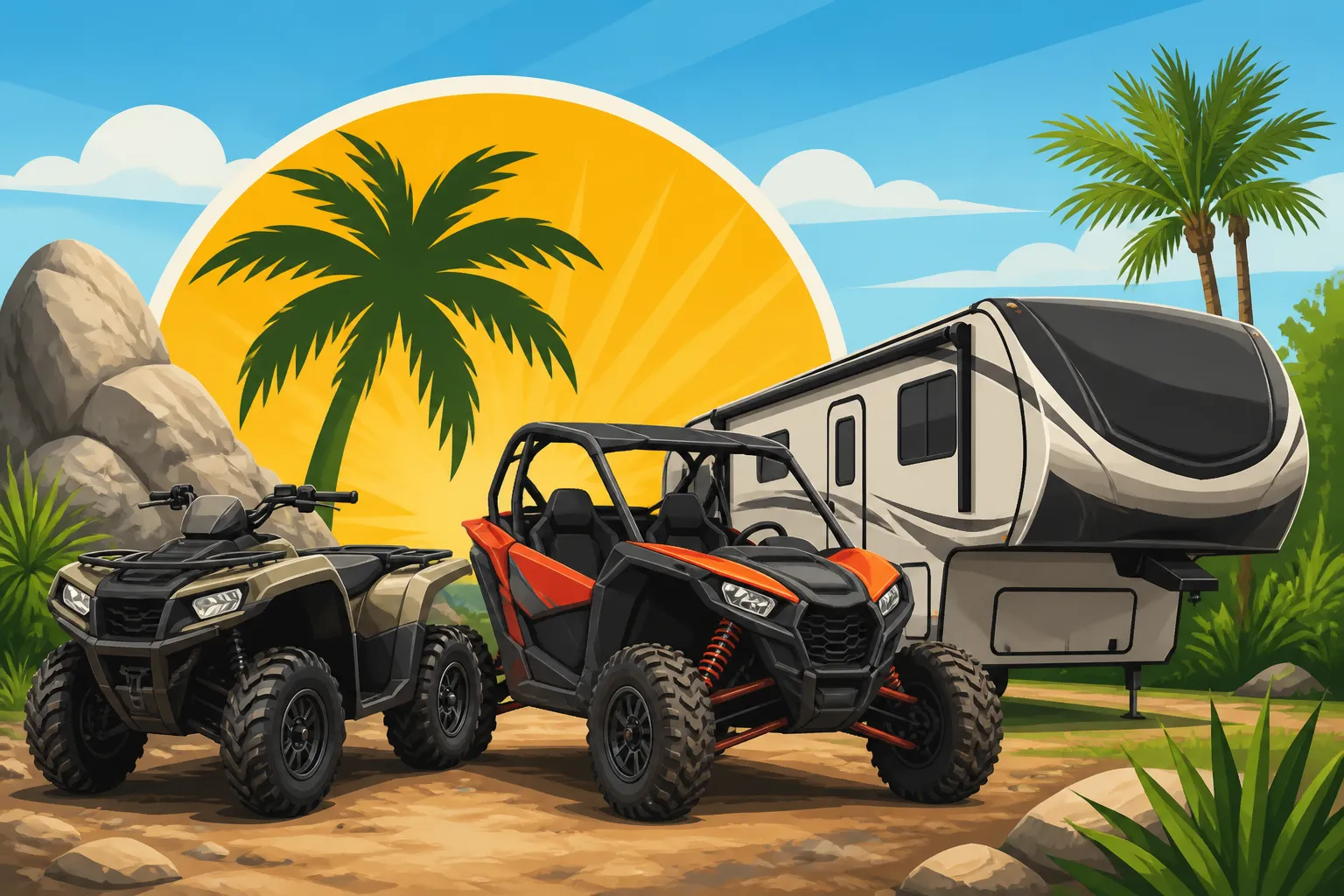
A campsite can have utilities and still be a poor fit for a large RV or a long combination of tow vehicle, trailer, and machine. When you contact the park, give the overall length of your setup—not just the length of the motorhome or camper. Ask whether you can park the tow vehicle and ATV or UTV trailer at the site, or whether there is a separate parking area.
Think through how you’ll move around once you’re parked. A tight site may leave little room to unload a quad, open a toy hauler ramp, or turn a trailer without blocking a neighboring space. If you’re bringing a side-by-side on a separate trailer, mention its dimensions. Width and turning room can matter as much as length, especially when you’re arriving after a long drive and would rather not reorganize your gear in a busy campground.
If you’re comparing options, Florida OHV Campgrounds With Hookups and Florida Riding Areas With RV Sites can help you frame the questions to ask. Don’t treat a general campground description as confirmation that a particular site can accommodate your exact rig. Get the measurements and site arrangement confirmed directly before you commit.
| What to confirm | Why it matters | Useful question |
|---|---|---|
| Utility connections | “Hookups” may not mean full hookups | Which utilities are connected at this specific site? |
| Electrical connection | RV requirements vary | What connection is available, and where is it located? |
| Site dimensions | A rig may fit differently than expected | What are the usable length and width? |
| Trailer parking | Your RV may not be the only vehicle | Can the tow vehicle and machine trailer remain at the site? |
| Riding access | Camping and riding may be handled separately | Does this reservation include riding access, or is that arranged separately? |
| Arrival procedure | Late arrivals can create avoidable stress | Where do I check in, and what should I do if I arrive after hours? |
Plan the ride as carefully as the campsite
Check park access, machine rules, and trail options
Hard Rock is a riding destination as well as a place riders may plan an overnight stay. Before loading, confirm which machines are permitted in the areas you intend to use and whether there are specific restrictions for ATVs, UTVs, or other off-highway vehicles. Don’t rely on an old conversation, a friend’s past visit, or a general trail description to establish today’s rules.
The park’s layout and riding features can shape what you bring. If you’re interested in technical terrain, learn what the park offers and choose a route that matches your experience. The details in Hard Rock’s Rock Garden and Climbs may help you think about whether your group wants that style of riding. Riders who prefer less demanding terrain should ask about suitable routes and any areas that are best avoided by beginners.
A navigation app can be useful for organizing a route and keeping track of where your group has been. Some riders use onX Offroad to review route information and plan a day, but treat any app as a planning aid—not a substitute for the park’s current map, posted instructions, or staff guidance. Private riding areas can change access conditions, close sections, or direct traffic in ways that a downloaded map may not reflect.
Check closures and riding conditions close to departure
A trail that was open on a previous visit may not be open when you arrive. Weather, maintenance, events, and land-management needs can affect access. Check directly with the park before driving, especially if your trip depends on a particular section or type of terrain. Florida Trail Closures You Should Check First offers a useful reminder to make closure checks part of the planning process rather than an afterthought.
Florida conditions can change quickly. Heavy rain may make some routes muddy, while heat and humidity can make a long ride more tiring than it looked on a map. For practical preparation, review Florida Trail Riding in the Rainy Season and Florida Trail Riding in Summer Heat. Pack water, protective gear, and a way to communicate with your group, and decide in advance when you’ll turn back if the weather or trail conditions become uncomfortable.
If you use onX Offroad or another mapping tool, download or review what you need before setting out, but verify your route against park information. Keep your group together at trail junctions and agree on a meeting point in case someone takes a wrong turn. A little preparation is particularly helpful when riders have different comfort levels or are operating machines with different capabilities.
Make the RV stay work for the whole group
Organize arrival, unloading, and daily routines
A smooth arrival starts before you reach the campground. Keep your reservation details, site assignment, park instructions, and any required documents easy to find. If your RV is towing a machine trailer, plan where you’ll stop to check directions or adjust straps without blocking traffic. When you arrive, follow staff directions and posted signs rather than driving around to find a more convenient route.
Once you’re parked, establish a safe unloading routine. Choose a spot where the machine can come off the trailer without crossing a busy campground lane or creating a hazard for nearby campers. Keep helmets, goggles, boots, and gloves together so nobody is searching through storage compartments at the last minute. If several people are riding, designate one person to check that machines are secured before travel and that the group has what it needs before leaving the campsite.
Consider how your group will handle meals, charging devices, wet gear, and muddy equipment. Ask what facilities are available instead of assuming there is a wash station or a place to clean machines. Pack a ground mat or storage bins to keep grit and mud from spreading through the RV. For a multi-day visit, divide gear into riding and campsite bags; it makes early starts easier and helps keep dirty equipment separate from sleeping and cooking areas.
Set clear expectations for camping and riding
Campground etiquette matters when many visitors arrive with trailers, machines, and early riding plans. Keep noise low during posted quiet hours, avoid running engines longer than necessary, and secure equipment when it’s not in use. Check where machines may be operated and where they must be trailered or pushed. A campsite is not automatically permission to ride through every nearby area.
Before departure, review Florida OHV Trail Etiquette Locals Expect and Florida ATV Camping With Trail Access for broader planning considerations. At the park, follow its own rules first. Rules for a private riding property may differ from those at a national forest or state forest, so don’t carry assumptions from one place to another.
If your group includes newer riders, agree on a pace and regrouping plan before heading out. Experienced riders sometimes move ahead without realizing that a beginner is struggling with a route or machine. Decide who rides in front and behind, and make sure everyone knows what to do if the group gets separated. If a route feels beyond someone’s skill level, choosing an easier option is better than turning a fun weekend into a stressful recovery.
Use a simple trip checklist before you leave
Confirm the details in one conversation
A short call or message to the park can settle several uncertainties at once. Have your RV dimensions, trailer length, machine type, and planned arrival date ready. Ask about the specific site, available utilities, parking arrangement, riding access, check-in process, and any machine restrictions. If you’re bringing a group, ask whether everyone needs to check in together or whether each reservation is handled separately.
Keep the answers with your travel documents. If you speak by phone, write down the name of the person you spoke with and the key details they gave you. This is especially helpful when you have a long drive from another part of Florida and need to make decisions before loading. Reconfirm important details shortly before departure if weather, special events, or changing conditions could affect your plans.
Use onX Offroad or another navigation tool to organize your route to the area, but check the park’s directions and arrival instructions independently. A mapping app may choose a route that is awkward for a large RV or trailer. If the park recommends a particular entrance or approach, use that guidance even if your usual navigation route suggests a shortcut.
Pack for both campsite comfort and trail safety
A practical packing list should cover the RV, the machine, and the people riding. Bring the personal protective equipment required by the park, plus suitable clothing for dust, mud, heat, and changing weather. Carry drinking water and basic supplies for minor trail delays. Check the machine before the trip, including tires, brakes, lights, fluids, and tie-down points, so a simple maintenance issue doesn’t consume your first day.
Don’t forget the trailer. Check the hitch connection, safety chains, tires, lights, and straps before setting out. Secure loose gear so it cannot shift during travel, and keep frequently needed items—such as a tire gauge, gloves, or rain layer—reachable without unpacking everything. If you’re transporting multiple machines, check that each one is properly secured and that your total load is appropriate for your vehicle and trailer.
A final practical checklist:
- Confirm the exact site utilities and dimensions.
- Verify RV, tow vehicle, and trailer parking arrangements.
- Ask whether camping and riding access are separate.
- Check which machines and riding areas are permitted.
- Review closures, weather, and arrival instructions.
- Pack riding gear, water, tools, and secure storage for muddy equipment.
- Save the park’s contact information and route instructions.
A little advance checking can make an RV stay at Hard Rock far more comfortable. The key is to verify the details that vary from site to site—hookups, space, parking, and riding access—rather than assuming they come as one package. With those pieces settled, you can spend less time troubleshooting at camp and more time enjoying the ride.
Disclaimer
This article is for general informational purposes only and does not constitute professional advice. Laws, prices and regulations vary by location and change over time. Consult a qualified professional for guidance on your specific situation.