Where Florida Bans Side-by-Sides on Trail
A side-by-side can look perfectly suited to a Florida trail and still be turned away at the gate. The frustrating part is that there is no single statewide list of trails that accept every UTV: access depends on the riding area, trail designation, vehicle dimensions, and current closures. This guide explains where restrictions commonly apply and how to check before hauling your machine.
Why Florida Side-by-Side Trail Access Varies
There is no blanket statewide trail rule
Florida does not treat every off-highway riding area as one connected trail network. A county, state forest, national forest, or privately operated park can set access rules for the land it manages. That means a side-by-side allowed at one riding area may be prohibited on a trail a short drive away.
Even within a single property, access may vary by route. A wide forest road might allow a UTV while a narrow, designated ATV trail nearby does not. A park can also have trails intended for different vehicle classes, with separate rules for width, machine type, or permitted use. The name “OHV area” alone does not tell you that every kind of off-highway vehicle can use every trail.
This is why advice from a friend, an old ride report, or a map pin can be misleading. The rider may have been on a different route, visited under different conditions, or been using a vehicle that fits a restriction your machine does not. Start with the manager’s current rules and map for the specific place you plan to ride.
Trail designation and vehicle type both matter
A side-by-side is not automatically treated as an ATV just because both are off-highway vehicles. Managers may distinguish between motorcycles, ATVs, and wider or heavier utility vehicles when designating trails. A route marked for motorcycles and ATVs, for example, should not be assumed to permit a UTV unless the area’s rules say so.
Width is an especially common dividing line. Narrow trails may pass through trees, between posts, or over terrain that cannot safely accommodate a wider vehicle. A width limit may be posted at the entrance, shown in the trail rules, or enforced at a gate. Don’t assume that a machine that is only a little wider than the limit will be waved through.
Weight and vehicle class can also affect access. A route designed around smaller machines may not be suitable for a heavier side-by-side, even if its width appears acceptable. For a broader look at how riding-area rules differ, see [Florida National Forest Riding vs State Forest Riding] and [Florida State Forest OHV Areas Explained].
Places and Routes Where Side-by-Sides May Be Restricted
Narrow, ATV-focused trails are a common restriction point
One of Florida’s clearest examples is Croom Motorcycle Area in the Withlacoochee State Forest. Croom is associated with motorcycle and ATV riding, and side-by-sides can be turned away because the area’s access rules and trail design do not accommodate them. The practical lesson is simple: don’t read “off-highway vehicle area” as “all OHVs welcome.”
Croom’s entrance restrictions are a useful reminder that arriving at the gate is too late to settle vehicle eligibility. A UTV can be loaded, fueled, and ready for a weekend only to find that it is not permitted through the entrance. Review [Why Croom Turns Away Side-by-Sides] and [Croom's 55-Inch Width Check at the Gate] before planning a visit, and confirm the current policy with the area if anything is unclear.
Similar issues can arise on other narrow ATV or motorcycle routes. A trail may have tight turns, narrow bridges, vegetation close to the trail, or physical barriers that prevent wider machines from passing. Even where the landscape looks open on a map, the actual path can be too narrow or restricted for a side-by-side.
A wide vehicle may be barred even when a trail looks passable
A trail’s appearance in a photo or satellite view is not proof that a UTV is allowed. The visible section might be a forest road rather than a designated trail, or it could be a route where only certain vehicle types are permitted. Some restrictions exist to protect the trail or natural resources, not just because a machine physically cannot fit.
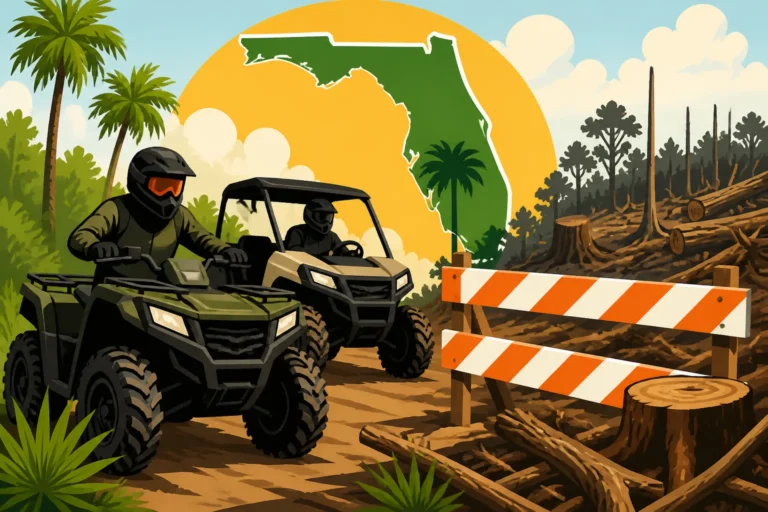
Likewise, being able to drive through an opening does not mean you are authorized to do so. Gates, bollards, signs, and width checks are there to establish or enforce access conditions. Do not try to bypass a barrier, follow an unauthorized route around it, or rely on the fact that another rider seems to have made it through.
A machine’s advertised width can also differ from its real-world width once accessories are installed. Tires, wheel spacers, doors, mirrors, and other additions can affect the overall dimensions. If an area sets a maximum width, ask how it measures the vehicle and whether the rule refers to the machine as equipped. For a related explanation, see [Florida's ROV Width Rule Explained].
Forest roads and designated OHV trails are not interchangeable
A common source of confusion is seeing a road open to vehicles and assuming the connecting trail is open to the same vehicle. Forest road access and trail access can be governed by different designations. One route may be a general-use road, while a nearby path is limited to motorcycles or ATVs.
This distinction matters in national forests as well as state forests. A route on a map may have a specific vehicle designation, seasonal closure, or other restriction. Don’t use a road’s appearance, its name, or the fact that it appears on a navigation app as a substitute for checking its official status.
Plan the route as a sequence of confirmed segments rather than as one broad destination. If your intended ride requires leaving a permitted road and entering a narrower trail, confirm that transition is allowed for your UTV. The [Florida ATV Trail Map Downloads] guide can help with map planning, while the area manager’s current rules should settle whether your vehicle may use a specific route.
How to Check Whether Your UTV Is Allowed
Start with the land manager’s current rules
First identify who manages the riding area: a national forest, state forest, county, or private operator. Then check that manager’s official rules and map for the exact trail system, not just the property name. Look for vehicle categories, width restrictions, closures, seasonal conditions, and any entry requirements.
If the information is ambiguous, contact the office or gate before you leave home. Ask a direct question that includes your machine’s make or type and its overall width as equipped. “Are side-by-sides allowed?” is a useful start, but “Can my UTV, with this measured width, use these named trails?” is more likely to get an answer you can act on.
Keep in mind that a rule posted at the trailhead can take priority for your ride if a route has recently closed or conditions have changed. Check for temporary alerts shortly before departure, especially after heavy rain, storm damage, prescribed burns, or maintenance. [Florida Trail Closures You Should Check First] offers more context on why a route that was open on a previous trip may not be open today.
Use digital maps as planning aids, not permission
Digital trail maps can make it easier to see where a route goes, locate access points, and plan around nearby roads. Tools such as onX Offroad may help you organize a route and compare trail information before a trip. They can be especially useful when you are trying to avoid arriving at a trailhead with a trailer only to discover that your chosen entrance is on the wrong side of a restricted route.
Still, a line on an app does not grant access. A mapped route may be outdated, may not identify a vehicle-specific restriction, or may not reflect a temporary closure. Treat mapping tools as a way to prepare questions and plan alternatives, then check the land manager’s own information before riding.
A practical approach is to compare the official map with your navigation app and note any discrepancies. If the official map labels a route for ATVs or motorcycles only, don’t assume that onX Offroad—or any other map display—overrides that designation. When the two sources appear to conflict, contact the manager before you load up.
Confirm the machine’s dimensions before the trip
Measure the UTV in the configuration you intend to ride. Include the widest parts of the machine and any accessories that extend beyond its body. If you are near a posted limit, don’t rely on a brochure measurement or a guess based on the tires.
Write down the measurement and have it ready when you call the riding area. Ask whether the posted maximum is measured from tire edge to tire edge, from the widest point, or according to another method. A quick confirmation can prevent a long drive, a gate dispute, or a last-minute search for somewhere else to ride.
If your UTV is close to the limit, leave room for uncertainty rather than assuming the most generous interpretation. You can also ask whether the property offers a separate area or route for wider vehicles. For additional planning, see [Florida ATV Trails That Allow Side-by-Sides], but verify each location’s current requirements directly before traveling.
A Better Way to Plan a Side-by-Side Ride
Match the trail to the machine before choosing the destination
It is tempting to pick a popular riding area first and work out the details later. For a UTV, reverse that process: begin with your machine’s dimensions and type, then shortlist areas that specifically allow side-by-sides. This makes it easier to avoid spending time and money on a destination that only accepts smaller machines.
Think about the whole trip, not just the trail itself. Check whether the property has a suitable entrance, trailer parking, required permits, and routes that connect without passing through a restricted section. A UTV-appropriate trail is not much help if the staging area cannot accommodate your trailer or the planned loop leads onto a prohibited ATV-only path.
A comparison table can help keep your research straight:
| What to check | Why it matters | What to confirm |
|---|---|---|
| Vehicle category | “OHV” may not include every vehicle type | Whether side-by-sides are explicitly allowed |
| Width limit | UTV access may depend on overall dimensions | How width is measured and whether accessories count |
| Trail designation | Different routes may have different rules | Whether your specific route accepts UTVs |
| Temporary closures | Access can change because of conditions or work | Current alerts and the status of your planned route |
| Entry and staging | Parking and trail access may be separate issues | Trailer access, parking, permits, and check-in rules |
This small amount of preparation is more useful than trying to interpret a restriction at the trail entrance. It also gives you a fallback: if one trail is closed to UTVs, you can switch to a confirmed alternative instead of improvising on the spot.
Build a backup plan for restrictions and closures
Choose a second riding option before leaving, ideally one that clearly permits your vehicle. Check its location, entry requirements, and operating conditions so that it is a real alternative rather than a name saved in your phone. A backup plan is especially valuable for weekend trips, when a last-minute change may mean a longer drive or limited parking.
It also helps to save the official trail map and contact details while you have reliable service. Cell coverage can be inconsistent in rural areas and forest land. A downloaded map or a written note with the approved route can help you avoid turning onto an unverified trail when you lose signal.
When planning in onX Offroad, use the app to lay out possible routes and mark access points, then compare those plans against official information. That extra step can catch a route that appears connected digitally but is not authorized for a side-by-side. Keep a second route in mind in case a ranger, gate attendant, or current closure notice directs you elsewhere.
Don’t use public-road permission as a trail-access shortcut
Rules for riding on roads and rules for riding trails are separate questions. A machine that may use a particular road under local rules does not automatically have permission to enter a nearby trail system. In the same way, a trail pass or riding-area entry does not make public roads legal routes for a UTV.
This distinction is easy to miss when a trailhead is close to a road or when a route appears to connect two riding areas. Check the rules for each segment, including any road crossings or short road connections. The guide to [Florida ATV Road Rules: Where You Can Legally Ride] covers the separate road-access question.
Never assume that a trail is open simply because it is unpaved, signed for vehicles, or used by someone else. If access depends on a local designation, posted signs and the managing authority’s rules matter. A cautious route plan protects both your ride and the land you are using.
What to Do if You Are Turned Away
Stay calm and clarify the restriction
If staff tell you that your side-by-side cannot enter, ask which rule applies and whether it affects the entire property or only the planned route. The answer may clarify whether the issue is vehicle class, width, a temporary closure, or a trail-specific restriction. Be polite and avoid arguing that the machine fits through a gap or that another rider was allowed in.
If you believe there is a misunderstanding, explain your machine’s dimensions and ask whether there is an official measurement method or a designated UTV route. Do not pressure staff to make an exception. They are responsible for enforcing the area’s access rules, and a disagreement at the entrance is unlikely to improve your ride.
Take note of the route name, sign, or rule that caused the problem. That detail helps you correct your plan next time and ask more precise questions before returning. If you need a different destination, use your backup rather than trying an unmarked route nearby.
Avoid unauthorized detours
A closure or vehicle restriction does not make nearby land an acceptable substitute. Do not go around a gate, cut across vegetation, or follow a route simply because it looks like it reconnects with the official trail. Unapproved detours can damage sensitive areas and create safety problems for other riders.
When a trail is blocked, turn around and follow the marked route back to a permitted road or staging area. If signage is confusing or missing, contact the manager for direction rather than relying on another rider’s guess. This is particularly important on forest land, where roads, trails, and closed areas can be close together.
A side-by-side’s size and weight can leave a larger footprint than a smaller ATV, especially on soft or wet ground. Respecting closures helps keep routes in rideable condition and reduces the chance that managers will need to impose broader restrictions. The goal is not simply to get through a ride today; it is to preserve access for future visits.
Make the next trip easier
After the ride, save the details that proved useful: the official map, the right entrance, any machine-width guidance, and the contact information for the land manager. If you discovered that a route excludes UTVs, note that clearly so you do not repeat the same planning mistake on your next trip.
Rules can change, so treat your notes as a starting point rather than a permanent guarantee. Recheck the official information before each visit, especially if you are returning after a long gap or riding during a season when closures and maintenance are more likely.
For trailer logistics, [Florida ATV Trailheads With Parking for Trailers] can help you think beyond the trail itself. For broader route research, keep [Florida ATV Trails That Allow Side-by-Sides] and the current official maps close at hand. A few checks before departure are far less frustrating than discovering the restriction after your UTV is already off the trailer.
Disclaimer
This article is for general informational purposes only and does not constitute professional advice. Laws, prices and regulations vary by location and change over time. Consult a qualified professional for guidance on your specific situation.