Florida Wet Season Riding and What Closes
Florida’s wet season can turn a familiar Florida trail into a muddy, flooded, or temporarily closed route—sometimes after a single afternoon storm. That makes it hard to know whether to load the ATV, choose another riding area, or stay home. This guide explains what typically changes during the rainy months, how to check for closures, and how to ride more safely when trails are wet.
What Florida’s wet season means for trail riders
Florida’s rainy season generally brings frequent showers, thunderstorms, and periods of heavy rain. The exact timing and intensity vary by region and year, so a trail that is dry in one part of the state may be soaked somewhere else. Even within one riding area, shaded low ground and sandy, elevated sections can behave very differently.
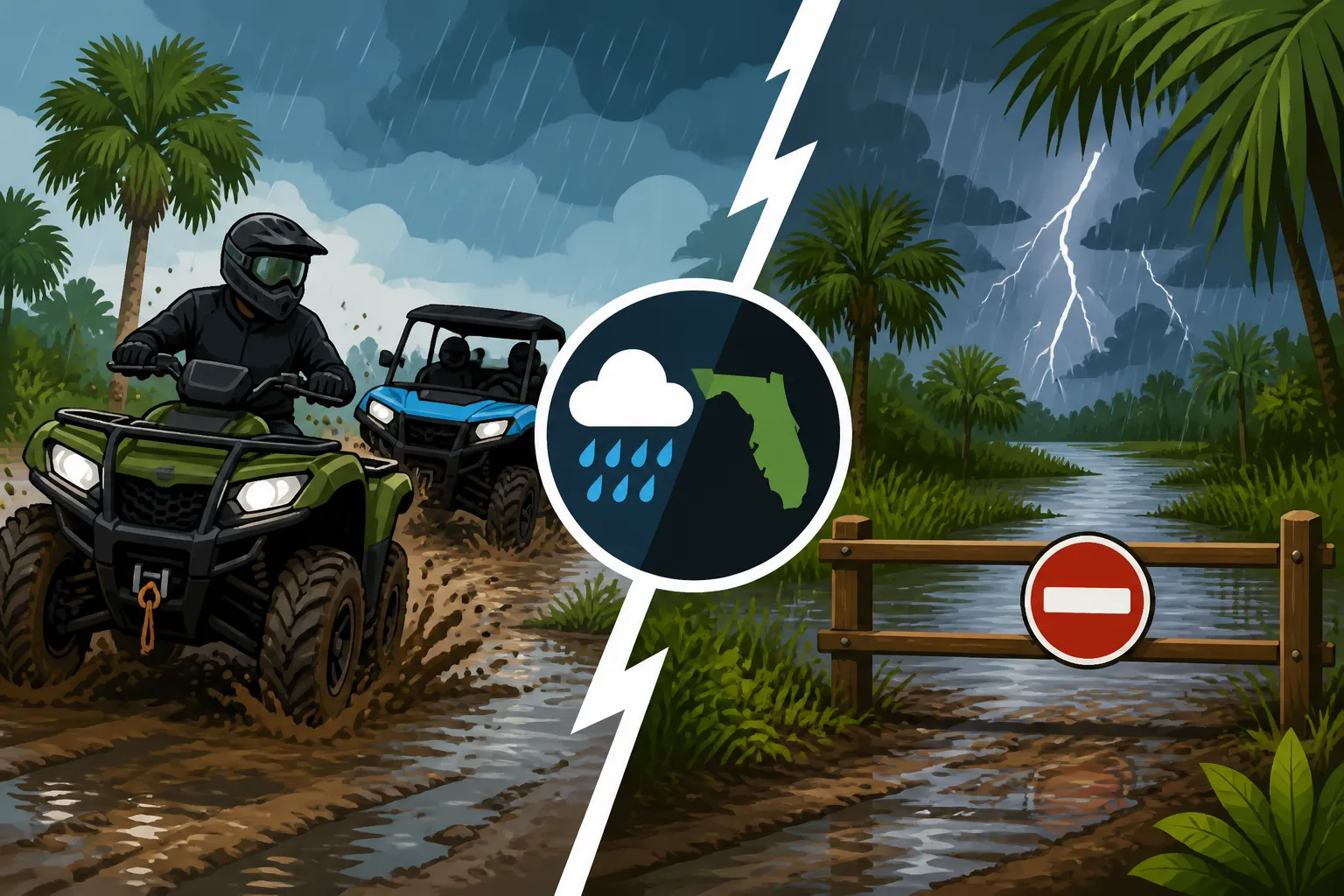
For riders, the important point is that rain does not automatically mean a riding area is closed. A trail may remain open but become more difficult, while another section may be blocked because of standing water, erosion, storm damage, or a land-management decision. Check the status of the specific area you plan to visit rather than assuming conditions based on the forecast alone.
Why trails change so quickly after rain
Florida’s soil and terrain are not all the same. In sandy areas, rain can make the surface firmer in places, while water can collect in low spots and rut-prone sections. In wetter or wooded areas, a trail may hold standing water long after nearby roads have dried. A route that looked manageable the previous weekend can also change after repeated storms.
A short shower and an extended period of heavy rain can have very different effects. A brief shower may leave most of a route rideable, though slippery roots and puddles still deserve caution. After several days of rain, drainage ditches, low crossings, and unpaved access roads may be difficult or unsafe to pass. A weather app showing a break in the rain does not necessarily tell you whether a trail has drained.
Conditions also vary by location. Croom Motorcycle Area, parts of the Ocala National Forest, and riding areas in the Panhandle each have distinct terrain and management rules. Check the specific location before making a long drive. For a broader look at where riding areas are and how their settings differ, see [Florida State Forest OHV Areas Explained] and [Ocala National Forest ATV Trails in Florida].
Why an open area may still have closed trails
An OHV area can be open while particular trails or facilities are closed. Managers may close a section to prevent damage to a saturated trail, allow repairs, address storm debris, or protect sensitive land. A campground, staging area, or access road may also have different conditions from the trail network itself.
Closures can be temporary and may change after conditions improve. That does not make an old social media post or last month’s trip report a reliable source for today’s ride. Look for information from the land manager responsible for the area, and pay attention to posted notices at the entrance or trailhead. The practical details are covered further in [Florida Trail Closures You Should Check First].
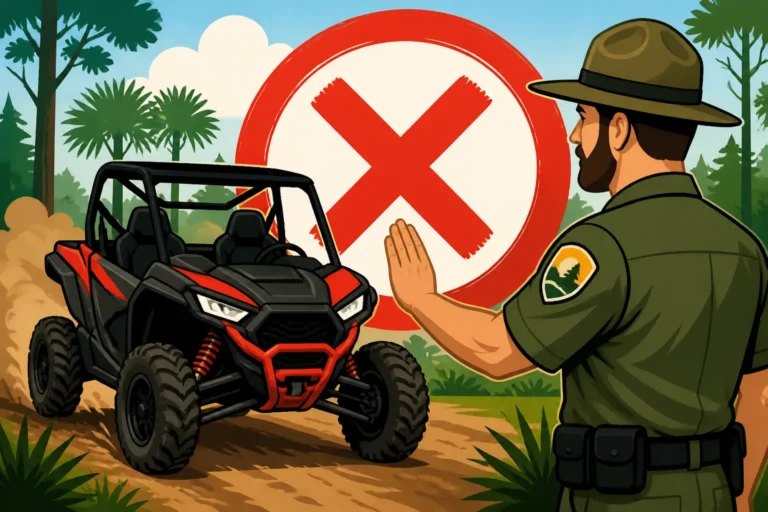
A marked closure is not a suggestion to find a way around the barrier. Riding around a gate or onto an unmarked route can damage land, put you in a hazardous area, and create trouble for other riders by contributing to broader restrictions. If a route is blocked, use an authorized open route or change plans.
Rainy-season riding is not the same as mud-park riding
A designated mud park is managed for a different kind of riding than a public forest trail system. A muddy route at a private park may be part of the experience, while deep mud on a public trail can damage the route and lead to closures. Do not treat a puddle or flooded trail in a public riding area as an invitation to test how deep it is.
If your group is specifically looking for mud, a permitted riding facility may be a more appropriate choice than a public trail. Start with [Florida Mud Parks: Where Riders Actually Go], then check the park’s own rules and operating information before heading out. Conditions and policies are not interchangeable between private parks and public lands.
How to check trail conditions and closures before you leave
A rainy-season trip goes more smoothly when you check conditions twice: once while planning, and again shortly before departure. A forecast can help you decide whether to bring rain gear or choose a different day, but it cannot confirm whether a particular trail is open. The land manager’s notices and conditions at the trailhead matter more for that decision.
Use the land manager’s information first
Identify who manages the area you want to ride. Public forests, national forests, and private parks may post updates through different official channels. Check the relevant land manager’s current notices for closures, access restrictions, storm damage, and other conditions. If the information is unclear, contact the office or visitor information channel listed by the manager.
A trail map app can help you plan and keep track of where you are, but it should not be treated as proof that a trail is open. For example, onX Offroad can be useful for organizing a route and reviewing mapped features, but check official notices for closures and restrictions before you ride. Maps can also lag behind changes on the ground, so follow signs and barriers even if a route appears open in an app.
If you use onX Offroad to plan a route, compare it with the riding area’s official map and access rules. Confirm that the route is permitted for your machine and that it does not cross a closed or restricted section. Keep a separate backup plan in case the access road, staging area, or part of the trail network is unavailable.
Check the forecast and the route, not just the town
Weather can vary considerably over a short distance. A forecast for a nearby town may not match conditions at the trailhead, particularly when thunderstorms are scattered. Look at the forecast for the riding area and the route you need to reach it, then consider recent rainfall as well as rain expected on the day of the ride.
The drive can be part of the problem. An unpaved road or low-lying access route may be harder to navigate after heavy rain, even if the riding area itself remains open. If you are hauling a trailer, think through whether you can turn around safely if the route is soft, flooded, or blocked. A last-minute detour on a narrow forest road can be stressful when you have a trailer behind you.
Use a planning checklist so you do not rely on one source or one quick glance:
- Check the land manager’s notices for the riding area.
- Review the area’s official map and rules.
- Check the local forecast and recent rain conditions.
- Confirm that the access road and staging area are usable.
- Pick an alternate riding area or a clear plan to turn back.
- Recheck for updates before you load and leave.
The seasonal overview in [Florida Trail Riding in the Rainy Season] can help you think through how weather affects a ride, while [Florida ATV Trail Conditions After Heavy Rain] focuses on what to consider after a substantial downpour.
Understand what trail maps can and cannot tell you
A map helps you navigate, but it cannot always show a fresh washout, fallen tree, flooded low spot, or newly posted closure. That is true whether you are using a printed map, an official digital map, or an app such as onX Offroad. Keep your phone charged, consider bringing an offline map if available, and do not assume you will have dependable cell service throughout a ride.
At the trailhead, take a moment to read the posted map and notices. If the route you planned is marked closed, update your plan before unloading. If a sign on the trail conflicts with what you saw online, follow the sign and ask the manager for clarification when possible.
It also helps to share your route and expected return time with someone who is not riding with you. If the group changes plans because of weather or a closure, send an update. That simple habit can make it easier for someone to know where to start looking if you do not return when expected.
| Before the ride | What to check | Why it matters |
|---|---|---|
| Area status | Official closure and access notices | A riding area can be open while some trails are closed |
| Recent weather | Rainfall and current forecast near the route | Trails and access roads may remain wet after rain stops |
| Route plan | Official map, allowed machine types, and restrictions | A mapped route may not be authorized or currently usable |
| Trailhead | Posted notices, barriers, and local conditions | Conditions may have changed since you checked online |
| Backup plan | Alternate open route or a different riding area | Prevents pressure to enter a closed or unsafe section |
How to ride safely when trails are wet
Wet ground changes traction, stopping distance, and visibility. Mud can hide holes, branches, and uneven surfaces, while rain can make roots, leaves, and compacted soil slippery. Slow down, leave more room between machines, and be ready to stop if you cannot see what is ahead.
Avoid guessing at the depth of water
A puddle may be shallow, or it may conceal a rut, soft edge, debris, or a sudden drop. Do not ride into water just because another machine has crossed it. The water may be deeper than it looks, and the route underneath may have changed since the previous crossing.
If a crossing is flooded or its bottom cannot be seen, the safer choice is to turn around rather than test it. Do not follow a group into water without knowing whether the route is open and suitable for your machine. For more preparation advice, see [What Florida Riders Carry for Deep Water Crossings], but remember that equipment cannot make an unknown or prohibited crossing safe.
When conditions are uncertain, ask the riding-area staff or choose another route. A small detour is far less costly than a stalled machine, a damaged trail, or a rescue situation. Be especially cautious around drainage areas and low ground after prolonged rain.
Protect the trail as well as your machine
Spinning tires can dig deep ruts and widen a trail as riders try to avoid mud. That can worsen erosion, damage vegetation, and make the route harder for everyone else to use. If a marked trail is too soft to ride without tearing it up, turn around or choose a firmer open route. Do not create a bypass around a muddy section.
Keep to designated trails and follow any posted direction or seasonal restriction. Wet conditions can make the edge of a trail look like a convenient way around a puddle, but riding off-route can damage sensitive areas and violate the site’s rules. Good trail etiquette matters even more when the ground is vulnerable; [Florida OHV Trail Etiquette Locals Expect] offers more on sharing riding areas responsibly.
If the group is riding different types of machines, agree on a pace and stopping plan before leaving the staging area. A heavy side-by-side may behave differently from a smaller ATV in soft ground, and a rider who is comfortable in mud may not be familiar with the route. Keep the group together and stop in a safe place if someone needs help.
Prepare for rain, heat, and changing daylight
Rain gear can help, but it does not replace sensible decisions about weather. Florida thunderstorms may bring lightning, strong wind, and sudden downpours. If storms develop, stop riding and follow the riding area’s safety guidance. Do not continue simply because the group has already traveled a long way to get there.
Wet-season rides can still be hot and humid. Bring drinking water, plan breaks, and watch for signs that someone is becoming overheated or exhausted. Muddy riding also makes it easier to underestimate how much effort the day is taking. Advice in [Florida Trail Riding in Summer Heat] is useful even when rain is in the forecast.
Before setting out, make sure each machine is in good condition and that your group has basic recovery and first-aid supplies suited to the ride. Tell everyone what to do if a machine becomes stuck or a storm forces the group to stop. A clear plan helps prevent one rider from taking a risky shortcut while the rest of the group waits.
When to change plans instead of riding
A rainy forecast does not always mean you need to cancel, but there are times when changing plans is the better choice. A confirmed closure, flooded access route, severe weather warning, or trail so saturated that riding would damage it is a strong reason to choose another day or location. You are not being overly cautious by avoiding a risky ride; you are protecting your group, your machines, and the trails you want to return to.
Choose a different area only after checking its rules
If your planned area is closed or too wet, another nearby area may have different conditions—but do not assume it is open just because it is farther away or has different terrain. Check its official notices, permitted vehicle types, access requirements, and current restrictions. A route that works for an ATV may not be appropriate for a wider UTV, and a trail network may have machine-specific rules.
If you use onX Offroad to compare possible routes, treat it as a planning aid rather than a closure authority. Confirm each option with the relevant land manager or private park. Avoid building a backup plan that depends on connecting trails or roads you have not confirmed are legal to ride.
If no suitable area is open, postpone the ride. That may feel disappointing after loading gear and arranging a group outing, but it is better than arriving at a closed gate or trying to force a route through unsafe conditions. A flexible plan makes wet-season riding less frustrating.
Know when conditions are beyond your group’s comfort
A route can be technically open but still be a poor choice for your experience level, machine, or group. Deep mud, poor visibility, slippery slopes, and rising water can turn an ordinary ride into a recovery problem. If riders are uncertain, visibility is poor, or the group cannot safely manage the terrain, stop and reassess.
Consider the least experienced rider when choosing a route. Someone who has handled dry sand may not be ready for a slick, rutted trail. Make sure everyone understands that turning back is an acceptable decision, not a failure. For families or mixed-skill groups, a shorter open route with clear turnaround points may be the better rainy-season outing.
Finally, leave room in your schedule for conditions to change. Do not plan a ride that depends on racing daylight or returning before a storm at all costs. The best wet-season ride is one where everyone gets home safely and the trail is left in good condition for the next group.
Disclaimer
This article is for general informational purposes only and does not constitute professional advice. Laws, prices and regulations vary by location and change over time. Consult a qualified professional for guidance on your specific situation.