The Ocala Centennial Loop’s 47 Miles
A 47-mile ride sounds straightforward until you start wondering where the route begins, whether your machine fits, and what happens if a section is closed. The Ocala Centennial Loop offers a long ride through the Ocala National Forest, but a good day depends on checking access, preparing for sandy terrain, and planning for a full day away from services.
What to expect from the Ocala Centennial Loop
Understanding the 47-mile route
The Ocala Centennial Loop is a roughly 47-mile off-highway vehicle route in the Ocala National Forest. It’s a substantial ride, not a quick lap around a small recreation area. Riders may spend much of the day on the trail once they account for staging, breaks, navigation, changing conditions, and the pace of the slowest rider in the group.
The route takes you through the central Florida landscape many visitors come to Ocala to experience: sandy ground, pine woods, palmetto, and stretches where shade may be limited. Conditions can vary along the route and from one visit to the next. Loose sand can make steering tiring, while rain may change traction or leave low spots soft and muddy. A machine that feels comfortable on a short local loop may feel very different after hours of riding.
The word “loop” is useful, but it shouldn’t replace route planning. Confirm the route’s current alignment, the authorized entry points, and any temporary closures before heading out. Forest roads, trail connections, and recreation-area access can change, and a map from a previous trip may not reflect what’s open now. For a broader route overview, see Ocala Centennial OHV Trail: 47 Miles in Florida.
Is the loop a good fit for your group?
A long loop can be rewarding for riders who are comfortable managing a full day outdoors and whose machines are suited to the trail. It may be less enjoyable for a first-time rider who has never handled loose sand, a family group with very young children, or a party where one machine has a mechanical issue early in the ride. Matching the route to the group is more important than finishing a mileage target.
Think about the least experienced rider, not just the strongest one. A confident rider on a well-prepared side-by-side may find the pace easy, while a beginner on a smaller ATV may need more time and frequent breaks. If you have mixed skill levels, agree ahead of time that the group will stay together and turn around if someone is uncomfortable or a machine starts acting up.
| Planning question | Why it matters | A practical approach |
|---|---|---|
| Has everyone ridden sandy trails before? | Sand can demand steady throttle, relaxed steering, and attention to changing ground. | Practice on a shorter, appropriate trail before committing to a long day. |
| Can each machine handle the route? | Mechanical trouble far from the staging area can become a serious inconvenience. | Check tires, fluids, brakes, battery, cooling, and recovery gear before leaving. |
| Is the whole group comfortable with the distance? | Stops, navigation, and slower riders add time beyond the miles themselves. | Set a conservative pace and have a clear turnaround plan. |
| Is the route open and accessible? | Closures or access changes can affect the day’s plan. | Check official forest information and current maps before departure. |
Plan the ride before you leave home
Check access, closures, and vehicle requirements
Start with current information for the Ocala National Forest, including trail status, access points, and any restrictions that apply to your vehicle. Don’t assume a trail is open just because a previous map shows it, or because another rider recently posted a trip report. Recent weather, maintenance, resource protection, or other forest-management needs can affect access.
Check that your ATV or UTV is permitted on the route. Vehicle width and other machine-class rules matter on public OHV trails, and a side-by-side should never be assumed to fit every trail simply because it can travel off-road. If your group has different machine types, confirm the route rules for each one before loading the trailer. Florida ATV Trails That Allow Side-by-Sides offers a useful starting point for understanding why side-by-side access can differ by trail.
An app such as onX Offroad can help you review terrain and keep track of your position, especially when you download maps before losing cell service. Use it as a planning and navigation aid, not as a substitute for official forest information or posted signs. Check Florida Trail Closures You Should Check First before making the drive, and follow the closure information provided by the land manager even if a digital map appears to show a passable route.
Sort out passes, titles, and other paperwork
Public-land riding can involve requirements beyond simply bringing a machine. Review the applicable forest OHV pass rules before your trip, including whether you need a pass for the vehicle and how it must be displayed or carried. If you’re visiting Florida from another state, don’t assume an out-of-state registration automatically covers every Florida requirement. Florida National Forest OHV Pass: 3-Day, 7-Day or Annual and Florida OHV Permit Rules for Out-of-State Riders can help you identify the questions to resolve before leaving.
Title requirements are a separate issue from trail passes. Florida’s rules for off-highway vehicles depend on the machine and the circumstances in which it is used, so make sure your ownership paperwork is in order before a public-land ride. A title or bill of sale is also useful if you need to establish ownership. Review Florida’s Off-Highway Vehicle Title Rules Explained if you’re unsure what documentation applies to your quad or side-by-side.
Keep essential documents together rather than scattered between vehicles. A small waterproof pouch can hold identification, proof of ownership, pass information, emergency contacts, and any required safety-course documentation for younger riders. That may feel like over-preparing for a recreational ride, but it’s much easier to answer a question at the trailhead when everything is accessible than to search through a glove box in the parking area.
Prepare your machine and your group
Check the ATV or UTV before the trail
A machine can be in good shape for a short neighborhood ride and still be poorly prepared for a long forest loop. Before loading up, check tire condition and pressure, brakes, throttle response, lights, steering, battery connections, and fluid levels. Look for loose fasteners, cracked belts or hoses, leaks, or anything that sounds different from usual. If you find a problem at home, it’s easier to fix it there than on a sandy trail.
Bring basic recovery and repair supplies suited to your vehicle and your experience. That might include a tire repair kit, a portable inflator, a small tool kit, a tow strap, and water-resistant storage for items you don’t want covered in dust. Side-by-side drivers should think through how they would recover their machine if it became stuck or disabled. A recovery strap is not a plan by itself: riders should know where safe attachment points are and how to use equipment without putting people in danger.
Pack with Florida’s weather in mind. Sun, humidity, sudden showers, and insects can make a pleasant morning uncomfortable by midday. Carry enough drinking water for the full outing, not just the ride you hope to complete. For broader preparation ideas, What to Carry Into a Florida State Forest covers the kinds of basics worth considering before a public-land trip.
Set expectations for navigation and group riding
Before starting, identify your intended route, planned breaks, and a point where the group can reassess whether to continue. Make sure every rider understands the plan and knows what to do if the group gets separated. Choose a lead rider who is comfortable navigating and a sweep rider who will stay behind the last machine. Avoid letting faster riders drift far ahead while newer riders struggle to keep sight of the group.
Download maps for offline use before arriving. Cell service can be unreliable in forested areas, and a phone that appears to have a signal at the entrance may lose it farther into the forest. With onX Offroad or another mapping tool, check that the relevant area is saved locally and that riders know how to locate their position on the screen. Carrying a backup map or having a second rider with offline navigation can help if a device battery dies.
Keep the pace comfortable enough that riders can react to changing ground and other trail users. Leave room between machines, slow down when visibility is limited, and avoid sudden stops in places where the trail narrows. If someone wants to take a break, make sure the group stops in a safe location where approaching riders can see the parked machines. Florida OHV Trail Etiquette Locals Expect is useful background for sharing the trail responsibly.
Make the day enjoyable and safer
Ride within your ability
Loose sand is one of the conditions that can surprise riders who are more familiar with hard-packed roads. A machine may wander or feel less responsive, especially when the rider tenses up and makes abrupt steering corrections. Keep your attention on the trail ahead, avoid staring only at the front tires, and use smooth control inputs. If you’re new to sand, practice on a shorter route first rather than learning the basics halfway through a long loop.
Don’t treat the 47-mile figure as a challenge that everyone must finish. Turn around if a rider is fatigued, a machine develops a problem, the group is behind schedule, or weather makes continuing uncomfortable. A sensible turnaround is a successful decision, not a failed ride. The same goes for skipping a section that looks beyond your group’s ability or choosing a shorter day when conditions are poor.
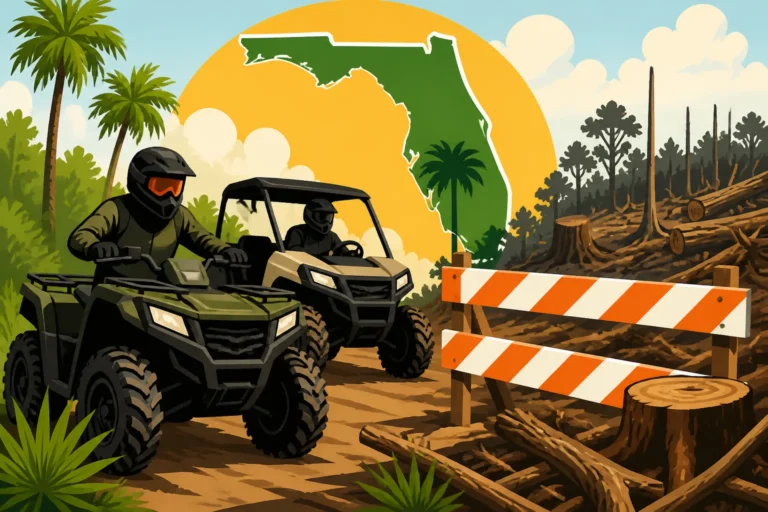
Respect trail signs and barriers even if the route beyond them looks passable. A closed segment may be protecting a sensitive area or responding to a hazard that isn’t visible from where you are. Stay on designated routes and avoid creating new tracks around puddles or obstacles. Florida Riding on Public Land: Permits and Proof provides additional context on being prepared for a public-land ride.
Account for heat, breaks, and the return trip
A long ride takes more energy than many people expect. Riders may feel fine at the staging area and then become tired, thirsty, or less attentive after hours of sun and vibration. Schedule breaks before everyone is exhausted, drink regularly, and eat something if you’re out for much of the day. If someone develops confusion, unusual weakness, severe dizziness, or other concerning symptoms, stop riding and seek appropriate help.
Plan the return with daylight, fuel, and equipment condition in mind. Don’t use every bit of fuel on the way out and hope the machine will make it back. Leave enough reserve for detours, slow travel, or a missed turn. If your group is towing machines, check the trailer and tie-downs before departing and again after the first stretch of highway.
Finally, leave the area in good condition. Pack out trash, avoid disturbing wildlife, and don’t ride through standing water or vegetation just to make a more exciting route. Good trail behavior helps protect the places riders come to enjoy and keeps the experience safer for everyone using the forest.
Disclaimer
This article is for general informational purposes only and does not constitute professional advice. Laws, prices and regulations vary by location and change over time. Consult a qualified professional for guidance on your specific situation.