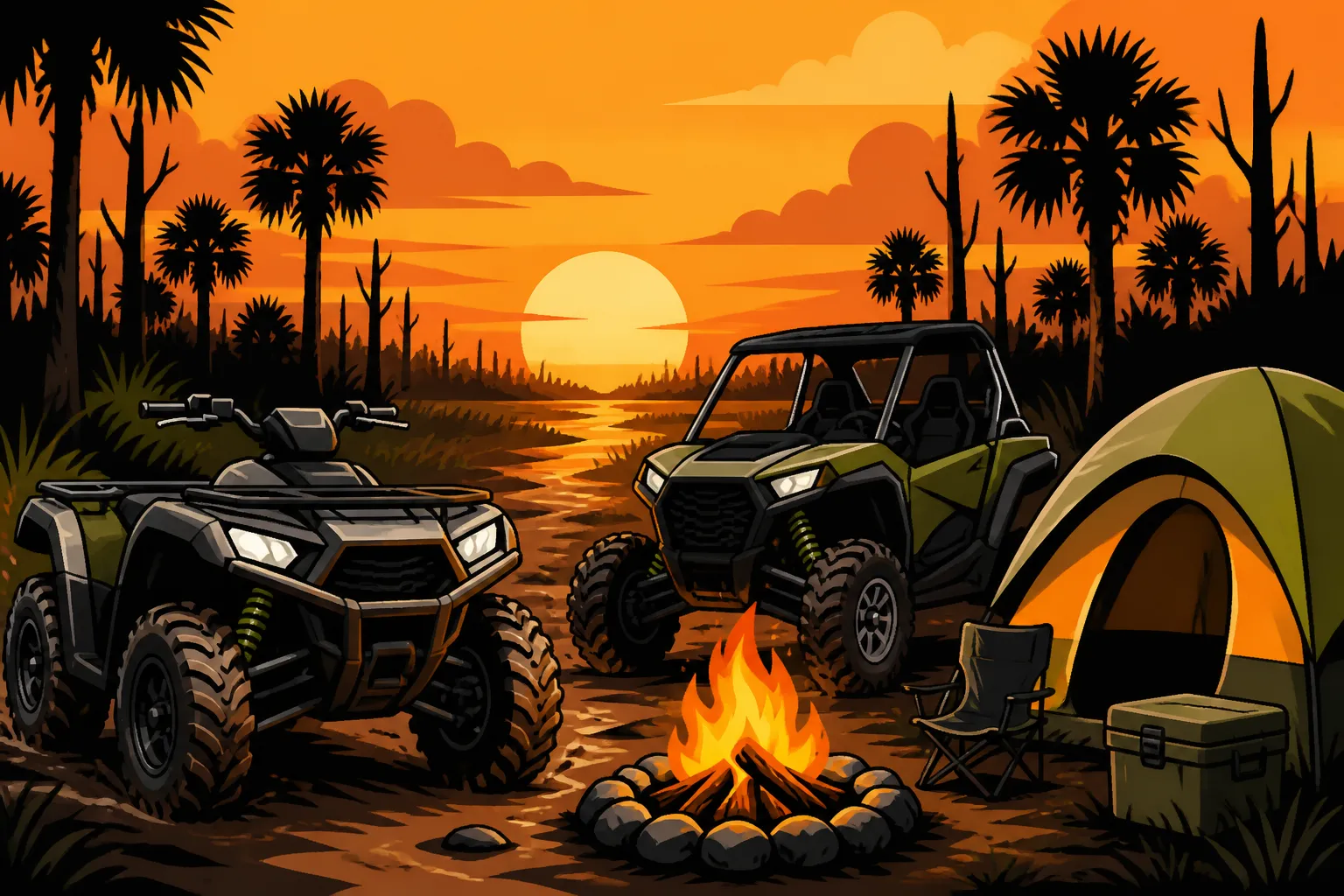
Tate’s Hell Camping Options
Tate’s Hell can feel wonderfully remote, but that same isolation makes camping logistics easy to underestimate. A campsite may not offer the services you expect, and staying in the forest does not automatically mean every road or trail is open to your ATV or UTV. This guide explains camping choices, how to plan a riding-focused visit, and what to check before you leave home.
Choose a Tate’s Hell camping style that fits your trip
Start with the kind of campsite you need
Camping in Tate’s Hell State Forest is best approached as a choice between a more basic forest experience and a site with the amenities your group needs. Primitive camping can suit riders who are comfortable bringing their own water, supplies, and backup plans. It is less forgiving if you arrive expecting a full-service campground, nearby stores, or dependable phone reception.
Before booking, check the current information for the specific campsite you have in mind. Confirm what is provided, whether you need a reservation or permit, what vehicle access is allowed, and whether the site can accommodate your tent, trailer, or RV. Don’t rely on a general description of the forest to answer those questions: conditions and facilities can differ from one camping area to another.
If you are comparing Tate’s Hell with other places to stay, Florida Riding Areas With Primitive Camping can help you think through whether a low-amenity setup fits your group. For a broader look at how camping access and riding access relate, see Florida OHV Campgrounds With Hookups. A campsite with hookups may be more comfortable, but it still may not put you directly on an approved OHV route.
Check the named camping areas before committing
High Bluff and New River are names you may encounter while researching Tate’s Hell recreation and camping. Treat each as a specific location to investigate rather than assuming all forest sites have the same layout, facilities, or access rules. Look for details about the site itself, the approach road, parking space, water availability, toilets, fire rules, and any restrictions that matter to your group.
Think through the arrival as well as the overnight stay. A long trailer, a late arrival, or a vehicle that handles rough roads poorly can turn a simple drive into the hardest part of the trip. If your group includes young children, older relatives, or riders who need easy access to supplies, a more remote site may require extra planning even if it sounds ideal on paper.
Reserve or confirm the site through the applicable official channel, and save the confirmation where you can reach it offline. Keep a copy of directions and the campground’s rules on your phone and, if practical, on paper. Cell coverage can be inconsistent in remote forest areas, so it is wise not to make your arrival depend on loading a map or reservation email at the last minute.
Match the campsite to your group and equipment
A quiet primitive site may be perfect for a small group with tents and a well-stocked truck. The same setup can be frustrating for a family traveling with a large trailer, several children, or someone who needs predictable facilities. Make a practical list before choosing: sleeping setup, cooking plan, drinking water, sanitation, shade, power needs, and how you will store food and riding gear.
Also consider how much room your equipment needs. A campsite that can fit a vehicle may not have enough convenient space for a truck, trailer, and several machines. Ask about parking and site dimensions instead of assuming that “vehicle accessible” means suitable for a long rig. If you are hauling a side-by-side, check that the access road and the destination are appropriate for its size and ground clearance.
For an overnight trip, make a simple comfort-versus-remoteness comparison:
| Camping need | A basic forest site may suit you if | Look for a more developed option if |
|---|---|---|
| Water | You can bring and safely store what your group needs | You need a dependable on-site water source |
| Toilets | Your group is prepared for basic facilities | A restroom is essential for comfort or accessibility |
| Power | You can camp without electrical hookups | Medical equipment or other needs require reliable power |
| Parking | Your vehicle and trailer fit the site and access road | You need more room or easier maneuvering |
| Supplies | You can pack everything before entering the forest | You want nearby services or frequent resupply |
| Phone access | You have offline directions and an emergency plan | Reliable communication is a priority |
Plan riding access separately from camping
A campsite does not guarantee a ride route
One of the easiest assumptions to make is that camping inside a forest means you can ride an ATV or UTV from your site wherever you like. Don’t plan on that. Camping permission, vehicle access, and OHV riding authorization are separate issues, and a road that is open to ordinary traffic is not automatically an approved riding route.
Use the current forest rules and maps to identify where riding is allowed, which routes are open to your machine, and whether a permit is required. The Tate’s Hell OHV Trail System in Florida overview is a useful place to start, but confirm current access details before traveling. For context on how state forest riding areas work, read Florida State Forest OHV Areas Explained.
Pay attention to machine-specific restrictions, too. An ATV and a wider side-by-side may not be treated the same way on every route. Do not assume that a road is suitable because it appears on a general navigation map. Check whether it is designated for OHV use, whether seasonal or temporary restrictions apply, and whether your machine’s width or other characteristics affect access.
Get permits and rules in order before arrival
If your ride plan depends on an OHV pass, confirm which pass applies to the area and how to obtain it before you leave. Florida state forest riding rules and pass requirements are distinct from rules for national forest trails or private riding parks. The Florida State Forest OHV Day Use and Annual Passes guide can help you identify the questions to resolve, including whether the pass is per machine and what proof to carry.
Keep required documents accessible, not buried under camping gear. Depending on the rules for your trip, you may need to show a pass, safety-course documentation, or proof that you own or are authorized to use the machine. Make sure every rider understands the route boundaries and knows where to stop if a trail is blocked or marked closed.
For route research, onX Offroad can be useful for reviewing mapped roads and planning a general approach. Treat any app as a planning aid rather than permission to ride: confirm routes against official forest information, posted signs, and current closures. A line shown on a digital map does not override a gate, sign, or land-management rule.
Build your route around the campsite
Before setting out, identify the actual drive between the campground and your planned riding area. A campsite can be a comfortable base without being adjacent to the route you want to ride. You may need to trailer the machines to a designated staging area instead of riding from the campsite, particularly if the connecting road is not approved for OHV use.
Plan a conservative first ride. Tate’s Hell is known for a remote, low-lying landscape, and route conditions can change with weather. Soft ground, standing water, damaged roads, or a closed section can make a route much slower than it looked on a screen. Agree on a turnaround time and a backup route, and let someone outside the group know your broad plan.
Use onX Offroad to save a route or mark a staging point before you lose reliable service, then compare that plan with the official information available for the forest. Carry an offline map or another navigation backup. If you are new to the area, keeping the first day’s ride short gives you room to learn the terrain and get back to camp before dark.
Prepare for a remote forest stay
Pack for limited services and changing conditions
A remote camping trip works best when you arrive ready to stay put. Bring enough drinking water, food, fuel, first-aid supplies, lighting, and charging options for the length of your visit, with a reasonable reserve. If you are bringing a generator, stove, or firewood, check the site rules first; fire restrictions and allowed equipment can change with conditions.
Weather can affect both camping comfort and riding access. Pack clothing that handles heat, rain, mud, and insects rather than planning around a perfect forecast. Keep dry clothes in sealed bags, protect important paperwork and electronics, and have a way to clean or contain muddy gear without leaving waste at the site.
Think about your return trip, too. If you expect to ride through wet or sandy conditions, bring recovery basics suitable for your vehicle and machine, and make sure someone in the group knows how to use them. Do not rely on a nearby service station or repair shop being open or close by. The more self-sufficient your group is, the less a small delay can disrupt the entire weekend.
Make a communication and safety plan
Phone reception may be limited in parts of a remote forest. Download maps and reservation details before arrival, share your itinerary with someone who is not riding, and agree on a check-in time. Keep phones charged, but do not make them your only navigation or emergency tool. The advice in Florida Trailhead Cell Service and Getting Help is relevant when planning for areas where coverage may be unreliable.
Before leaving camp, tell the group which route you are taking, when you expect to return, and what to do if riders become separated. Ride within the least experienced person’s ability, carry basic first-aid supplies, and avoid turning a scenic detour into an unplanned crossing of a closed or restricted area. If a machine breaks down, staying together and contacting help through a planned backup method is safer than sending one rider off alone without a clear destination.
Pack out trash and leave the site as you found it. Follow posted rules for fires, waste, quiet hours, pets, and food storage. Good campsite habits matter in a natural area, and they also make it easier for the next group to enjoy the same site.
Recheck access before you drive
A route or campsite that worked on a previous visit may not be available the next time. Weather, maintenance, land-management decisions, and seasonal conditions can affect access. Check current campsite availability, forest notices, and riding-area closures shortly before departure. Florida Trail Closures You Should Check First offers a useful reminder to make this a routine part of planning rather than an afterthought.
A simple final check can prevent a long, disappointing drive:
- Confirm the campsite reservation, arrival instructions, and check-in requirements.
- Verify the campsite’s facilities, access road, parking, and rules for your equipment.
- Confirm which routes are open to your ATV or UTV and whether a pass is required.
- Save directions, maps, and emergency contacts for offline use.
- Check the weather and any closure notices again before leaving.
- Tell someone your itinerary and expected return time.
onX Offroad can help you organize waypoints and keep your planned route available offline, but use official information to settle questions about legal access. When your map, a sign, or a closure notice conflicts with an assumption you made at home, follow the posted restriction and choose another route.
Tate’s Hell can be a rewarding base for a quiet camping and riding trip when you plan for its remoteness. Choose a campsite for the facilities and space your group genuinely needs, confirm access separately for your machines, and bring the supplies and navigation tools that let you handle a change of plan. That preparation leaves more room to enjoy the forest instead of troubleshooting the basics after you arrive.
Disclaimer
This article is for general informational purposes only and does not constitute professional advice. Laws, prices and regulations vary by location and change over time. Consult a qualified professional for guidance on your specific situation.