Reporting a Stolen Quad With Title in Hand
The pit in your stomach, the sudden panic when you realize your beloved quad, your ticket to freedom on Florida's trails, isn't where you left it. It's a truly devastating moment, a violation that can leave you feeling utterly helpless. But here's a crucial fact: if you have your Florida ATV or UTV title in hand, you're already in a much stronger position. This comprehensive guide will walk you through the essential steps to report your stolen quad, leveraging that vital piece of paper to navigate the recovery process as smoothly as possible.
The Immediate Aftermath: What to Do First When Your Quad is Gone
Discovering your ATV or UTV has been stolen is an incredibly jarring experience. The initial shock can make it difficult to think clearly, but taking the right first steps immediately can significantly impact the chances of recovery and the ease of filing claims. Don't let the panic paralyze you; lean into the process.
Confirm the Theft and Secure the Scene
Before jumping to the worst conclusion, take a deep breath and double-check. Did you lend it to a friend or family member who forgot to tell you? Did you park it in a slightly different spot than usual after a long day of riding? Sometimes, in our haste, we can misremember. Once you've definitively confirmed that your quad is indeed missing from where it should be, your immediate next step is to secure the area.
If the theft happened at your home, check for any signs of forced entry – a broken gate, a cut lock, footprints, or tire tracks. It’s absolutely crucial that you avoid touching or disturbing anything that could be potential evidence. The police will need to examine the scene, and you don't want to inadvertently compromise any fingerprints or other clues that could help them track down your machine or the culprits. Just observe and note what you see.
Gather Essential Information Before Calling
Even amidst the chaos and frustration, try to compile as many details as possible before you even pick up the phone to call law enforcement. This preparation will not only make the reporting process quicker but will also ensure that the police have all the critical information they need to act swiftly. The more precise you are, the better the chances of a positive outcome.
Your Florida ATV title is your absolute best friend in this scenario. It contains the Vehicle Identification Number (VIN), which is the unique fingerprint of your quad. Make sure you have it readily accessible. Along with the VIN, gather the make, model, year, and color of your ATV or UTV. Think about any unique modifications, custom paint, stickers, aftermarket parts like a winch, specialized tires, or a particular light bar setup. These distinctive features can be invaluable in identifying your machine if it's spotted. Note the last known location, date, and time you saw your quad, and whether anything was attached to it, like a trailer, a plow, or a specific set of tools. Having a clear, detailed history, even if you just purchased the quad, is crucial; a well-structured [Florida ATV Bill of Sale: What It Needs to Say] could be a helpful supplementary document alongside your title, perhaps one you generated through a service like LawDepot, which specializes in legal forms.
Contacting Law Enforcement: Your Title as Your Proof
Once you have gathered all the necessary information, contacting law enforcement is the single most important action you will take. This official report is the foundation of any recovery effort and is absolutely non-negotiable for insurance purposes. Don't delay this step, as time is often of the essence in theft cases.
Filing the Official Police Report
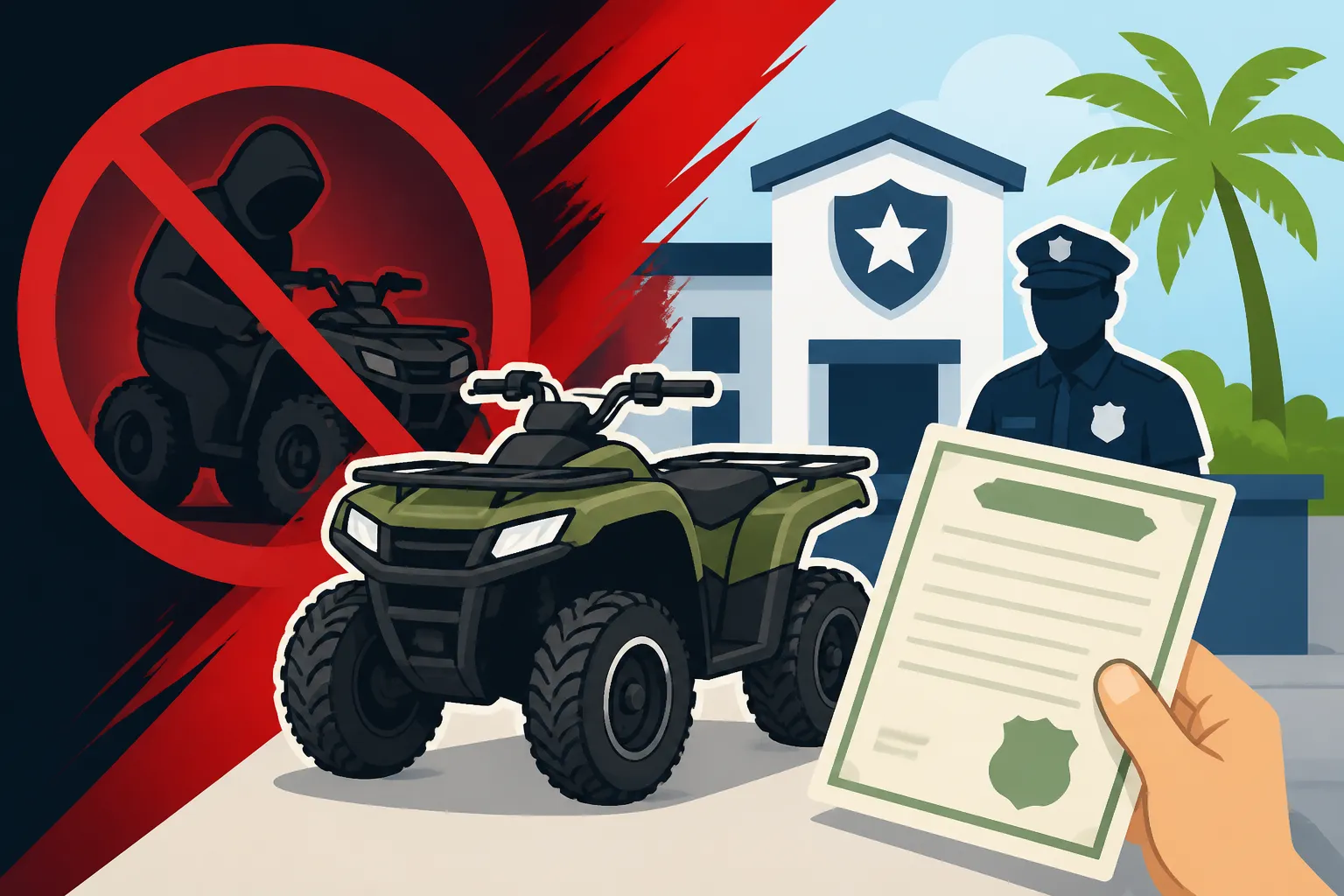
If your quad has just been stolen and you believe the thieves might still be in the vicinity or if there's any immediate danger, call 911. Otherwise, contact your local non-emergency law enforcement line or the sheriff's office in the county where the theft occurred. Clearly state that your ATV or UTV has been stolen and provide your location. When an officer arrives, be prepared to present your Florida ATV title immediately.
Your title isn't just a piece of paper; it’s definitive proof of ownership, complete with the VIN, make, model, and other identifying characteristics of your machine. This information is critical for the police. They will use it to create an official police report, which formally documents the theft. This report is then used to enter your quad's VIN and details into state and national law enforcement databases, such as the NCIC (National Crime Information Center), alerting other agencies if your machine is found anywhere else. This step is what officially makes your quad a "stolen vehicle" in the eyes of the law.
The Importance of a Complete Police Report Number
Once the officer has taken all the details and filed the report, you absolutely must obtain the official police report number. This number is your golden ticket for all subsequent actions related to the theft. Without it, you'll find it incredibly difficult to follow up with the police department, make an insurance claim, or even refer to the incident accurately.
Ask the responding officer for a copy of the report, or at the very least, the case number, and any instructions on how to obtain a full copy later. This report number will be the primary reference point for your insurance company, for any online community posts you might make to aid in recovery, and for checking the status of the investigation with law enforcement. Keep it safe, perhaps even taking a photo of it.
Navigating Insurance and Recovery with Your Title
With the police report filed and your title confirming ownership, you can now move on to the next critical steps: dealing with your insurance company and exploring additional avenues for recovery. Your title continues to play a central role in these processes, streamlining bureaucratic hurdles and fortifying your claims.
Notifying Your Insurance Company
If you have comprehensive coverage on your ATV or UTV, which typically includes theft protection, contacting your insurance provider should be your very next move after filing the police report. Your Florida ATV title serves as irrefutable proof of your insurable interest and legal ownership. Without a clear title, proving to an insurance company that you own the machine can become a frustrating, uphill battle, potentially delaying or even jeopardizing your claim.
Provide your insurance agent with all the details you gave to the police, including the official police report number, the VIN, make, model, and any unique features of your stolen quad. Insurance companies typically have a waiting period, often 30 days, to allow law enforcement time to potentially recover the vehicle. If your quad isn't recovered within that timeframe, they will usually proceed with a payout based on its market value. Be aware that if your quad is found after you've received a payout, the insurance company will typically take legal ownership of the recovered machine. It’s also crucial to remember that if you have a lien on your quad, as detailed in [Florida ATV Title With a Lien Recorded], the insurance payout will go to the lienholder first to satisfy the outstanding loan balance.
Utilizing Public and Online Resources for Recovery
While law enforcement does its vital work, you don't have to sit idly by. Actively leveraging public and online resources can significantly increase the chances of your quad being spotted and recovered. Social media platforms, especially local community groups and ATV-specific forums, can be incredibly powerful tools.
Post clear photos of your stolen quad, if you have them, along with its make, model, color, and most importantly, the VIN from your title. Emphasize any unique identifying marks. While sharing this information, always exercise caution: never confront individuals you suspect of having your quad directly. Instead, relay any potential leads or sightings immediately to law enforcement, providing them with as much detail as possible. Remember, a thief trying to sell a titled quad faces a much harder time than one selling an untitled machine, as the official paperwork provides a clear trail. Services like [Checking a Florida Quad's Title History] exist to help potential buyers verify legitimate ownership, making it harder for illicit sales to go through undetected.
Preventing Future Thefts: Lessons Learned
Even in the stressful aftermath of a theft, it's worth considering how to prevent such a devastating event from happening again. While no security measure is foolproof, layers of protection can significantly deter thieves and make your quad a less attractive target. This is where the long game of prevention comes in, reinforcing the value of your titled investment.
Consider investing in robust security measures. This could include heavy-duty chains and locks, ground anchors, and secure sheds or garages. GPS tracking devices, hidden kill switches, and alarm systems can also provide valuable layers of protection. When storing your quad, try to keep it out of sight, especially if you're not actively using it. Even something as simple as moving it from a visible driveway spot to a less obvious location can make a difference. The goal is to make your quad as difficult and time-consuming as possible for a thief to steal, reducing the likelihood that they'll target your machine in the first place.
What Your Florida ATV Title Means in a Theft Claim
Your Florida ATV title isn't just a regulatory requirement; it's a powerful document that holds immense weight when your quad is stolen. It's the lynchpin in proving your ownership and facilitating both the police investigation and any subsequent insurance claims. Understanding its significance can empower you through the recovery process.
Proving Legal Ownership Beyond Doubt
In the unfortunate event of a theft, your Florida ATV title serves as the ultimate, indisputable proof of legal ownership. This piece of paper legally establishes that you are the rightful owner of the machine. Without it, proving your ownership could become an incredibly complex and frustrating bureaucratic process, especially if you had purchased the quad in a private sale with only a simple bill of sale or, worse, no paperwork at all. The title eliminates any ambiguity.
Insurance companies, law enforcement agencies, and even potential buyers (after recovery, or for a future sale) all rely on the title as the primary document confirming who legally owns the ATV or UTV. This is why properly titling your machine after purchase, and understanding the process of [Buying a Used ATV in Florida: Transferring the Title], is so vitally important. It safeguards your investment against myriad issues, including theft. The title ensures that when you report your quad stolen, there is no question about your right to do so or your legal claim to the machine.
The VIN and Its Role in Tracking and Recovery
The Vehicle Identification Number (VIN) printed prominently on your Florida ATV title is much more than just a string of characters; it is the unique identifier for your specific quad. Every ATV and UTV has its own distinct VIN, much like a fingerprint. This number is absolutely crucial for law enforcement in tracking, identifying, and ultimately recovering stolen machines.
When your quad's VIN is entered into national databases, it creates a digital flag that alerts authorities nationwide. Even if a thief attempts to alter the appearance of your quad – changing its color, removing identifying stickers, or swapping out parts – the VIN remains the constant identifier. Law enforcement officers are trained to locate and verify VINs, which allows them to confirm if a suspicious machine is indeed your stolen property. This makes the title, and the VIN it clearly displays, an indispensable tool in the fight against ATV theft.
Recording a Lien on Your Title and Its Impact on Theft
For many riders, financing a quad is a common practice. If you purchased your ATV or UTV with a loan, your Florida title will reflect this by listing a lienholder – typically the bank or credit union that provided the financing. This recorded lien has specific implications in the event of theft, affecting both your responsibilities and the claims process.
When a lien is recorded on your title, it means that while you are the owner, the financial institution also has a vested legal interest in your quad until the loan is fully repaid. Should your titled quad be stolen and deemed a total loss by your insurance company, any payout from the insurance claim will first be directed to the lienholder. This ensures the outstanding loan balance is settled. Only after the lien is satisfied would any remaining funds be paid to you. This system adds another layer of accountability, as the lienholder also has an interest in ensuring the quad is properly documented and, if stolen, that the theft is thoroughly investigated and managed through the insurance process.
| Step | Action | How Your Title Helps |
|---|---|---|
| 1. Confirm Theft | Double-check, secure the area. | Provides all identifying details to confirm it's truly gone. |
| 2. Gather Info | VIN, make, model, year, color, mods, last seen. | Crucial: Contains the VIN and full description. |
| 3. Contact Police | Call 911 or non-emergency; file official report. | Establishes undeniable proof of ownership for the report. |
| 4. Get Report Number | Obtain official case number for follow-up. | Essential for all subsequent steps (insurance, recovery efforts). |
| 5. Notify Insurance | File a claim if you have theft coverage. | Proves legal ownership and insurable interest. |
| 6. Aid Recovery | Share details (VIN, photos) on social media, online forums. | Allows others to verify if a suspicious sale matches your stolen quad. |
Disclaimer
This article is for general informational purposes only and does not constitute professional advice. Laws, prices and regulations vary by location and change over time. Consult a qualified professional for guidance on your specific situation.