Three Wheels or Four: What Still Counts as an ATV
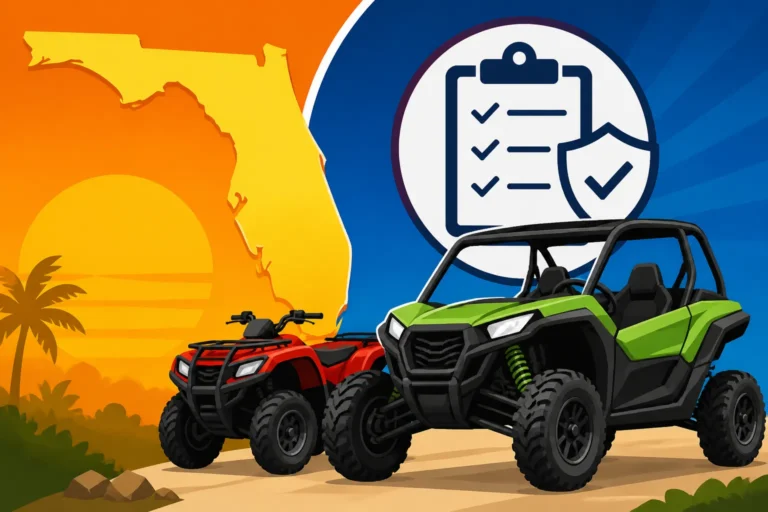
It can be incredibly confusing to figure out what exactly the state of Florida considers an "All-Terrain Vehicle" (ATV) when you're thinking about titling or riding your off-road machine. With so many different types of quads, three-wheelers, side-by-sides, and customized vehicles out there, it's easy to feel lost in the legal definitions. This guide will walk you through Florida's specific rules, clarifying the distinction between three-wheeled and four-wheeled machines and what makes an ATV an ATV in the eyes of the law, helping you navigate the titling process with confidence.
Decoding Florida's ATV Definition: More Than Just Wheels
When you hear "ATV," most people immediately picture a four-wheeled quad. But in Florida, the legal definition of an all-terrain vehicle is a bit more nuanced, and it's absolutely crucial to understand if you want to title your machine correctly and avoid any surprises. The state's definition isn't just about the number of wheels; it delves into how you sit, how you steer, and even the vehicle's size.
Florida Statute 317.0003(1) lays out the criteria, stating that an ATV is "any motorized off-highway vehicle 55 inches or less in width, having a dry weight of 1,500 pounds or less, designed to travel on three or more non-highway tires, and manufactured for use by a single operator or by a single operator and one passenger, with a straddle seat, and handlebars for steering control." That's a mouthful, right? But every single one of those elements is a key piece of the puzzle. It means that even if you have an older three-wheeler, it could still very much be classified as an ATV for titling purposes, provided it meets the other specifications. The "straddle seat" and "handlebars for steering" are particularly defining characteristics that separate ATVs from other types of off-road vehicles you might encounter. Understanding [Florida's Off-Highway Vehicle Title Law Explained] is your first step.
The Critical Role of the Straddle Seat and Handlebars
Let's zoom in on a couple of those key features that truly define an ATV in Florida: the straddle seat and handlebars. This isn't just some arbitrary detail; it's a fundamental design element that differentiates an ATV from nearly every other kind of off-road vehicle. If your machine requires you to sit astride it, like you would a horse or a motorcycle, and you steer it with handlebars, it's signaling to the state that it's likely an ATV.
Think about the typical riding position on a quad or a three-wheeler. You're straddling the engine or frame, using your body weight to help control the machine as you lean into turns and navigate rough terrain. This posture, combined with handlebar steering, is a hallmark of the ATV experience. It’s what gives you that direct, physical connection to the vehicle and the ground beneath you. Without these two elements, even if your machine has four wheels and is used off-road, it might not technically be an ATV under Florida law. This distinction will guide you on whether you need an ATV title or perhaps something else entirely.
Weight and Width: The Often-Overlooked Factors
Beyond the seating and steering, two other critical factors often trip people up when trying to classify their off-road vehicle as an ATV in Florida: dry weight and width. These measurements aren't just for bragging rights; they're legal thresholds that determine how your machine is categorized and, consequently, how it needs to be titled.
An ATV, according to Florida Statute, must be 55 inches or less in width and have a dry weight of 1,500 pounds or less. "Dry weight" refers to the weight of the vehicle without fuel, oil, coolant, or other fluids. This means that many of the larger, more powerful four-wheelers and virtually all side-by-sides automatically fall out of the ATV category because they exceed these limits. If your quad is wider than 55 inches, for example, it's not an ATV in Florida, even if it has handlebars and a straddle seat. Instead, it's likely classified as a Recreational Off-highway Vehicle (ROV) or Utility Terrain Vehicle (UTV), which have different titling requirements. You'll definitely want to understand [Florida's 55-Inch ATV Definition and Why It Matters] to avoid any misclassification.
Three-Wheeled Machines: Still Part of the ATV Family?
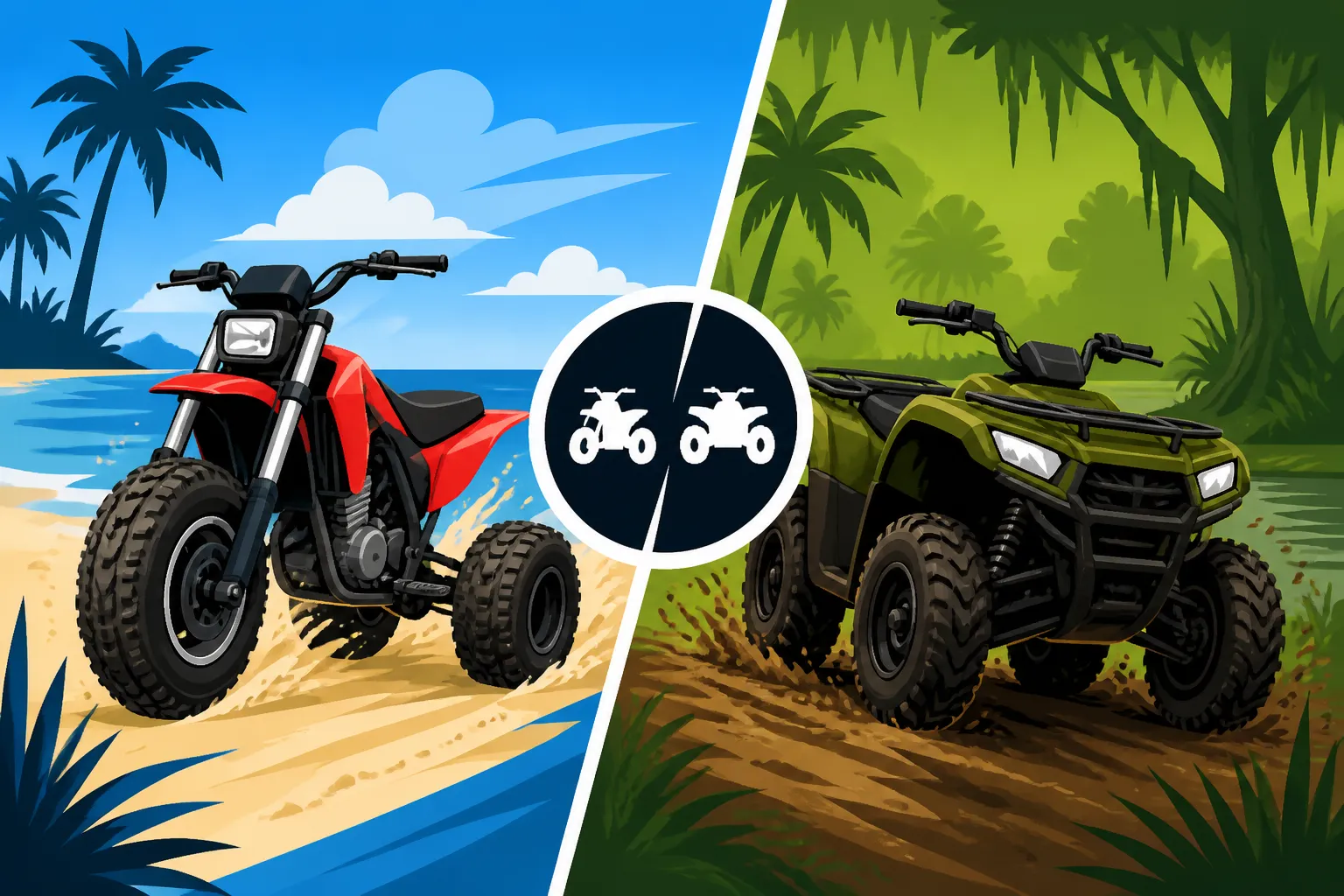
For many years, three-wheeled ATVs, often called "trikes," were a common sight in the off-road world. While their popularity waned, and manufacturers largely shifted to four-wheeled designs due to safety concerns and evolving rider preferences, these machines still exist. And if you own one in Florida, you might be wondering if it still counts as an ATV for titling purposes. The short answer is: yes, absolutely, provided it meets the other criteria.
Florida's definition of an ATV specifically includes vehicles designed to travel on "three or more non-highway tires." This language clearly encompasses three-wheeled machines, ensuring that they're not left in a legal gray area. So, if you've got a vintage Honda ATC, a Kawasaki Tecate, or any other three-wheeled off-highway vehicle, it can still be titled as an ATV in Florida. The key is that it must also meet the requirements for a straddle seat, handlebar steering, and fall within the 55-inch width and 1,500-pound dry weight limits. Don't let the common perception that all ATVs have four wheels mislead you; Florida law recognizes and covers its three-wheeled cousins.
Titling Your Three-Wheeler: What to Expect
If you're looking to title a three-wheeled ATV in Florida, the process is generally the same as titling a four-wheeled quad. You'll need to gather your proof of ownership, which typically means a Manufacturer's Certificate of Origin (MSO) for new machines or a properly endorsed title if you bought it used. If you're dealing with an older three-wheeler that might predate titling requirements in its original state, or perhaps you bought it without traditional paperwork, you might need to jump through a few extra hoops to establish ownership.
In such cases, a bill of sale can be crucial, detailing the vehicle's make, model, VIN, and the transaction. Sometimes, an affidavit of ownership might even be necessary. When you're dealing with a machine that might not fit the classic four-wheeler mold, such as an older three-wheeler or a custom-built quad, having clear documentation is paramount. Services like LawDepot can help you generate comprehensive bills of sale or affidavits of ownership, ensuring all details of your unique off-highway vehicle are properly recorded, which can be crucial during the titling process. You'll take these documents to your local Florida county tax collector's office or a designated service center. They'll verify the VIN and process your application. Don't forget that a VIN verification, often done by law enforcement or a licensed dealer, might be required, especially for out-of-state or older machines.
Common Misconceptions About Three-Wheelers
One of the biggest misconceptions about three-wheelers is that they are no longer legal to ride or title. While it's true that their production largely ceased and some public riding areas might have specific rules, the state of Florida itself does not prohibit their ownership or titling. If your three-wheeled machine fits the ATV definition outlined above, it is eligible for an off-highway vehicle title. The issues often arise from outdated information or confusion with other types of vehicles.
Another common mistake is assuming that because a three-wheeler is older, it automatically falls into a different category or is exempt from titling. This isn't necessarily true. If it meets the current statutory definition of an ATV, it needs an OHV title if you plan to ride it on designated public lands in Florida. Always check the specific laws and regulations, rather than relying on hearsay, to ensure your classic three-wheeler is fully compliant.
The Four-Wheeler Spectrum: Not All Quads Are ATVs
While most four-wheeled machines with straddle seats and handlebars are indeed ATVs, there's a significant caveat in Florida law: the width and weight limits. Many modern, high-performance quads have grown in size, pushing them beyond the 55-inch width or 1,500-pound dry weight threshold. When this happens, your "quad" legally transforms into a different category of off-highway vehicle, usually a Recreational Off-highway Vehicle (ROV) or Utility Terrain Vehicle (UTV). This is a critical distinction that can change how your machine is titled and, in some cases, even where you can ride it.
The intent of the law is to classify vehicles based on their physical characteristics, not just what manufacturers or enthusiasts call them. So, if your four-wheeled machine measures 56 inches wide, it’s not an ATV for titling purposes in Florida, even if it looks and feels like one. Instead, it would fall under the ROV category, which has its own set of rules and a different titling process. This makes measuring your machine accurately a crucial step before heading to the tax collector's office. You might also find yourself needing to read up on [Florida UTV Titling for Side-by-Sides Over 55 Inches] if your machine crosses that threshold.
The 55-Inch Rule and Your Quad
Let's really hammer home the importance of the 55-inch width rule for four-wheeled machines. This is arguably the most common reason why a modern "quad" might not be considered an ATV in Florida. Many sport quads and utility ATVs today are designed with wider stances for stability, performance, or carrying capacity. While fantastic for riding, it can complicate the titling process if you don't realize the legal implications.
To measure your quad's width, you typically measure the widest point from the outside of one tire to the outside of the opposite tire. Make sure your tires are properly inflated for an accurate measurement. If that measurement comes in at 55.1 inches or more, your machine is no longer an ATV by Florida's definition. Instead, it likely becomes an ROV. This distinction is vital because the forms, fees, and even the type of title you receive will be different. It’s not about arguing semantics with the clerk; it’s about aligning your vehicle with the state's legal framework.
Dry Weight Considerations for Quads
While less common than the width issue, the dry weight limit of 1,500 pounds can also push a four-wheeled machine out of the ATV classification. Modern utility quads, especially those with larger engines, heavy-duty suspensions, and additional accessories, can sometimes approach or exceed this weight. Manufacturers usually list the dry weight in the owner's manual or on their specifications page. It's always a good idea to double-check this figure.
If your four-wheeler weighs more than 1,500 pounds dry, it will also fall into the ROV category alongside the wider machines. Again, this changes the titling procedure. Understanding these specific limits helps you correctly identify your vehicle's class from the outset, saving you potential headaches and wasted trips to the Department of Highway Safety and Motor Vehicles. For those machines that break the 1,500-pound barrier, you'll want to review [Florida UTV Title for a Machine Over 1,500 Pounds].
Beyond ATVs: Other Off-Road Vehicles and Their Classifications
It’s easy to group all off-road vehicles into one mental category, but Florida law is quite specific. Just because it drives off-road doesn't make it an ATV. Understanding these distinctions is critical for correct titling and knowing where you can legally operate your machine. The biggest players here are side-by-sides, also known as Utility Terrain Vehicles (UTVs) or Recreational Off-highway Vehicles (ROVs), but there are other categories too.
These vehicles have specific characteristics that set them apart from ATVs, primarily in their seating, steering, and overall dimensions. Misclassifying your vehicle can lead to delays in the titling process, incorrect paperwork, or even issues when trying to access public riding areas. The state wants to ensure that each type of vehicle is appropriately titled and regulated according to its design and potential use, making it paramount for owners to know exactly what they have.
Side-by-Sides (UTVs/ROVs): The Wider, Heavier Cousins
Side-by-sides, UTVs, or ROVs are the most common off-road vehicles that get confused with ATVs. They are designed for off-highway use, but they differ significantly in their construction and operation. The Florida Statute defines an ROV as a "motorized off-highway vehicle 80 inches or less in width which has a dry weight of 3,500 pounds or less, designed to travel on four or more non-highway tires, and manufactured for use by a single operator or by a single operator and one or more passengers, with a nonstraddle seat, and a steering wheel for steering control." This definition directly contrasts with an ATV in several key ways.
First, the width for an ROV is generally wider than an ATV, up to 80 inches, and the dry weight limit is significantly higher at 3,500 pounds. Second, and perhaps most visibly, ROVs feature a non-straddle seat – typically bucket seats or a bench seat, allowing occupants to sit side-by-side (hence the name). Third, they are steered with a steering wheel, not handlebars. These fundamental differences mean that if you have a Polaris RZR, a Can-Am Defender, or a Yamaha Wolverine, it is almost certainly an ROV/UTV, not an ATV, and will be titled under that classification. You can read more about [Florida's ROV Definition: 80 Inches and 3,500 Pounds] for further clarification.
Off-Highway Motorcycles (Dirt Bikes)
Off-highway motorcycles, commonly known as dirt bikes, are another distinct category of off-road vehicle. While they share the "off-highway" aspect with ATVs, their two-wheeled design, single-track operation, and motorcycle-style frame clearly set them apart. Florida's titling requirements for off-highway motorcycles are separate from those for ATVs or ROVs, reflecting their unique characteristics.
If you own a dirt bike, you'll follow the process for titling an off-highway motorcycle, not an ATV. These distinctions are important for both titling and understanding the rules of the trail, as some riding areas may have specific zones or regulations for two-wheeled vehicles versus four-wheeled or wider machines.
Go-Karts and Golf Carts: Not Off-Highway Vehicles for Titling
Sometimes, people wonder if their go-kart or golf cart falls under the off-highway vehicle titling requirements. Generally speaking, go-karts and golf carts are not considered ATVs or ROVs in Florida for titling purposes. Go-karts, while certainly off-road capable, typically do not meet the design specifications for an ATV or ROV and are usually not titled by the state. You can learn more about this specific issue by checking out [Does Florida Title a Go-Kart or Only ATVs].
Golf carts, on the other hand, are regulated separately. While they can be driven on certain public roads in Florida under specific conditions (usually with speed limits and local ordinances governing their use), they are not considered off-highway vehicles in the same vein as ATVs or ROVs. They have their own set of rules regarding operation and modifications, but they do not typically receive an OHV title.
| Feature | ATV (All-Terrain Vehicle) | ROV (Recreational Off-highway Vehicle) / UTV (Utility Task Vehicle) | Off-Highway Motorcycle (Dirt Bike) | Go-Kart (Typical) | Golf Cart (Typical) |
|---|---|---|---|---|---|
| Number of Wheels | 3 or 4 | 4 or more | 2 | 4 | 4 |
| Steering Control | Handlebars | Steering Wheel | Handlebars | Steering Wheel | Steering Wheel |
| Seating Type | Straddle Seat | Non-straddle (Bucket or Bench) | Straddle Seat | Bucket Seat | Bench Seat |
| Max Width | 55 inches or less | 80 inches or less | N/A (single track) | Varies, usually narrow | Varies, usually narrow |
| Max Dry Weight | 1,500 pounds or less | 3,500 pounds or less | N/A | Varies | Varies |
| Primary Use | Off-road recreation/utility | Off-road recreation/utility | Off-road recreation | Recreation (private land) | On-road (low speed), golf |
| Florida Titling | Required for public land use | Required for public land use | Required for public land use | Generally Not Titled | Generally Not Titled |
Titling Practicalities and What to Bring to the DMV
So, you've measured your machine, confirmed its seating and steering type, and you're pretty sure you know what you've got. Now, it's time to gather your paperwork for the actual titling process. This can feel like a daunting task, especially if your machine has a complex history or if you're not entirely sure what forms you need. Knowing what to expect and having all your documents in order will make the experience at the Florida Department of Highway Safety and Motor Vehicles (DHSMV) or your local county tax collector's office much smoother.
Even if you're buying a quad from a private seller, ensuring you have a detailed bill of sale is crucial. This document, which you can often generate through platforms like LawDepot, should clearly state the buyer, seller, date, purchase price, and a complete description of the vehicle, including the VIN. If there's any ambiguity in your machine's classification, having this detailed documentation can help clarify it for the titling clerk. For new machines, the Manufacturer's Certificate of Origin (MSO) is your golden ticket. For used machines with an existing title, ensure it's properly signed off by the previous owner. Understanding [Florida ATV Bill of Sale: What It Needs to Say] is a key component of this.
Essential Documents for Titling Any OHV
Regardless of whether your machine is a three-wheeled ATV, a wider four-wheeled ROV, or a dirt bike, there are several foundational documents you'll need to present to the Florida DHSMV. This list is fairly consistent across all off-highway vehicle types, designed to prove ownership and ensure the vehicle's identity. Failing to have any of these in order can halt your titling application right in its tracks, sending you home to gather more paperwork.
First and foremost, you'll need proof of ownership. For a new machine, this will be the Manufacturer's Certificate of Origin (MSO) or Manufacturer's Statement of Origin. This document is like the birth certificate for your vehicle. If you're buying a used machine that's already been titled in Florida or another state, you'll need the original physical title, properly signed and dated by the seller, along with a bill of sale. Second, a completed Application for Certificate of Title With/Without Registration (Form HSMV 82040) is always required. Third, you'll need proof of identity for yourself, such as a Florida driver's license or ID card. Fourth, payment for the applicable titling fees and sales tax will be due at the time of application. Finally, for many used or out-of-state machines, a VIN verification (Form HSMV 86062) will be necessary, confirming the vehicle's identification number matches its documentation. If you bought from a dealer, much of this will be handled for you, but it's still good to know what [Florida Dealer Paperwork When You Buy a New ATV] involves.
When Paperwork Gets Complicated: Rebuilt or Homemade Machines
Sometimes, you might have an off-road machine that doesn't come with a neat MSO or a clear chain of titled ownership. This is especially true for older three-wheelers, custom-built quads, or vehicles that have been heavily rebuilt from parts of several different machines. In these situations, titling can become significantly more complex, requiring additional documentation and, sometimes, an inspection. This is where understanding Florida's process for [Titling a Homemade or Rebuilt ATV in Florida] becomes crucial.
For rebuilt or homemade machines, you'll typically need to provide bills of sale for the major components (like the frame, engine, etc.) if available. You'll also need to complete specific forms that detail the construction process and attest to the vehicle's originality. A physical inspection by a DHSMV compliance examiner or law enforcement officer will usually be required to verify the VIN (or assign a new one if it's homemade) and ensure the vehicle meets safety standards. This can be a lengthy process, so patience and meticulous record-keeping are your best friends. It's a situation where using a platform like LawDepot to draft comprehensive affidavits detailing the machine's history and construction could be invaluable, as it provides a legally sound narrative of your vehicle's journey to you.
Disclaimer
This article is for general informational purposes only and does not constitute professional advice. Laws, prices and regulations vary by location and change over time. Consult a qualified professional for guidance on your specific situation.