FDACS and Who Actually Runs the Course
Florida’s under-16 ATV safety course can be confusing because the state agency, course platform and land manager may not be the same organization. Knowing what FDACS does—and what it does not do—helps you choose an accepted course, keep the right proof and avoid a problem at the trailhead.
FDACS’s role in Florida’s OHV safety course
FDACS is the Florida Department of Agriculture and Consumer Services. It is the state agency responsible for Florida’s off-highway vehicle safety and training program. The Florida Forest Service is part of FDACS and manages OHV recreation on designated state forest land.
That does not necessarily mean a rider takes a class in a FDACS office or speaks with a state employee while completing it. A course may be delivered through an online platform or an instructor, while FDACS remains the state agency responsible for the program. The agency, course provider and place where you ride have different jobs.
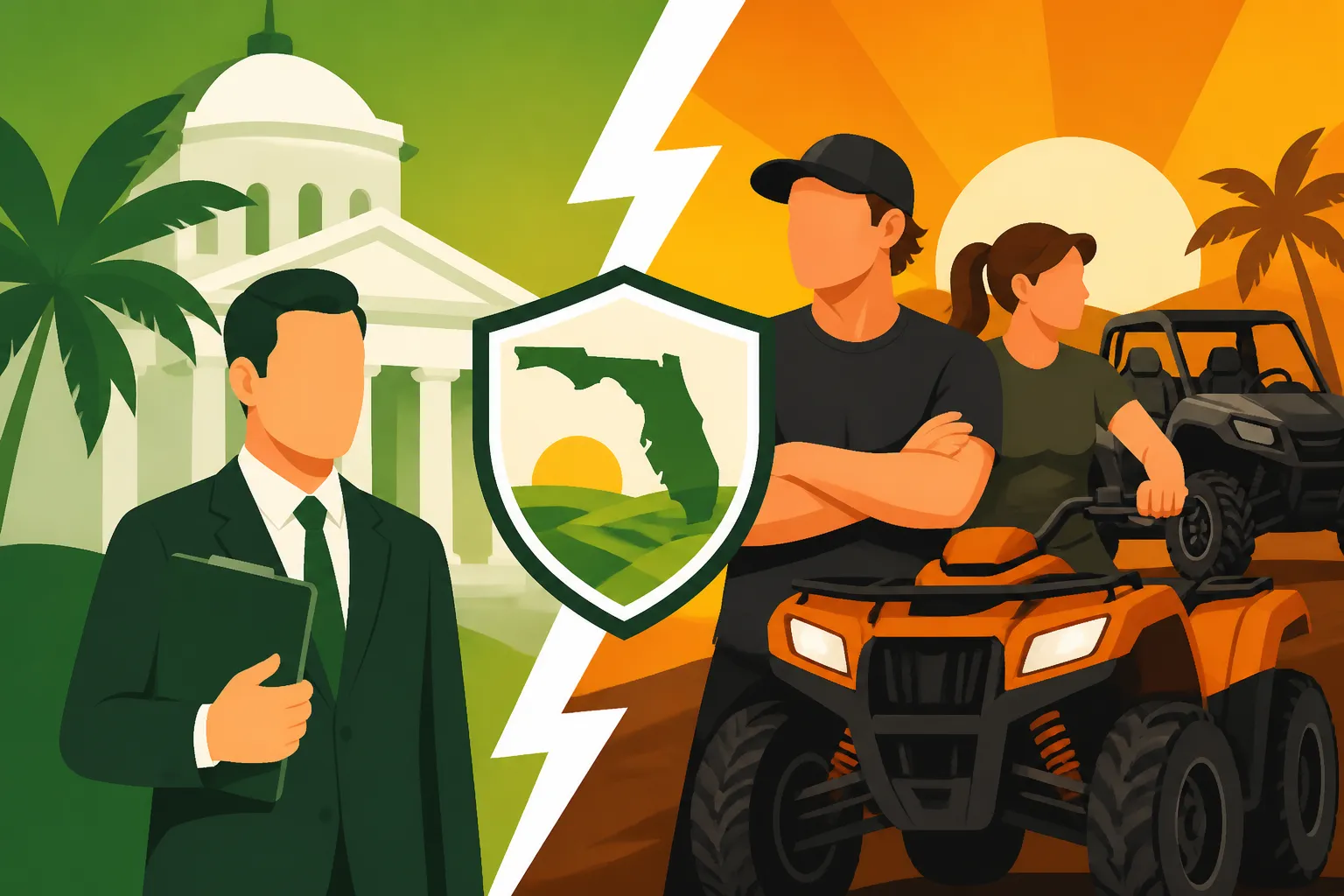
| Organization | What it generally does | What it does not necessarily do |
|---|---|---|
| FDACS | Oversees Florida’s OHV safety and training program | Personally teach every course or operate every course website |
| Florida Forest Service | Manages state forests and provides information about riding on them | Set every rule for federal or privately managed riding areas |
| Course provider | Delivers lessons, instruction and, when applicable, proof of completion | Decide that every land manager will accept its course |
| Land manager | Sets and enforces access requirements for its riding area | Replace the state agency responsible for Florida’s OHV program |
The distinction matters most when a child rides on public land. Florida’s under-16 safety requirement and a particular riding area’s entry conditions can overlap, but they are not automatically identical. A forest or park may have its own instructions about which course it accepts and what proof to carry.
For a broader overview of the age-related rule, see Florida ATV Safety Course Requirements for Riders Under 16. The state program is also discussed in FDACS Safety Certification for Young Florida Riders.
Why people mix up the agencies
The word “course” can refer to several things: the state’s safety requirement, an online learning module, an in-person class or a certificate accepted by a specific land manager. Riders may see a course linked from a government page but then complete the material on a separate platform. That does not, by itself, mean the outside platform is setting Florida law.
There is another source of confusion: Florida has both state and federal public riding areas. FDACS and the Florida Forest Service are relevant to the state program and state forest access. A national forest is managed by a federal agency, so riders should also check that forest’s current OHV rules. An online course that appears suitable for one location should not be assumed acceptable everywhere.
When a course page is reached through a state agency’s official OHV information, that is a useful starting point. Still, read the course description and confirm it matches the riding area you plan to visit. If the platform or course name is unfamiliar, ask the land manager before relying on it.
Who needs to take the course, and why
Florida’s safety education requirement is particularly relevant to riders under 16 using an OHV on public land. The requirement is not simply a suggestion to take a class before riding; it is part of the safety framework for young riders. The exact details that matter can depend on the location, the machine and the rider’s circumstances, so check the current official instructions before a trip.
Do not treat a course certificate as a general riding permit. Completing a safety course does not, by itself, give permission to ride on a closed trail, waive a land manager’s other rules or turn an ATV into a road-legal vehicle. A course credential is one item in a larger set of requirements that may include a pass, a permitted vehicle type, supervision and compliance with trail rules.
Public riding requirements can differ from riding at a private park. A private operator may set its own minimum age, training, helmet and supervision conditions. Ask the operator directly rather than assuming a state public-land rule controls every private facility.
Before enrolling, establish which requirement applies to your situation:
- Identify the riding area. Find out whether it is a state forest, national forest, another public property or a private park.
- Check the manager’s rules. Look for the current OHV page or contact the office responsible for the site.
- Confirm the course is accepted. Ask about the exact course or provider, especially if the site specifies a particular safety course.
- Check whether additional rules apply. A certificate may not replace requirements for supervision, protective equipment, permits or machine eligibility.
This is especially important when your trip includes more than one area. A course accepted by one manager may not satisfy another manager’s entry requirements. Two Different Florida Safety Course Rules explains why state law and land-specific rules should be checked separately.
For riders planning to use Florida’s national forests, review Florida National Forest Under-16 Course Requirement and Which Online Safety Course Florida’s National Forests Accept. The federal land manager’s acceptance instructions matter even when the rider has completed a course connected with Florida’s state program.
A course is not the same as an OHV pass
A safety certificate and a riding pass serve different purposes. The course addresses rider knowledge and safe operation; a pass or permit, where required, concerns access to a specific riding area. Having one does not automatically provide the other.
Before leaving, confirm whether the area requires an OHV pass, whether it applies to each machine and where it must be displayed or carried. The relevant instructions can differ between national forests and state forests. Florida ATV Safety Course for Public Land Riding and Florida National Forest OHV Pass: 3-Day, 7-Day or Annual cover these separate parts of trip planning.
How to complete the course and keep useful proof
Start with official information rather than searching for a course by name and choosing the first result. A search can return courses intended for other states, private parks or general recreational education. Those may contain useful material without meeting the requirement for your planned Florida ride.
Use the official FDACS or Florida Forest Service OHV information as your starting point, then follow its current course directions. If a riding area is managed by another agency, check that agency’s own requirements as well. Where the instructions are unclear, contact the site before enrolling; it is easier to resolve acceptance questions at home than at a trailhead.
The course format may be online, in person or a combination, depending on the program and available options. Follow the provider’s instructions for completing all required material. If a certificate or completion record is issued, save it in more than one accessible form.
A practical record-keeping routine:
- Save the completion record. Download or print it if the provider makes that option available.
- Keep a digital copy. Store it on a phone or in an account you can access without relying on a single email.
- Carry a paper copy when practical. A phone can lose power, get wet or have no signal at a remote trailhead.
- Check the name and details. Make sure the record is legible and belongs to the rider who completed the course.
- Review the riding area’s proof rules. Confirm whether the manager wants a certificate, a completion number or another form of verification.
Do not assume that an online account will be available at the trail. Some trailheads have limited or no cell service, and a manager may ask for proof before riding. Carrying a Safety Certificate on the Trail has more on keeping documentation accessible.
If a parent or guardian is handling the paperwork, keep the young rider’s own course record easy to identify. A family may have several riders, machines and passes; mixing up certificates can turn a simple check into a delay. Keep the course proof separate from registration or title documents, which show different things. An OHV title is not a substitute for safety training, and a course certificate is not proof of ownership.
If the course page or certificate causes trouble
If a link is broken, a course is unavailable or the provider’s completion record does not arrive, do not assume the requirement has been waived. Contact the course provider for help with access or records, and contact the relevant land manager to ask what it will accept while the issue is being resolved.
If you have completed a different course elsewhere, provide the exact course name and the organization that issued it when asking about acceptance. Saying only that the rider “has a certificate” may not give the manager enough information to confirm it meets the site’s requirement.
A course that was completed for another state or organization may cover similar safety subjects but still need to be checked for Florida acceptance. The same applies to a certificate earned years earlier: do not assume it expires, or that it is accepted indefinitely, without confirming the current program and site rules. See Does a Florida Safety Course Expire? for the expiration question.
What the course does not replace
A safety course teaches important skills and rules, but it cannot make an unsafe ride safe on its own. Parents and guardians still need to match the machine to the rider’s size and experience, explain trail behavior and supervise appropriately when required. Course completion is not a substitute for direct attention to a young rider.
It also does not override rules that apply to the machine or riding area. Check the specific trail system for vehicle-width limits, closures, permitted routes and any required pass. A course certificate does not allow an ATV or UTV on a route that excludes that machine.
The same principle applies to road use. An OHV course does not grant permission to ride on a public road, and it does not replace any separate age, licensing or roadway rule. Trail access and road access are different questions. For road-use basics, see Florida ATV Road Rules: Where You Can Legally Ride.
Parents should also confirm the supervision rule that applies to the intended location. Requirements can vary according to whether the rider is on public land, a road or a private property. Florida Adult Supervision Rules on Public Land addresses the public-land issue, while the land manager can answer questions about its own site.
A short pre-ride check can prevent the most common misunderstandings:
- Is the rider required to complete the course for this location?
- Does the manager accept the exact course completed?
- Is proof of completion available offline?
- Are supervision and protective-equipment requirements also met?
- Does the machine qualify for the trail, and is the required pass in place?
- Are the route and riding area open?
If the answer to the course-acceptance question is uncertain, get clarification before you travel. FDACS is the key state agency behind Florida’s OHV safety and training program, but the organization that delivers instruction and the agency managing a particular riding area may be different. Treating those roles separately is the simplest way to avoid relying on the wrong certificate or assuming that a course covers every part of a ride.
Disclaimer
This article is for general informational purposes only and does not constitute professional advice. Laws, prices and regulations vary by location and change over time. Consult a qualified professional for guidance on your specific situation.