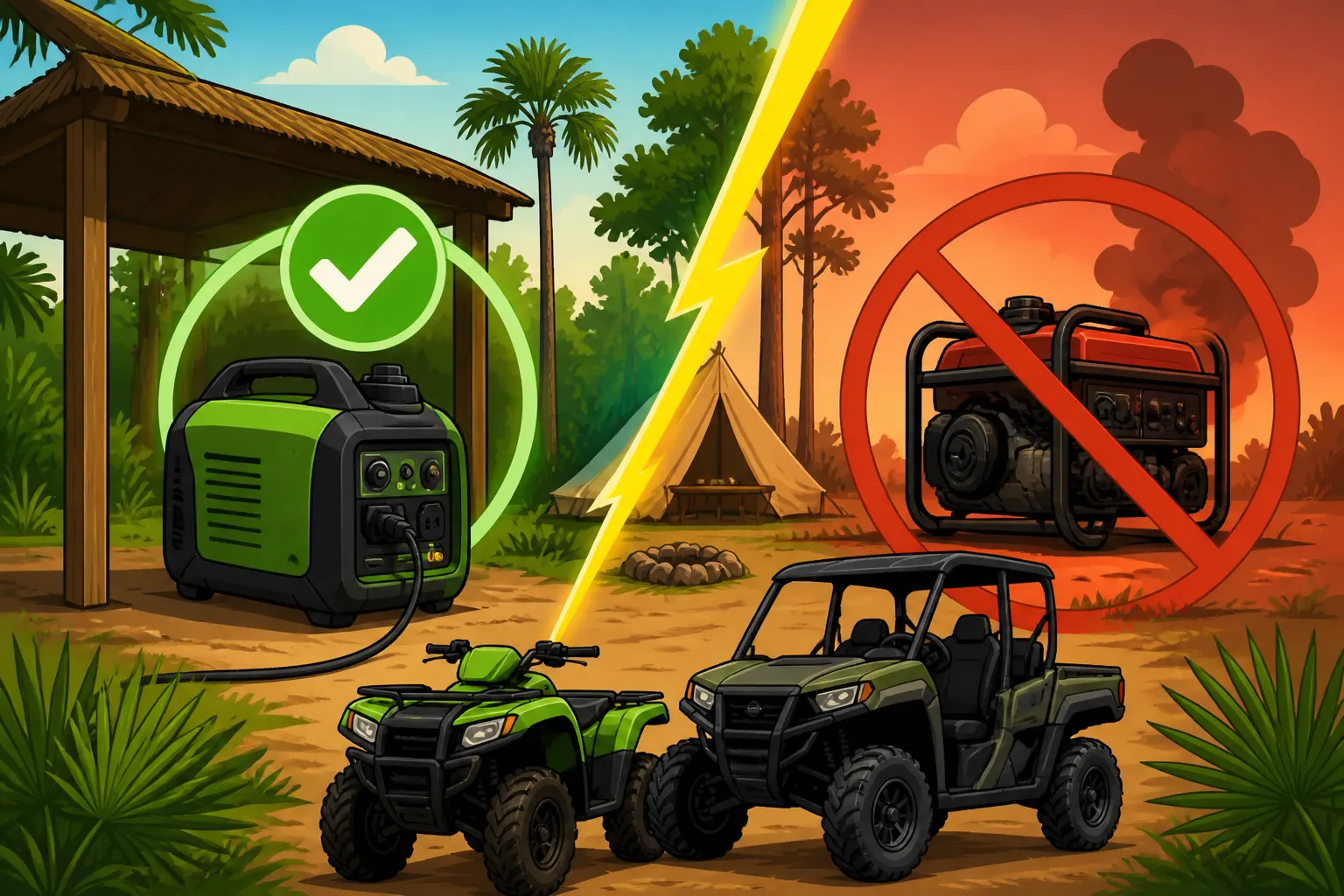
Generator Rules at a Primitive Site
A generator can make a remote Florida campsite more comfortable, but it can also disturb other campers or create a serious exhaust and fire hazard. Rules depend on the site operator, so an OHV pass alone does not tell you whether generators are allowed or when they can run. Check the campground’s current rules before packing one, then plan for quiet, safe operation.
Check the site rules before you bring a generator
There is no reliable assumption that every Florida primitive site follows the same generator policy. A site may prohibit generators, allow them only during specified hours, or permit them subject to noise, placement, and fire-safety conditions. Rules can differ between public land, private parks, and even separate camping areas at the same riding destination.
Start with the organization that manages the campsite. Read the current camping information, reservation details, posted signs, and any rules sent with your booking. If the wording is unclear, call or message the site before you leave. Ask specifically whether portable generators are allowed, whether quiet hours apply, and whether there are restrictions on fuel storage or generator location.
For OHV trips, keep camping permission separate from riding permission. An OHV pass may cover use of a riding area without granting a campsite or allowing a generator there. The distinction is explained in Florida Camping Pass vs Florida OHV Pass. Rules for permits and day use are also separate from the rules for overnight stays; see Florida State Forest OHV Day Use and Annual Passes and Florida ATV Camping With Trail Access when planning a trip that combines riding and camping.
| What to check | Why it matters | What to confirm |
|---|---|---|
| Generator allowance | Some sites may prohibit generators altogether | Whether your generator type is permitted |
| Operating hours | Quiet periods may restrict use | The allowed hours and any posted quiet-time schedule |
| Noise requirements | A permitted generator can still disturb others | Any sound limits, distance rules, or enclosure requirements |
| Campsite layout | Safe placement depends on nearby tents, vehicles, and other sites | Where the unit may run and how far it must be from occupied areas |
| Fire and fuel rules | Conditions and restrictions can change | Whether fuel may be stored at the site and what fire rules are active |
| Electrical setup | Connections and cords can create hazards | Whether site outlets are available and what equipment is permitted |
A campground’s general information may not answer every practical question. Ask whether the rule applies to all generators or only certain types, such as inverter models. If the site has designated generator hours, confirm what those hours mean in practice, including whether they apply at night or during early morning. Do not rely on another camper’s recollection when the current site rules are available.
At state forest or national forest destinations, check the managing agency’s current information as well as the campground’s instructions. Restrictions may be updated for fire conditions, maintenance, or other site-specific reasons. The same caution applies at private parks: a general park page may not spell out every campground condition, so confirm directly if generator use will affect your booking.
If generator use is a must-have, consider a campground with electrical hookups instead of assuming a primitive site will accommodate it. The difference between basic camping and a site with power is covered in Florida OHV Campgrounds With Hookups. At Croom, check the current conditions for the specific camping area rather than treating its rules as a template for other Florida sites; Croom Camping at Buttgenbach Mine offers more context for planning there.
Keep noise and campsite conflicts under control
Permission to run a generator does not mean it is considerate at any hour or in any location. Sound carries across open campsites, especially when other campers are sleeping or when the generator is positioned between tents. A unit that sounds manageable beside a busy road may feel intrusive in a quiet, wooded campground.
Follow any posted quiet hours, and treat them as a minimum standard for courtesy. If no specific hours are listed, ask the site operator what campers are expected to do. Avoid running the unit late at night or early in the morning unless the rules clearly allow it and there is a genuine need. Check Quiet Hours at an OHV Campground for more on how campground quiet periods affect a riding trip.
Placement can make a meaningful difference. Put the generator only where the campground allows it, and avoid positioning it close to another camper’s sleeping area. Do not place it on a narrow path, beside a shared cooking area, or where its sound and exhaust will be directed toward neighboring sites. A longer extension cord may help you keep the generator farther from your own tent, but it does not make an unsafe location acceptable. Follow the generator and cord manufacturers’ instructions, and keep cords out of walkways where someone could trip.
A quiet model can reduce disturbance, but “quiet” is not a substitute for checking local rules. Do not assume a particular generator style is automatically permitted. Likewise, avoid trying to muffle a unit with blankets, improvised covers, or tightly enclosed barriers. Anything that blocks airflow can cause overheating or increase exhaust danger. Use only accessories and arrangements approved by the manufacturer and allowed by the site.
If someone nearby asks you to reduce noise, respond calmly and check the posted policy. If the generator is operating within the rules but still creating a conflict, the campground host or manager can clarify the expectations. Do not argue about a rule based on what another site allowed; conditions and policies can vary.
A practical decision is to leave the generator at home if you only need it for a short period. Charge devices before departure, use battery-powered lights, and consider a battery power station or solar charger where it suits your needs. These options are not a fit for every electrical load, but they can reduce noise and remove the need to manage gasoline at camp.
Run it safely and prepare for changing conditions
Generator safety matters more than convenience. Never run a portable generator inside a tent, camper, vehicle, shed, or other enclosed or partly enclosed space. Do not place it under a canopy or near an opening where exhaust could enter a sleeping area. Carbon monoxide is odorless, and exhaust can become dangerous even when the generator seems to be outside. Keep it outdoors and follow the manufacturer’s distance and ventilation instructions.
Choose a stable, dry location that complies with site rules and the manufacturer’s guidance. Keep the generator away from dry leaves, brush, and other easily ignited material. Do not operate it where rainwater can reach electrical connections, and do not cover it in a way that restricts ventilation. If weather turns severe, shut it down and handle it as directed by its manual rather than improvising a shelter.
Fuel deserves its own plan. Store fuel only in an approved container, in a location and manner allowed by the campground. Keep it away from heat, flames, cooking equipment, and the generator’s hot parts. Shut the generator off and let it cool before refueling. Do not refuel it while it is running or hot, and clean up any spill promptly using safe practices. If the site prohibits fuel storage or generator operation, do not try to work around the restriction.
Use electrical equipment according to the generator’s instructions. Inspect cords for cuts, damaged plugs, or loose connections before each trip. Keep connections dry and avoid running cords where vehicles can drive over them. Never connect a generator to a building’s wiring through an improvised setup; a proper transfer arrangement and qualified installation are needed for that kind of use. For campsite use, connect only equipment in the manner described by the generator manufacturer and the campground.
Florida’s dry periods and local fire restrictions can affect what is safe or permitted, even if a generator was allowed on a previous visit. Check for current restrictions before departure and again at the site. Fire Restrictions During a Dry Spring explains why seasonal conditions deserve attention. A generator is not a campfire, but its hot components, fuel, and exhaust still require careful handling.
Before leaving home, make a simple checklist:
- Confirm that generators are allowed at the exact campsite you plan to use.
- Note the permitted operating hours and any noise or placement requirements.
- Read the generator manual for ventilation, weather, fuel, and electrical instructions.
- Bring suitable cords and approved fuel containers, if the site permits them.
- Plan where the generator can run without directing exhaust or noise toward tents.
- Check for current fire restrictions and any updated campground notices.
- Have a quieter backup plan if the generator cannot be used.
If the rules are uncertain when you arrive, ask the host or site manager before starting the unit. A quiet-hours or generator restriction is easier to follow when you know it in advance, and a last-minute question is preferable to disturbing a campsite or creating a safety problem.
The most dependable approach is straightforward: treat generator use as site-specific, not as a benefit automatically included with an OHV pass or a primitive campsite. Confirm permission, respect quiet periods, keep exhaust well away from people and enclosed spaces, and follow fire and fuel directions. If the site does not allow generators, choose a different power option or a campground with hookups rather than risking a violation or an unsafe setup.
Disclaimer
This article is for general informational purposes only and does not constitute professional advice. Laws, prices and regulations vary by location and change over time. Consult a qualified professional for guidance on your specific situation.