Florida ATV Title Requirements for a New Resident
Moving to a new state is exciting, but it often comes with a heap of bureaucratic hurdles, and bringing your beloved ATV or UTV with you to the Sunshine State is no exception. Many new Florida residents find themselves scratching their heads, wondering if their existing out-of-state title is enough or what the process entails to get their off-highway vehicle (OHV) legal here. This comprehensive guide is designed to demystify the Florida ATV title requirements for new residents, helping you navigate the process smoothly so you can hit the trails without a hitch.
Why Florida Requires Titling for New Residents
It might feel redundant to title your ATV again, especially if you already went through the process in your previous state. However, Florida has its own set of rules for off-highway vehicles, and understanding these regulations is the first step to becoming a compliant rider in your new home. Florida law mandates that all ATVs and UTVs used on public lands be titled. This isn't just a suggestion; it's a legal requirement designed to establish clear ownership, deter theft, and ensure that if you ever need to sell your machine, you have the proper paperwork.
Understanding Florida's OHV Laws
Florida's approach to ATV and UTV titling is fairly straightforward: if you plan to ride your machine on any public land, including designated state forests, national forests, or wildlife management areas, it absolutely needs a Florida title. This applies even if your previous state didn't require a title for ATVs, which can be a significant point of confusion for new arrivals. Imagine rolling up to the Croom Motorcycle Area, ready for a day of fun, only to be turned away because your quad isn't properly titled in Florida. It's a frustrating scenario that's easily avoided with a bit of preparation. The title serves as official proof of ownership, a crucial document for identification and legal operation within the state's public trail systems.
This titling requirement also plays a vital role in consumer protection and law enforcement. When an ATV is titled, it creates a public record of ownership, making it much harder for stolen machines to be resold. For owners, it provides a strong legal basis for your claim to the vehicle. While you might keep your ATV exclusively on private property, say a large ranch or a friend's land, a title is still highly recommended. It smooths out future transactions, like selling the ATV or claiming it on an insurance policy, by providing undisputed proof that the machine belongs to you. Florida takes its OHV laws seriously, and the titling process is a cornerstone of that regulatory framework. You can read more about this in [Florida Off-Highway Vehicle Title Rules Explained].
The "New Resident" Definition
When does Florida consider you a "new resident" for titling purposes? Generally, if you've established residency in Florida, you're expected to title your vehicles, including ATVs, within a certain timeframe. Establishing residency can mean many things: obtaining a Florida driver's license, registering to vote, enrolling your children in public school, or even declaring homestead exemption on a property. The state sees these actions as indicators that Florida is now your primary home.
Once you've made the move, you typically have 30 days to obtain a Florida driver's license, and this often kickstarts the clock for titling all your vehicles. It’s not uncommon for folks to move down, get settled, and then realize they need to update all their vehicle paperwork. For your ATV, this means converting your out-of-state title (if you had one) to a Florida title. Even if your old state didn't issue titles for ATVs, once you reside here, Florida's titling requirements apply to your machine. The key is that your intent to reside in Florida permanently or for an extended period triggers these obligations. Don't wait until you're ready to hit the trails or sell your machine; address the residency aspect as soon as you're settled to avoid any last-minute stress or potential penalties.
Essential Documents for New Resident ATV Titling
Walking into the tax collector's office prepared is half the battle. For new residents, bringing an ATV from another state adds a few extra layers of documentation that you'll need to sort out. The Florida Department of Highway Safety and Motor Vehicles (FLHSMV) and your local county tax collector's office will require specific forms and proofs to process your new title. Gathering these in advance will save you multiple trips and a good deal of frustration.
Proof of Ownership from Your Previous State
This is arguably the most critical document you'll need. If your ATV was titled in your previous state, you'll need to present that original title. This title acts as the direct link showing that you legally owned the machine before moving to Florida. The process usually involves surrendering your out-of-state title in exchange for a new Florida title. Ensure the title is free of any alterations, erasures, or smudges, as this could raise red flags and cause delays.
What if your previous state didn't title ATVs? This is a very common scenario, especially if you moved from a state with less stringent OHV regulations. In this case, you'll need to provide alternative proof of ownership. This might include your original Manufacturer's Certificate of Origin (MSO or MCO), a bill of sale, or even old registration documents from your previous state. The goal is to establish a clear chain of ownership from the manufacturer to you. If you're missing an MSO and didn't have a title, a detailed bill of sale with the VIN and seller information becomes incredibly important. You might find resources on sites like LawDepot helpful for drafting or understanding what a strong bill of sale should contain, ensuring it meets basic legal standards for proving ownership.
Even with a strong bill of sale, the tax collector might require additional steps to confirm ownership if no prior title or MSO exists. This can sometimes involve signing an affidavit swearing to your ownership. It's a bit more work, but it's crucial to be honest and thorough to avoid any issues down the line. Remember, the state wants to make sure the ATV isn't stolen and that you are indeed the rightful owner before issuing a new Florida title. If you're buying a used ATV in Florida that has no MSO, the titling process is similar for new residents who come from a state that didn't title ATVs. For more on this, check out [Proof of Ownership When the MSO Is Missing].
Verification of the ATV's Identity
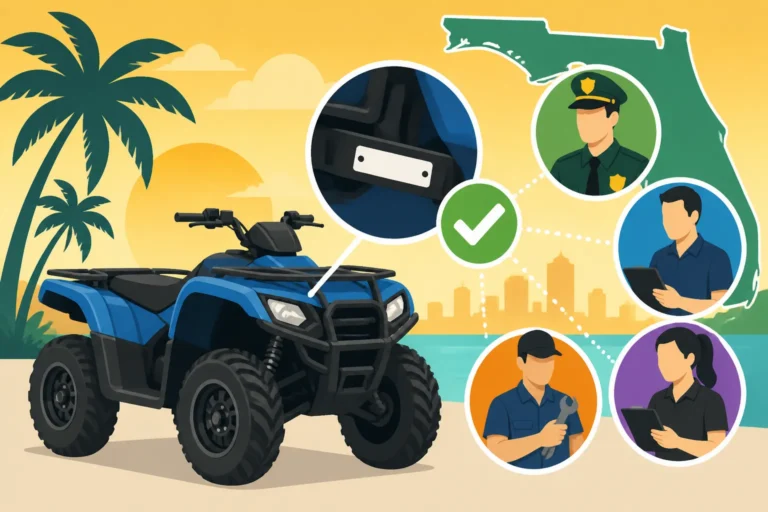
Florida requires a Vehicle Identification Number (VIN) verification for any vehicle being titled in Florida that was previously titled or registered out-of-state. This is a crucial step to confirm that the VIN on your paperwork matches the physical VIN stamped on your ATV and to ensure the vehicle hasn't been reported stolen or tampered with. It's a safeguard for everyone involved.
The VIN verification can be performed by several authorized individuals. This includes law enforcement officers (police, sheriff's deputies, FHP), licensed Florida motor vehicle dealers, or tax collector employees. You'll typically need to complete Form HSMV 82042, "Vehicle Identification Number and Odometer Verification." Some county tax collectors have designated staff who can perform the verification on-site, but it's always wise to call ahead and confirm, or even ask if you can bring your ATV to the office for inspection, which might not always be practical. If you're unsure who can perform this vital check, you can explore [Who Can Verify an ATV VIN in Florida?]. Make sure the VIN on your machine is clean and legible, as any difficulty reading it could delay the process significantly.
Personal Identification and Residency Proof
When you go to title your ATV, you'll also need to prove who you are and that you are, in fact, a Florida resident. This involves bringing specific identification documents. Your valid Florida driver's license or identification card is usually the primary form of ID they'll accept. If you're still in the process of getting your Florida driver's license, other forms of government-issued ID might be accepted in conjunction with proof of Florida residency.
Proof of Florida residency can include a utility bill in your name at a Florida address, a lease agreement, a Florida voter registration card, or a Florida declaration of domicile. Essentially, you need documents that clearly show your name and your new Florida address. It's always a good idea to bring more than one form of residency proof, just in case. The tax collector's office wants to ensure that the person requesting the title is legitimately a resident of the state and the rightful owner of the ATV. Don't forget that if there are two owners, both will generally need to be present or provide proper authorization. For more details, [What a County Clerk Checks on Your Application] might be a helpful resource.
The Titling Process for Out-of-State ATVs
So, you've gathered all your documents and you're ready to make it official. The process of titling an out-of-state ATV in Florida, while requiring attention to detail, is manageable once you understand the steps. It primarily involves completing the correct forms, getting your VIN verified, and presenting everything to your local tax collector's office.
Step-by-Step Application
The core document you'll need to complete is Form HSMV 82040, the "Application for Certificate of Title With/Without Registration." Even though ATVs don't get traditional registrations or license plates in Florida (unlike cars), this is the standard form used for titling. You'll fill out your personal information, the ATV's details (make, model, year, VIN), and information about its previous ownership. Be meticulous and double-check every entry, as errors can cause your application to be rejected.
Along with Form 82040, you’ll also need to submit your out-of-state title (if you have one) or your alternative proof of ownership (MSO, bill of sale, etc.). Don't forget the completed VIN verification form (HSMV 82042). All these documents will be presented together to the clerk. Make sure you have copies of everything for your own records before you hand over the originals. This is a crucial step for new residents, as the office needs to see the clear transition of the vehicle into Florida's system. Understanding [Florida's ATV Title Application Explained] can give you a deeper dive into filling out the forms correctly.
Navigating the Tax Collector's Office
In Florida, ATV titles are handled by your local county tax collector's office. Each county has one or more locations, so it's a good idea to check their website for hours of operation, required documents, and whether they accept appointments or are walk-in only. Some larger counties might have a specific counter for titling vehicles, while others might have a general service area. Preparing for your visit by knowing these details can save you significant wait time and frustration.
When you arrive, be prepared to wait, especially during peak hours. Bring all your original documents, including your personal ID and proof of residency. The clerk will review your application and supporting paperwork. They'll check the VIN verification, confirm your identity, and calculate the fees owed. Be polite and patient; the clerks are there to help, but they are also bound by strict state regulations. If there are any discrepancies or missing items, they will inform you. Addressing them quickly and calmly is key to a successful visit. You might also want to explore [Florida County Tax Collector vs Service Center for ATV Titles] for insights into different service options.
Addressing Missing or Incomplete Paperwork
It's not uncommon for new residents to face challenges if their original out-of-state paperwork is lost, incomplete, or if their previous state had very different titling laws. For instance, if you've lost your out-of-state title, you might need to apply for a duplicate title in your previous state before you can title it in Florida. This can add significant time and hassle to the process. Alternatively, if your old state didn't title ATVs and you only have a bill of sale, make sure it's as detailed as possible, including the full names and addresses of both buyer and seller, the date of sale, purchase price, and the ATV's full VIN.
In some cases, if robust proof of ownership is truly missing (e.g., no title, no MSO, vague bill of sale), the Florida Department of Highway Safety and Motor Vehicles (FLHSMV) might require you to obtain a bonded title. This is a more complex process that involves purchasing a surety bond to cover potential claims against the vehicle's ownership. While not the first option, it's a pathway for those with significant paperwork challenges. The tax collector's office can provide guidance on these more complex situations. Don't be afraid to ask questions; it's better to get it right than to face issues later. If you run into this, reading up on [Buying a Quad With No Title From a Neighbor] might be useful, as some of the principles apply.
Costs and Fees Associated with Titling
Understanding the financial side of titling your ATV in Florida as a new resident is crucial. Beyond the bureaucratic steps, there are specific fees you'll need to pay to make your machine fully compliant in the state. These costs are generally standardized, but certain situations can incur additional charges.
Standard Titling Fees
When you title your ATV in Florida, you'll encounter a few standard fees. The primary cost is the initial title application fee. This is a set amount that covers the administrative processing of your new Florida title. Think of it as the base price for getting your machine officially recognized by the state. You'll also typically pay a service charge, which is a small fee collected by the county tax collector's office for their role in facilitating the transaction.
Beyond these, there might be a lien recording fee if you have a loan on your ATV and your financial institution needs to be listed as a lienholder on the new Florida title. This ensures that the lender's interest in the vehicle is legally protected. These fees are usually paid at the tax collector's office when you submit your application. It's always a good idea to call your specific county tax collector beforehand or check their website to get the most up-to-date figures, as these can sometimes be adjusted. For a full breakdown, check out [Florida ATV Title Fee Breakdown: $29 Plus Service Charges].
Sales Tax Considerations
One area that often surprises new residents is the application of sales tax. If you originally purchased your ATV less than six months before moving to Florida, and you did not pay sales tax on that purchase in your previous state (or if the tax rate was lower than Florida's), Florida may require you to pay the difference. The state wants to ensure that it collects its due sales tax on vehicles brought into the state that are still relatively new to the owner.
The exact calculation for sales tax can be complex, involving the purchase price of your ATV and Florida's current sales tax rate. If you paid sales tax in your previous state, you'll generally need to provide proof of that payment (e.g., a line item on your original bill of sale or purchase agreement) to avoid paying it again. Even if you owned the ATV for a long time, the tax collector will review the situation to ensure compliance. This is a common point of inquiry, so be prepared with your original purchase documents. Sites like LawDepot might offer resources that help you understand what constitutes a strong proof of purchase for tax purposes. For a deeper dive into this, see [Florida Sales Tax When You Title an ATV].
Expedited Options and Their Costs
For those who need their Florida ATV title quickly, the state offers an expedited "Fast Title" service. This option allows you to receive your paper title much faster than the standard processing time, which can sometimes take several weeks to arrive by mail. The Fast Title is incredibly useful if you need the title quickly for a specific reason, such as selling the ATV, recording a lien promptly, or needing the physical paper title for an out-of-state transaction.
Choosing the Fast Title option typically involves an additional fee on top of the standard titling costs. This extra charge covers the accelerated processing and printing of your title. While it adds to the overall expense, the convenience of receiving your title in a matter of days (often even the same day if submitted early enough) can be well worth the cost for many new residents. Again, check with your local tax collector for the exact fee for this expedited service. If time is of the essence, [Florida Fast Title for an ATV: The $7 Expedited Option] can provide more information on how this works.
| Document/Service | Description | Estimated Standard Cost | Potential Additional Cost |
|---|---|---|---|
| Initial Title Application | Base fee for processing a new Florida ATV title. | Check local Tax Collector | N/A |
| Service Charge | Administrative fee collected by the county tax collector. | Check local Tax Collector | N/A |
| VIN Verification | Usually no direct charge if done by authorized personnel (fees may apply if private service). | Often part of process | N/A |
| Sales Tax | Applied if ATV purchased < 6 months ago and tax wasn't paid/fully paid in previous state. | Varies by ATV value | Varies |
| Lien Recording Fee | If a lien needs to be recorded on the title. | Check local Tax Collector | N/A |
| Fast Title Option | Expedited processing for quicker title delivery. | Check local Tax Collector | Additional fee for speed |
| Duplicate Out-of-State Title | If original out-of-state title is lost. | Varies by prior state | Potentially significant |
Note: All costs are estimates; consult your local Florida County Tax Collector's office for current and exact fees.
Common Challenges and How to Overcome Them
Even with all the right information, titling an out-of-state ATV in Florida as a new resident can sometimes present unique challenges. Foreseeing these potential hurdles and knowing how to address them can save you a lot of stress and ensure a smoother process.
When Your Previous State Didn't Title ATVs
This is perhaps the most common difficulty new Florida residents face. Many states do not require titles for ATVs, especially older models or those primarily used off-road. You might have only a bill of sale, an old registration, or just the Manufacturer's Certificate of Origin (MSO). When Florida requires a title, it feels like you're starting from scratch.
The key here is strong alternative proof of ownership. As mentioned, the MSO is gold. If you don't have it, a detailed bill of sale is critical. This document should clearly identify the ATV by its VIN, state the full names and addresses of the buyer and seller, the date of sale, and the purchase price. The more information, the better. If you only have a vague handwritten receipt, you might need to gather additional supporting evidence, such as old insurance policies, repair records, or even sworn affidavits from previous owners. The Florida Department of Highway Safety and Motor Vehicles wants to establish a clear chain of custody to prevent fraud and theft. Preparing these documents meticulously is vital, and you might even consider using a template from a service like LawDepot to ensure your bill of sale covers all necessary legal bases. Without a prior title, you are essentially establishing the first legal title in Florida for that specific machine, which means extra scrutiny.
Issues with VIN Verification
While usually a straightforward process, VIN verification can sometimes hit snags. The most common issue is a VIN that is difficult to read due to dirt, rust, or damage. If the VIN isn't perfectly clear, the verifying officer or official might be hesitant to sign off on the form. Before you go for verification, thoroughly clean the area where the VIN is stamped (usually on the frame) to ensure it's easily legible.
Another challenge can arise if the VIN on your physical ATV doesn't match the VIN on your ownership documents. This is a serious issue that will halt the titling process immediately. It could indicate a clerical error on a previous title or, in more severe cases, suggest the ATV has been tampered with or is stolen. If there's a discrepancy, you'll need to contact the authority that issued your previous title or registration to resolve the error. If the issue is with the ATV itself (e.g., a missing or altered VIN plate), you'll be looking at a much more complicated process, potentially involving law enforcement investigation. Always double-check your VINs before starting any paperwork.
Dealing with Liens from Out-of-State
If you financed your ATV and still owe money on it, your lender (lienholder) will be listed on your original out-of-state title. When you move to Florida, this lien needs to be properly recorded on your new Florida title. This often requires cooperation between you, your lender, and the Florida tax collector's office. Your lender might need to send the original out-of-state title directly to the Florida tax collector's office, or they might send it to you with instructions to then submit it for titling.
It's crucial to communicate with your lienholder as soon as you plan to title your ATV in Florida. Ask them about their specific process for handling out-of-state title transfers and lien recordings. They might have a specific department or forms they need you to complete. Florida will issue a new title with your lender listed as the lienholder, and often, this will be an electronic lien (ELT) rather than a physical paper title unless you specifically request one. This simply means the lien information is stored electronically, and your lender will receive confirmation directly. For more details on this, refer to [Florida ATV Title With a Lien Recorded]. The goal is to ensure your lender's security interest in the ATV is maintained under Florida law.
Disclaimer
This article is for general informational purposes only and does not constitute professional advice. Laws, prices and regulations vary by location and change over time. Consult a qualified professional for guidance on your specific situation.