Florida’s Off-Highway Title Rules in Plain English
If you're a Florida rider, the thought of titling your ATV or UTV might bring on a minor headache. It feels like there’s a secret language to understand, and the last thing you want is to get tripped up by bureaucratic red tape when all you really want is to enjoy the open trails or your private property. This guide is designed to unravel that confusion, breaking down Florida’s off-highway vehicle title rules into straightforward, easy-to-understand language so you can title your machine with confidence and ease.
Why Does Florida Care About Titling Your OHV Anyway?
It’s easy to feel like the state just wants to collect fees or add more paperwork to your life, but there are legitimate reasons behind Florida’s off-highway vehicle (OHV) titling requirements. For many riders, the primary concern is simply having fun, but the state looks at these machines from a different angle – one that involves ownership, public safety, and accountability.
More Than Just a Piece of Paper: The Purpose of a Title
Think of your OHV title as its birth certificate and proof of ownership rolled into one. It’s the official document issued by the Florida Department of Highway Safety and Motor Vehicles (FLHSMV) that legally identifies you as the owner of that specific ATV or UTV. Without a title, proving you own your machine can become a real nightmare, especially in situations like theft or resale. This little piece of paper, whether it's an electronic title or a physical one, serves as the ultimate legal evidence.
Beyond simple ownership, the title helps to create a public record. This record allows law enforcement to track machines, making it harder for stolen ATVs and UTVs to be resold illicitly. It also helps to prevent title jumping, a shady practice where a seller tries to avoid paying sales tax by not titling a machine in their own name before selling it to you. A clear chain of title protects everyone involved in a transaction.
For lenders, the title is crucial because it allows them to record a lien if you finance your purchase. This means the lienholder's interest in the machine is legally protected until the loan is paid off. So, while it might seem like just another form, your OHV title is a cornerstone of responsible ownership and helps keep the off-road community a little safer and more transparent.
When a Title Becomes Absolutely Essential
While you might be able to ride an untitled ATV on private land in Florida, there's a huge catch: if you plan to hit any public trails or designated riding areas, a Florida OHV title is an absolute must. This is a critical distinction that many riders overlook, leading to frustrating encounters with park rangers or law enforcement. The moment your wheels touch public soil – be it a state forest, national forest, or any other publicly managed off-road park – that title needs to be in your name and on record.
This requirement for public land use is designed to ensure accountability and help fund the very trails you enjoy. Fees associated with titling and certain public land passes contribute to the maintenance and development of these riding areas. If you're wondering [Who Must Title an ATV in Florida], the simple answer for most recreational riders is: anyone who intends to ride on public land. Even if your machine never sees a paved road, public land use triggers the title requirement.
Consider a scenario where you've just bought a shiny new side-by-side and are eager to explore the Ocala National Forest. Without a title, you won't even make it past the gate at a place like the Rodman Trailhead. It’s not just about avoiding fines; it’s about compliance with the rules that govern access to these incredible natural resources. Always check the rules for the specific area you plan to ride, but assume a title is needed for public access.
What an OHV Title Doesn't Do
It's easy to confuse an OHV title with other vehicle-related paperwork, especially if you're used to cars or trucks. However, Florida’s off-highway vehicle title is distinct and comes with specific limitations. The most common misconception is that a title makes your ATV or UTV street legal. Let's be crystal clear: [What an OHV Title Does Not Let You Do] is ride on paved public roads or highways. A title in Florida only confirms ownership and is required for public land access; it does not grant permission for road use.
Another point of confusion for some riders is the idea that a title includes registration or a license plate. Unlike cars, Florida OHVs do not receive a license plate or registration tag for the machine itself. There's no annual renewal sticker to put on your quad. The title is a one-time issuance of ownership, not an ongoing permit to operate. You might need a separate OHV pass for state or national forests, but that's entirely different from a title or traditional vehicle registration.
Finally, a title doesn't automatically imply insurance coverage or dictate where you can ride. While having a title might be a prerequisite for some insurance policies, it isn't proof of insurance itself. You'll still need to secure specific off-road vehicle insurance if you want coverage for your machine. And even with a title, you're still bound by local ordinances and private property rules. Always verify local regulations and obtain landowner permission before riding anywhere other than a designated public OHV park.
Understanding the Different Kinds of Off-Highway Vehicles in Florida
Florida law is pretty specific when it comes to categorizing off-highway vehicles, and these distinctions are crucial because they dictate how your machine is titled and, in some cases, where you can ride it. What you might casually call a "quad" could legally be an ATV, or it might fall into the side-by-side category, each with its own set of rules.
Defining "ATV" and "UTV" in Florida Law
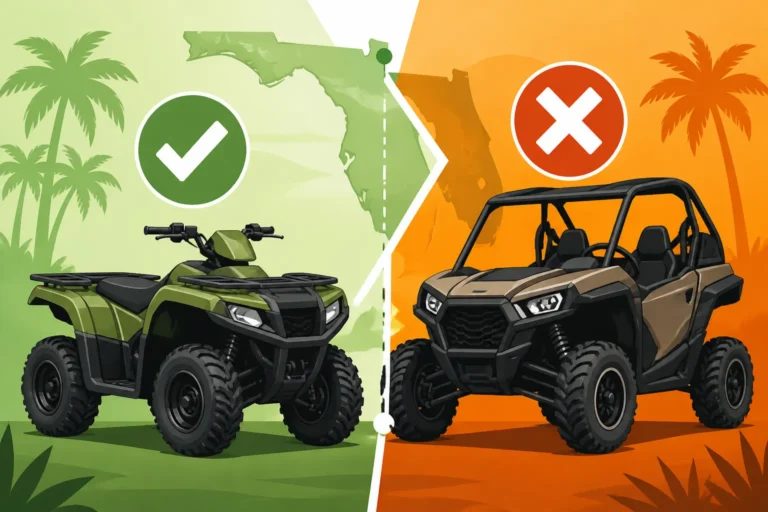
Florida statute takes a very precise approach to what constitutes an "all-terrain vehicle" (ATV) versus a "recreational off-highway vehicle" (ROV), which most of us call a UTV or side-by-side. An ATV, by Florida definition, is a motorized off-highway vehicle fifty-five inches or less in width, having a dry weight of one thousand five hundred pounds or less, designed to travel on three or more non-highway tires, and manufactured for use by a single operator or a single operator and passenger. This 55-inch width cutoff is incredibly important, as anything wider automatically falls into a different class.
On the other hand, what we commonly refer to as a UTV or side-by-side is typically classified in Florida as a Recreational Off-Highway Vehicle (ROV). These machines are generally wider, heavier, and often designed to carry more passengers or cargo. An ROV is defined as a motorized off-highway vehicle eighty inches or less in width, having a dry weight of three thousand five hundred pounds or less, designed to travel on four or more non-highway tires, and manufactured for use by a single operator and one or more passengers. If your machine is wider than 55 inches but less than 80 inches, and heavier than 1,500 pounds but less than 3,500 pounds, it's almost certainly an ROV for titling purposes. Understanding these specific measurements is key to navigating [Florida's Off-Highway Vehicle Title Rules Explained].
The difference in classification directly impacts how you apply for a title and what forms you might use. For example, if you have a machine that's clearly an ATV, the process will align with that specific classification. If you're riding a larger side-by-side, you'll be looking at [Florida UTV Titling for Side-by-Sides Over 55 Inches]. Don't assume all your off-road machines are treated the same way on paper; a quick measure and weight check can save you a lot of hassle at the county tax collector's office.
The Importance of Width and Weight
When it comes to Florida's off-highway vehicle titling, the phrases "55 inches or less" and "1,500 pounds or less" are not just arbitrary numbers; they are the legal backbone for categorizing your machine. For an ATV, these dimensions are critical. If your machine exceeds either the 55-inch width or the 1,500-pound dry weight limit, it ceases to be legally classified as an ATV in Florida, even if it has an ATV-style saddle seat and handlebars. This means it will fall into the ROV (Recreational Off-Highway Vehicle) category for titling.
This distinction is more than just semantics; it can affect everything from the specific forms you need to fill out to potential restrictions on where you can ride. For instance, some public trails might have width restrictions that would exclude an ROV but allow an ATV. It’s important to know your machine's exact specifications – dry weight, not wet with fuel and accessories, and its maximum width from outside tire to outside tire. You can usually find these details in your owner’s manual or on the manufacturer’s website.
Measuring your machine correctly before heading to the tax collector’s office is a smart move. An honest mistake in classification could lead to delays or even needing to restart the titling process. Understanding [Florida's 55-Inch ATV Definition and Why It Matters] is the first step in ensuring a smooth titling experience and avoiding any surprises when you present your paperwork.
Other Off-Highway Vehicles That Need a Title
While ATVs and UTVs (ROVs) are the most common off-highway vehicles discussed, Florida's titling requirements extend to other machines that fall under the broader "off-highway vehicle" umbrella. This often includes off-highway motorcycles, which are commonly known as dirt bikes. If your dirt bike is primarily designed for off-road use and is not street legal, it likely requires an OHV title in Florida. This is a surprise to some riders who might assume dirt bikes are exempt.
The key across all these categories is the "off-highway" designation. If a vehicle is manufactured for use exclusively off of public roads and highways, and doesn't meet the criteria for a traditional street-legal vehicle, then Florida typically requires it to be titled as an OHV. This includes specialized buggies, and even some custom-built machines, provided they meet the size and weight criteria for an OHV. It’s always best to clarify with the FLHSMV or your local tax collector if you have an unusual or custom-built machine.
It’s worth noting that vehicles like golf carts and some low-speed vehicles (LSVs), while they might be used off-road, typically have their own distinct titling or registration rules that differ from ATVs and UTVs. The important takeaway is that if you intend to ride it on public lands, or want clear proof of ownership to protect your investment, you should almost certainly plan on obtaining a Florida OHV title.
The Nitty-Gritty of Getting Your Florida OHV Title
Alright, let's get down to brass tacks: how do you actually get this all-important title in your hands? The process isn't as intimidating as it might seem, but it does require attention to detail and having all your ducks in a row before you visit the county tax collector's office.
Gathering Your Essential Documents
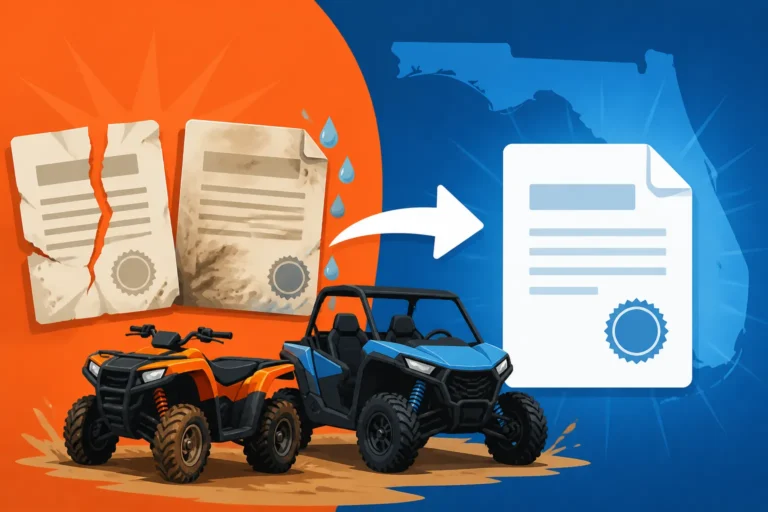
Before you even think about walking into the tax collector's office, you need to have a specific set of documents ready. Missing just one piece of paper can send you right back home, wasting your precious time. The cornerstone of titling a new off-highway vehicle is the Manufacturer’s Certificate of Origin (MCO), sometimes called a Manufacturer’s Statement of Origin. This document is essentially the "birth certificate" for your new ATV or UTV and proves it hasn't been titled before. If you bought your machine from a dealer, they should provide this to you.
For used ATVs or UTVs, the previous Florida title, properly signed and dated by the seller, is your golden ticket. It needs to be clear of any liens, or accompanied by a lien satisfaction if there was one. Along with the title, you’ll absolutely need a bill of sale. Even if you're buying from a friend or neighbor, a solid [Florida ATV Bill of Sale: What It Needs to Say] is crucial. This document establishes the purchase price (for sales tax purposes) and formalizes the transfer of ownership. You can find reliable templates online, perhaps even through services like LawDepot, to ensure all necessary information is included.
Finally, you’ll need a completed Florida title application form (HSMV 82040), proof of your identity (like a Florida driver's license), and possibly a VIN verification if the machine is from out-of-state or has special circumstances. Don't forget proof of Florida residency if your license doesn't already establish it. Having these items organized in a folder will make your visit much smoother.
| Document Type | New OHV (From Dealer) | Used OHV (Private Sale) | Used OHV (Out-of-State) |
|---|---|---|---|
| Proof of Ownership | Manufacturer’s Certificate of Origin (MCO) | Previous Florida Title (signed by seller) | Out-of-State Title (signed by seller) or MCO |
| Sale Details | Dealer Invoice/Bill of Sale | Bill of Sale (signed by both parties) | Bill of Sale (signed by both parties) |
| Application Form | Form HSMV 82040 | Form HSMV 82040 | Form HSMV 82040 |
| Identification | Florida Driver’s License/ID | Florida Driver’s License/ID | Florida Driver’s License/ID (plus proof of residency) |
| Lien Release | N/A (unless dealer arranged financing) | If applicable (lienholder satisfaction) | If applicable (lienholder satisfaction) |
| VIN Verification | N/A (unless dealer did not verify, or custom build) | N/A (unless from out-of-state, or custom build) | Required, typically Form HSMV 84490 (Law enforcement or dealer) |
| Power of Attorney | N/A (unless someone else is titling for you) | N/A (unless someone else is titling for you) | N/A (unless someone else is titling for you) |
The Step-by-Step Application Process
Once your documents are gathered, the actual application process for your Florida OHV title is fairly straightforward. Your first stop will be your local Florida county tax collector's office or a designated license plate agent. It's usually a good idea to check their specific hours and whether they require appointments, as wait times can vary significantly from one office to another, such as [Marion County ATV Title Office Hours] versus [Polk County ATV Title Walk-In Wait].
Upon arrival, you'll present all your compiled documents to a clerk. They will review everything, cross-referencing your MCO or previous title with your bill of sale and identification. This is where attention to detail really pays off; if any names, VINs, or dates don't match, you'll likely face delays. The clerk will guide you through completing any remaining sections of the [Florida's ATV Title Application Explained] form, ensuring all fields are correctly filled out, especially the odometer reading if applicable (though most OHVs don't require this).
After the paperwork review, you'll pay the necessary fees, which include the initial title application fee, any applicable sales tax, and a service charge. Once payments are processed, the clerk will issue you a temporary receipt. This receipt is your proof that the titling process has begun. The physical title will then be mailed to you, or held electronically, within a few weeks. You can often check the status of your application online.
Understanding the Costs Involved
Titling an OHV in Florida isn't free, but the costs are generally manageable and predictable. The primary fee you'll encounter is the initial title application fee. This fee is standard across the state and covers the administrative cost of processing your ownership change and creating the new title record. It's often broken down as part of the overall charges when you buy a machine.
Beyond the initial application fee, you'll almost certainly pay Florida sales tax. This is calculated based on the purchase price listed on your bill of sale, so ensure that amount is accurate. If you bought your OHV from a private seller, you’re still responsible for paying this sales tax at the time of titling. There’s also a mandatory service charge that applies to virtually all title transactions processed by the county tax collector. This fee helps cover the operational costs of the local office handling your paperwork.
You might also encounter a few optional or situational fees. For example, if you need a paper copy of an electronic title, there's a small charge. If you want to expedite the process and receive your title faster, Florida offers a "Fast Title" option for an additional fee. This can be appealing if you need the physical title in hand quickly for some reason. Always ask for a complete breakdown of charges when you're at the tax collector's office so you know exactly what you're paying for. To get a clear picture, refer to a breakdown like [Florida ATV Title Fee Breakdown: $29 Plus Service Charges].
Common Titling Hurdles and How to Jump Them
Even with the best intentions, the OHV titling process can hit snags. These challenges often arise from past ownership issues, lost paperwork, or unique situations like custom builds. But don't despair – there are usually solutions.
Buying an OHV Without a Title or MSO
This is one of the most common and anxiety-inducing situations for Florida riders: you find a great deal on an ATV or UTV, but the seller either never titled it, lost the original paperwork, or doesn't have the Manufacturer's Certificate of Origin (MSO). It happens all the time, but it doesn't necessarily mean the machine is worthless or untitleable. The crucial first step is to get as much information as possible from the seller, especially a clear explanation of why the title or MSO is missing.
If the seller simply never titled a new machine, they must obtain the MSO from the dealer (if they bought new) or the previous owner. They are the legal owner and must be the one to provide the MCO or a properly transferred title. You cannot "title jump" in Florida, meaning you can't simply take the MSO from the original owner and title it directly in your name if there was an intermediate seller. That intermediate seller must first title it in their name. If the MSO is lost, the original dealer might be able to issue a duplicate, but this can be a lengthy process.
For a used machine with a missing title, the situation is tougher. The seller should ideally apply for a duplicate title (e.g., [Florida ATV Title Lost or Damaged: Getting a Duplicate]) before selling it to you. If they can't or won't, you might be able to pursue a bonded title, but this is a more complex and expensive process that involves a surety bond and proving your legitimate ownership to the state. Always be extremely cautious buying a machine without a clear chain of title; it can be a red flag for stolen property. Using a service like LawDepot to draft an affidavit of ownership or a detailed bill of sale might help your case if you pursue a bonded title, but prevention is always better than cure.
Titling a Machine You Built Yourself
Thinking about tackling a custom build or assembling an ATV or UTV from various parts? That’s an exciting project, but it brings unique challenges when it comes to titling. Since there's no manufacturer to issue an MCO, and no previous title, you'll be creating the initial ownership record. This process for [Titling a Homemade or Rebuilt ATV in Florida] requires meticulous documentation and proof of where all the major components came from.
You’ll need to keep detailed receipts for every major part you purchase – the frame, engine, transmission, etc. If you're using a donor frame from another machine, you'll need its VIN and any associated paperwork. The FLHSMV needs to be confident that the machine isn't built from stolen parts. Once assembled, you'll need to apply for a VIN assignment from the state. This usually involves an inspection by law enforcement to verify the components and ensure the machine is safely constructed for off-highway use.
After receiving your assigned VIN, you'll then proceed with the standard title application, but instead of an MCO or previous title, you’ll present your receipts, proof of VIN assignment, and the inspection report. It’s a bit more involved than titling a factory-new machine, but entirely doable if you document everything thoroughly from the start. Think of it as building your paperwork as carefully as you build your machine.
Lost Paperwork or Making Corrections
Life happens, and sometimes important documents like your title or MCO get misplaced, damaged, or even destroyed. The good news is that Florida has a clear process for replacing a lost or damaged title. If your Florida OHV title goes missing, you can apply for a duplicate title through your local tax collector’s office. You’ll need to complete a specific application form for a duplicate title, provide your identification, and pay a duplicate title fee. This process is generally straightforward, assuming you are the recorded owner of the machine.
What about making corrections to a title? Maybe a name was misspelled, or the VIN was entered incorrectly by a previous owner or dealer. Errors on a title can cause headaches down the line, especially when you go to sell the machine. If the error occurred when the title was first issued and it was a mistake by the FLHSMV or the dealer who processed it, you should contact them immediately. Often, they can correct the error without a significant fee if it was their oversight.
If the error was on a previous owner’s behalf or discovered long after the fact, you might need to involve the previous owner or even obtain a court order in more complex cases. Always double-check your title and MCO the moment you receive them to catch any discrepancies early. Addressing issues like [Fixing a Misspelled Name on a Florida Title] right away can prevent bigger problems later.
Disclaimer
This article is for general informational purposes only and does not constitute professional advice. Laws, prices and regulations vary by location and change over time. Consult a qualified professional for guidance on your specific situation.