Florida Sidewalk and Bike Path Rules for Quads
It's a scene many Florida ATV and UTV owners have probably imagined: you’ve just come off a great trail ride or finished working on your property, and the quickest way to your destination is a paved path or even the sidewalk alongside the road. It feels convenient, and perhaps even safer than riding on the street itself. However, the temptation to use sidewalks and bike paths with your quad in Florida can quickly lead to misunderstandings, fines, and even more serious legal issues. This comprehensive guide will untangle Florida's specific rules, making it clear why these seemingly innocent shortcuts are almost always off-limits for your off-highway vehicle.
The Harsh Reality: Why Sidewalks and Bike Paths Are Generally Off-Limits
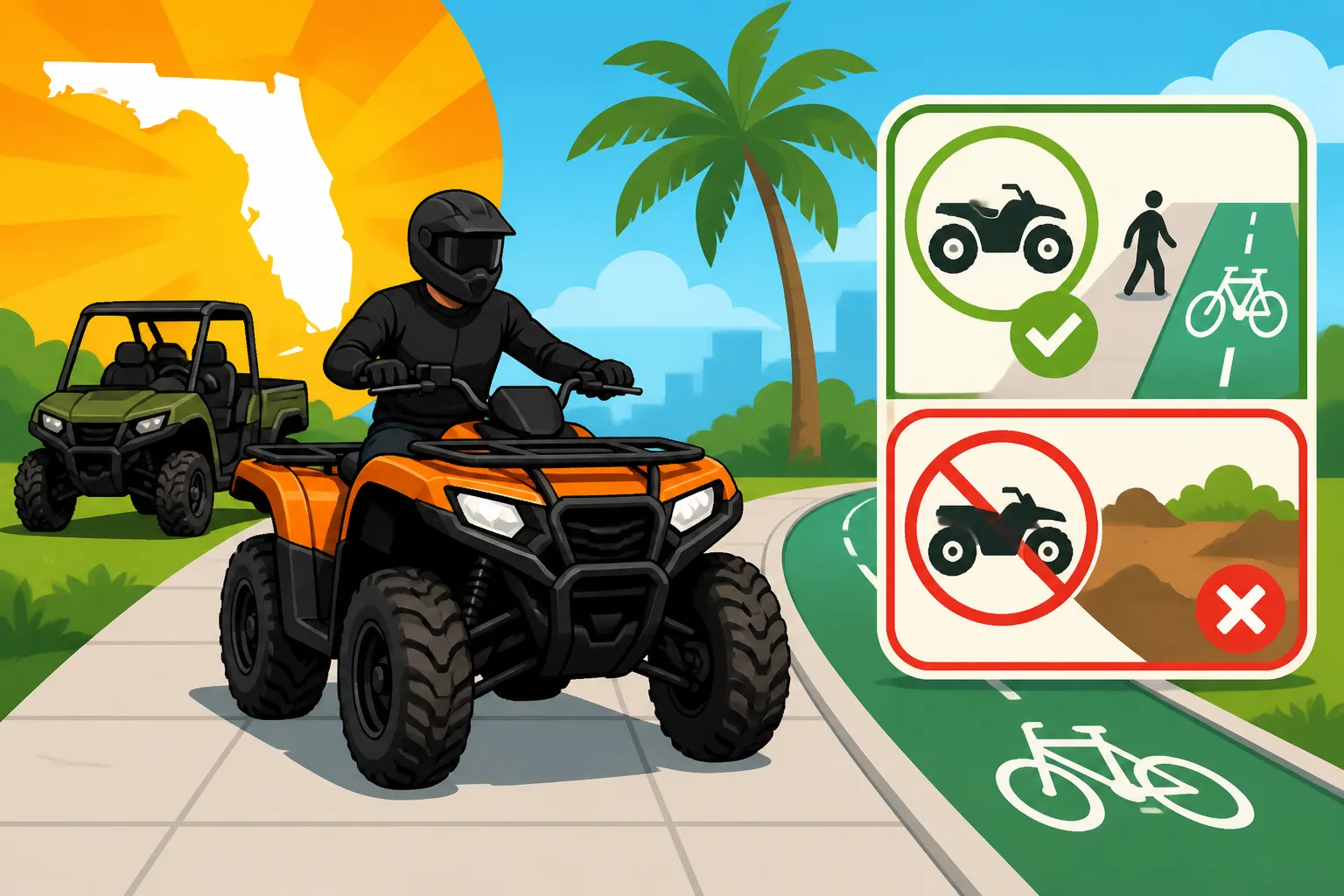
For many ATV and UTV riders, the allure of a paved path or sidewalk seems like a sensible alternative to riding on busy streets. It looks smoother, often feels less congested, and might even seem safer for a non-street-legal machine. However, in Florida, the law draws a very sharp distinction between where an off-highway vehicle (OHV) can and cannot operate, and unfortunately for quad owners, sidewalks and bike paths fall squarely into the "cannot" category. This isn't just a suggestion; it's a legal mandate rooted in the fundamental design and purpose of these paths and the machines themselves.
Understanding Florida's ATV Definition
To truly grasp why sidewalks and bike paths are no-go zones, we first need to understand how Florida defines an All-Terrain Vehicle (ATV). The state views an ATV as a motor vehicle that is designed to travel on four low-pressure tires, has a seat designed to be straddled by the operator, and handlebars for steering. Critically, it is classified as a "non-highway vehicle," meaning its primary design and intended use are for off-road environments. This definition immediately sets it apart from vehicles designed for road travel, which are equipped with features and specifications for public street use.
This classification isn't just bureaucratic jargon; it's the foundation of all ATV regulations. The physical characteristics—like often lacking turn signals, rearview mirrors, or even proper headlights and taillights for street visibility—are direct results of this non-highway designation. Furthermore, Florida has specific width and dry weight limits that help define an ATV, further distinguishing it from larger utility vehicles or street-legal machines. Your quad, even if it feels nimble, is legally built for dirt, sand, and trails, not concrete pedestrian infrastructure.
The "Non-Highway Vehicle" Distinction
The designation of an ATV as a "non-highway vehicle" is perhaps the most crucial legal concept to internalize when considering riding on any public thoroughfare in Florida. This term signifies that the vehicle is not manufactured, designed, or equipped for use on public streets, roads, or highways. While some states have provisions for making certain OHVs street-legal, Florida's stance is generally much stricter, especially for traditional ATVs. This means that, unlike a car, truck, or even a properly converted Low-Speed Vehicle (LSV), your ATV does not possess the inherent legal right to share spaces intended for conventional traffic or, more relevant to this discussion, pedestrians and cyclists.
This distinction extends beyond just main roads. A sidewalk, by legal definition, is a portion of a street exclusively for pedestrian use. A bike path, or bicycle path, is a right-of-way designated for bicycles, sometimes shared with pedestrians. Neither of these is classified as an "off-highway" environment or a "roadway" for general vehicular travel. The very essence of a "non-highway vehicle" is that it should not be on such infrastructure. Any attempt to use them effectively places your machine, and yourself, outside the bounds of its legal operating environment.
Safety Concerns and Public Perception
Beyond the legal definitions, there are profoundly practical and safety-oriented reasons why ATVs are banned from sidewalks and bike paths. Imagine a scenario where a child on a bicycle or an elderly pedestrian is sharing a narrow path with a powerful, roaring quad. The speed, weight, and sheer presence of an ATV are simply incompatible with the vulnerable nature of pedestrians and cyclists. ATVs, even smaller models, are significantly heavier and faster than bicycles and move with a different dynamic than foot traffic. They are designed for rough terrain, not smooth, shared pathways.
The noise generated by an ATV, even at low speeds, can startle and disorient path users, increasing the risk of accidents. Furthermore, the handling characteristics of an ATV, while excellent for off-road maneuvering, are not optimized for precision turns around people or sudden stops in crowded pedestrian areas. Allowing ATVs on these paths would create an immediate and severe safety hazard. Moreover, every instance of an ATV illegally riding on a sidewalk or bike path erodes public trust and damages the reputation of responsible OHV enthusiasts. It fuels negative perceptions that can make it harder for the ATV community to advocate for more legitimate riding opportunities and [Florida ATV Trails: Every Public Riding Area].
Specific Florida Statutes That Govern Off-Highway Vehicle Use
Understanding the general principles behind Florida's rules is one thing, but knowing the specific statutes that govern where off-highway vehicles (OHVs) can and cannot operate is crucial for every rider. These laws aren't vague suggestions; they are explicit directives that carry real consequences if violated. For anyone considering taking their quad onto a sidewalk or bike path, familiarizing yourself with these legal texts can save you a significant amount of trouble down the line.
Florida Statute 316.2074: The Core OHV Rule
The primary legal framework that dictates ATV operation in Florida is Statute 316.2074, often referred to as the "Operation of an all-terrain vehicle, an off-highway vehicle, or an off-highway motorcycle" law. This statute is comprehensive and lays out in no uncertain terms where these vehicles are permitted and, more importantly for our discussion, where they are expressly prohibited. It clearly states that an all-terrain vehicle, an off-highway vehicle, or an off-highway motorcycle "may not be operated on any public road, street, or highway of this state." This prohibition is broad, and it specifically encompasses areas that are part of the "public road, street, or highway," which legally includes sidewalks and bike paths by extension.
The statute does carve out very narrow exceptions, primarily for crossing a highway or for agricultural purposes, but these are highly conditional and do not grant permission for general use on sidewalks or bike paths. The intention of this law is to keep off-highway vehicles strictly in off-highway environments. Trying to interpret a sidewalk as a less-trafficked "unpaved road" is a common misunderstanding, but the law makes a distinct difference. If you're on public land and it's not a designated off-highway trail or a very specific unpaved road under certain conditions, you're likely breaking the law. For more detail on allowed road use, consider reading [Florida ATV Road Rules: Where You Can Legally Ride].
The Definition of a "Roadway" vs. "Sidewalk" or "Bike Path"
A key component of understanding Florida Statute 316.2074 involves knowing how the law defines different areas of public travel. These definitions are not interchangeable and are fundamental to the legal restrictions on ATVs.
- Roadway: Legally, a "roadway" is defined as that portion of a highway improved, designed, or ordinarily used for vehicular travel, exclusive of the berm or shoulder. While some ATVs can be operated on specific unpaved county roads in Florida under certain conditions, this is a very particular allowance and applies to what the statute calls an "unpaved roadway."
- Sidewalk: In direct contrast, a "sidewalk" is defined as "that portion of a street principally intended for the use of pedestrians." The operative word here is "pedestrians." It is not designed or intended for any motorized vehicle, especially not an OHV.
- Bike Path/Bicycle Path: These are typically defined as a path or lane, usually physically separated from motorized traffic, exclusively for the use of bicycles, often allowing pedestrians as well. They are built to different engineering standards than roadways and are designed to accommodate the speeds and weights of bicycles and foot traffic, not ATVs.
The critical distinction is the intended use and design. An ATV, being a "non-highway vehicle," is by its nature excluded from areas specifically designated for pedestrians or bicycles, which are integral parts of the broader "highway" system but are not "roadways" in the sense that an ATV might be permitted on an unpaved section. Trying to shoehorn an ATV onto a sidewalk or bike path is a misapplication of these legal definitions and an invitation for a citation.
Penalties for Violating Sidewalk and Bike Path Rules
The consequences for operating an ATV on a prohibited surface like a sidewalk or bike path in Florida are not trivial. These aren't just polite suggestions; they are enforceable laws, and law enforcement officers, including county sheriffs and Florida Highway Patrol, do issue citations. The typical penalty involves a traffic infraction, which comes with a financial fine. While the exact amount can vary by county and the specific circumstances, it's generally a significant sum that can quickly negate any perceived convenience of the illegal shortcut.
Beyond the immediate financial penalty, there can be other, more severe repercussions. In some cases, especially if reckless operation is involved or if there's any perceived danger to pedestrians or property, your ATV could be impounded. Retrieving an impounded vehicle involves additional storage fees, towing costs, and administrative hassles that can add up to hundreds or even thousands of dollars. Repeated offenses could lead to more serious legal action. Moreover, riding illegally can affect your driving record and potentially even your insurance rates, even though [Does Florida Require ATV Insurance for Road Use?] typically refers to highway-legal vehicles. Ultimately, the risk of a ticket, impoundment, and the associated legal headaches far outweighs any short-term gain from riding on restricted paths. It's simply not worth it.
Exceptions and Misconceptions: Where Riders Get Confused
The rules surrounding ATV and UTV use in Florida can often feel like a tangled web, leading to common misconceptions about where these machines can and cannot go. Many riders, with good intentions, might believe certain situations allow them to briefly use a sidewalk or bike path, only to find themselves on the wrong side of the law. It’s important to clarify these areas of confusion to ensure all riders understand the strict boundaries set by Florida statutes.
Private Property vs. Public Access Points
One of the most frequent areas of misunderstanding arises when an ATV owner rides on their own private property but needs to cross or access it via a public sidewalk or bike path. The law is very clear: you are generally free to ride your ATV on your own private land without needing a title or registration, provided you have the landowner's permission. [Can You Ride an Untitled ATV on Private Land in Florida?] However, the moment your wheels touch public property, such as a sidewalk, shoulder, or bike path that abuts your land, you are subject to the state's OHV laws.
This means even if your driveway opens directly onto a public sidewalk, you cannot simply ride your ATV across that sidewalk to get to your private property. Similarly, if you store your quad in a shed accessible only by crossing a neighbor's yard and then a public bike path, that bike path segment is still off-limits. The short distance doesn't make it permissible. The law does not make exceptions for convenience or proximity to private land. Any public path or right-of-way is governed by its specific regulations, regardless of your ultimate destination being private property. This can be frustrating, but it’s a crucial distinction.
Farm and Ranch Exemptions (and Their Limits)
Florida law does provide certain exemptions for the operation of ATVs and UTVs for agricultural purposes. This is another area that frequently causes confusion, as some riders misinterpret these specific allowances as a blanket permission for broader road use. The [Florida Farm and Ranch ATV Road Exceptions] are generally very narrow and apply to specific scenarios directly related to farming, ranching, or other agricultural operations.
Typically, these exemptions allow for the crossing of a public highway or road, or limited operation on unpaved public roads, when directly performing duties related to the agricultural enterprise. For instance, a farmer might be able to cross a paved road to move between two fields, or ride briefly on the shoulder of an unpaved road to inspect fences. However, these exemptions do not extend to using sidewalks or bike paths for these purposes. Sidewalks and bike paths are distinct from roadways and are not considered part of the agricultural operation’s necessary travel paths. A farmer cannot, for example, ride their ATV down a bike path that runs alongside their fields, even if they are checking crops. The agricultural exemption is for the specific function of the machine in agriculture, not for general transportation on paths intended for non-motorized traffic.
The "Dirt Road" Confusion: Why It Doesn't Apply Here
Perhaps the biggest source of confusion stems from Florida's allowance for ATVs to be operated on "unpaved roadways" under specific conditions. Many riders incorrectly equate an unpaved roadway with any unpaved surface, including dirt trails that might run parallel to a paved road, or even unpaved sections of bike paths. This is a critical error. The [Florida's Unpaved Road Rule for ATVs Explained] applies to roadways—that is, roads primarily designed for vehicle traffic, even if they are unpaved.
A dirt road, even if it's narrow and lightly used, is structurally and legally different from a bike path or a pedestrian trail, even if that path is made of packed dirt or gravel. Bike paths and sidewalks, regardless of their surface material, are legally designated for bicycles and pedestrians. They are not considered "roadways" in the sense that an ATV is permitted. The width, signage, and overall intent of the path determine its classification. Simply because a path is unpaved does not automatically open it up for ATV use. Riders must always confirm the legal designation of a path or road to avoid penalties. A designated off-highway vehicle trail is designed for quads, but a dirt path specifically for bicycles is not.
What You Can Do: Safe and Legal Riding Alternatives in Florida
While the restrictions on riding ATVs and UTVs on Florida's sidewalks and bike paths are strict, this doesn't mean your opportunities for enjoying your machine are limited. On the contrary, Florida offers a wealth of legal and exciting options for off-highway vehicle enthusiasts. The key is knowing where to go and understanding the permitted uses. By focusing on these approved venues and methods, riders can enjoy their quads safely, legally, and without the worry of citations or impoundment.
Exploring Florida's Dedicated OHV Parks and Trails
The absolute best and safest way to enjoy your ATV or UTV in Florida is to ride it where it was designed to be ridden: on dedicated off-highway vehicle parks and trails. Florida boasts a fantastic network of public and private riding areas that cater to all skill levels and types of machines. These locations are specifically designed, maintained, and legally sanctioned for OHV use, providing expansive terrain, challenging obstacles, and a community of like-minded riders.
Take, for instance, the Croom Motorcycle Area within the Withlacoochee State Forest, often touted as [Croom Motorcycle Area: Florida's Biggest OHV Park]. Croom offers miles of diverse trails, from sandy tracks to more technical routes. Similarly, the Ocala National Forest provides extensive opportunities, with dedicated trail systems like the [Ocala National Forest ATV Trails in Florida] that wind through the natural Florida scrub. For those who prefer mud and open spaces, Florida has numerous private "mud parks" like Hog Waller ATV Resort or Redneck Mud Park, which are explicitly designed for machines to get dirty and allow for camping and events, making them true destinations for riders looking for [Florida Mud Parks: Where Riders Actually Go]. These areas often require specific permits or day-use fees, but they offer an unparalleled legal riding experience.
Legal Road Crossings and Agricultural Exemptions
While continuous operation on public roads, sidewalks, or bike paths is forbidden, there are very limited circumstances where an ATV or UTV might legally interact with a paved public road. The most common allowance is for crossing a paved highway or road. Florida Statute 316.2074 generally permits an ATV to cross a public road, street, or highway at approximately a 90-degree angle, and only at a place where a quick, safe crossing can be made. This is typically done when moving between two legal riding areas or between private properties that are bisected by a road. It's not an excuse to ride along the road, but merely to cross it efficiently and safely.
Furthermore, the specific [Florida Farm and Ranch ATV Road Exceptions] provide allowances for agricultural use. As discussed, these are very specific and apply when the vehicle is being used for farming, ranching, or other bona fide agricultural purposes. This might involve riding on unpaved county roads to access different parts of a large property or crossing paved roads as part of essential farm work. These are strict functional exemptions, not recreational ones. Riders must always exercise extreme caution, yield to all other traffic, and adhere to speed limits when utilizing these limited allowances.
Understanding How to Make a UTV Street-Legal (LSV Conversion)
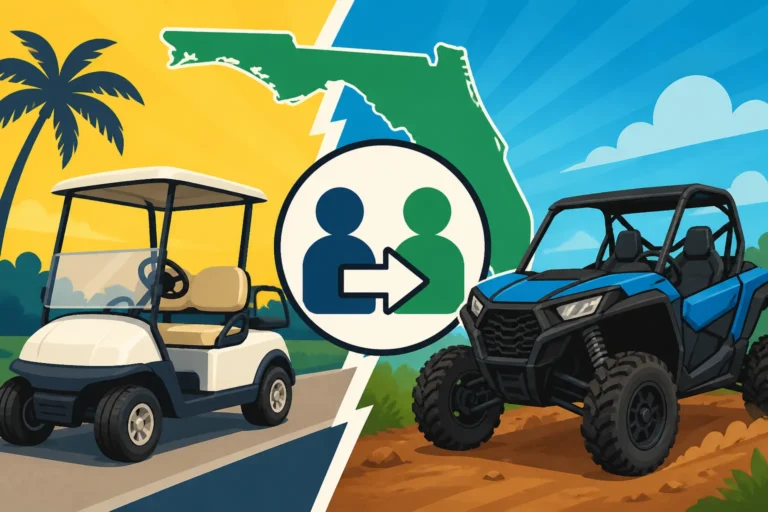
For those who truly desire the ability to legally operate their side-by-side (UTV) on some public roads, converting it into a Low-Speed Vehicle (LSV) is a viable, though distinct, option. It's crucial to note that this pathway is generally available for UTVs, which are typically wider and have a more car-like steering wheel, and not traditional straddle-seat ATVs. An LSV is defined in Florida as any four-wheeled electric vehicle whose top speed is greater than 20 miles per hour but not greater than 25 miles per hour. They are typically allowed on roads with posted speed limits of 35 mph or less.
To become an LSV, a UTV must meet a range of safety equipment requirements. These often include headlamps, stop lamps, turn signals, tail lamps, reflex reflectors, parking brakes, rearview mirrors, a windshield, seatbelts, and a Vehicle Identification Number (VIN). The process involves ensuring your UTV meets all these specifications, potentially through aftermarket modifications. Companies like SuperATV offer various accessories—from full windshields and turn signal kits to rearview mirrors—that can help UTV owners equip their machines to meet LSV compliance. Once converted, the vehicle must be registered and titled as an LSV and carry appropriate insurance. While this doesn't grant access to major highways or bike paths, it does open up local streets in communities with lower speed limits. For full details on the process, you would need to consult resources like [Florida LSV Registration and Insurance Rules] and understand the [Florida LSV Top Speed Limit]. It's a significant investment, but it's the only legal route for limited street use for many side-by-sides.
The Broader Implications for the ATV Community
The issue of where ATVs and UTVs can and cannot legally operate extends far beyond individual citations. Every instance of illegal riding, particularly on shared public spaces like sidewalks and bike paths, has ripple effects that can impact the entire off-highway vehicle community in Florida. Understanding these broader implications is vital for fostering a sustainable future for ATV and UTV recreation in the state. Responsible riding isn't just about avoiding a ticket; it's about safeguarding the future of the sport for everyone.
Maintaining a Positive Image for Riders
In any community, a few bad apples can spoil the bunch, and unfortunately, illegal ATV use on inappropriate surfaces contributes to a negative public image for all riders. When pedestrians or cyclists encounter an ATV on a path meant for them, their reaction is often one of alarm, frustration, or even anger. They perceive the rider as reckless, disrespectful, and a safety hazard. These negative experiences quickly spread, leading to complaints to local authorities, calls for stricter enforcement, and even public pressure to close down existing legal riding areas.
A strong, positive public image is crucial for the long-term health of the OHV community. It helps garner support for new trail developments, protects existing access, and ensures that the sport is viewed as a legitimate, responsible recreational activity. Riders who consistently adhere to the rules, stick to designated trails, and transport their machines legally—for example, by trailering them to a trailhead instead of riding through town—contribute positively to this image. Conversely, every illegal ride on a sidewalk undermines these efforts and makes it harder for the collective voice of the ATV community to be heard positively.
Advocacy for More Riding Areas
The logical and most effective solution to the problem of illegal ATV riding on inappropriate surfaces is to have more appropriate surfaces. This is where advocacy comes into play. Instead of taking shortcuts on bike paths, the ATV community can channel its energy into working with local and state governments, land managers, and environmental groups to identify and develop new legal riding areas. This might involve supporting existing organizations, joining a local ATV club, or even initiating conversations with county commissioners.
Advocacy can take many forms: attending public meetings, writing letters, participating in trail cleanup days, or volunteering to maintain existing trails. When the OHV community demonstrates a commitment to responsible riding and good stewardship, it builds credibility and makes a stronger case for expanding access. It's a proactive approach that moves beyond simply reacting to restrictions. Identifying potential land for new trails, securing funding, and navigating permitting processes are complex undertakings, but they are far more productive than individual acts of defiance that only lead to greater restrictions.
Gearing Up for Legal Riding
Embracing legal and responsible riding also means being properly equipped for the environments where ATVs and UTVs are meant to be. This isn't just about the machine itself, but also the accessories and gear that enhance safety, performance, and compliance on actual trails or in designated OHV parks. Riding on rough, natural terrain requires different considerations than cruising on pavement, and a focus on legal riding encourages riders to invest in the right setup.
For instance, robust tires designed for mud, sand, or rocks are essential for the diverse Florida landscapes you’ll encounter on trails, rather than street tires that might perform better on a sidewalk. Proper protective gear, including DOT-approved helmets (which are mandatory for riders under 16 on public lands in Florida, and always a good idea for everyone), goggles, gloves, and sturdy boots, are non-negotiable for safe trail riding. For UTV owners, adding features like a heavy-duty winch, skid plates, or even a lift kit for navigating challenging terrain, can significantly enhance the trail experience. Companies like SuperATV specialize in a vast array of aftermarket parts and accessories that cater specifically to the demands of off-road riding, ensuring machines are well-prepared for their intended environments. Investing in these types of modifications ensures your machine is optimized for the thrill of the trail, not the regret of a ticket on a bike path.
Florida OHV Access: Sidewalks & Bike Paths
| Path Type | Legally Permitted for ATVs/UTVs? | Primary Intended Use | Key Distinguishing Feature (for ATVs) |
|---|---|---|---|
| Sidewalk | No | Pedestrians | Exclusively for foot traffic; motor vehicles prohibited |
| Bicycle Path | No | Bicycles (often shared with pedestrians) | Exclusive right-of-way for non-motorized transport; motor vehicles prohibited |
| Unpaved Roadway | Yes (Under Specific Conditions) | Vehicular Travel (often rural, low-traffic) | Part of the "roadway" system, but unpaved; OHVs may operate under specific rules |
| Dedicated OHV Trail | Yes | Off-Highway Vehicles | Specifically designed and designated for ATV/UTV recreation |
| Paved Public Road | No (Except for 90-degree crossing) | General Vehicular Traffic | Requires street-legal vehicle; OHVs generally prohibited from driving along |
Disclaimer
This article is for general informational purposes only and does not constitute professional advice. Laws, prices and regulations vary by location and change over time. Consult a qualified professional for guidance on your specific situation.