Hurricane Cleanup and Florida ATV Road Access
When a hurricane slams into Florida, the aftermath can be a chaotic, frustrating mess. Roads are blocked, power is out, and it feels like the whole world has been turned upside down. In those desperate moments, the thought often crosses people's minds: "My ATV or UTV could be a lifesaver right now – to clear debris, get to town for supplies, or check on loved ones." This guide will cut through the uncertainty, explaining when and how you might (or might not) legally use your ATV on Florida roads during hurricane cleanup, and what critical factors determine your access.
The Allure of ATVs for Hurricane Cleanup in Florida
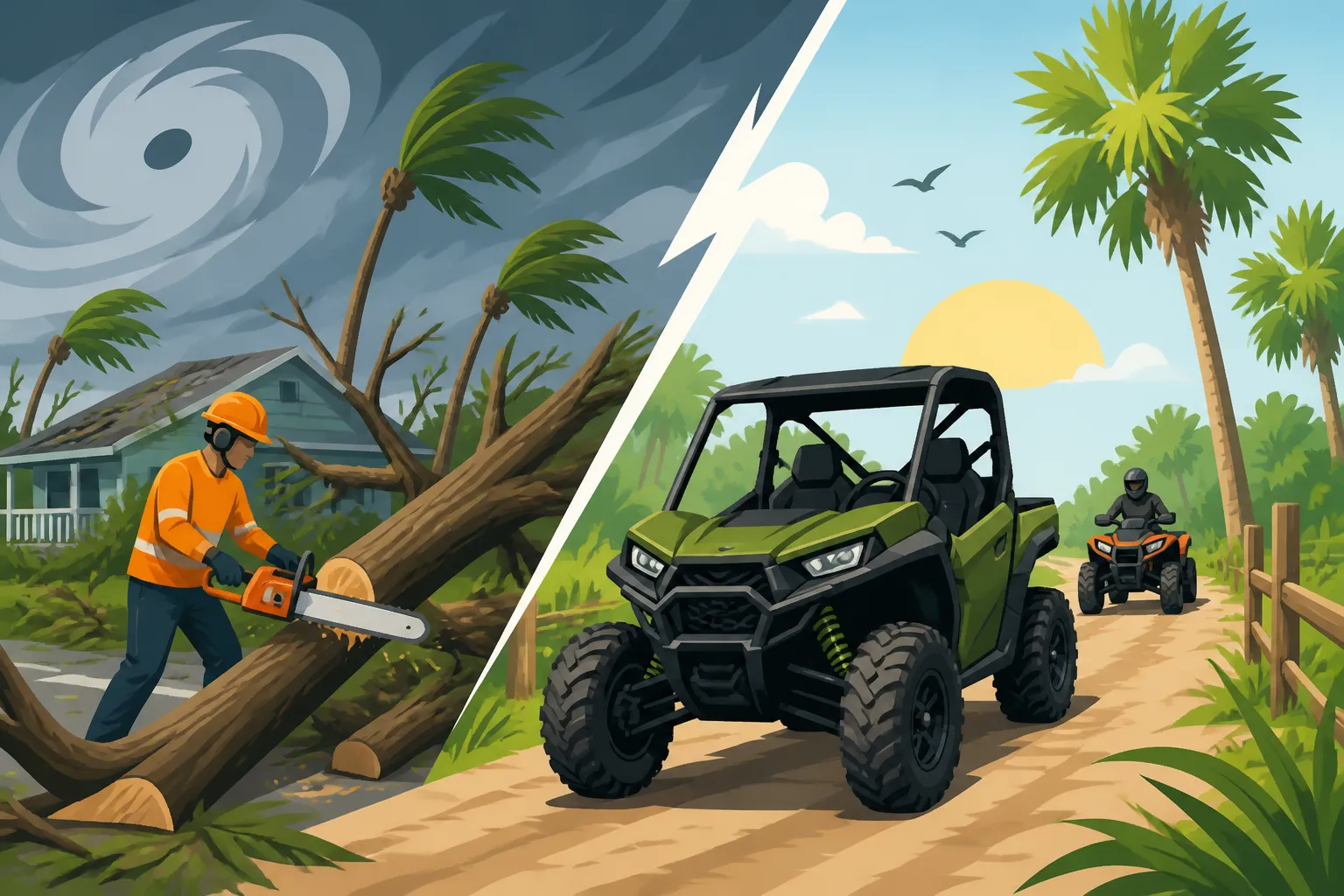
It’s completely understandable why your ATV or UTV might look like the perfect tool after a hurricane. Imagine your street, usually clear and safe, now resembling a war zone: downed trees blocking driveways, power lines tangled across intersections, and scattered debris everywhere. Your car is useless, but your trusty quad, with its off-road capabilities and ability to navigate tough terrain, seems tailor-made for this exact situation.
Why Your Quad Seems Like the Obvious Solution
Let's face it, your ATV is built for challenges. It can rumble over logs, push through standing water, and often squeeze past obstacles that would stop a full-size truck dead in its tracks. You're thinking about needing to get to the local hardware store for emergency supplies, or perhaps clear a path just to get your family out of a compromised home. Maybe you need to reach a neighbor who is elderly or infirm, and the only way there is through a field full of downed branches. Your UTV, especially one equipped with a winch or a sturdy front bumper, might even seem like a viable option for moving smaller trees or large branches off a critical path. It feels like common sense, a tool for survival and community aid.
The desire to help, to be self-reliant, and to simply get things done is strong in the wake of a disaster. People often see their machines as an extension of their preparedness, and in many off-road scenarios, that's absolutely true. Brands like SuperATV offer heavy-duty axles and lift kits that can make a machine even more capable of traversing difficult terrain, which might seem ideal for a hurricane-ravaged landscape. But the immediate thought often jumps to, "Can I just drive it on the road to get there?"
The Gap Between Practicality and Legality
Here's where the rubber meets the road, or rather, where the knobby tires meet the law. While your ATV's practical utility after a hurricane is undeniable, the legal framework governing its use on public roads in Florida is incredibly strict, even in emergencies. The instinct to use the most effective tool at hand is powerful, but navigating the legal landscape during a disaster can be tricky. You don't want to add a citation or an impounded vehicle to your list of post-hurricane woes. The line between what's possible with an ATV and what's legally permissible can feel like a chasm, especially when you're under stress and just trying to cope.
Florida's Standard ATV Road Rules: The Harsh Reality
Before we dive into potential emergency exceptions, it’s crucial to understand Florida’s baseline rules for ATVs and UTVs on public roads. This context is vital because any emergency access will be a deviation from these very strict regulations, not a complete overhaul.
Why Florida ATVs Cannot Use Paved Streets
Florida law is very clear on this: generally, ATVs and UTVs are not street legal. You cannot just drive them down a paved road or highway. The statute specifically defines Off-Highway Vehicles (OHVs) and outlines where they can be operated, which primarily includes designated off-highway trails, private property, and very limited exceptions for unpaved roads under specific conditions. You can dive deeper into this topic by reading [Are ATVs Street Legal in Florida?].
This restriction isn't just a minor technicality; it's fundamental. OHVs are not designed, manufactured, or intended for highway use. They lack many of the safety features required for on-road vehicles, such as turn signals, brake lights, proper mirrors, and occupant protection in a collision with a street vehicle. Their tires are usually not suitable for pavement, affecting handling and braking. This is why attempting to ride an ATV on a paved street in normal circumstances can lead to significant penalties, including fines and possibly having your machine impounded. [Florida Penalties for Illegal ATV Road Riding] can give you a clear picture of the consequences.
Limited Exceptions for Unpaved Roads
Now, there are some very narrow exceptions for unpaved roads, but these come with a host of conditions:
- Unpaved County Roads: Some counties may designate specific unpaved county roads for ATV use, but this requires an explicit ordinance from that county. These are not widespread, and you can't assume a dirt road is fair game. You can check out [Florida County ATV Opt-Outs: Why Rules Change at the Line] to understand this better.
- Agricultural and Hunting Use: There are specific exemptions for agricultural purposes, like moving equipment on a farm, or for hunting access on certain types of private or permitted public lands. However, these are strictly tied to the activity and the land, not general road access. [Florida Farm and Ranch ATV Road Exceptions] covers these scenarios.
- Crossing a Highway: You can cross a paved highway at a 90-degree angle if it’s safe to do so, primarily to get from one section of off-road trail or private property to another. This is a quick, direct crossing, not riding on the highway.
It's a tightrope walk of rules, and under normal conditions, the general advice is to assume your ATV or UTV is not allowed on any public road unless you have absolute, verifiable proof otherwise, often directly from the local sheriff's office or county commission.
Emergency Declarations and ATV Access: What Actually Changes?
This is where the core of your question lies: does a hurricane emergency change these strict rules? The answer is nuanced, and it hinges entirely on official declarations and specific directives from authorities. It's rarely a blanket "anything goes."
The Role of Executive Orders and Local Ordinances
When a hurricane hits, the Governor of Florida can declare a state of emergency, and individual counties or municipalities can follow suit. These declarations trigger various emergency powers, which can include temporary waivers or modifications of certain laws, but they are very specific. It is not automatic. For example, an executive order might temporarily allow certain utility vehicles or emergency response vehicles (which could include some UTVs) to operate on roads for disaster relief. However, this is usually for official personnel or contractors, not the general public riding their personal ATVs.
What you're really looking for are specific instructions or temporary ordinances from your local county or city government or the local Sheriff's Office. They are the ones on the ground, assessing the immediate needs and safety concerns. They might issue a statement like, "Due to impassable roads, residents are permitted to use ATVs on unpaved roads for essential travel between X and Y during daylight hours," but this would be a very rare and highly localized directive. Without such a directive, the standing state laws still apply. Don't rely on rumor or what a neighbor thinks they heard. Seek official, written guidance.
Limited, Specific Allowances Versus General Road Access
Let's be realistic: while your ATV or UTV might be critical for clearing your private property or getting from your house to a direct neighbor's through a field, the likelihood of a general allowance to ride on main public roads, even unpaved ones, is low. Public safety remains a paramount concern. Even if roads are blocked, there's still the risk of collisions with emergency vehicles, downed power lines that are hard to see, or other hazards that untrained ATV operators might not navigate safely. Emergency responders also need clear access for their own operations, and a proliferation of personal ATVs could hinder rather than help.
Here’s a critical point: if any allowance is made, it will likely be extremely specific:
- Designated Routes: "ATVs may be used for access on County Road A and B only, from dawn to dusk."
- Specific Purposes: "ATVs permitted for debris removal on private property, and for essential travel to obtain food/water if all other routes are impassable."
- Emergency Personnel Only: "Only authorized emergency and utility personnel may use OHVs on public roads."
Never assume. Always verify with official sources. Contacting your local Sheriff's office or emergency management agency would be the most reliable way to get current information on [Florida Sheriff Enforcement of ATV Road Rules] during a declared emergency.
Safe and Legal Post-Storm ATV Operation: Navigating the Aftermath
Even if there are no official allowances for road use, your ATV can still be an invaluable tool in the wake of a hurricane, especially on private property or within designated safe zones. Safety, however, must be your absolute top priority.
Prioritizing Safety During Cleanup
Post-hurricane environments are incredibly dangerous. Here's what you need to keep in mind:
- Downed Power Lines: These are deadly. Assume any downed line is live. Stay far away and report it immediately to your utility company. Your ATV offers no protection from electrocution.
- Hidden Debris and Obstacles: Floodwaters can hide anything from sharp metal to deep holes. Be extremely cautious, ride slowly, and ideally, walk the path first if possible.
- Floodwaters: Don't assume your ATV can handle deep water. Many ATVs are not designed for prolonged submersion, and even if they can cross, the water can hide dangerous currents, sharp objects, or contaminants. Water damage to your engine or electrical system can be immediate and costly. Equipping your machine with a snorkel kit (perhaps from SuperATV) might help in specific water crossings, but it's not a license to go submarining.
- Fuel and Maintenance: Ensure your machine is in top working order before and after use. Check tires, brakes, and fluids. Carry extra fuel if you can, as gas stations may be closed or without power.
- Personal Protective Equipment: Helmets, goggles, gloves, long pants, and sturdy boots are essential. Even if you're just riding across your yard, the risk of falling debris or unseen hazards is high. [Florida ATV Helmet Law for Riders Under 16] is a good baseline to think about, but everyone should wear a helmet in these conditions.
Utilizing Your ATV Legally on Private Property
This is where your ATV truly shines in a post-hurricane scenario. On your own private land, you generally have the freedom to use your ATV for cleanup, debris removal, and navigating your property.
- Clearing Driveways and Paths: Use your ATV to haul small branches, pull light debris, or even winch out a small fallen tree.
- Accessing Outbuildings: If sheds or barns are cut off by debris, your ATV can often get you there.
- Checking Fences and Property Lines: Assess damage to your property without needing to walk through dangerous terrain.
- Supporting Neighbors (With Permission): If you're helping a neighbor, ensure you have explicit permission to operate your ATV on their property. Remember, [What a Landowner Can Do About Trespassing Riders] still applies, even in emergencies.
You can also use a utility trailer hooked up to your ATV to transport supplies, tools, or small amounts of debris. This keeps heavy loads off your back and makes cleanup much more efficient.
What to Do If You Need to Use a Public Road
If you genuinely believe you need to use a public road with your ATV for essential purposes after a hurricane, and you're unsure if it's permitted, here's the proper course of action:
- Contact Local Authorities: Your county Sheriff's Office or emergency operations center is the first and best point of contact. Explain your situation, the specific road you need to use, and why.
- Ask for Written Confirmation: If they verbally approve, ask if they can provide any written confirmation or point you to a specific public notice or executive order. This can protect you if you encounter another officer who isn't aware of a temporary directive.
- Assume "No" Until You Hear "Yes": The default is that ATVs are not allowed on public roads. Only proceed if you have clear, official permission or if the situation is truly life-threatening and no other option exists (in which case, emergency services should be your absolute first call).
- Drive Cautiously and Be Identifiable: If you are given permission, drive extremely slowly, be highly visible (wear bright colors), and be prepared to stop and explain yourself to any law enforcement or emergency personnel you encounter. Have your identification ready, as [What Florida Deputies Check at a Roadside Stop] can be extensive.
Remember, the goal is safety and recovery, not adding to the challenges for yourself or emergency responders. Your ATV can be a powerful asset during hurricane cleanup, but only when used responsibly and, whenever possible, within the bounds of the law.
| Situation | Normal Florida ATV Road Rules | Potential Emergency ATV Road Rules (Post-Hurricane) |
|---|---|---|
| Paved Public Roads | Generally NOT ALLOWED. Violates [Why Florida ATVs Cannot Use Paved Streets]. | Generally NOT ALLOWED unless explicit, official local directive for specific routes/purposes. |
| Unpaved Public Roads (County) | Allowed ONLY if specifically designated by county ordinance. Check [Florida's Unpaved Road Rule for ATVs Explained]. | POSSIBLE if specific county/local directive for essential travel/cleanup due to impassibility. |
| Private Property | Generally ALLOWED with owner's permission. | ALLOWED for cleanup, access, debris removal. Highly recommended use. |
| Crossing Paved Roads | Allowed at 90-degree angle for shortest distance. | Same rules apply; proceed with extreme caution due to debris/emergency traffic. |
| Essential Travel (e.g., supplies) | Not permitted on public roads. | POSSIBLE if critical and specifically authorized by local emergency services. |
| Emergency Debris Removal | Not permitted on public roads by private individuals. | POSSIBLE for private property. Public road use only if explicitly authorized. |
| Law Enforcement Interaction | Expect to be cited and possibly impounded for illegal use. | Be prepared to explain your purpose; official documentation of permission is vital. |
Disclaimer
This article is for general informational purposes only and does not constitute professional advice. Laws, prices and regulations vary by location and change over time. Consult a qualified professional for guidance on your specific situation.