Towing a Trailer With an ATV in Florida
Riding an ATV or UTV in Florida offers an incredible sense of freedom and utility, but if you've ever needed to haul something substantial—whether it's gear for a hunting trip, supplies for your property, or just some firewood for a campfire—you've likely pondered the complexities of towing a trailer. It's not as simple as hitching up and going, especially with Florida's specific rules and diverse terrains. This guide is here to untangle the practicalities and legalities of towing a trailer with your quad or side-by-side in the Sunshine State, helping you do it safely and effectively.
The Basics of Towing with an ATV or UTV in Florida
So, you've got a quad or a side-by-side, and you've got something you need to move. The idea of using your off-road machine to haul a trailer is appealing, especially when a truck just can't get to those hard-to-reach spots. But before you even think about attaching anything, it's crucial to understand the fundamental rules and capabilities that govern towing with these vehicles in Florida. It’s not just about brute strength; it’s about safety, legality, and knowing your machine’s limits.
Legalities and Limitations on Public Roads
This is often where the rubber meets the road, or rather, where the knobby tires don't meet the paved road. The biggest hurdle for towing a trailer with an ATV or UTV in Florida revolves around where you can actually operate these machines. Generally speaking, ATVs and UTVs are not considered street legal for use on most public paved roads in Florida. This means if you're planning on towing a trailer on a state highway, a county road with asphalt, or even many municipal streets, you're likely venturing into illegal territory. It's a common frustration for riders who use their machines for work or recreation, expecting the same road access as a truck.
There are, however, some very specific exceptions. Florida law does allow ATVs and UTVs on unpaved county roads if the county has specifically designated them for OHV use, or if you're using them for agricultural purposes on a farm or ranch. For example, if you're working on a large tract of agricultural land, you might be able to traverse certain public dirt roads with a trailer in tow, moving feed or equipment. But even then, there are rules about daytime use, speed limits, and sometimes requiring a licensed driver. It’s a patchwork of regulations that can be incredibly confusing. For a deeper dive into these rules, check out [Florida ATV Road Rules: Where You Can Legally Ride] or [Are ATVs Street Legal in Florida?]. Don't assume you can just hook up and go on any public thoroughfare.
The consequence of ignoring these rules can range from a citation to your machine being impounded, which nobody wants. Therefore, if your towing needs involve public roads, your best bet is almost always to transport your ATV or UTV with its trailer on an actual highway-legal trailer behind a truck or SUV to your destination. Once you're on private property, a designated off-road park, or a specific unpaved access road where OHV use is permitted, then you can confidently hook up your trailer.
Understanding Your Machine's Towing Capacity
Just because your ATV or UTV can accept a hitch doesn't mean it can safely tow any amount of weight. Every machine has a manufacturer-specified towing capacity, which is a critical piece of information often found in your owner's manual. This figure is determined by a myriad of factors, including engine size, frame strength, braking capability, and suspension design. Exceeding this capacity isn't just risky for your machine's longevity; it's downright dangerous.
Think about it: an overloaded ATV trying to stop on a sandy trail or navigate a tight turn will behave unpredictably. You risk losing control, damaging your drivetrain, or even tipping over. It’s not just the weight of the trailer itself, but the weight of everything you put on the trailer. Always factor in both. For instance, a small 300cc ATV might comfortably pull a few hundred pounds, while a larger 700cc+ ATV could handle closer to 1,000-1,500 pounds. UTVs, with their more robust frames and often larger engines, typically boast significantly higher towing capacities, sometimes well over 2,000 pounds, making them incredibly versatile workhorses. [Florida UTV Title for a Machine Over 1,500 Pounds] gives some insight into how UTVs are classified, and often these larger machines are built with utility in mind.
A good rule of thumb is to always stay below your machine's maximum towing capacity, especially when riding on challenging terrain like soft sand or steep inclines. The manufacturer's rating is usually for ideal conditions on a flat, firm surface. Real-world Florida conditions, with our infamous sugar sand, mud, and sometimes uneven tracks, will put more stress on your vehicle. If you’re unsure about your machine's exact rating, locate your owner’s manual or look it up on the manufacturer’s website. Don't guess; your safety and the health of your machine depend on it.
Essential Equipment for Safe ATV/UTV Towing
Once you've wrapped your head around the legal landscape and know your machine's limits, it's time to talk gear. Towing safely isn't just about having a trailer; it's about having the right trailer and the right accessories to connect it securely to your ATV or UTV. Trying to make do with mismatched or inadequate equipment is a recipe for disaster, especially when you're navigating Florida's diverse and sometimes unpredictable terrain.
Choosing the Right Trailer
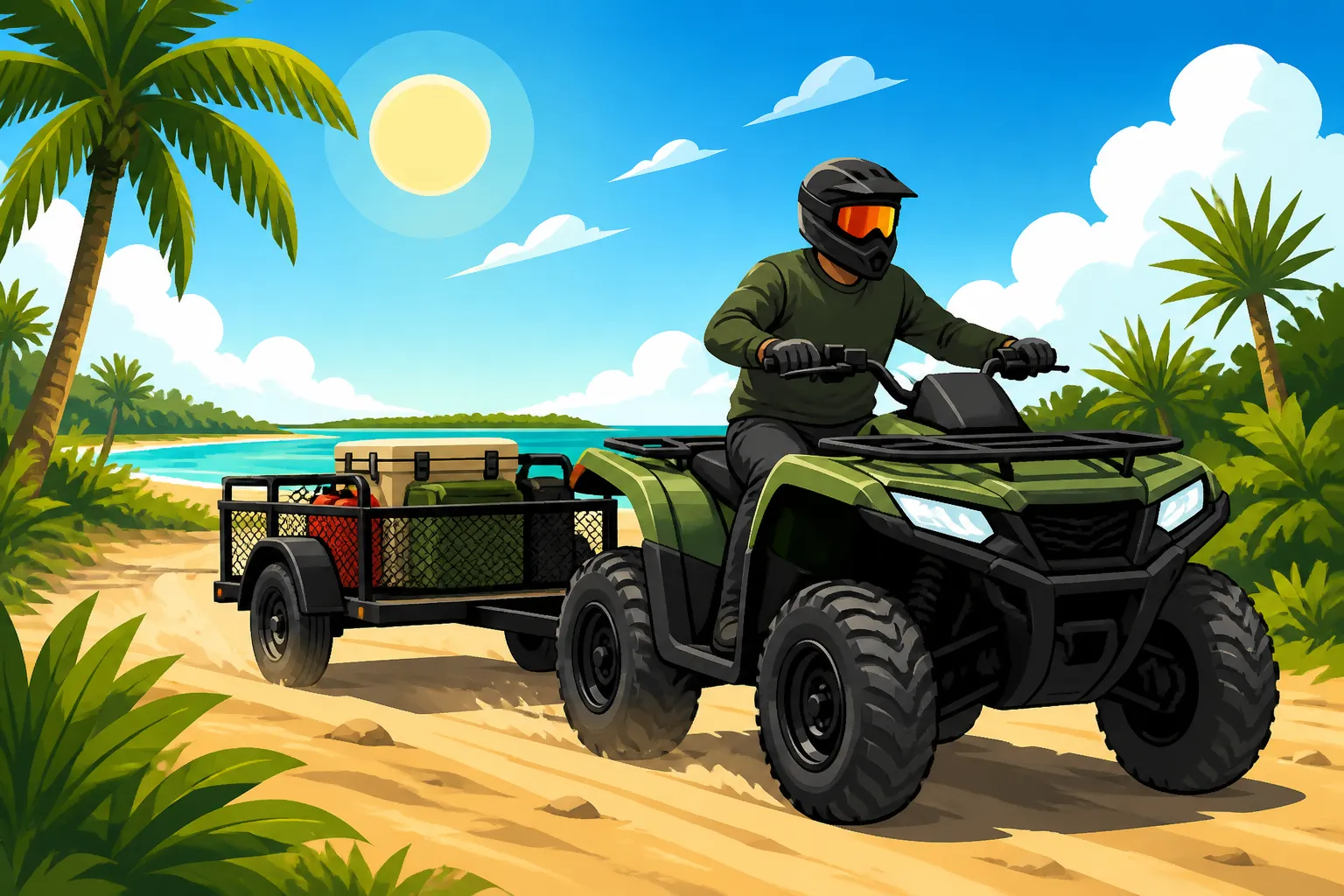
Selecting the proper trailer is paramount. For ATVs and UTVs, you're generally looking at smaller, lighter-duty trailers compared to what you'd hitch to a truck. Common types include small utility trailers, dump trailers, logging carts, and even specialized deer or game carts. The "right" choice depends entirely on what you intend to haul.
Consider the weight capacity of the trailer itself, ensuring it can handle your typical loads. Also, think about its construction: will it stand up to the rigors of off-road use? Look for trailers with sturdy frames, decent ground clearance, and tires that can handle rough terrain. Many small utility trailers designed for garden tractors can work for ATVs, but you might need to upgrade the tires if you're frequently in mud or soft sand. For instance, if you're hauling firewood across uneven ground, a dedicated logging arch or dump trailer might be more efficient and safer than trying to pile logs onto a flatbed utility trailer. Companies like SuperATV offer robust hitch accessories and often small utility trailers designed specifically for the demands of off-road vehicles, ensuring they can withstand more than just a trip around the backyard.
Another crucial factor is the trailer's hitch type. Most ATV/UTV trailers will use a ball hitch or a pin-style hitch. Ensure the trailer's hitch mechanism is compatible with your ATV's receiver. Pin hitches are common for very light loads or simple carts, but for anything substantial or if you anticipate uneven terrain, a ball hitch generally offers more security and articulation. Always inspect the trailer for damage before each use, especially the hitch connection, tires, and axle. A blown tire on a trailer in the middle of a remote trail is a headache you definitely want to avoid.
Hitches, Balls, and Towing Accessories
Your ATV or UTV likely came equipped with some form of towing capability, even if it's just a simple tow loop. However, to safely connect a proper trailer, you'll need the right hitch setup. Most modern ATVs and UTVs have a square receiver tube, similar to trucks, though often smaller (typically 1.25 inches instead of 2 inches for ATVs, and 2 inches for UTVs). You'll then need a drawbar that slides into this receiver, ending with a ball hitch of the appropriate size (usually 1 7/8 inch or 2 inch). Ensure the ball size on your drawbar matches the coupler on your trailer. A mismatch here is incredibly dangerous.
Beyond the basic hitch and ball, safety chains are absolutely non-negotiable, especially if you're ever near public roads (even designated unpaved ones) or crossing paths with others. These chains provide a critical backup connection should the primary hitch fail. Always cross the chains under the trailer tongue to create a cradle, which helps keep the tongue off the ground if it disconnects. Furthermore, consider adding reflective tape to your trailer, and if you plan on using it after dusk (even on private land), invest in some magnetic or clip-on LED trailer lights. Even though ATVs typically aren't on paved roads, good visibility is always a smart move, especially in areas with other riders or property users.
For those pushing their machines with heavier loads, especially through mud or over obstacles, upgrading to a heavy-duty drawbar or a specialized hitch can provide extra peace of mind. Some riders even opt for multi-ball hitches to accommodate different trailers. SuperATV, for instance, is a popular brand that offers a range of heavy-duty receiver hitches, recovery points, and accessory mounts specifically designed to enhance the towing and utility capabilities of your ATV or UTV. Having robust, high-quality towing accessories ensures that your connection point is the least of your worries when you're tackling a tough job or a tricky trail.
Safe Towing Practices and Considerations
Towing with an ATV or UTV isn't just about having the right equipment; it's about how you use it. The dynamics of pulling a trailer significantly change how your machine handles, and ignoring these changes can lead to dangerous situations. Florida's varied terrain, from dense scrub to deep mud, only adds to the complexity. Being a responsible and safe tower requires a combination of common sense, careful preparation, and mindful operation.
Weight Distribution and Load Securement
The way you load your trailer is just as important, if not more important, than the total weight you're hauling. Improper weight distribution can lead to "tongue weight" issues, where either too much or too little weight is pressing down on the hitch ball. Too much tongue weight can cause your ATV's front end to lift or become light, reducing steering control and braking effectiveness. Too little tongue weight can cause the trailer to sway violently, making it extremely difficult to control, especially at speed or on uneven ground. A good rule of thumb is to aim for about 10-15% of the total trailer weight (trailer + cargo) to be on the tongue.
Always place heavier items low and over the trailer's axle. Distribute weight evenly from side to side to prevent tipping. Once your cargo is positioned correctly, secure it! Use strong ratchet straps or tie-downs to prevent anything from shifting, sliding, or falling out during transit. Imagine hitting a bump or navigating a sharp turn; unsecured cargo can become a dangerous projectile or throw off your balance, potentially leading to a rollover. On a bumpy, root-filled trail in Florida, a shifting load is a guaranteed way to lose control. Double-check all straps before you set off, and periodically check them during your journey, especially after rough sections.
For example, if you're hauling a deer out of the woods, position it so its weight is balanced over the trailer's axle, and then cinch it down tightly. Don't just toss it in and hope for the best. The same applies to bags of feed, tools, or camping gear. Every item should be snug and immovable within the trailer bed.
Braking, Turning, and Terrain Challenges
When you add a trailer, even a small one, your ATV or UTV's performance changes dramatically. One of the most critical impacts is on braking. Your stopping distances will increase significantly because your machine now has more momentum to overcome. Always anticipate stops much earlier and apply brakes smoothly to avoid skidding or jackknifing the trailer. This is especially true on loose surfaces like Florida's sugar sand, where traction is already at a premium.
Turning also requires more consideration. The added length of the trailer means you'll need a wider turning radius. Cut corners too sharply, and your trailer tires will likely run off the trail, potentially getting stuck or hitting an obstacle. Always look further ahead than usual to plan your turns and allow ample space. Descending hills with a loaded trailer is another situation that demands extreme caution. The weight of the trailer can push your ATV downhill faster than intended. Use low gear and engine braking as much as possible, and only use your brakes intermittently to avoid overheating them.
Florida's varied terrain presents unique challenges. Soft sand can quickly bog down a loaded ATV and trailer, requiring careful throttle control and sometimes even engaging 4WD if your machine has it. Muddy sections become even trickier, as the trailer adds drag and can easily get stuck. Knowing your machine’s capabilities and reading the terrain ahead are crucial skills. If you're riding in the [Florida Trail Riding in Summer Heat] or [Florida Trail Riding in the Rainy Season], you'll encounter different challenges. The dry season might mean more soft sand, while the wet season brings mud and standing water. Always err on the side of caution; if a section looks too tough for your loaded setup, it probably is.
Common Scenarios for Towing with Your Quad in Florida
While ATVs and UTVs might be primarily recreational vehicles for many, their utility for towing a trailer is undeniable in numerous real-world scenarios across Florida. From enhancing outdoor adventures to tackling property maintenance, a properly equipped and operated quad or side-by-side with a trailer can be an invaluable asset. Understanding these common uses helps clarify why safe towing practices are so essential.
Hauling Gear for Hunting, Fishing, or Camping
Florida's vast natural landscapes offer incredible opportunities for hunting, fishing, and camping, and often, these pursuits require hauling a fair amount of gear into places a truck simply can't reach. Imagine a hunting trip into a wildlife management area (WMA) or a remote part of the Ocala National Forest. You might need to carry tree stands, decoys, coolers full of provisions, scent control equipment, and maybe even a large game animal back out. Trying to shoulder all that gear over miles of uneven terrain is exhausting, if not impossible.
This is where your ATV or UTV, hitched to a utility trailer or specialized game cart, becomes your best friend. You can load up your tent, sleeping bags, cooking equipment, fishing rods, tackle boxes, and a week's worth of food and water, making your remote camping experience much more comfortable. When you're out hunting, a sturdy trailer can save your back (and your hunting partners' backs) by easily transporting a harvested deer or hog back to your vehicle. Remember to check local WMA rules, as many allow ATVs and UTVs on designated trails and access roads, but rarely on main paved thoroughfares. For more on accessing these areas, you can look up [Florida Hunting Access Roads in Florida and Quad Use] and [Florida ATV Camping With Trail Access]. The ability to carry more means you can stay out longer and be better prepared for whatever Florida’s wilderness throws at you.
Farm, Ranch, and Property Maintenance Tasks
For landowners, farmers, and ranchers in Florida, ATVs and UTVs are often indispensable work vehicles, and towing is a significant part of their daily utility. These machines are perfectly suited for navigating pastures, groves, and wooded areas where larger tractors or trucks would struggle or cause too much damage. A trailer behind your quad can haul everything from bags of feed for livestock, fencing materials, tools for repairs, bags of fertilizer, or even small implements like sprayers or spreaders.
Consider the task of clearing brush or fallen branches after a storm. Instead of making countless trips by hand, you can load a small dump trailer with debris and easily transport it to a burn pile or disposal area. When managing crops or orchards, you can tow bins of harvested produce or supplies for irrigation. For these agricultural applications, Florida law often provides specific exceptions that might allow limited use of ATVs and UTVs, sometimes with trailers, on public roads for agricultural purposes. This is a critical distinction that acknowledges the working nature of these machines in rural settings. Brands like SuperATV offer heavy-duty attachments and cargo solutions designed to handle the rigorous demands of farm and ranch work, making these tasks much more efficient. If your use falls into this category, understanding the specifics of [Florida Agricultural Property ATV Exceptions] can save you a lot of hassle.
Recovering a Stuck Machine or Assisting Others
Beyond hauling supplies, towing plays a crucial role in recovery scenarios, both for your own machine and for helping fellow riders. Anyone who has ridden Florida's trails knows that getting stuck in deep mud or soft sand is not a matter of "if," but "when." Having the ability to tow a stuck machine out of a predicament can be a lifesaver, especially if you're riding in remote areas.
While a dedicated winch is often the preferred method for self-recovery or pulling others from a bind, sometimes a good old-fashioned tow strap and a strong hitch are all you have. When using a tow strap for recovery, connect it securely to the recovery points on both machines, avoiding axle shafts or suspension components that could be damaged. Always use a gentle, steady pull rather than a sudden jerk, which can snap straps, damage hitches, or even cause a rollover. Ensure both drivers are aware of the plan and communicate clearly.
Even if you're not pulling out a stuck machine, having towing capacity means you can assist a disabled vehicle back to camp or to a staging area. A flat tire, a dead battery, or a mechanical issue far from the trailhead can be a major problem without the means to tow. Being prepared with a tow strap and knowing how to safely utilize your machine's towing capacity makes you a more self-reliant rider and a valuable member of any riding group. Again, reliable gear from companies like SuperATV, including robust tow straps and recovery kits, can be invaluable in these situations. It's not just about what you can haul, but what you can help retrieve when things go sideways.
Disclaimer
This article is for general informational purposes only and does not constitute professional advice. Laws, prices and regulations vary by location and change over time. Consult a qualified professional for guidance on your specific situation.