Florida Rules for Riding Two Up on a Quad
There's a common sight on Florida's back roads and trails: a quad roaring by with a passenger perched precariously behind the driver. It looks like fun, and maybe even practical if you're trying to fit more people on a ride. But the reality is, Florida's rules for riding two up on a quad are often misunderstood, leading to confusion, tickets, and, more importantly, serious safety risks. This guide is here to clear the air, breaking down the specific regulations, safety considerations, and the crucial differences between ATVs and UTVs when it comes to carrying passengers in the Sunshine State.
The Core Rule: Single Rider Means Single Rider (Most of the Time)
It’s easy to look at an ATV, especially one with a slightly longer seat, and think, "Hey, there's room for two!" However, when it comes to Florida law and, more importantly, safety, the design of your ATV dictates its passenger capacity. This is where a lot of riders get into a sticky situation without even realizing it.
Understanding Florida's ATV Definition
In Florida, an All-Terrain Vehicle (ATV) is generally defined as a motorized, off-highway vehicle designed to travel on four or more low-pressure tires, having a seat designed to be straddled by the operator, and handlebars for steering control. Crucially, most ATVs are manufactured and designed for single-rider use only. That means the entire machine—its suspension, braking system, engine power, and overall balance—is calibrated for one person's weight and handling input.
This single-rider design is the foundational concept in Florida's ATV regulations. When you see a standard sport quad or even a utility ATV, it’s built for one. The frustration of seeing others double up and seeming to get away with it is completely understandable. You might wonder why your machine, which looks capable, isn't allowed to carry a passenger. The answer lies deep in the engineering and the legal definitions that prioritize rider safety above all else. Understanding these definitions is key to navigating the rules, as laid out in the [Florida Off-Highway Vehicle Title Rules Explained].
When a "Two-Rider" ATV Is Actually Legal
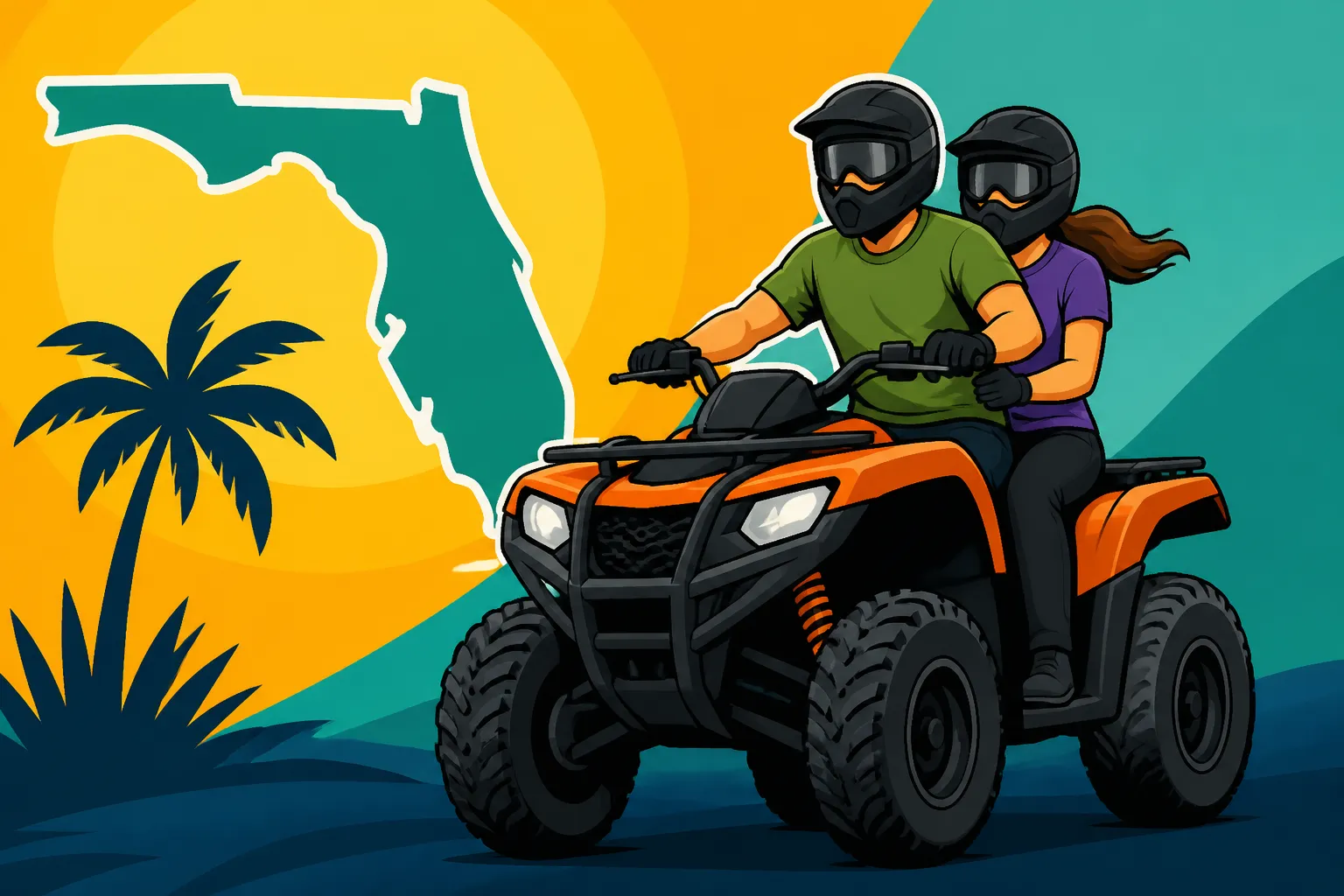
Now, there's a significant exception to the "single-rider only" rule, and it's where much of the confusion stems from: the purpose-built two-up ATV. These aren't your average quads. A two-rider ATV, sometimes referred to as a "tandem" ATV, is specifically designed by the manufacturer to safely carry an operator and one passenger.
How do you spot one? Look for clear indicators:
- An extended, elevated, or specially designed passenger seat: This isn't just a slightly longer seat; it's often a separate, often slightly raised, padded area clearly meant for a second person.
- Integrated passenger handholds: These are dedicated grab bars or handles for the passenger to hold onto, not just a rack or a fender.
- Passenger footrests: Clearly defined and robust footrests specifically for the passenger.
- Manufacturer designation: The most crucial point. The manufacturer's sticker, owner's manual, or even the VIN itself will indicate that the machine is designed for two occupants.
These machines are built with a longer wheelbase, heavier-duty suspension, and often more powerful engines to compensate for the added weight and altered center of gravity. They are less common than single-rider ATVs, and they are the only ATVs legally permitted to carry a passenger in Florida. Without these specific manufacturer-designed features, attempting to carry a passenger on a standard ATV is not only illegal but also incredibly dangerous. This distinction is vital, especially given Florida's broad [Florida's 55-Inch ATV Definition and Why It Matters] for classification.
The "Where" Matters: Public Roads vs. Private Property vs. Designated Trails
Understanding whether your ATV can legally carry a passenger is only half the battle. The other crucial factor is where you're riding. Florida has specific stipulations that change depending on whether you're on paved roads, unpaved county roads, private land, or dedicated off-highway vehicle (OHV) parks.
Riding Two-Up on Florida's Public Roads (Limited Exceptions)
Generally speaking, ATVs are not street legal in Florida. They are off-highway vehicles, and for good reason—they lack features like turn signals, rearview mirrors, and often the stability needed for paved road speeds and traffic. There are, however, very specific and limited exceptions where ATVs might be allowed on certain public roads, such as unpaved county roads in counties that specifically permit it, or for agricultural purposes.
Even in these rare instances, the rules for carrying a passenger become even more stringent. If your ATV is a single-rider model, carrying a passenger on any public road or right-of-way, even one where ATVs are otherwise permitted, is almost certainly illegal. The core rule that only purpose-built two-up ATVs can carry passengers still applies, and in fact, is often more strictly enforced on public thoroughfares due to the increased risk to other motorists and pedestrians. Local law enforcement officers are well-versed in the specifics of [Florida ATV Road Rules: Where You Can Legally Ride] and [Florida's Unpaved Road Rule for ATVs Explained], and they will check if your machine is rated for two riders. This is where [Florida ATV Passenger Rules] come into sharp focus.
Private Property: Your Land, Your Rules (Mostly)
When you're riding on your own private property, or private land with explicit permission from the landowner, you generally have more leeway. State laws regarding vehicle registration, licensing, and road use don't typically apply in the same way. However, this doesn't mean all bets are off when it comes to carrying passengers.
While you might not face a ticket from the sheriff for riding two-up on a single-rider ATV in your own backyard, the safety risks remain paramount. An ATV's design limitations don't disappear just because you're on private land. The chances of a rollover, loss of control, or injury are still very real, and potentially even higher if the terrain is challenging or the driver is inexperienced. Furthermore, if an accident occurs on private property, your liability could be significant. Even if you're not breaking a state law, you could still be held responsible for injuries to an unauthorized passenger. It’s always best to err on the side of caution and follow manufacturer guidelines, even on private land.
Designated OHV Trails and Parks: Follow Their Specific Rules
Florida is home to fantastic OHV riding areas, including state forests and private mud parks. These areas provide incredible opportunities for legal and fun off-road adventures. However, each park or trail system typically has its own set of rules and regulations, which can be even more specific than general state law.
For instance, Croom Motorcycle Area within the Withlacoochee State Forest, a highly popular riding spot, has very clear rules about vehicle width and capacity. While they accommodate a variety of OHVs, they will enforce the "single rider" rule for ATVs not designed for a passenger. You might encounter similar restrictions at other places listed in [Florida ATV Trails: Every Public Riding Area]. Some parks might have lengthier, more technical trails where a passenger would simply be too dangerous, regardless of the ATV's design. Always check the specific rules of the park or trail system you plan to visit before you load up and head out. Ignoring these rules could lead to being turned away at the gate, or worse, a citation from a park ranger. Even something as seemingly minor as [Croom's 55-Inch Width Check at the Gate] can impact whether your machine, let alone your passenger, is allowed entry.
Safety First: Why the Rules Exist and What to Consider
It might seem like a bureaucratic headache, but the rules against riding two-up on single-rider ATVs are rooted deeply in safety. These aren't arbitrary guidelines designed to spoil your fun; they're in place to prevent serious injuries and fatalities. As a rider, understanding these dangers isn't just about avoiding a ticket—it's about protecting yourself, your passenger, and your investment.
The Dangers of Unsafe Passenger Riding
When an ATV is designed for one rider, every aspect of its engineering is focused on that single point of contact and weight distribution. Introducing a passenger fundamentally alters these dynamics, creating a host of hazards:
- Changed Center of Gravity: Adding a passenger, especially an untrained one, raises and shifts the machine's center of gravity. This makes the ATV far more prone to rollovers, particularly during turns, climbs, descents, or when encountering uneven terrain. A sudden shift in the passenger's weight can easily destabilize the machine.
- Impaired Steering and Braking: The extra weight means the ATV's suspension is overloaded, potentially "bottoming out" over bumps. Steering becomes sluggish and less responsive. Braking distances increase dramatically, as the system is not designed to stop the combined weight of two riders and the machine efficiently.
- Reduced Visibility: A passenger can obstruct the operator's view, especially when looking over a shoulder to check for obstacles or other riders.
- Lack of Control and Injury Risk for Passenger: Passengers on a single-rider ATV have nowhere safe to hold on, no proper footrests, and no way to actively participate in balancing the machine. They are essentially dead weight, easily thrown off during bumps or sudden maneuvers. Their legs or arms can get caught in moving parts, leading to severe injuries.
- Operator Fatigue: The added effort required to control an overloaded and unbalanced ATV can quickly lead to operator fatigue, further increasing the risk of an accident.
These are not hypothetical scenarios; they are common causes of ATV accidents that result in severe injuries, including broken bones, head trauma, and spinal injuries. The machine simply isn't engineered for it, and no amount of skill can fully compensate for fundamental design limitations. When you're considering performance parts or upgrades for your ATV, perhaps from a reputable company like SuperATV, remember that these parts are designed to enhance the machine's performance within its intended use. Adding a passenger to a single-rider ATV negates many of these benefits and introduces new risks.
Essential Gear and Training for All Riders (Including Passengers)
If you do have a purpose-built two-up ATV, or if you're ever a passenger in a UTV, proper safety gear and an understanding of safe riding practices are absolutely non-negotiable. Even on a machine designed for multiple occupants, accidents can happen, and preparation is your best defense.
Every rider, including the passenger, should wear:
- DOT-Compliant Helmet: This is the single most important piece of safety gear. Florida has specific rules, especially for younger riders, as outlined in [Florida ATV Helmet Law for Riders Under 16].
- Eye Protection: Goggles or a face shield are essential to protect against dust, debris, branches, and insects.
- Long Sleeves and Pants: While it might seem counterintuitive in Florida's heat, long-sleeved shirts and sturdy pants (like jeans or riding pants) protect against scrapes, cuts, and sun exposure.
- Over-the-Ankle Boots: Protect your feet and ankles from impacts and keep them secure on footrests.
- Gloves: Provide grip, reduce fatigue, and protect hands from abrasions.
Beyond gear, communication between the operator and passenger is critical. The passenger should understand how to brace themselves for bumps, turns, and acceleration/braking. They should also know not to lean excessively or make sudden movements that could unbalance the machine. Remember, even with a multi-rider machine, the focus is always on a safe, controlled ride.
UTVs and Side-by-Sides: Designed for Multiple Riders
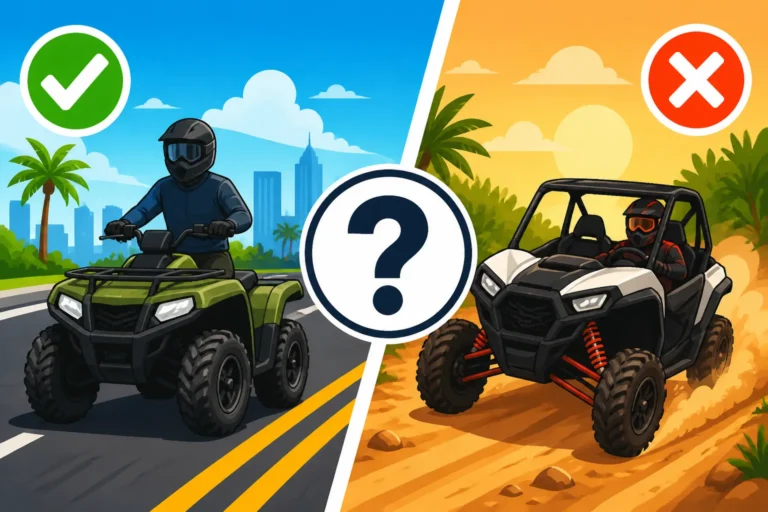
When people think about riding "two up" or with more than one person off-road, what they're often really thinking of are UTVs, or Utility Terrain Vehicles, also commonly known as side-by-sides. These machines are fundamentally different from ATVs and are specifically designed to carry multiple occupants safely and comfortably.
The Clear Difference: UTVs Are Passenger-Friendly
Unlike ATVs, which require the operator to straddle a seat and use handlebars, UTVs feature a steering wheel, foot pedals (like a car), and often bucket or bench seats. They are built with a roll cage, seatbelts, and a wider, more stable stance, making them inherently safer for carrying passengers. Florida law recognizes UTVs as a distinct class of off-highway vehicle, often referred to as a "Recreational Off-Highway Vehicle" (ROV) or "Utility Vehicle."
The key distinctions for passenger carrying include:
- Seating: UTVs come with multiple seats (typically 2, 3, 4, or even 6), often side-by-side, much like a car.
- Safety Features: Roll cages, seatbelts, and sometimes even doors are standard, offering significant protection.
- Stability: Their wider track and lower center of gravity make them far more stable with passengers than any ATV.
- Manufacturer Design: From the ground up, UTVs are designed and marketed as multi-passenger vehicles.
This clear design intent is why UTVs are the go-to choice for families or groups wanting to ride together. When considering a multi-passenger off-road experience, a UTV is almost always the safer and legally compliant option. You can learn more about how these machines are classified by checking out [Florida UTV Titling for Side-by-Sides Over 55 Inches]. And for those wondering about on-road access, there are even specific considerations for [Is a UTV Street Legal in Florida?] under certain conditions as an LSV. Companies like SuperATV offer a vast array of UTV accessories, from roofs and windshields to lift kits and protective armor, all designed to enhance the utility, safety, and comfort of these multi-passenger machines.
UTV Passenger Rules and Considerations
While UTVs are built for passengers, they still have rules and common-sense safety guidelines:
- Seating Capacity: Always adhere to the manufacturer's stated seating capacity. Don't try to squeeze more people into a UTV than it has designated seats and seatbelts for.
- Seatbelts: Everyone in a UTV, including passengers, must wear a seatbelt at all times. This is often a legal requirement on public lands and a critical safety measure everywhere else.
- Age Restrictions: Many public OHV parks and even private parks have age restrictions for UTV passengers, especially for those in front seats. Younger children may be required to ride in the back or meet certain height/weight requirements to ensure the seatbelt fits properly.
- Keep Limbs Inside: Passengers should keep their arms and legs inside the vehicle at all times to prevent injuries from brush, trees, or rollovers.
- Designated Passenger Areas: Ensure all passengers are in designated seating areas, not standing in the bed of the UTV or sitting on laps.
Riding in a UTV is a fantastic way to share the off-road experience with friends and family. By respecting the vehicle's design and adhering to safety rules, you can enjoy Florida's trails and wilderness safely and legally with your companions.
Comparing Passenger Carrying Capabilities
To help clarify the distinctions between different types of off-highway vehicles and their ability to carry passengers in Florida, here's a simple comparison:
| Feature | Single-Rider ATV (Most Common) | Purpose-Built Two-Up ATV | Utility Terrain Vehicle (UTV/Side-by-Side) |
|---|---|---|---|
| Designed for Passengers? | No | Yes, one passenger | Yes, multiple passengers |
| Seating Type | Straddle seat (one operator) | Extended/elevated straddle seat | Bench or bucket seats |
| Steering | Handlebars | Handlebars | Steering wheel |
| Footrests | Operator only | Operator & passenger footrests | Floorboard for all occupants |
| Handholds | Operator only | Dedicated passenger handholds | Grab handles (dash, roll cage) |
| Seatbelts | No | No | Yes (for all seating positions) |
| Roll Cage | No | No | Yes (standard) |
| Legal in FL for 2-Up? | No (illegal and unsafe) | Yes | Yes |
| Common Use | Sport, utility, hunting (single) | Utility, touring | Recreation, work, hunting (multi-person) |
When in doubt, always default to the side of safety and legality. If your machine isn't explicitly designed for a passenger by the manufacturer, it's best to enjoy your ride as a solo adventure, or consider investing in a UTV if multi-person riding is your goal.
In Florida, the rules for riding two up on a quad are quite clear: if your ATV wasn't specifically designed and manufactured to carry a passenger, then it's a single-rider machine, and you should never carry a second person on it. Trying to squeeze a passenger onto a standard ATV is not only against the law in many situations but significantly compromises safety, dramatically increasing the risk of serious accidents. While it's tempting to share the thrill of the ride, especially on Florida's beautiful trails and backroads, prioritizing safety and legality is always the smartest move. If you're looking for a multi-passenger off-road experience, UTVs are the purpose-built solution, offering a safe and enjoyable way to explore with friends and family. Stay informed, ride safe, and always choose the right machine for your adventure.
Disclaimer
This article is for general informational purposes only and does not constitute professional advice. Laws, prices and regulations vary by location and change over time. Consult a qualified professional for guidance on your specific situation.