Polk County Ranch Roads
It's incredibly frustrating when you just want to get your ATV or UTV from point A to point B in a rural area, especially somewhere like Polk County, only to be met with confusing rules about what roads you can actually use. You see neighbors doing it, you hear conflicting stories, and the last thing you want is a hefty fine or, even worse, an accident because you weren't clear on the law. This guide is here to untangle the complexities of riding your off-highway vehicle (OHV) on those vast, unpaved ranch roads and other county thoroughfares in Polk County, giving you the clarity and confidence to ride legally and safely.
Florida's Core Rules: Can Your ATV or UTV Legally Touch a Road?
Let's get straight to the heart of the matter: Florida law is pretty specific about where and how you can operate an off-highway vehicle (OHV), which includes most ATVs and UTVs, on public roads. The general rule is that paved roads are largely off-limits for OHVs. This often comes as a surprise to new riders or those visiting from states with different laws, but it's a critical distinction to remember. You can’t just hop on your quad and zip down a main highway or even a paved county road to the grocery store.
The Unpaved Road Exception: Where OHVs Might Be Allowed
However, there's a significant exception that brings a sigh of relief to many riders in rural parts of Florida: unpaved roads. Florida Statute 316.2123, often referred to as Florida's Off-Highway Vehicle Title Law Explained, carves out specific allowances for OHVs on certain unpaved surfaces. Essentially, it states that an OHV can be operated on an unpaved road that is maintained by a county or municipality. This is huge for areas like Polk County, which are crisscrossed with countless miles of dirt, gravel, and shell roads.
But there’s a catch, of course. A county or municipality has the authority to prohibit OHV use on any of these unpaved roads within its jurisdiction. So, while the state law opens the door, local governments can close it. This is why understanding the specific local ordinances, like those in Polk County, becomes so crucial. Think of it like this: the state gives a general "okay," but then it hands the final decision down to the local level. It's not enough to just know the state law; you also need to know if your local county has enacted any additional rules or bans. This distinction between state and local rules is often what trips up riders and leads to confusion. For more general insights into where you can ride, check out [Florida ATV Road Rules: Where You Can Legally Ride].
Defining an "Unpaved Roadway" and Your Machine
When we talk about "unpaved roadway," what exactly does that mean? The statute defines it pretty clearly: it's any road, or section of a road, that does not have a paved surface like asphalt, concrete, or brick. This includes dirt roads, gravel roads, shell roads, and even some sand tracks that are officially maintained by the county. It's not just a random path through the woods; it needs to be an official, maintained thoroughfare. Understanding [Unpaved Roadway: How the Statute Defines It] is key to knowing if you're on a legal path.
Now, about your machine itself. Florida law also has definitions for what constitutes an ATV, a UTV (or ROV – Recreational Off-highway Vehicle), and other off-highway vehicles. Generally, ATVs are under 55 inches wide and weigh less than 1,500 pounds dry weight, designed for single riders (or two if specifically manufactured for it). UTVs, or side-by-sides, are usually wider and heavier, designed for multiple passengers and often utility tasks. The rules for road use apply broadly to both, but sometimes specific county ordinances might differentiate. For example, if you've got a wider UTV, you'll need to be especially mindful of any posted width restrictions, though the state's unpaved road exception generally applies across these OHV categories.
Polk County's Ranch Roads: Unraveling the Local Realities
Polk County, with its vast citrus groves, cattle ranches, and expansive undeveloped lands, presents a unique situation for ATV and UTV riders. The landscape is a mix of private property, public county-maintained unpaved roads, and often, private roads that look suspiciously like public ones. This blend can make it particularly challenging to discern where you can legally ride.
Private vs. Public: The Golden Rule of Riding
The absolute golden rule in Polk County, and anywhere in Florida for that matter, is this: private land requires permission. If you're on a ranch road that is entirely on private property, you must have explicit permission from the landowner to ride there, regardless of whether it's paved or unpaved. Without it, you are trespassing, and that's a problem no rider wants. This applies to ranch roads, farm roads, hunting lease roads – any road not officially designated and maintained as a public thoroughfare. Many ranch roads are critical for agricultural operations and simply aren't meant for recreational riding without consent. For situations involving private land access, understanding [Ranch Easements and Written Permission] can be incredibly helpful.
On the other hand, if a ranch road or similar unpaved path is indeed maintained by Polk County, then the Florida Statute 316.2123 applies. This means you can operate your ATV or UTV on it, provided Polk County has not enacted a specific ordinance prohibiting such use. The challenge for riders is knowing which is which. It's not always obvious, especially when rural roads can blur the lines. Your best bet is to check with the Polk County Clerk of Courts or the County Public Works department to see if a specific road or area falls under county maintenance and if there are any local prohibitions. Don't assume; verify.
What to Look For: Signs, Posted Limits, and Local Ordinances
When you're out exploring Polk County, keep your eyes peeled for official signs. These signs are your primary indicator of a road's status.
- "Private Road" or "No Trespassing" signs: These are clear indicators that you need permission. Respect them.
- Posted speed limits or road names: These often, but not always, suggest a publicly maintained road.
- County ordinance signs: Sometimes, counties will post signs explicitly stating "No OHV Use" or similar, even on unpaved roads. If you see one, that road is off-limits.
Beyond signage, it's wise to do a little homework before you head out. Polk County's official website is a good starting point to look for local ordinances related to OHV use. You can often find maps or lists of roads that are either designated for or prohibited from OHV operation. Ignorance of the law is not an excuse, and a deputy or a game warden won't be swayed by "I didn't know." Being proactive and checking these resources can save you a lot of grief.
Safety, Equipment, and Smart Riding on Polk County Roads
Even on legally accessible unpaved roads, operating an ATV or UTV is a serious endeavor that requires adherence to safety standards and specific equipment requirements. This isn't just about avoiding tickets; it's about protecting yourself and others.
Essential Equipment for Road Use
When riding your OHV on unpaved public roads in Polk County, you need to ensure your machine is appropriately equipped, especially if visibility is a concern or if you might be riding near dusk or dawn.
- Lights: Florida law states that if conditions such as fog, rain, or smoke (common during burn season in Polk) reduce visibility, or if it's nearing dusk or dawn, your OHV must be equipped with headlights and taillights. Many modern ATVs and UTVs, especially from brands like SuperATV which offers a wide range of lighting upgrades, come standard with these. But if your machine is older or primarily set up for competition, double-check. For a full breakdown, see [Florida ATV Lights and Equipment for Road Use].
- Eye Protection: All riders under the age of 16 must wear a United States Department of Transportation (USDOT) approved safety helmet. For all riders, eye protection is strongly recommended and often required on public lands. Even on unpaved roads, dust, gravel, and insects can pose a significant hazard to your eyes.
- Spark Arrestor: While not specifically for road use, any OHV operated in Florida on public lands (which would include county-maintained unpaved roads) must have a working spark arrestor. This prevents sparks from igniting dry vegetation, a critical concern in Florida's dry seasons.
Driver Requirements and Passenger Rules
Operating an OHV on a public unpaved road in Florida also comes with driver and passenger requirements:
- Licensed Driver: The operator of the OHV on any public unpaved road must possess a valid driver's license. This means a learner's permit won't cut it. For a deeper dive, read [Do You Need a Driver's License for an ATV in Florida?].
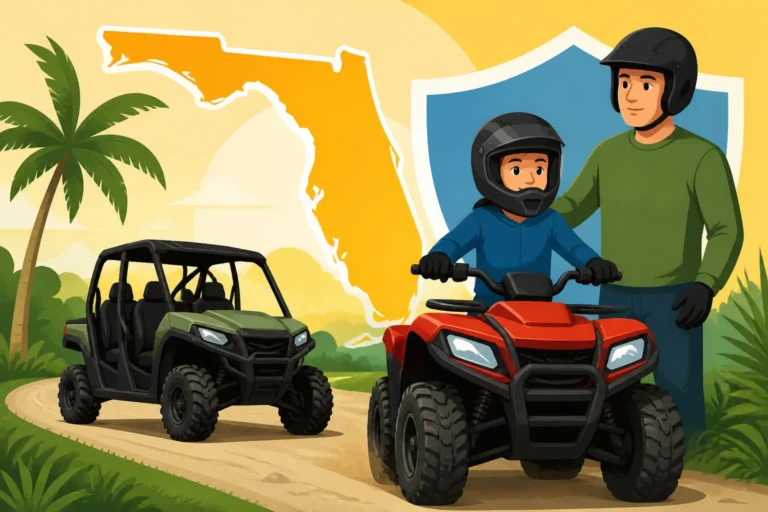
- Age and Supervision: Riders under 16 have additional rules, often requiring direct supervision by a licensed adult. Remember, just because they can ride on private land doesn't mean they can ride unsupervised on a county-maintained unpaved road.
- Passengers: If your ATV is designed by the manufacturer for only one rider, carrying a passenger is generally illegal on public roads. UTVs, being multi-passenger vehicles, are designed for more than one, but always adhere to the manufacturer's specified capacity. For more details, consult [Florida ATV Passenger Rules].
- Helmets for Minors: For any rider under 16, a USDOT-approved helmet is absolutely mandatory, no exceptions. This applies even on unpaved county roads. See [Florida ATV Helmet Law for Riders Under 16].
Practicing Smart Riding Etiquette
When sharing unpaved roads, even with sparse traffic, responsible riding is paramount. Dust control, especially during dry periods, is a courtesy to residents and other road users. Slow down when approaching homes or other vehicles, and be prepared for unexpected obstacles like wildlife or farm equipment. Many riders enhance their machines with durable components from companies like SuperATV for greater reliability on rough terrain, but even the best parts don't replace common sense and courteous riding habits.
Beyond Unpaved: Understanding Paved Road Restrictions and Alternatives
While the focus here is on Polk County's unpaved ranch roads, it's crucial to reiterate why paved roads are generally a no-go for ATVs and UTVs in Florida and what your alternatives are. Misconceptions here can lead to serious legal trouble.
Why Paved Roads Are Largely Off-Limits
The primary reason ATVs and UTVs are restricted from paved public roads in Florida is their design. They lack many of the safety features, signaling capabilities, and stability needed for safe operation in typical vehicular traffic. They're not designed for high speeds on asphalt, and their tires are often not suited for gripping paved surfaces effectively, especially during turns or braking. This isn't just a regulatory hurdle; it's a safety consideration for everyone on the road. Attempts to make an ATV or UTV "street legal" in Florida usually involve complex and often impossible modifications to meet car-like standards for lights, signals, mirrors, and tires, and even then, their classification as an OHV still restricts them from many public roads.
The Low-Speed Vehicle (LSV) Exception for UTVs
One notable exception, though it applies to specific UTVs and requires significant modification and registration, is converting a UTV into a Low-Speed Vehicle (LSV). An LSV in Florida is generally defined as a four-wheeled vehicle whose top speed is greater than 20 miles per hour but not greater than 25 miles per hour. These vehicles can be operated on public roads with posted speed limits of 35 mph or less. However, converting a UTV to an LSV is not a simple task. It requires proper titling, registration, insurance, and specific safety equipment like seat belts, headlamps, turn signals, brake lights, reflex reflectors, parking brake, a windshield, and a VIN. This is a very different class of vehicle than your typical trail-ready UTV.
Trailering: The Safest Way to Connect the Trails
For most ATV and UTV enthusiasts in Polk County who want to ride trails or access different riding areas that aren't connected by legal unpaved roads, trailering your machine is the safest and most legal option. Hauling your quad or side-by-side on a trailer ensures you stay within the bounds of the law and avoid any citations for illegal road use. It also keeps your machine from unnecessary wear and tear on surfaces it wasn't designed for. Companies like SuperATV also offer various trailer accessories and tie-down solutions, making it easier and safer to transport your pride and joy. For tips on secure transport, check out [Trailer Lights That Keep You Out of Trouble].
Here's a quick comparison of road types and OHV legality:
| Road Type | Florida State Law (General) | Polk County (Requires Verification) | Key Requirements (If Legal) |
|---|---|---|---|
| Paved Public Roads | Generally NOT Permitted | Generally NOT Permitted | N/A (Unless converted to LSV) |
| Unpaved County Roads | PERMITTED, unless local prohibition | Check local ordinances & signage | Licensed driver, eye protection, lights (if needed), spark arrestor, age/passenger rules |
| Private Ranch Roads | PERMITTED with landowner's explicit consent | Landowner's explicit consent needed | Permission, plus all general safety rules for private land |
| Designated OHV Trails | PERMITTED, with proper permits & safety gear | Check specific trail rules | Permits, safety course (for minors), helmets, spark arrestor |
In summary, riding your ATV or UTV in Polk County's expansive rural areas can be incredibly rewarding, but it's essential to understand and respect the nuanced rules. Always prioritize safety, get permission for private lands, and know the specific local ordinances for unpaved county roads. By doing your homework and riding responsibly, you can enjoy the vast beauty of Polk County from the seat of your off-highway vehicle. When in doubt, always err on the side of caution or, even better, load up the trailer and head to a designated OHV park or trail system. Remember, your off-highway vehicle is a powerful machine, and respecting the law is part of being a responsible rider. Don't forget that [What Florida Deputies Check at a Roadside Stop] is something you want to be prepared for. And ensuring you have proper documentation like your title, as discussed in [Florida's Off-Highway Title Rules in Plain English], is always a smart move.
Disclaimer
This article is for general informational purposes only and does not constitute professional advice. Laws, prices and regulations vary by location and change over time. Consult a qualified professional for guidance on your specific situation.