Florida Rules for a Quad With Headlights and Turn Signals
It's a common frustration for quad owners in Florida: you've invested in your machine, maybe even added some fantastic safety features like headlights and turn signals, and you're left wondering why you still can't just run to the corner store or cruise down a paved county road. This guide is here to clear up the confusion, explain the specific Florida laws that govern ATVs and UTVs on public roadways, and detail exactly what those added lights and signals do and don't mean for your ride.
The Core Reality: What Florida Law Says About ATVs on Paved Roads
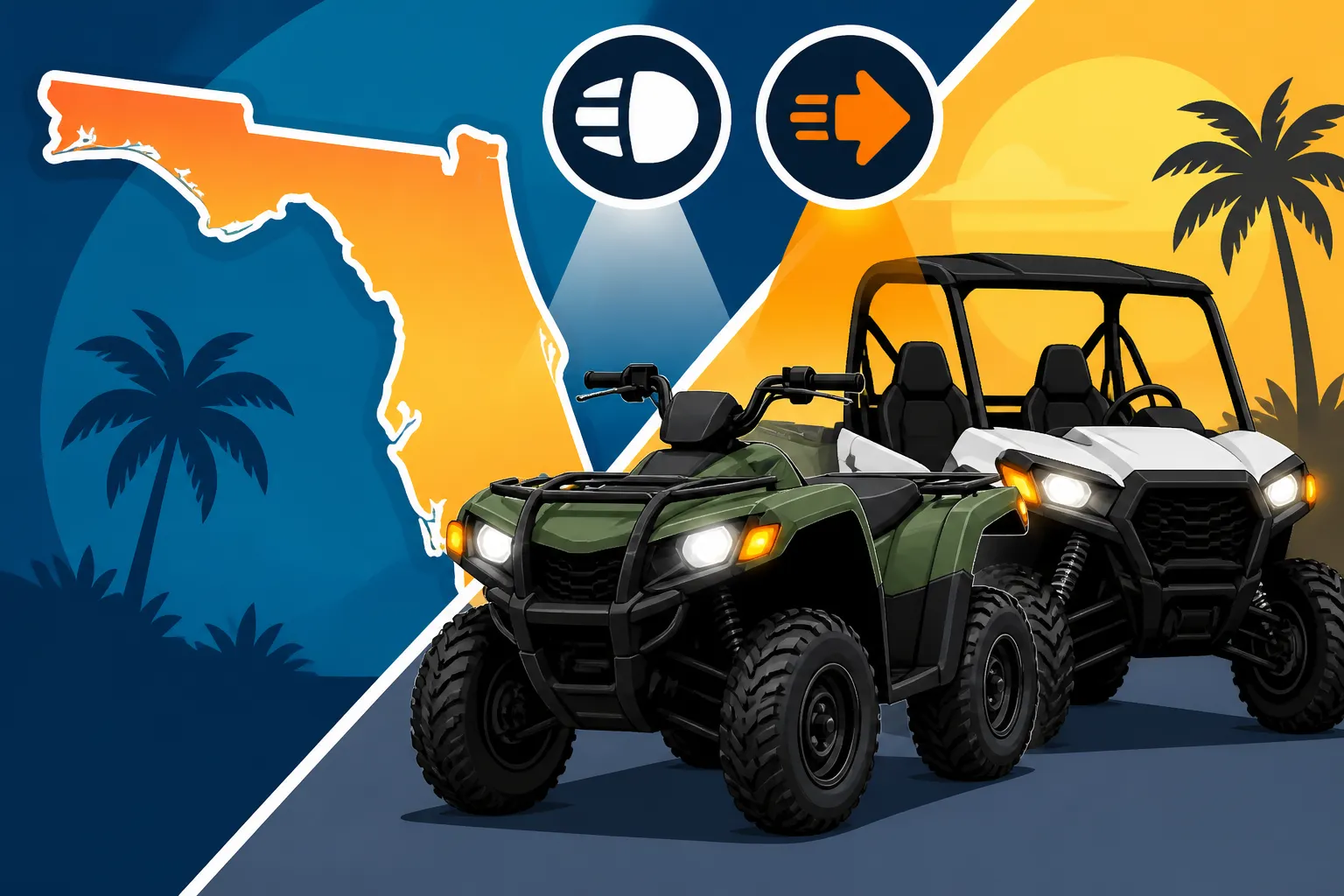
Let's cut right to the chase: in the vast majority of cases, adding headlights, turn signals, a horn, or even a windshield to your all-terrain vehicle (ATV) or utility terrain vehicle (UTV) does not make it street legal for paved roads in Florida. The state's statutes are very clear on what constitutes a street-legal vehicle, and ATVs, by their fundamental design and purpose, simply don't fit the bill. It's a tough pill to swallow when you see all these modifications, but the law looks at the core definition of the machine.
Why Your ATV Isn't a Car (Even With All the Gear)
Florida law defines an ATV as a motorized off-highway vehicle weighing 1,500 pounds or less, 55 inches or less in width, and having three or four non-highway tires. The key phrase there is "non-highway tires" and the overall design for off-road use. Even if you slap on DOT-approved tires, bright LED headlights, and a full turn signal kit, the vehicle's original manufacturer's certificate of origin (MSO) and its fundamental design for challenging terrain typically dictate its classification. Law enforcement officers, county clerks, and the Department of Highway Safety and Motor Vehicles (DHSMV) will refer back to these core characteristics, not your aftermarket additions.
Think about it this way: you can put racing stripes and a spoiler on a sedan, but it doesn't magically become a race car in the eyes of the law or a racing association. Similarly, bolting on a full lighting kit, perhaps from a reputable brand like SuperATV, significantly enhances visibility and safety for off-road adventures, but it doesn't reclassify your ATV as a street-legal vehicle. This can be particularly confusing for those new to the state or used to different regulations elsewhere, leading to unwarranted tickets. You might find it helpful to understand [Florida's 55-Inch ATV Definition and Why It Matters] in this context.
The Difference Between an ATV, ROV, and Street-Legal LSV
To further complicate matters, Florida has different classifications for off-highway vehicles, and understanding these distinctions is crucial. An ATV, as mentioned, is generally smaller and designed for a single rider or two. A Recreational Off-Highway Vehicle (ROV), often called a UTV or side-by-side, is typically wider than 55 inches, can weigh more than 1,500 pounds, and often has a steering wheel and side-by-side seating. These distinctions are important because while neither is inherently street legal on paved roads, UTVs sometimes have a clearer path to being converted into a Low-Speed Vehicle (LSV).
A Low-Speed Vehicle (LSV) is a whole different beast. It's explicitly designed to be street legal, typically has a top speed between 20 and 25 mph, and must meet stringent federal safety standards, including headlights, taillights, turn signals, brake lights, reflex reflectors, a rearview mirror, a parking brake, and a vehicle identification number (VIN). Some UTVs can be modified with a full "street legal kit" to become an LSV, but this is a complex and often costly process involving inspections and proper titling. An ATV, due to its inherent design, rarely qualifies for such a conversion. For UTV owners, exploring [Florida UTV Titling for Side-by-Sides Over 55 Inches] and [Florida Low-Speed Vehicle Rules for Side-by-Sides] might be worthwhile.
Unpaved Roads: Where Headlights and Turn Signals Might Matter
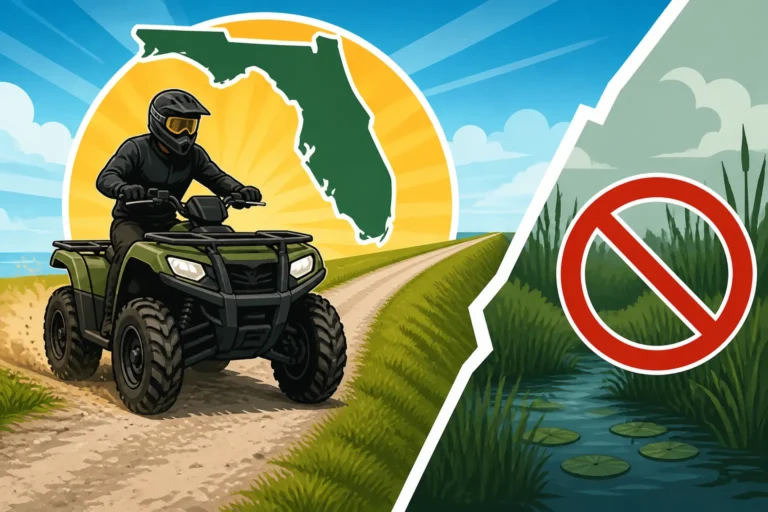
While your equipped quad likely won't see a paved highway, there are specific, limited circumstances where ATVs are permitted on certain public unpaved roads in Florida. In these situations, having proper lighting and signaling equipment, even if not strictly mandated by the base law for the exemption itself, significantly enhances your safety and the safety of others sharing the road. This is where your investment in those accessories truly pays off from a practical standpoint.
The Specifics of Florida's Unpaved Road Rule
Florida Statute 316.2123 allows for the operation of ATVs and UTVs on unpaved roads owned and maintained by a county or municipality under very strict conditions. The most critical stipulations include:
- Daytime Hours Only: This is non-negotiable. Even with powerful headlights and taillights, you cannot legally operate an ATV on these designated unpaved roads between sunset and sunrise. [Florida's Daytime-Only ATV Road Rule] is very clear on this.
- Licensed Driver: The operator must possess a valid driver's license. No learner's permits or unlicensed driving allowed on public access routes. Understanding [Florida ATV Road Use Needs a Licensed Driver] is key.
- Eye Protection: All operators and passengers must wear eye protection, such as goggles or a face shield.
- Helmet for Minors: Riders under 16 years of age must wear a USDOT-approved helmet.
- Designated Roads: Not all unpaved roads are open. Counties and municipalities must specifically designate these roads as accessible for ATVs. You can't just assume any dirt road is fair game.
So, while your new turn signals won't let you ride at night, they certainly make you more visible when turning onto a designated unpaved road during the day, especially if that road is dusty or winding.
Enhanced Safety vs. Legal Requirement
It's important to distinguish between what the law requires and what is simply smart for safety. The law for unpaved road access doesn't specifically mandate turn signals or headlights, beyond requiring eye protection and helmets for certain riders. However, common sense dictates that these features drastically improve your presence to other vehicles—be it a truck coming around a blind curve or another off-road vehicle.
Imagine you're on a dusty, unpaved county road, heading to the [Croom Motorcycle Area: Florida's Biggest OHV Park]. You need to make a left turn onto another dirt road that leads to your staging area. Without turn signals, you're relying solely on hand signals, which can be hard to see in bright sun or dust. With a proper signal kit, perhaps one installed from a kit by SuperATV, your intentions are clearly communicated, reducing the risk of a collision. Headlights, even during the day, increase your visibility, making your quad more noticeable to oncoming traffic or vehicles pulling out from private driveways.
Crossing Paved Roads and Other Limited Exceptions
There are indeed some very narrow situations where your ATV with all its lights and signals might briefly touch a paved road legally. These are not broad permissions to cruise down main streets, but rather specific, tightly defined exceptions designed to allow riders to access trails or conduct necessary agricultural work without excessive detours.
The "Direct Crossing" Rule
Florida law permits an ATV to "directly cross" any public road or highway, provided the crossing is made at a right angle to the paved road, at a place where the crossing is safe, and without unduly interfering with vehicular traffic. This means you can traverse a paved road to get from one section of a trail system to another, or from your private property to a public unpaved road. However, "directly crossing" does not mean riding down the paved road for any distance, even a short one. It's a straight shot across.
This exception is designed to be as brief as possible. You stop, you look both ways, you cross. Your added headlights and turn signals are incredibly valuable here. Imagine crossing a busy two-lane highway where visibility is key. Clearly indicating your intent to cross with a turn signal and being highly visible with your headlights can prevent a dangerous situation. For more details on this, check out [Florida ATV Crossing a Paved Highway].
Agricultural and Emergency Use Exceptions
Another important set of exceptions applies to agricultural operations. ATVs and UTVs may be operated on public roads and highways for agricultural purposes by farmers or their employees. This means using the machine to move between fields, check fences, or transport equipment necessary for farming activities. The vehicle must be used exclusively for agricultural tasks, not for recreational joyrides on public land. This is where a UTV, often equipped with utility beds and even more advanced lighting, can be particularly useful. Many farmers rely on accessories from companies like SuperATV to enhance the functionality and safety of their utility vehicles in these demanding environments.
Furthermore, during emergency situations, such as disaster relief efforts or when directed by law enforcement, ATVs and UTVs may be operated on public roads as necessary. This is a rare circumstance, but it acknowledges the utility of these machines in specific critical contexts where traditional vehicles might be hampered.
The Real-World Implications and Risks of Non-Compliance
It's easy to get caught up in the desire to make your ATV more versatile, but ignoring Florida's specific laws can lead to significant headaches, financial penalties, and even safety risks. The investment in those extra lights and signals, while great for safety off-road, won't protect you from the consequences of illegal road use.
Fines, Impoundment, and Insurance Headaches
If you're caught operating an ATV illegally on a paved road in Florida, you could face a citation, which can carry a substantial fine. More severely, your ATV could be impounded, leading to towing and storage fees on top of the initial fine. Retrieving an impounded vehicle is often a costly and time-consuming process. Ignoring the law can quickly turn a fun ride into a legal and financial nightmare. Explore [Florida Penalties for Illegal ATV Road Riding] and [Florida ATV Impound After a Road Violation] to understand the potential repercussions.
Beyond the immediate legal penalties, operating your ATV on a paved public road when it's not street-legal can complicate insurance claims. If you're involved in an accident, your insurance company might deny coverage if the vehicle was being operated in violation of state law, leaving you personally liable for damages and injuries. This could expose you to immense financial risk, making the cost of a few minutes of illegal road riding astronomically high.
Navigating the Gray Areas: When in Doubt, Don't
The laws around ATV and UTV use on public roads can sometimes feel like a maze, especially with differing county ordinances. Some counties in Florida have explicitly designated certain unpaved roads for ATV use, while others might have stricter bans. It's always best to check with the local county sheriff's office or Department of Transportation for specific rules in the area you plan to ride. [Florida County ATV Opt-Outs: Why Rules Change at the Line] is a testament to this variation.
When faced with a situation where you're unsure if a road is permissible, the safest and most responsible course of action is to avoid it. Trailer your machine to the designated off-road riding areas. Your ATV, even with the best aftermarket lighting and signaling from SuperATV, is designed for the trails, mud, and sand, not the asphalt. Keeping your riding where it's legal ensures you stay safe, avoid fines, and preserve the privilege of riding for everyone.
Here's a quick comparison of vehicle types and their general road legality in Florida:
| Vehicle Type | Typical Max Width | Typical Max Weight | Paved Road Legal | Unpaved Road (Designated) Legal | LSV Conversion Possible | Common Features Enhancing Safety (Not Legality) |
|---|---|---|---|---|---|---|
| ATV (Quad) | 55 inches | 1,500 lbs | No | Yes (with conditions) | Rarely | Headlights, taillights, turn signals, horn |
| ROV (UTV/SxS) | >55 inches | >1,500 lbs | No | Yes (with conditions) | Yes (with full kit/inspection) | Headlights, taillights, turn signals, horn, windshield |
| LSV (Low-Speed Vehicle) | Varies | Varies | Yes | Not applicable | N/A (designed street-legal) | All street-legal requirements built-in |
Remember, while accessories like headlights and turn signals significantly enhance safety and visibility, they do not change the fundamental classification of your ATV or UTV in Florida. Always prioritize understanding and adhering to the law to ensure enjoyable and legal riding experiences.
Disclaimer
This article is for general informational purposes only and does not constitute professional advice. Laws, prices and regulations vary by location and change over time. Consult a qualified professional for guidance on your specific situation.