Florida Snowbirds Riding Quads on Park Streets
As a snowbird in Florida, you might envision cruising your quad or side-by-side around the friendly streets of your mobile home park, RV resort, or private community. However, the reality often hits hard: the relaxed vibe of your seasonal home doesn't always extend to ATV use on local "park streets," and what seems like a harmless ride can quickly lead to misunderstandings, fines, or even impoundment. This guide will help you understand the nuanced rules governing ATV and UTV use within Florida's various park and private community settings, ensuring your winter escape remains enjoyable and compliant.
Florida's General ATV Road Rules: A Baseline for Park Streets
Before diving into the specifics of park streets, it's crucial to understand Florida's general stance on ATVs and UTVs on public roads. This provides the baseline from which all other rules branch. Many snowbirds come from states with different regulations, leading to confusion. In Florida, ATVs are generally designed for off-road use, and state law largely restricts their operation on paved public roadways.
The Statute's Stance on Paved Public Roads
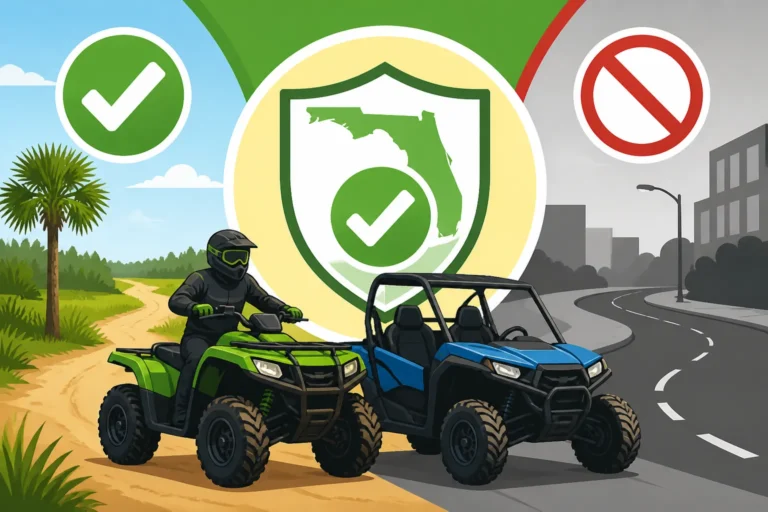
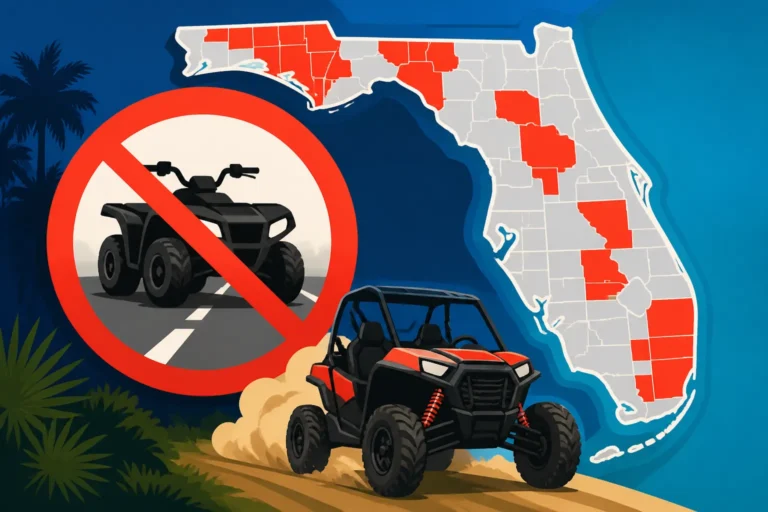
Florida Statute 316.2123 is the core of this discussion. It clearly states that off-highway vehicles, which include ATVs and UTVs (unless specifically modified to meet other classifications like Low-Speed Vehicles or street-legal conversions), are generally prohibited from operating on public roads and highways. This isn't just a suggestion; it's a hard rule with consequences. The frustration is understandable: you bought your machine for enjoyment, and suddenly it feels like you can't use it for simple transportation within your temporary community. Yet, this prohibition is in place for safety, as ATVs lack many of the safety features required for on-road vehicles, and their handling characteristics are vastly different. When considering the paved streets within a mobile home park or an RV resort, many people mistakenly believe these are exempt from state law. While they might be if strictly private, the default assumption should be that any paved road could fall under these state rules. You might even find yourself getting a ticket from a sheriff's deputy if they consider the park's main thoroughfares to be public access points. For a deeper dive, check out [Are ATVs Street Legal in Florida?].
Exceptions for Unpaved Roads
Now, here's where it gets a bit more complex and offers a glimmer of hope for some riders. Florida law does provide specific exceptions for unpaved roads. An ATV or UTV can often be operated on an unpaved road that is not a public highway, paved, or maintained by a public entity, under certain conditions. These conditions include operating during daylight hours, having a valid driver's license (if applicable for the rider's age), and sometimes adhering to a posted speed limit. This exception is often what snowbirds hope applies to their community's internal roads. However, even with this exception, the community itself—whether it's an HOA, a park management, or a campground—still has the final say over its own private property. Just because the state allows it on some unpaved roads doesn't mean your specific park must permit it. Think of it this way: your community might have specific covenants or rules that are more restrictive than state law. You need to know [What 316.2123 Actually Permits].
Equipment and Licensing for Permitted Road Use
Even if your specific situation allows for ATV use on certain roads, there are equipment and licensing requirements to consider. For any road use, even on designated unpaved roads, Florida law requires that the ATV or UTV be equipped with proper lighting for daytime operation (if necessary for visibility), and the operator must be at least 16 years old and hold a valid driver's license for operation on any public right-of-way. This is a crucial point for many snowbirds, especially those who might allow younger family members to operate their machines. Furthermore, if you're trying to make your UTV more versatile for potential limited road use, companies like SuperATV offer a range of accessories, from turn signal kits to rearview mirrors, that can help meet basic safety and visibility standards, though these modifications alone won't make a standard ATV street legal on all public roads. It’s important to understand [Florida ATV Lights and Equipment for Road Use] before you head out.
Navigating "Park Streets": Mobile Home Parks, RV Resorts, and Private Communities
The term "park streets" is broad and encompasses a variety of private roads within different community types, each with its own set of rules and enforcement mechanisms. This is where most snowbirds encounter their specific challenges. The key distinction is whether the road is considered public or truly private, and who has jurisdiction over it.
Mobile Home Parks and RV Resorts
Mobile home parks and RV resorts are typically private properties. The roads within these parks, even if paved and maintained, are usually considered private streets. This means that while state law might prohibit ATVs on public paved roads, the park management or HOA can establish its own rules regarding the operation of recreational vehicles, including ATVs and UTVs, on their private property. These rules are usually outlined in the park's covenants, conditions, and restrictions (CC&Rs), or in the resort's operational guidelines. It’s not uncommon for these private communities to ban ATVs and UTVs entirely, or to severely restrict their use (e.g., only for direct ingress/egress, speed limits, specific hours).
The rationale often stems from noise concerns, safety for pedestrians and golf carts, and liability issues. Imagine a busy RV park with kids playing and people walking dogs; a powerful ATV can be perceived as a significant hazard. Therefore, before you even unload your quad, always check with the park management or your HOA documents. Ignoring these rules can lead to fines, eviction from the park, or losing your privilege to bring the machine back. Don't assume that because golf carts are allowed, ATVs are too; [Florida Golf Cart Laws vs ATV Laws] are very distinct.
Gated Communities and HOAs
Gated communities and those governed by Homeowners' Associations (HOAs) present a similar but sometimes even more complex scenario. The roads within these communities are almost universally private, owned and maintained by the association. HOAs have significant power to regulate activities within their jurisdiction, including the use of recreational vehicles on internal streets. These rules are legally binding for residents and guests.
An HOA might permit UTVs that are primarily used for utility purposes (e.g., landscaping, maintenance) but prohibit ATVs used purely for recreation. Some might allow UTVs if they meet certain criteria for "low-speed vehicles" (LSVs), which involves specific modifications like seatbelts, headlights, taillights, turn signals, and a top speed between 20-25 mph. However, converting an ATV into an LSV is a significant undertaking and generally applies more to side-by-sides. If you're exploring this route, ensure any aftermarket parts, like those from SuperATV, comply with LSV requirements. It’s a completely different legal classification, and you'll need to research [Florida Low-Speed Vehicle Rules for Side-by-Sides]. Always obtain a copy of the HOA's specific rules regarding off-highway vehicles and understand them thoroughly.
Campgrounds and Private Lands
For snowbirds staying in campgrounds, especially those with extensive private road networks, the rules will again be set by the campground owner or operator. Many private campgrounds have designated areas for ATV riding or specific rules for travel to and from trailheads. It's crucial to distinguish between campground internal roads for accessing sites and designated off-road trails.
On purely private land, such as a large ranch or agricultural property, the landowner's permission is paramount. If you're visiting friends with a sizable property, their word is essentially the law on their land. However, this private land exemption does not extend to public roads or even the private roads of neighboring communities without explicit permission.
Here’s a quick overview of how rules can vary:
| Community Type | Typical Road Classification | General State Law Application | Community Rules (Examples) | Key Action for Snowbirds |
|---|---|---|---|---|
| Mobile Home Parks | Private | Limited direct application | Often restricted/banned for safety, noise, liability. | Check park management/lease agreement. |
| RV Resorts | Private | Limited direct application | Similar to mobile home parks; may allow golf carts but not ATVs. | Consult resort rules upon check-in. |
| Gated Communities / HOAs | Private | Limited direct application | Rules in CC&Rs; UTVs might be allowed if LSV-compliant. | Review HOA documents thoroughly. |
| Public Campgrounds (State/National Parks) | Public (within park) | Full application of state laws | ATVs generally restricted to designated trails, not park roads. | Check specific park regulations, often found online. |
| Private Campgrounds | Private | Limited direct application | Varies widely; some have designated riding areas. | Inquire directly with campground staff. |
Practical Advice and Avoiding Pitfalls for Snowbird Riders
Given the complexities, snowbirds need to be proactive and informed to avoid legal trouble or conflict within their temporary communities. It's about enjoying your time without unnecessary stress.
Do Your Homework Before You Arrive
The single most important piece of advice is to inquire about ATV/UTV rules before you commit to a long-term stay in a park or community. Don't assume. Call the park office, read their online FAQs, or review the HOA documents if available. Ask specific questions: "Are ATVs or UTVs permitted on internal roads?" "Are there any designated riding areas?" "What are the rules regarding noise or hours of operation?" This upfront research can save you a huge headache and potentially a wasted trip if your machine won't be welcome.
Understand the "Low-Speed Vehicle" Distinction
For many side-by-side owners, the idea of converting their machine into a Low-Speed Vehicle (LSV) for limited community use is appealing. An LSV is a street-legal classification in Florida for vehicles with a top speed between 20 and 25 mph, equipped with specific safety features like headlights, taillights, stop lamps, turn signals, reflex reflectors, a parking brake, rearview mirrors, a windshield, seatbelts, and a Vehicle Identification Number (VIN). While this can make a UTV eligible for use on roads with a speed limit of 35 mph or less, it's a formal conversion process that involves registration, titling, and insurance. It's not just slapping on a few accessories; it's a change in legal classification. Many products from companies like SuperATV can help with the conversion process, providing compliant lights and mirrors, but the full conversion requires diligence. Remember, even an LSV-converted UTV would still be subject to the private rules of your park or HOA, which might still prohibit them.
Be Mindful of Noise and Community Harmony
Even if a park's rules technically allow ATVs or UTVs, being a good neighbor goes a long way. The noise levels of many off-road machines, especially those with aftermarket exhausts, can be a major source of complaint in residential or resort settings. Operating your machine respectfully, adhering to quiet hours, and avoiding excessive noise can help prevent conflicts and potential rule changes. Many communities, especially those catering to a retiree demographic, prioritize peace and quiet. Your responsible behavior could influence whether these machines are tolerated in the future.
Know the Penalties for Non-Compliance
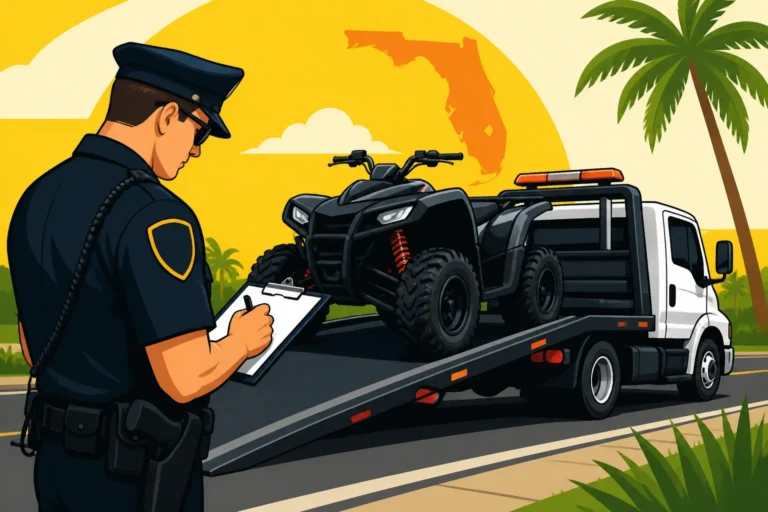
Operating an ATV or UTV illegally on public roads in Florida can lead to significant penalties, including fines, impoundment of your vehicle, and even criminal charges in some cases. If you're riding in a private community against its rules, the penalties might be internal: fines from the HOA, loss of riding privileges, or even being asked to leave the property. Law enforcement can still get involved if the private property rules are violated in a way that breaks a public law, such as reckless endangerment or excessive noise that becomes a nuisance. Understanding [Florida Penalties for Illegal ATV Road Riding] is critical. Always carry proof of ownership, and if your machine is titled, know [What an OHV Title Does Not Let You Do] on public roads.
This article is for general informational purposes only and does not constitute professional advice. Laws, prices and regulations vary by location and change over time. Consult a qualified professional for guidance on your specific situation.