Why Night Road Riding Is Not Allowed in Florida
It's incredibly frustrating, isn't it? You've got your powerful ATV or UTV, the Florida sun is finally setting, and the air is getting wonderfully crisp – the perfect conditions for a peaceful ride. But then you remember: public roads are off-limits for ATVs and UTVs at night. This guide is here to clear up exactly why Florida law restricts off-highway vehicles to "daytime hours only" on approved roadways, helping you understand the logic behind the rules and avoid any costly mistakes.
The Core Rule: Why Daytime-Only Matters on Florida Roads
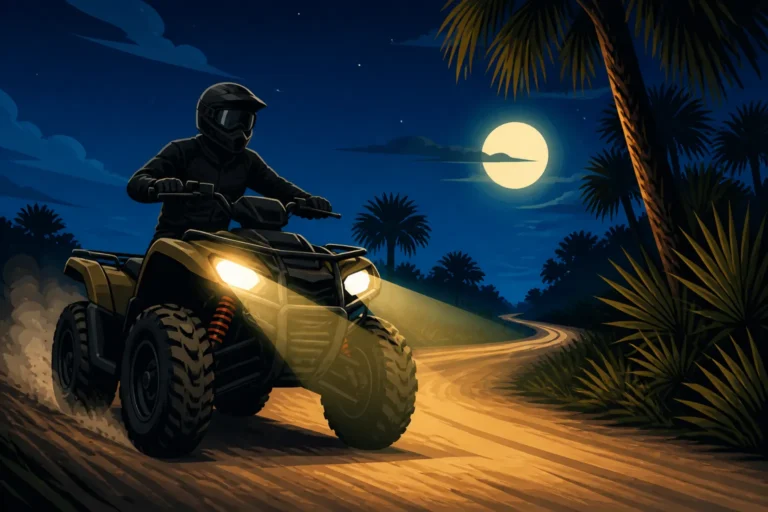
For many of us who love the open air and the rumble of an engine, the idea of a serene night ride down a quiet dirt road in Florida sounds absolutely idyllic. Picture it: the stars are out, the air is cool, and the trails are empty. Unfortunately, when it comes to public roads, Florida's legislature has drawn a clear line in the sand, mandating that ATVs and UTVs are strictly for "daytime hours only." This isn't just a suggestion; it's a fundamental part of the state's off-highway vehicle (OHV) laws, designed with safety and practicality in mind. It's a tough pill to swallow for riders who feel their machines are perfectly capable, but understanding the root causes of this rule can help make sense of the restriction.
Understanding Florida's Statutory Language for ATV Road Use
Let's dive into the nitty-gritty of the law. Florida Statute 316.2123, which outlines the conditions under which an all-terrain vehicle (ATV) or utility vehicle (UTV) may be operated on certain public roads, explicitly states: "An all-terrain vehicle or utility vehicle may be operated on an unpaved road during daytime hours only." That phrase, "daytime hours only," is the critical part. It’s not vague; it leaves no room for interpretation about riding after sundown. The law doesn't say "if you have good lights" or "if the road is empty." It's a blanket restriction on the time of day.
This legislative intent is primarily rooted in safety. Lawmakers recognize that ATVs and UTVs, while incredibly fun and useful off-road, are fundamentally different from street-legal automobiles. They aren't designed to blend seamlessly with typical road traffic, especially when visibility is compromised. Imagine the scenario: you're enjoying a beautiful sunset ride on a county dirt road, perhaps feeling perfectly safe and visible. But as the last rays of sun dip below the horizon, a local sheriff's deputy spots you. Even if you're going slow and being careful, that deputy is obligated to enforce the "daytime hours only" rule. It’s not personal; it’s about upholding a statute designed to protect everyone on the road.
Visibility, Safety, and the Risk Factors of Night Riding
The primary reason for the daytime-only rule boils down to inherent safety concerns. First and foremost, visibility plummets significantly at night, even with the best aftermarket lighting. While your ATV might have some headlights, they are typically designed for illuminating the trail directly in front of you, not for projecting across vast distances or being easily seen from multiple angles by other vehicles. This becomes a critical issue when sharing any type of public thoroughfare, even an unpaved one, with cars, trucks, or even bicycles that might not expect an OHV after dark.
Think about it from another driver's perspective. A car driver at night relies on standard vehicle lighting – bright headlights, clear taillights, and reflective surfaces – to identify other vehicles and gauge their distance and speed. An ATV, even a large UTV, presents a much smaller profile than a car or truck. Its lights might not meet the brightness, beam pattern, or placement standards required for regular road vehicles, making it incredibly difficult for other drivers to spot you until it's too late. This reduced visibility drastically increases the risk of collisions, not just for the ATV rider but for anyone else on the road.
Beyond other vehicles, night riding on Florida's unpaved roads introduces unique hazards specific to the environment. Wildlife, such as deer, wild hogs, or even panthers in certain areas, becomes far more active and unpredictable after dark. Encountering a large animal unexpectedly on a dimly lit trail or road can lead to serious accidents. Furthermore, the terrain itself, with its ruts, hidden potholes, or sudden changes in elevation that are easy to spot in daylight, can become dangerous surprises at night. These factors compound the inherent safety risks, making the "daytime hours only" rule a crucial safeguard for everyone.
What "Daytime Hours Only" Actually Means for Riders
The phrase "daytime hours only" might seem straightforward, but when you're out riding and the sun begins to set, the exact cutoff can feel a bit ambiguous. However, Florida law isn't guessing; it operates on clear definitions, and for OHV use on public roads, those definitions mean you need to plan your rides meticulously to ensure you're off the road before it gets too dark. Ignoring these definitions isn't just tempting fate; it's inviting a conversation with law enforcement that you'd rather avoid.
Defining "Daytime" by the Statute
Legally speaking, "daytime hours" in Florida typically refer to the period between sunrise and sunset. This is a common legal standard used across various statutes, not just those pertaining to ATVs. It doesn't mean "when it's mostly light out" or "when I can still see pretty well." It's a specific window of time that changes daily throughout the year. For instance, in the summer, you'll have longer daylight hours, while in the winter, the sun sets much earlier. This means that a ride you comfortably finish at 6 PM in July might be well into illegal territory by 5 PM in December.
The practical implication of this definition is that twilight hours – that beautiful, hazy period just after sunset and just before sunrise – are generally not considered "daytime." If you're on a public, unpaved road during these times, you could be cited. It's crucial for riders to be aware of the daily sunrise and sunset times, which are readily available on weather apps or online, and to plan their rides accordingly. This might mean starting your ride earlier in the day or cutting it short to ensure you're back on private property or trailering your machine before the sun officially dips below the horizon. Trying to push it "just a little longer" can be the exact moment you find yourself in violation of the law.
The Difference Between Private and Public Land Night Riding
It’s important to clarify that Florida’s “daytime hours only” rule specifically applies to the operation of ATVs and UTVs on public roads and highways. This distinction is vital because it means that night riding is permissible in other contexts, namely on private property or within designated off-road parks that explicitly allow it. For many riders, this provides a critical outlet for their love of night-time adventures.
If you own a large tract of land, or have explicit permission from a landowner, you are generally free to ride your ATV or UTV on that private property at any hour, day or night, as long as you're not disturbing neighbors or violating noise ordinances. Similarly, many of Florida's dedicated [Florida Mud Parks: Where Riders Actually Go] and [Florida ATV Trails: Every Public Riding Area] offer specific opportunities for night riding. These parks often have controlled environments, designated trails, and sometimes even additional lighting or staff on hand to ensure safety during nocturnal operations. They understand the appeal of night riding and cater to it within their private boundaries, which are separate from state road laws. This is where those powerful aftermarket light bars, like the ones from SuperATV, truly shine – illuminating rugged trails and open fields under the stars without the worry of state road law violations.
The contrast here highlights the state's concern for public safety on shared infrastructure versus individual freedoms on private land. While you might dream of riding your machine through the cool night air on a quiet county road, the law mandates that such experiences are reserved for private spaces. It’s a classic example of balancing individual recreation with broader public safety. Always confirm the specific rules of any private park or trail system regarding night riding before heading out, as their internal regulations may still apply.
Equipment Limitations and Why They Factor In
You might be thinking, "But my ATV/UTV has headlights! And I can add more lights!" And you'd be right – most modern ATVs and UTVs come equipped with factory lighting, and the aftermarket is full of incredible illumination options. However, the legal definition of what constitutes appropriate lighting for night road use is far more stringent than what comes standard on most off-highway vehicles, or even what a rider might add for improved trail visibility. This difference is a major contributing factor to why night road riding for ATVs remains prohibited in Florida.
The Standard ATV Lighting Setup vs. Road Requirements
When you look at a typical ATV or UTV, its factory lighting system is designed primarily for off-road functionality. The headlights are usually powerful enough to illuminate the immediate trail ahead, helping you navigate obstacles in low-light conditions or dense foliage. Taillights provide some visibility from the rear, often sufficient for following other riders on a trail. However, these lights are rarely, if ever, DOT (Department of Transportation) approved for street use. This means they don't meet the specific brightness, beam pattern, aiming, or visibility angles required for vehicles operating on public roads at night.
Consider the differences: a street-legal vehicle's headlights are engineered to project light in a specific pattern that illuminates the road without blinding oncoming drivers. Its taillights are bright enough to be seen from a significant distance, and often include brake lights that are noticeably brighter. ATVs, on the other hand, might have lights that are too diffuse, too narrowly focused, or simply not bright enough to effectively signal their presence to other drivers from a distance required for road safety. Even with factory-equipped lights, an ATV simply doesn't conform to the safety standards set for road-legal vehicles, which is a major reason why [Florida ATV Lights and Equipment for Road Use] discusses requirements for legal operation.
Aftermarket Solutions and Their Legal Standing
Many riders invest heavily in aftermarket lighting, and for good reason! Products from companies like SuperATV offer incredibly robust and powerful LED light bars, spot beams, and floodlights that can turn even the darkest trail into daylight. These additions are fantastic for enhancing visibility during off-road night rides, whether you're navigating a technical section, setting up camp, or just extending your time on private land. You might even add turn signals, a horn, and mirrors, transforming your UTV into something that looks almost street-legal.
However, here’s the critical catch: adding a full suite of aftermarket lights, no matter how powerful or comprehensive, does not magically grant an ATV or UTV permission to operate on Florida's public roads at night. The "daytime hours only" restriction is tied to the vehicle's classification as an off-highway vehicle, not just its equipment. While these accessories improve your safety and visibility for permissible riding (i.e., off-road or on private land), they don't override the state statute that limits OHV road use to daylight hours. A deputy isn't going to wave you on after sundown just because you have a brilliant SuperATV light bar illuminating the whole county road. The law looks at the vehicle type and the time of day, not merely the presence of extra lights.
The key takeaway is that while aftermarket lighting is a valuable safety and convenience upgrade for off-road enthusiasts, it doesn't change the fundamental legal framework for ATVs and UTVs on Florida's public roads. These regulations are deeply rooted in the vehicle classification and its intended use, rather than what accessories you've bolted on.
Penalties, Enforcement, and What's at Stake
Riding your ATV or UTV on a public, unpaved road in Florida after sunset might seem like a minor transgression, especially if you feel you're being safe and responsible. However, law enforcement in Florida takes these rules seriously. Violating the "daytime hours only" restriction can lead to more than just a stern warning; it can result in significant financial penalties, legal hassles, and even the loss of your machine. It's crucial for every rider to understand the potential repercussions, as the risks far outweigh the momentary thrill of a late-night ride.
The Cost of a Citation for Night Road Riding
If a law enforcement officer catches you riding your ATV or UTV on a public road during non-daytime hours, you're likely to receive a citation. The specific [Florida ATV Ticket Cost for Illegal Road Riding] can vary, but it's generally a non-criminal moving violation. However, these tickets are not cheap. Beyond the base fine, you'll often incur court costs, and if you choose to fight the ticket, you might face legal fees. These costs can quickly add up, turning a quick, enjoyable ride into a financial headache that could set you back hundreds of dollars.
But the financial strain isn't the only concern. Receiving a citation means you'll have to deal with the court system, potentially taking time off work to appear before a judge or dealing with administrative processes. It can be a significant hassle and a drain on your time and energy. In some cases, depending on the circumstances or if it's a repeat offense, law enforcement might even have the authority to impound your vehicle. Imagine your beloved quad or side-by-side being towed away; getting it back can be a lengthy, expensive process, involving impound fees, storage charges, and proof that the violation has been resolved. This is why understanding [Florida ATV Impound After a Road Violation] is so important. It's a stark reminder that what seems like a small infraction can quickly escalate into a major ordeal.
Insurance Implications and Liability Concerns
Beyond the immediate penalties, operating an ATV or UTV illegally on a public road, especially at night, can have severe insurance and liability ramifications. Most ATV insurance policies are written with the understanding that the machine will be operated legally and in accordance with state laws. If you're involved in an accident while riding during prohibited hours on a public road, your insurance company could deny coverage. This means you could be personally responsible for not only your own injuries and machine damage but also for any damages or injuries you cause to other people or property.
Consider this scenario: You're riding your UTV on a county dirt road just after sunset, believing it's still light enough. Another vehicle, perhaps a truck, comes around a bend and doesn't see your OHV until it's too late. There's a collision. Even if the other driver is partly at fault, your illegal presence on the road could put you in a very vulnerable position. Without insurance coverage, you'd be facing potentially astronomical medical bills, repair costs for both vehicles, and even lawsuits. The legal and financial fallout from such an incident could be devastating, impacting your finances and future for years. This severe risk is a foundational reason why the "daytime hours only" rule is so strictly enforced, aiming to prevent these very scenarios from occurring.
Exceptions, Workarounds, and Designated Roadways
While the general rule in Florida prohibits night road riding for ATVs and UTVs, the law sometimes carves out very specific, narrow exceptions for certain situations. It's important not to confuse these limited exceptions with a general waiver of the rule. These are not open invitations for recreational night riding but rather pragmatic allowances for essential functions. Additionally, some local jurisdictions have their own unique approaches to OHV access, which might allow for more flexibility under highly regulated conditions.
Agricultural and Emergency Exceptions
Florida law does recognize that there are specific, non-recreational uses for ATVs and UTVs that might necessitate their operation on public roads outside of daylight hours. For instance, in agricultural settings, farmers and ranchers often rely on these vehicles to manage vast properties, check on livestock, or perform crucial tasks that might extend into the night. The statute generally includes provisions that allow ATVs and UTVs to be operated on public roads incidental to agricultural pursuits, provided certain safety measures (like lights) are in place. However, this is not a blanket permission; it's strictly tied to the purpose of the activity.
Similarly, in emergency situations, such as disaster relief efforts following a hurricane or a search-and-rescue operation, ATVs and UTVs might be crucial for accessing areas impassable by conventional vehicles. Law enforcement, emergency services, or authorized personnel involved in these critical tasks may operate OHVs on public roads outside of daylight hours as needed. These are highly specific, job-related exceptions that do not apply to the average recreational rider. It’s vital to understand that these allowances are for necessity, not leisure, and require official authorization or direct involvement in these designated activities.
Designated ATV Roads and Local Ordinances
Here’s where things can get a little nuanced: some Florida counties have taken steps to create "designated ATV roads" or "designated unpaved roads" where ATVs and UTVs are permitted to operate under specific conditions. These are not widespread, but they do exist. In such areas, local county commissions have passed ordinances that allow OHV use on certain public roads. The intent is often to provide residents with access to trails or to connect communities where unpaved roads are common. It's worth looking into [Florida Counties That Designated ATV Roads] to see if your area has such provisions.
However, even on these designated roads, the "daytime hours only" rule often still applies unless the local ordinance explicitly states otherwise and details the specific lighting and safety equipment required for night operation. Most local ordinances simply mirror the state law regarding time restrictions, but provide the designated pathways for daytime use. Therefore, while a county might open up specific roads, a rider still has to verify that night riding is permitted on those specific roads and what, if any, additional requirements are in place. Always check the very latest local ordinances for [Florida ATV Road Rules by County] before venturing out, as these rules can change and are often more restrictive than you might hope for.
Comparing ATVs, UTVs, and LSVs on Florida Roads
It's easy to get confused when you see different types of utility vehicles on the road in Florida, some seemingly operating at night, while your ATV or UTV is restricted to daytime. The key lies in understanding the distinct legal classifications of these vehicles. While your ATV and many UTVs fall under the "off-highway vehicle" umbrella, other categories like Low-Speed Vehicles (LSVs) and even some street-legal UTV conversions operate under an entirely different set of rules, particularly when it comes to night driving.
Why Street-Legal Conversions Aren't Enough for Night Road Use
You might encounter passionate riders online or at events who swear they've made their UTV "street legal" by adding a windshield, turn signals, mirrors, a horn, and even a license plate. While it's true that some UTVs can be legally converted into Low-Speed Vehicles (LSVs) or even full street-legal vehicles in Florida, this is a distinct and rigorous process that goes far beyond simply bolting on a few accessories. The core issue for ATVs and most UTVs is their fundamental classification as off-highway vehicles under state law. This classification inherently limits their use on public roads to "daytime hours only."
For an ATV, no amount of aftermarket modification will change its designation. It remains an ATV, and thus, its road use is restricted to daylight. For a UTV, while it might have the potential to become an LSV, it requires a comprehensive inspection and certification that it meets all federal and state motor vehicle safety standards, including very specific lighting requirements for night operation. It’s not just about having lights, but having the right kind of lights, properly installed and aimed, that meet DOT specifications. So, while a company like SuperATV offers fantastic mirrors, windshields, and lighting kits, these are typically designed to enhance safety and performance within the OHV framework, not to magically transform an ATV into a night-legal road vehicle. The process to legally convert a UTV into an LSV is complex and detailed, as discussed in topics like [Turning a Side-by-Side Into a Florida LSV].
The Different Rules for LSVs and Golf Carts
The reason you see some golf cart-like vehicles, or even converted UTVs, operating on public roads at night is because they fall into the "Low-Speed Vehicle" (LSV) or "golf cart" categories, which have entirely different legal frameworks than ATVs and UTVs. An LSV is defined as any four-wheeled vehicle whose top speed is greater than 20 miles per hour but not greater than 25 miles per hour, and which is manufactured to comply with the safety standards established in 49 C.F.R. Part 571. This includes requirements for headlights, taillights, stop lights, turn signals, reflective devices, a parking brake, a rearview mirror, a windshield, seatbelts, and a vehicle identification number (VIN). If a vehicle meets all these criteria, it can be registered, titled, and insured as an LSV and is generally permitted on public roads with a posted speed limit of 35 mph or less, including at night.
Golf carts, on the other hand, have a top speed of no more than 20 mph. While they also have specific equipment requirements if used on public roads (often including headlights and taillights for night use, depending on local ordinances), their rules are tailored for lower speeds and specific communities. The recent [Florida Golf Cart Age Law Since October 2023] is a good example of how specific these regulations can get. The key difference from ATVs and UTVs is that these vehicles are designed, manufactured, and regulated for road use, albeit at lower speeds, and therefore, their lighting and safety equipment are held to a different standard, allowing for night operation under defined circumstances. This contrast highlights why [Florida Golf Cart Laws vs ATV Laws] are so distinct and why you can't simply apply one set of rules to the other.
Here's a quick comparison of the road use rules for different vehicle types in Florida:
| Feature | ATV / OHV | Converted UTV (as LSV) | Golf Cart (on designated roads) |
|---|---|---|---|
| Legal Road Use | Unpaved roads, specific designated roads | Public roads (≤35 mph posted limit) | Designated golf cart paths, local roads (≤25 mph) |
| Night Road Use | No (daytime hours only) | Yes (with proper LSV equipment/registration) | Yes (with proper lights, local ordinance permitting) |
| Required Equipment | Basic lights for off-road (varies) | Headlights, taillights, brake lights, turn signals, mirrors, windshield, seatbelts, horn | Headlights, taillights, brake lights (if used at night or specified by local ordinance) |
| Registration/Title | OHV Title required for public land use | Street legal title & registration required | No state title/registration required |
| Driver's License | Not explicitly required for off-road; for road use, must be licensed driver or under supervision | Required | Required (or permit if 15+) |
| Insurance | Not required for titling; recommended for liability | Required (minimum liability) | Not required (often recommended for liability) |
| Purpose on Road | Specific, limited exceptions (e.g., crossing, agricultural, designated roads) | Commuting, recreation | Short-distance travel in specific communities |
Disclaimer
This article is for general informational purposes only and does not constitute professional advice. Laws, prices and regulations vary by location and change over time. Consult a qualified professional for guidance on your specific situation.